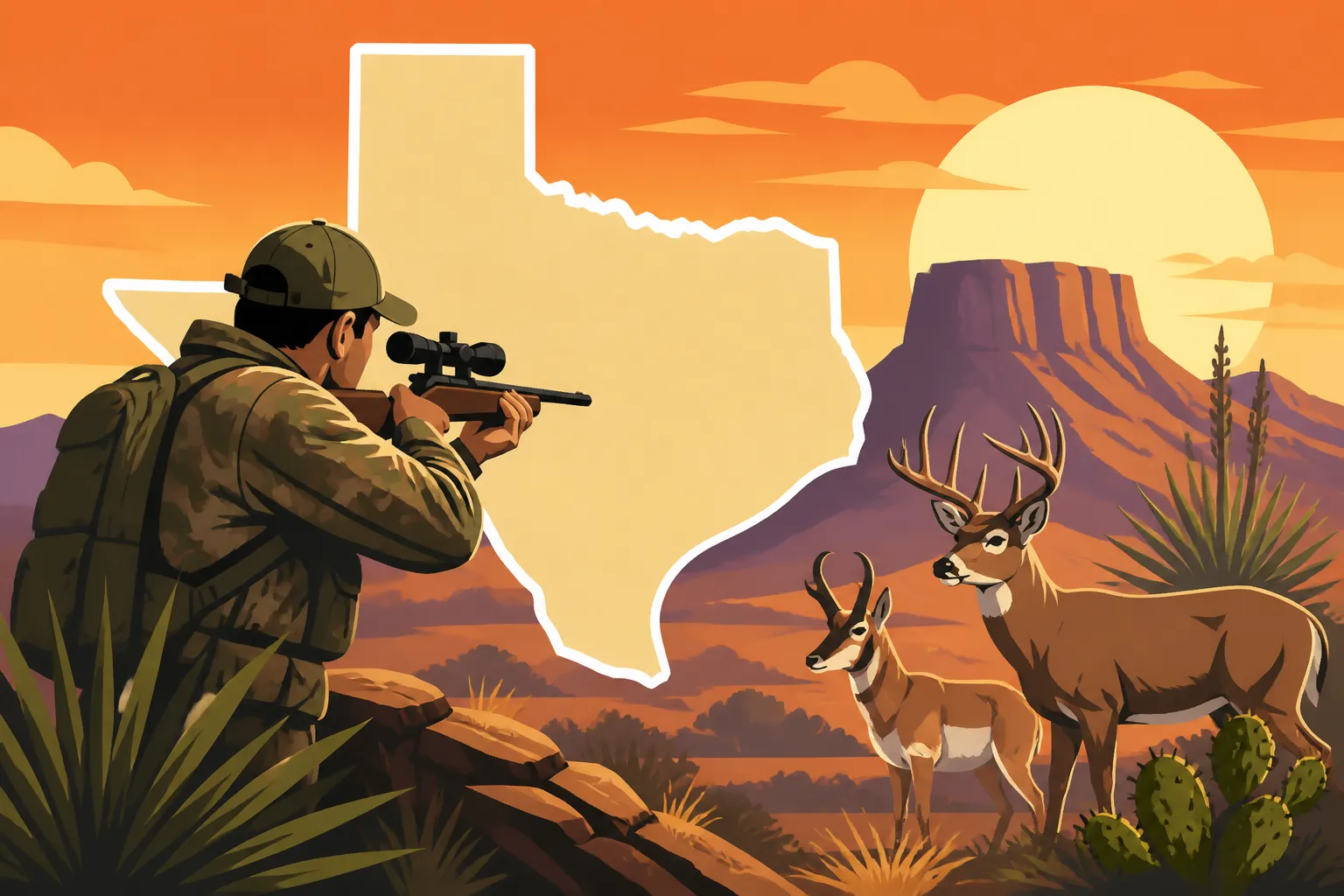
Panhandle & Trans-Pecos Hunting in Texas
If you've ever felt the pull of the wide-open spaces, the kind where the horizon stretches forever and mountains stand sentinel, you've likely dreamt of hunting the Panhandle and Trans-Pecos regions of Texas. These vast, rugged landscapes present a unique and often daunting challenge for hunters, far different from the dense brush of South Texas or the rolling hills of the Edwards Plateau. This comprehensive guide is here to demystify these epic hunting grounds, offering insights into the species, tactics, and preparations needed to successfully navigate the truly wild side of the Lone Star State.
Welcome to the Wild West of Texas Hunting: Panhandle & Trans-Pecos Overview
Stepping into the Panhandle or the Trans-Pecos is like entering a different world within Texas. Forget the stereotypical images of mesquite and live oaks; these regions offer a dramatic tapestry of landscapes, each demanding a distinct approach from the hunter. It's a land of extremes, where weather can change on a dime and the sheer scale of the terrain can feel overwhelming. But for those willing to put in the effort, the rewards – from elusive mule deer to majestic aoudad – are truly unforgettable.
Defining the Regions: Deserts, Canyons, and Prairies
The Texas Panhandle is precisely what its name suggests: the rectangular portion of North Texas that juts northward, bordered by Oklahoma and New Mexico. This region is characterized by flat, high plains, but don't let that fool you. It's crisscrossed by numerous river breaks, canyons, and draws carved by tributaries of the Canadian and Red Rivers, such as the famous Palo Duro Canyon. You'll find a mix of shortgrass prairie, agricultural fields, and rimrock country. The vast, open nature means long-range shooting is often the norm, and cover for both hunter and quarry can be scarce, pushing the limits of your spotting and stalking abilities. It’s a place where you can glass for miles, but finding game that isn't already looking back at you is the real art.
South and west, the Trans-Pecos region is arguably the most geographically diverse and wild part of Texas. It’s defined by the Pecos River to the east and the Rio Grande to the west and south, encompassing everything from high Chihuahuan Desert plateaus to towering mountain ranges like the Davis Mountains, Guadalupe Mountains, and Glass Mountains. This is big, rugged country with elevations ranging from less than 2,000 feet to over 8,700 feet at Guadalupe Peak, the highest point in Texas. Think vast expanses of creosote flats, arroyos, deep canyons, and scattered oases of juniper, oak, and pine at higher elevations. The sheer verticality and remoteness demand peak physical condition and meticulous planning. This isn't a place for the faint of heart or the poorly prepared, but the sense of accomplishment after a successful hunt here is unparalleled.
Why These Regions Challenge and Reward Hunters
Hunting in the Panhandle and Trans-Pecos is a true test of grit and skill, and that's precisely why it's so rewarding. The challenges are numerous: the immense scale of the landscape means vast areas to cover, often on foot, where a mile on the map feels like three in person. The weather can be brutal, from scorching desert heat to sudden, severe cold fronts and high winds. Water sources are often limited, impacting both wildlife movement and your own hydration strategies. Access can be difficult, with many areas being remote and requiring high-clearance vehicles, or even just good old-fashioned hiking.
However, these very challenges are what make hunting here so special. The animals that call these regions home are truly wild, shaped by their harsh environment into hardy, intelligent creatures. The sense of solitude and immersion in nature is profound; you can spend days without seeing another human hunter. The stunning panoramic views, the vibrant sunsets, and the sheer abundance of untouched wilderness offer an experience far beyond just pulling a trigger. When you finally connect with a mature mule deer buck or a wary aoudad ram after days of intense effort, the satisfaction is immense. It's a hunt that builds character, teaches resilience, and leaves you with stories that will last a lifetime.
Prime Game Species of the Panhandle
The Panhandle, with its unique blend of prairie and canyon lands, offers a diverse array of hunting opportunities. While often overshadowed by South Texas for whitetails, this region truly shines for specific species that thrive in its open, often unforgiving environment.
Pursuing Pronghorn Antelope on the Open Plains
When you think of the Texas Panhandle, often the first image that comes to mind is the majestic pronghorn antelope, often mistakenly called an "antelope" but actually North America's fastest land mammal. These incredible animals are built for speed and thrive on the wide-open grasslands, where their keen eyesight and incredible burst of speed are their best defenses. Hunting pronghorn here is an exercise in long-range spotting and patient stalking. You'll spend hours behind your binoculars and spotting scope, sweeping the plains for any flicker of movement or the distinct silhouette of a buck.
Securing a tag for pronghorn usually requires participation in the state's drawing system, as permits are limited and managed closely to maintain healthy populations. If you’re lucky enough to draw a tag, preparation is key. You'll want to review the Texas Pronghorn Season & Permits information well in advance. Spot-and-stalk is the primary method, often involving multiple, lengthy stalks to close the distance on an animal that can see you from miles away. This often means crawling on your belly for hundreds of yards, using every fold in the terrain to your advantage. Wind direction is critical, as is wearing appropriate camouflage that blends with the shortgrass prairie. Being proficient with a rifle at extended ranges (300-500 yards) is not just an advantage, it's often a necessity for a clean, ethical shot. Many hunters find using an app like onX Hunt invaluable for understanding terrain features, property lines, and potential stalking routes across these vast open spaces.
Whitetail and Mule Deer Opportunities in the Panhandle
While the Panhandle is renowned for its pronghorn, it also offers compelling deer hunting. Both whitetail and mule deer call this region home, often in distinct habitats. Whitetail deer in the Panhandle tend to stick to the river bottomlands, creek beds, and canyon breaks, where denser cover and water are more readily available. These are often smaller-bodied deer than their South Texas cousins, but they can still carry impressive antlers. Hunting them involves navigating riparian zones, focusing on typical whitetail tactics like stand hunting or still-hunting through thickets.
Mule deer, on the other hand, are the kings of the more open, rugged country, especially towards the western parts of the Panhandle near the Caprock Canyonlands. They prefer the sparse cedar breaks, mesquite flats, and juniper-dotted hillsides that characterize much of the High Plains. You can learn more in-depth about How to Hunt Mule Deer in the Panhandle. Mule deer hunting here is primarily a spot-and-stalk game. You’ll spend countless hours glassing from high vantage points, systematically picking apart distant hillsides and canyon rims for movement. Once a buck is spotted, the real challenge begins: planning an approach that keeps you out of sight and downwind, often across challenging terrain. The sheer scale means mule deer can disappear quickly, making quick decisions and physical endurance crucial.
Quail and Other Small Game
Beyond big game, the Texas Panhandle is a fantastic destination for quail hunting. Both Bobwhite and Blue (Scaled) Quail thrive in the mixed grasslands and shinnery oak country. The vast tracts of land, combined with favorable habitat conditions in good rainfall years, can lead to incredible quail populations. Chasing coveys of birds across the prairie with a good bird dog is a truly classic Western hunting experience. Understanding the Texas Quail Season Dates & Limit is vital before planning your trip.
In addition to quail, hunters can find opportunities for pheasant in agricultural areas, especially in the northern Panhandle, though their numbers can be localized. Dove hunting can also be excellent, particularly during the early September opener, with large concentrations of mourning and white-winged dove drawn to grain fields and water sources. Furthermore, predators like coyotes and bobcats are abundant and offer year-round hunting challenges, often calling for specialized calling tactics. For small game and predators, the wide-open nature of the Panhandle allows for extensive glassing and long shots, making it a unique setting for these pursuits.
Trans-Pecos: A Hunter's Rugged Paradise
The Trans-Pecos, with its dramatic mountain ranges and vast desert basins, offers an entirely different, perhaps even more demanding, hunting experience. This is truly Big Bend country, where every horizon holds a new challenge and an even more spectacular view.
Chasing Trophy Mule Deer in Mountainous Terrain
Mule deer are synonymous with the Trans-Pecos, particularly the mountain ranges like the Davis, Chisos, and Chinati Mountains. These are some of the largest-bodied and most impressive mule deer in Texas, known for their wide, heavy antlers. Hunting these animals is a truly physically demanding endeavor. Unlike the Panhandle where you might be crawling across flat plains, here you'll be hiking steep slopes, navigating rocky canyons, and climbing to high elevations to gain advantageous glassing points. The terrain itself is an obstacle, with loose rock, thorny brush, and unpredictable footing.
The primary tactic for these mountain muleys is intensive glassing from elevated positions, often at dawn and dusk when deer are most active. You’ll need top-tier optics – powerful binoculars and a high-magnification spotting scope – to pick apart distant hillsides. Once a buck is located, the stalk can involve hours of careful navigation, often requiring descents into deep canyons and arduous climbs back up. The deer are constantly on the move, bedding down in shaded pockets or in thick cover, making it a chess match of patience and strategic movement. Areas like Black Gap WMA: Trans-Pecos Mule Deer offer public land opportunities for this incredible pursuit, but be prepared for a truly wild and challenging hunt. The mule deer in this region are masters of their environment, and harvesting one is a monumental achievement.
The Ultimate Challenge: Aoudad Sheep Hunting
For many, the Trans-Pecos represents the pinnacle of Texas hunting because it's home to the free-ranging aoudad (Barbary sheep). These incredibly tough, agile, and elusive animals thrive in the sheer, rocky cliffs and mountainsides of the region. Aoudad are not native to Texas but have established robust free-ranging populations, primarily in the Trans-Pecos, offering a true mountain hunting experience that rivals hunts found in the Western states. They are often considered one of the most physically demanding hunts in North America, requiring incredible stamina, mental fortitude, and a good dose of luck.
Hunting aoudad is almost exclusively a spot-and-stalk affair, taking place in some of the most unforgiving terrain imaginable. You'll spend days hiking up and down mountains, glassing vast stretches of country, often covering significant vertical feet in a single day. When a ram is spotted, closing the distance can involve navigating dangerous ledges, loose scree, and dense brush. These animals have exceptional eyesight, making concealment paramount. Long-range shooting proficiency is often required, as aoudad frequently hold in positions that are difficult to approach closely. Many hunters opt for guided hunts due to the extreme nature of the terrain and the expertise required to locate and successfully stalk these animals. You can find more specific advice on Spot-and-Stalk Aoudad in West Texas, and resources like GoHunt often have detailed insights into public land strategies and areas for pursuing these impressive sheep. For those looking to go the lease route, understanding How to Hunt Aoudad Sheep on a Texas Lease can be very beneficial.
Javelina and Predator Hunting
Beyond the headline big game, the Trans-Pecos also offers unique opportunities for javelina (collared peccary) and a variety of predators. Javelina are small, pig-like mammals that roam the desert scrublands in family groups called "squadrons." They offer a fast-paced and exciting hunt, often located by scent or by spotting their dark forms moving through the brush. They have poor eyesight but an excellent sense of smell, so playing the wind is crucial.
The vastness and ruggedness of the Trans-Pecos also make it a prime location for predator hunting. Coyotes are abundant and offer year-round hunting, whether calling them into close range or taking long-range shots. Bobcats are also present, though much more elusive. For the truly adventurous, mountain lions roam these remote areas, though they are incredibly rare and notoriously difficult to hunt, typically requiring specialized knowledge and often dogs. Hunting these species provides a deeper appreciation for the desert ecosystem and offers continuous action outside of the main hunting seasons.
Navigating the Terrain: Hunting Methods and Tactics
Hunting in the Panhandle and Trans-Pecos is less about sitting in a blind and more about active pursuit. The terrain dictates the methods, emphasizing stealth, observation, and endurance.
Spot-and-Stalk Hunting: The Cornerstone of Western Texas
If there's one hunting method that defines Western Texas, it's spot-and-stalk. This isn't just a technique; it's a way of life for hunters in these regions. The vast, open landscapes, whether the rolling plains of the Panhandle or the rugged mountains of the Trans-Pecos, lend themselves perfectly to this approach. The process typically involves finding a high vantage point at first light, setting up your optics, and meticulously glassing every inch of visible terrain. This can take hours, as animals often blend seamlessly into their surroundings. Patience is not just a virtue here; it's a necessity.
Once an animal is spotted, the real chess match begins. You need to analyze the terrain between you and your quarry, considering wind direction, available cover, and potential escape routes for the animal. A successful stalk might involve circumnavigating an entire ridge, crawling on hands and knees through prickly pear, or navigating a rocky canyon bottom, all while keeping the wind in your favor and avoiding detection. This is where detailed topographic maps and satellite imagery, often provided by apps like onX Hunt, become invaluable for planning your approach and identifying hidden draws or cover. There's an immense satisfaction in successfully outwitting an animal on its home turf using nothing but your wits and stealth.
Understanding Water Sources and Travel Corridors
In arid environments like the Panhandle and Trans-Pecos, water is life, and understanding its role is crucial for locating game. Natural springs, stock tanks (also known as "tanks" or "dirt tanks"), and guzzlers are magnets for all wildlife, especially during dry periods. Animals will often travel significant distances to reach reliable water sources, making these areas prime for scouting and hunting. During the heat of the day, deer and other animals will often bed down relatively close to water.
Beyond water, identifying natural travel corridors is key. In the Panhandle, these might be the deep, winding creek beds or canyon systems that provide cover and direct movement across open country. In the Trans-Pecos, game trails often crisscross mountain saddles, follow the bottoms of arroyos, or lead to and from feeding areas on open slopes. Pay attention to pinch points where terrain funnels animals into predictable routes. Studying historical animal movement patterns and current sign (tracks, scat, rubs, scrapes) around these features can tell you a lot about how animals are using the landscape. Game cameras, strategically placed near these corridors and water sources, can be incredibly effective for patterning animal movement and helping you decide How to Scout for Deer Before Season in Texas.
Specialized Tactics for High-Country and Open-Country Hunting
While spot-and-stalk is universal, the specific nuances differ between the open plains and the high mountains. For open-country hunting in the Panhandle (think pronghorn and mule deer in flatter areas), the emphasis is on maximizing visibility and minimizing your own profile. This means using long-range optics and developing a keen eye for detecting subtle movements or changes in color at vast distances. Stalks often involve long crawls or circuitous routes to stay below the horizon line. You'll need to be proficient with shooting from various field positions, as a bench rest might not be an option when you finally get into range.
For high-country hunting in the Trans-Pecos (chasing mule deer or aoudad in the mountains), vertical movement is your primary challenge. Gaining elevation is critical for glassing, as it allows you to look down into steep canyons and across multiple ridges. Patience is tested not just by the animals, but by the physical demands of hiking at altitude. Knowing how to use thermals (updrafts and downdrafts of air that occur with temperature changes) is crucial in mountain hunting, as the wind often shifts dramatically with elevation and time of day. Animals will use these thermals to their advantage, especially when bedding down. Carrying a lightweight, yet sturdy shooting stick or bipod is essential for steadying your shot after an arduous climb.
Public vs. Private Access: Finding Your Hunting Grounds
Texas is predominantly private land, a fact that can be frustrating for many hunters. However, both the Panhandle and Trans-Pecos do offer opportunities for public land access, albeit with different challenges and rewards than private leases.
Public Land Opportunities: WMAs and National Grasslands
For the DIY hunter, public land is often the most accessible option, though it requires meticulous planning and often means competing with more hunters. In the Panhandle, you'll find limited but valuable opportunities in areas like the Rita Blanca National Grassland for deer and small game, and some state Wildlife Management Areas (WMAs). These areas are often managed through draw hunts, requiring an application and a bit of luck. The Annual Public Hunting Permit (APH) is your ticket to many of these smaller, scattered public hunting tracts, but always check specific regulations for each unit.
The Trans-Pecos, despite its vastness, also has limited public hunting, with the Black Gap WMA being the flagship. Black Gap is an enormous, rugged expanse offering draw hunts for mule deer, aoudad, javelina, and more. It's a true wilderness experience, requiring self-sufficiency and a high level of physical fitness. Other opportunities might exist in scattered state parks or smaller WMAs, but they are often highly regulated. Expect public lands to be harder to hunt, with wary animals and more pressure, but the sense of accomplishment from a successful public land hunt in these regions is truly special. Remember to always have your Texas Hunting License: Cost, Types & How to Buy (2026) in order and understand all public land rules.
Securing a Lease or Guided Hunt
Given the dominance of private land, many hunters opt to secure a hunting lease or book a guided hunt, especially for premium species like mule deer or aoudad. Hunting leases in these regions can vary widely in price and quality. A Panhandle lease for whitetail or small game might be more affordable, while a multi-year lease for mule deer in prime Trans-Pecos country could be a significant investment. When looking for a lease, consider factors like acreage, game population, proximity to water, and existing infrastructure. Many leases are found through word-of-mouth or online hunting forums and lease listing sites.
For those targeting specific trophy animals or who are new to the challenging terrain, a guided hunt is often the best route. Outfitters in both the Panhandle and Trans-Pecos specialize in various species, offering everything from fully outfitted mule deer hunts in the mountains to prairie dog shoots on the plains. A good outfitter provides experienced guides, access to private land, and often accommodations and meals. While more expensive, a guided hunt can dramatically increase your chances of success and provide invaluable local knowledge. Reputable outfits like those specializing in the Glass Mountains or Davis Mountains for aoudad can make a difficult hunt much more manageable. When researching, always ask for references and check reviews to ensure you're booking with a reputable operator.
Respecting Landowner Relations and Regulations
Whether on public or private land, respecting the land and its owners is paramount in Texas hunting. On public land, this means adhering strictly to all Texas Parks and Wildlife Department (TPWD) regulations, leaving no trace, and being courteous to other users. Pack out everything you pack in, and be mindful of noise and vehicle use.
On private land, strong landowner relations are the backbone of Texas hunting. If you're on a lease, treat the property as if it were your own, and respect any specific rules or requests from the landowner. Communicate clearly and frequently, and always get permission before accessing any new areas or making improvements. Even if you're just driving through private property to access public land, you must have explicit permission. Texas's strict trespass laws are enforced, and ignorance is no excuse. Always know your boundaries, which is where apps like onX Hunt, with their detailed property line overlays, prove invaluable. Remember that a good relationship with a landowner can open doors to future hunting opportunities and ensure a positive experience for everyone involved.
Essential Gear for Panhandle and Trans-Pecos Hunting
The unique environments of Western Texas demand specific gear choices. Your equipment needs to be rugged, reliable, and capable of performing in extreme conditions. Skimping on quality here can literally leave you in a bind.
Optics are King: Binoculars, Spotting Scopes, and Rangefinders
In the vast, open country of the Panhandle and the sprawling mountains of the Trans-Pecos, your eyes are your most important tool, and quality optics are an extension of them. You'll spend a tremendous amount of time behind glass, systematically searching for game, often at extreme distances.
A good pair of binoculars (10×42 or 12×50 are popular choices) is non-negotiable for general glassing and quick scans. Look for waterproof, fog-proof models with excellent light transmission. A spotting scope (20-60x or 25-75x magnification) is equally critical for identifying game at long ranges, judging antler size, and planning your stalk. A sturdy tripod for both your binoculars and spotting scope is essential; trying to hold them steady freehand for hours will quickly lead to fatigue and missed game. Finally, a reliable rangefinder is a must-have. Knowing the exact distance to your target, especially when shooting across canyons or open plains, is crucial for making ethical shots and mitigating the effects of bullet drop. Don't forget a backup battery for all your electronic optics. You can delve deeper into selecting the Best Hunting Optics for Texas: Scopes, Binos & Rangefinders to optimize your setup. Brands like Vortex, Leupold, and Zeiss are popular choices among serious Western hunters for their clarity and durability.
Footwear and Clothing for Extreme Conditions
Your feet are your most important mode of transportation in these regions, making footwear a critical consideration. You need sturdy, comfortable, and well-broken-in hiking boots that can handle rocky, uneven terrain, thorny brush, and long miles. Waterproofing is a huge plus, even in arid environments, for crossing seasonal creeks or dealing with morning dew. Consider boots with good ankle support to prevent twists and sprains, and always bring multiple pairs of quality merino wool socks to prevent blisters. For snake safety, especially in brushier areas, investing in a good pair of snake boots is highly recommended. Many hunters swear by them in these regions; learn more about the Best Snake Boots for Texas Hunting.
Clothing needs to be versatile and adaptable to rapidly changing weather. Layering is key. Start with moisture-wicking base layers to manage sweat. Add insulating layers for warmth, even if the day starts warm, as temperatures can drop quickly, especially in the mountains. An outer shell that is both windproof and waterproof is essential to protect against sudden squalls or sustained high winds. Camouflage patterns that match the local terrain – desert/arid patterns for much of the Trans-Pecos, or open country patterns for the Panhandle – will help you blend in. Don't forget a wide-brimmed hat for sun protection and quality gloves for grip and warmth.
Navigation and Safety Equipment
The vastness of the Panhandle and Trans-Pecos means you can get disoriented quickly, even with familiar landmarks. Reliable navigation tools are non-negotiable. While a traditional map and compass are excellent backups, a GPS device or a smartphone app like onX Hunt or GoHunt (with downloaded offline maps) is often the primary tool. These apps show property lines, topo maps, and your current location, which is critical for staying on track and avoiding trespassing. Always carry a portable power bank to keep your devices charged.
Safety equipment extends beyond navigation. A comprehensive first-aid kit is essential, tailored for cuts, scrapes, snake bites, and other outdoor emergencies. Carry plenty of water – often more than you think you'll need – and water purification tablets or a filter as a backup. A headlamp or flashlight, a fire-starting kit, a signal mirror, and a whistle can all be life-savers. If hunting alone or in remote areas, consider carrying a satellite communication device (like a Garmin inReach or Zoleo) for emergency communication, as cell service is often nonexistent. Finally, a field dressing kit with a sharp knife and game bags is crucial for processing your harvest efficiently, especially in warm weather.
| Item Type | Panhandle Essential | Trans-Pecos Essential |
|---|---|---|
| Optics | 10x Binoculars, Spotting Scope, Rangefinder, Tripod | 12x Binoculars, High-Power Spotting Scope, Rangefinder, Sturdy Tripod |
| Footwear | Sturdy, broken-in hiking boots, Snake Boots | High-ankle hiking boots, Snake Boots, Multiple Merino Socks |
| Clothing | Layered, light to mid-weight, wind/waterproof shell | Layered, insulated, heavy-duty wind/waterproof shell |
| Navigation | GPS/onX Hunt, map, compass, power bank | GPS/onX Hunt, topo map, compass, satellite communicator, multiple power banks |
| Water | 2-3 liters/day, purification tabs | 4+ liters/day, purification filter/tablets |
| Firearms | Flat-shooting rifle (e.g., .270, 6.5 CM, .300 WM) | Flat-shooting magnum rifle (e.g., .300 WM, 7mm Rem Mag) |
| Other | Field dressing kit, game bags, first-aid, headlamp | Field dressing kit, game bags, extensive first-aid, headlamp, signaling device, trekking poles |
Planning Your Expedition: Licenses, Seasons, and Scouting
A successful hunt in Western Texas often hinges more on meticulous planning than on luck. Understanding the regulatory landscape, seasonality, and how to effectively scout these expansive regions is paramount.
Understanding Texas Hunting Licenses and Permits
Before you even think about packing your bags, the first step for any Texas hunt is ensuring you have the correct licenses and permits. For most resident hunters, the Super Combo License covers annual hunting and fishing requirements. Non-residents will need to purchase a specific non-resident hunting license. Beyond the general license, specific endorsements are often required. For migratory birds like doves, a Migratory Bird Endorsement and HIP certification are mandatory.
Critically, for species like pronghorn and often mule deer on public lands (like Black Gap WMA), you'll need to apply for drawn hunts through the Texas Parks and Wildlife Department's Public Hunt Drawing System. These permits are limited and highly sought after, so applying early and understanding the application process is key. Some private land hunts, especially those participating in the Managed Lands Deer Program (MLDP), might operate under special regulations and tags, but you'll still need your general hunting license. Always double-check the current Texas Outdoor Annual regulations booklet before your hunt, as rules and seasons can change. You can find out more about the different types and costs in our guide, Texas Hunting License: Cost, Types & How to Buy (2026).
Key Season Dates for Western Texas Game
Season dates for deer, pronghorn, and other game can vary by county and management zone, especially in these vast regions. Mule deer season in the Trans-Pecos and Panhandle is generally shorter than whitetail season, typically running for a couple of weeks in late November and early December. Pronghorn season is even shorter, often just 9 days in early October, and is permit-only. Aoudad do not have a closed season or bag limit on private land, making them a year-round hunting opportunity, though specific public land drawn hunts will have set dates.
Quail season typically opens in late October or early November and runs through late February. Dove season kicks off on September 1st for the North and Central Zones, which includes much of the Panhandle. Predator hunting for species like coyotes and bobcats is open year-round. Always consult the official TPWD Outdoor Annual for the most current and accurate season dates, bag limits, and county-specific regulations to avoid any infractions.
Pre-Season Scouting and Remote Intelligence
For regions as massive and remote as the Panhandle and Trans-Pecos, pre-season scouting is not just helpful; it's practically mandatory. Driving and hiking large areas can be time-consuming and expensive, so leveraging "remote intelligence" is a smart approach.
Start with detailed satellite imagery and topographic maps, easily accessible through platforms like onX Hunt or Google Earth. Look for potential bedding areas (thick cover on slopes or in draws), feeding areas (agricultural fields, browse lines, open slopes), and critical water sources. Identify natural funnels, saddles, and potential travel corridors. Pay attention to elevation changes and areas that offer good glassing vantage points. This digital scouting allows you to narrow down vast areas to more manageable sections for ground-truthing.
If possible, make a physical scouting trip a few weeks or months before the season. This allows you to confirm what you saw on the maps, find fresh sign, identify access points, and get a feel for the terrain. Place trail cameras near water sources or along game trails to pattern animal movement. Even if you can't make a dedicated scouting trip, utilize information from guides, local landowners, and online hunting communities. Gathering as much intelligence as possible beforehand will significantly increase your chances of success and ensure you make the most of your time in these incredible, wild parts of Texas.
Disclaimer
Please remember that hunting regulations, seasons, and licensing requirements can change. Always consult the most current Texas Parks and Wildlife Department Outdoor Annual or their official website before planning any hunting trip. This guide is for informational purposes only and does not constitute legal advice.