How to Hunt Hogs at Night With Thermal
When daylight fades, the frustration of pervasive feral hog damage doesn't disappear; it often just becomes harder to combat. These adaptable creatures quickly learn to avoid human activity during the day, making traditional hunting methods less effective. This comprehensive guide will illuminate the powerful potential of thermal imaging technology, showing you how to effectively hunt hogs at night in Texas, reclaiming your land and peace of mind.
The Allure of Thermal Hog Hunting in Texas
Texas is home to an estimated 2.6 million feral hogs, and these prolific breeders cause immense damage to agriculture and natural resources annually, costing an estimated $52 million dollars in damage to the agricultural industry each year. Trying to keep their numbers in check can feel like an endless battle, especially when they become largely nocturnal. This is where thermal hog hunting shines, offering a distinct advantage that traditional methods simply can't match.
Why Hunt Hogs at Night?
If you've spent any time dealing with feral hogs, you've likely noticed they're often more active when the sun goes down. Wild pigs are intelligent animals that quickly adapt their behavior to avoid human predators, frequently becoming nocturnal. This shift means they'll spend their days hidden in dense cover, only to emerge under the cloak of darkness to feed, root up crops, and destroy pastures. Hunting them during daylight hours can often be a game of cat and mouse, with the hogs usually winning. By embracing night hunting, particularly with thermal optics, you align your efforts with their natural patterns, dramatically increasing your chances of encountering and removing them. In summer, especially, when daytime temperatures soar, hogs spend most of their time on their feet at night, foraging in fields. This makes summer nights a prime time for thermal hunting, offering a unique and productive opportunity to harvest feral pigs.
The Legal Landscape for Night Hunting
One of the biggest advantages for hunters looking to control feral hog populations in Texas is the state's highly permissive regulations regarding their hunting. Feral hogs are classified as unprotected, exotic, non-game animals, which means there's no closed season, no bag limit, and they can be taken by any means or methods at any time of year. This includes hunting them at night with thermal optics, night vision, and artificial lights on private land.
It's important to note that while no hunting license is required for landowners or their agents to kill feral hogs causing damage on private property, a valid Texas hunting license is generally required if you are hunting for trophy or food, or if you plan to trap or snare hogs. For public lands, a valid Texas hunting license is always required, and you must adhere to all specific regulations of that particular public hunting area. It's always a good practice to inform your local game warden of your plans when hunting feral pigs at night, especially to avoid any misunderstandings regarding the use of artificial lights, which are prohibited for hunting protected game animals like deer. You can find more detailed information on Texas hog hunting regulations in the Texas Parks and Wildlife Department's Outdoor Annual.
Understanding Thermal Imaging for Hog Hunting
Thermal imaging has revolutionized night hunting, offering capabilities that traditional optics simply can't match when pursuing nocturnal animals like feral hogs. It's truly a game-changer for effective population control.
How Thermal Technology Works
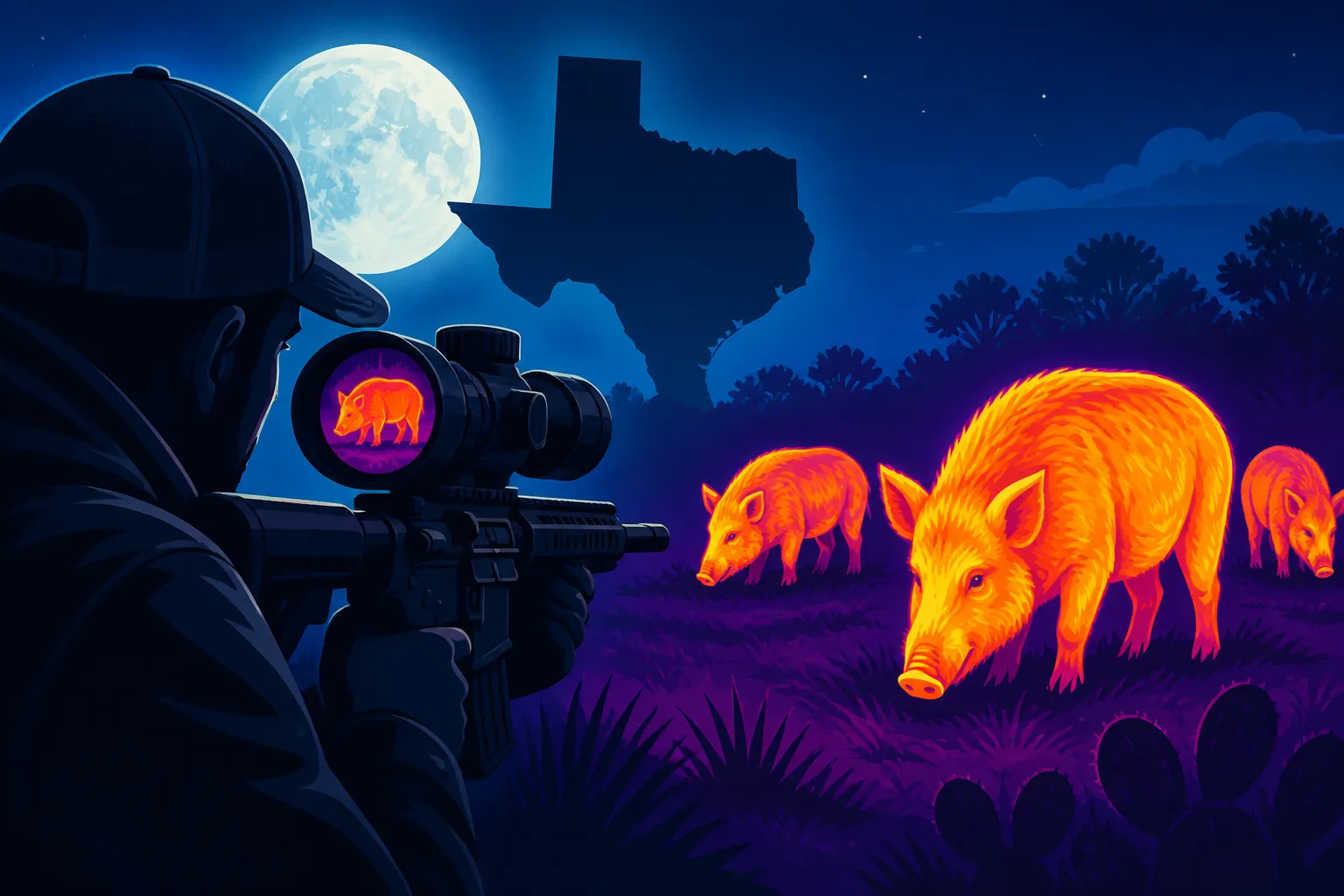
Unlike traditional night vision, which amplifies ambient light, thermal optics detect infrared radiation, which is emitted as heat by all objects and living things. Every warm-blooded animal, including a feral hog, has a distinct heat signature. Thermal scopes convert this heat data into a visible image on a screen, making warm targets stand out brightly against cooler backgrounds, regardless of the amount of ambient light available. This means thermal imaging works equally well in complete darkness, bright moonlight, or even through light fog, rain, or dense brush where conventional optics would struggle or fail. The image you see isn't a "picture" in the photographic sense, but rather a representation of heat differentials.
Thermal vs. Night Vision: A Hunter's Choice
When it comes to night hunting, the debate between thermal and night vision (NV) is common. Both have their merits, but for hog hunting, thermal often has a significant edge.
Night vision devices work by gathering and amplifying available light, whether from the moon, stars, or an infrared (IR) illuminator. They provide a more natural, green-tinged image that allows for good detail in low-light conditions. However, night vision has several limitations for hog hunting:
- Reliance on Light: If there's no moonlight or your IR illuminator isn't strong enough, visibility diminishes rapidly.
- Limited Range: Night vision generally can't spot targets as far away as thermal.
- Obstruction Issues: Dense foliage, tall grass, or even light fog can severely reduce clarity, as the light cannot penetrate these obstructions effectively. This is a major drawback when hogs are feeding in thick cover.
- IR Signature: While many IR illuminators are discreet, some emit a faint red glow that can be visible to some animals or other hunters.
Thermal, on the other hand, detects heat, making it vastly superior for spotting hogs in challenging conditions. Here's why thermal often wins for hog hunting:
- True Darkness Performance: Thermal works perfectly in absolute darkness, requiring no ambient light.
- See Through Cover: Its ability to "see" heat means it can penetrate light fog, smoke, and even dense brush or tall grass to reveal hidden animals, making hogs visible where night vision would only show brush.
- Extended Detection Range: Hogs can be detected at much greater distances, often 300-500+ meters, with thermal compared to night vision.
- Passive Detection: Thermal devices do not emit any light (IR or otherwise) that hogs can detect, giving you a stealth advantage.
While thermal may lack the fine detail of night vision at close range, its superior detection capabilities in varying conditions make it the preferred tool for covering large areas and finding elusive nocturnal hogs. Many serious hog hunters opt for a combination, using a thermal monocular for scanning and a night vision scope for closer, more detailed target identification, or a thermal scope on their rifle. You can delve deeper into the differences between these technologies in our guide on Thermal Scope vs Night Vision for Hog Hunting.
Key Features to Look for in a Thermal Scope
Investing in a thermal scope is a significant decision, and understanding the key features will help you choose the right device for your hunting needs.
- Resolution: Measured in pixels (e.g., 384×288, 640×480), higher resolution provides a clearer, more detailed image, especially at longer ranges. While higher resolution often means a higher price tag, it significantly improves target identification.
- Refresh Rate: Measured in Hertz (Hz), this indicates how many times the image updates per second. A 30Hz refresh rate is acceptable, but 50Hz or 60Hz provides a much smoother image, which is crucial for tracking moving animals and reducing motion blur.
- Detection Range: This specifies the maximum distance at which the device can detect a heat signature. While detection range can be impressive, remember that identification range (being able to tell what you're seeing) is always much shorter.
- Magnification (Base & Digital Zoom): A good base magnification allows for comfortable scanning, while digital zoom can help with identification. However, excessive digital zoom often degrades image quality, so prioritize optical quality.
- Battery Life: Night hunts can be long, so look for devices with extended battery life or the ability to use external power banks.
- Reticle Options & Zeroing: Customizable reticles and an easy-to-use zeroing system are essential for accurate shot placement.
- Durability and Weather Resistance: Your thermal scope will be exposed to the elements, so ensure it's robust, waterproof, and fog-proof.
Brands like Pulsar and AGM are popular choices among Texas hog hunters, offering a range of thermal scopes with varying features and price points. For instance, you might compare models like the Pulsar Thermion 2 with an AGM Rattler V2 to find the right balance for your budget and specific hunting style.
Essential Gear for a Successful Thermal Hunt
Thermal optics are undeniably the star of a night hog hunt, but they're just one piece of the puzzle. A few other essential items will ensure your hunt is safe, efficient, and successful.
Choosing Your Thermal Device
The market for thermal optics has expanded considerably, offering various configurations to suit different hunting styles and budgets.
- Thermal Scopes: These are designed to be mounted directly onto your rifle, providing a thermal image through your primary aiming device. They offer the most precise aiming solution for shooting at night. High-end models from brands like Pulsar and ATN offer exceptional clarity and features like built-in rangefinders and ballistic calculators.
- Thermal Monoculars: Handheld devices perfect for scanning and spotting hogs. They are crucial for situational awareness, allowing you to locate groups of hogs before you even raise your rifle. Many hunters use a monocular for initial detection and then switch to a thermal scope on their rifle for the shot. Popular choices include models from AGM, Pulsar, and even more budget-friendly options that still provide excellent detection.
- Thermal Clip-ons: These attach in front of your existing daytime scope, converting it into a thermal optic without requiring re-zeroing. They offer versatility, allowing you to use your familiar daytime setup at night. However, they can be heavier and may require specific scope setups to function optimally.
When making your choice, consider the typical distances you'll be hunting, the terrain, and your budget. For most dedicated night hunters in Texas, a quality thermal scope on the rifle, paired with a thermal monocular for scanning, is the ultimate setup. Our guide on the Best Thermal Monocular for Scanning in Texas can help you explore handheld options further.
Rifle and Ammunition Considerations
While hogs are notoriously tough, shot placement is always more critical than caliber size. However, having a rifle and ammunition combination that can deliver sufficient energy for quick, ethical kills is paramount.
- Calibers: Many calibers are effective for hogs. Common choices include .308 Winchester and .30-06 Springfield, which offer excellent knockdown power for larger hogs and confident shot placement. The 6.5 Creedmoor is also a popular choice, balancing power with manageable recoil, especially for precision shots. For AR-platform rifles, .223/5.56 NATO can be effective for headshots or smaller hogs, but a heavier bullet is recommended, and follow-up shots may be necessary for larger animals. The .300 Blackout is another good option for ARs, particularly with heavier subsonic loads for suppressed setups. Other effective calibers include .350 Legend and .450 Bushmaster.
- Ammunition: Choose hunting-specific ammunition designed for penetration and controlled expansion. Avoid varmint rounds, as hogs have thick hides and often a "shoulder shield" of cartilage that can be several inches thick, especially on older boars. Bonded or solid copper bullets are excellent choices for ensuring deep penetration and reliable performance.
Ultimately, use a rifle and caliber you are proficient with, as accurate shot placement is the number one factor in a clean kill.
Supporting Gear: Lighting, Calls, and Communication
Beyond your primary optics and firearm, several other items will make your night hunt more productive and safe.
- Red or Green Headlamps: While thermal lets you see, you'll still need light for navigating to and from your stand, setting up, or tracking a blood trail (though thermal helps with tracking, visual confirmation is key). Red or green light preserves your night vision better than white light and is less likely to spook animals.
- Game Calls: Electronic hog calls can be incredibly effective at bringing hogs into range. They mimic various sounds, such as piglets in distress or hog feeding frenzies, to attract curious or protective hogs.
- Two-Way Radios/Cell Phones: If hunting with a group, clear communication is vital for safety and coordinating stalks. Cell phones can work in areas with good service, but reliable two-way radios are often a better bet for remote leases.
- Other Essentials: Don't forget bug spray, especially in Texas, a comfortable backpack, plenty of water, and a good cooler for game recovery. For detailed information on field dressing in warm climates, check out our guide on How to Cool a Deer Fast in Texas Heat.
Mastering Thermal Hog Hunting Tactics
Thermal technology gives you a distinct advantage, but it doesn't replace sound hunting principles. Combining your new tech with smart tactics will elevate your success rates.
Scouting and Locating Hogs
Even with thermal, knowing where to start looking makes a huge difference.
- Daytime Scouting: Don't skip your daytime scouting! Look for fresh rooting, tracks, wallows, rubs on trees, and trails leading to and from feeding or bedding areas. Pay attention to water sources, especially during dry periods. Identifying these signs during the day helps you narrow down potential hot spots for your night hunt.
- Trail Camera Use: Traditional or cellular trail cameras can provide invaluable intelligence on hog movement patterns, preferred feeding times, and the size of sounders. Place cameras on trails, near feeders, or along fence lines to monitor activity. While thermal works at night, understanding the patterns through historical data is key.
- Thermal Scanning: Once night falls, use your thermal monocular to systematically scan open fields, pasture edges, and areas of thinner brush. Hogs will stand out clearly against the cooler background, allowing you to spot them at significant distances. Pay close attention to areas where crops are growing, as hogs will gravitate towards easy food sources. When scanning, move slowly and deliberately, covering all potential angles.
Stalking and Approaching Under Thermal
Once you've spotted hogs with your thermal, the stalk begins. This is where patience and environmental awareness become paramount.
- Wind Direction is King: Hogs have an incredible sense of smell. Always approach from downwind, even if it means taking a longer, more circuitous route. Thermal lets you see them, but they can still smell you from a long way off. Use a wind checker frequently.
- Terrain and Cover Utilization: Even at night, using terrain to your advantage for concealment is wise. Drop into draws, use tree lines, or navigate behind larger brush to break up your silhouette. Move slowly and quietly, minimizing noise from crunching leaves or snapping twigs. Hogs have excellent hearing and can detect unusual sounds.
- Silent Movement: Foot placement is critical. Test each step before committing your full weight. If you're hunting with a partner, communicate silently through hand signals or very low-volume radios. Remember that hogs can be quite skittish, especially if they've been pressured before.
Shot Placement and Recovery
Making an ethical, clean kill is the goal of every hunt, and thermal helps achieve this even in darkness.
- Ethical Shot Placement: Hogs have thick skin, a sturdy shoulder shield, and their vital organs (heart and lungs) are located lower and more forward in their chest compared to a deer. For a broadside shot, aim for the front shoulder, about one-third up from the body's bottom portion, aiming to penetrate both lungs and potentially the heart. Many experienced hunters advocate for a headshot, specifically behind the ear where the brain is, for an instant lights-out kill, but this is a smaller target and requires extreme precision, especially on a moving animal. The quartering-away shot is also effective, allowing you to aim for the vitals behind the shoulder and angling towards the opposite shoulder.
- Confirming the Kill: After the shot, observe the hog through your thermal. Look for signs of a hit, such as a drop, kick, or immediate thermal shutdown (indicating a central nervous system hit). Wait a few minutes before approaching. Never assume a hog is down for good; a wounded hog can be extremely dangerous.
- Tracking and Recovery: Even with thermal, recovering a downed hog in the dark can be challenging. If the hog runs, use your thermal to scan the area it fled. The heat signature of a recently deceased animal will often remain visible for some time, making tracking much easier than with traditional methods. Look for a thermal trail or the distinct heat blob of the animal itself. A good red or green light will aid in visual blood trailing if necessary.
Safety and Ethical Considerations
Hunting at night with advanced optics comes with a heightened sense of responsibility. Prioritizing safety and ethical practices is paramount.
Range Safety at Night
The darkness inherently adds a layer of complexity to firearm safety.
- Positive Target Identification: This is non-negotiable. With thermal, you're seeing a heat signature, not necessarily full detail. Always confirm what you're shooting at. Ensure there are no other animals or structures behind your target. Use a thermal monocular to scan thoroughly before raising your rifle, and then use your rifle-mounted thermal for final identification. Never shoot at a "blob" of heat without certainty.
- Know Your Backstop: Just as in daytime hunting, be absolutely sure of what lies beyond your target. Night conditions can make it harder to discern terrain features or property lines, increasing the risk of stray rounds. When hunting on a lease, understand the boundaries and potential hazards of the entire property, especially at night.
- Firearm Handling: Follow all fundamental firearm safety rules: treat every firearm as if it's loaded, keep the muzzle pointed in a safe direction, keep your finger off the trigger until ready to shoot, and be sure of your target and what's beyond it. These rules are even more critical when visibility is limited.
Respecting Wildlife and Land
Even when hunting an invasive species like feral hogs, ethical conduct is vital.
- Minimizing Disturbance: While hunting hogs is about control, strive to minimize disturbance to other wildlife. Avoid excessive noise or bright white lights that could distress non-target species.
- Property Lines and Boundaries: Always be aware of property lines. Trespassing, even unintentionally at night, can lead to serious legal trouble. Confirm your hunting area boundaries with the landowner before your hunt. Using mapping apps like onX Hunt or HuntStand can be incredibly helpful for maintaining awareness of property lines, even in the dark.
- Ethical Harvest: The goal is a quick, humane kill. This reinforces the importance of proper shot placement and using appropriate calibers and ammunition.
Post-Hunt Processing
Once a hog is down, the work isn't over. Proper handling ensures the meat is salvaged and minimizes waste.
- Immediate Field Dressing: In Texas heat, prompt field dressing is crucial to cool the carcass and preserve the meat. Remove the entrails as quickly as possible. This also reduces the animal's weight, making it easier to transport.
- Cooling the Carcass: After field dressing, get the carcass cooled down rapidly. This might involve quartering the animal and placing it in a cooler with ice, or hanging it in a walk-in cooler if available. The sooner the meat cools, the better its quality will be.
- Disease Awareness: Feral hogs can carry diseases like brucellosis. Always wear gloves when field dressing and handling hog carcasses, and cook the meat thoroughly to safe temperatures.
Thermal Optics Comparison
To help you decide which thermal device might be right for your hog hunting adventures, here's a comparison of common types:
| Feature | Thermal Monocular | Thermal Scope | Thermal Clip-on |
|---|---|---|---|
| Primary Use | Scouting, spotting, general observation | Primary aiming device for shooting | Convert daytime scope to thermal without re-zeroing |
| Mounting | Handheld | Mounts directly on rifle | Attaches to the objective of your existing daytime scope |
| Detection Range | Excellent | Excellent | Excellent (depends on resolution of clip-on) |
| Identification | Good (especially at closer ranges) | Very Good to Excellent | Good (can be limited by daytime scope magnification) |
| Detail/Clarity | Good | Very Good | Good |
| Cost | Mid-range | High | High |
| Pros | Portable, versatile, great for scanning large areas | Dedicated aiming solution, superior accuracy for shooting | No re-zeroing needed, maintains familiar eye relief |
| Cons | Not for direct aiming, requires switching to rifle scope | Heavier than monocular, single-purpose on rifle | Can be heavy, may affect rifle balance, costly |
| Ideal For | Initial target acquisition, scouting, general awareness | Dedicated night hunting rifle setup | Hunters wanting dual-purpose rifle with minimal fuss |
Remember that brands like ATN and RIX Optics also offer excellent thermal options for different hunting scenarios, from high-performance scopes to more versatile monoculars.
Disclaimer
Always consult the most current Texas Parks and Wildlife Department regulations and local ordinances before engaging in any hunting activities. Hunting laws can change, and it is the hunter's responsibility to stay informed and compliant. This guide is for informational purposes only and does not constitute legal advice.