Thermal Scope vs Night Vision for Hog Hunting
Trying to decide between a thermal scope and a night vision device for your late-night Texas hog hunts can feel like navigating a maze blindfolded. You've heard the whispers and seen the flashy ads, but what actually works best when you're out in the pitch-black South Texas brush or an open Panhandle field? This guide will cut through the noise, detailing the strengths and weaknesses of each technology so you can make an informed decision and be more successful in putting down those destructive feral hogs.
Understanding the Texas Hog Hunting Landscape at Night
Feral hogs are a massive problem across Texas, causing billions in agricultural damage annually and posing threats to native wildlife. Their nocturnal nature means that some of the most effective hunting happens under the cover of darkness. But that very darkness is what makes specialized optics essential. Without the right gear, you're essentially guessing, and that's not a recipe for successful, ethical hunting.
Why Night Hunting is So Effective for Hogs
Hogs have adapted incredibly well to human pressure, becoming largely nocturnal in many areas. They learn quickly, and daytime hunting pressure often pushes them into bedding down during the day and feeding exclusively at night. This shift in behavior makes night hunting not just an option, but often the most productive strategy for managing their populations, especially on private land where you can implement consistent pressure.
Think about a sweltering summer day in Texas; you wouldn't want to be rooting around in an open field, and neither do hogs. As soon as the sun dips, those temperatures become much more tolerable, and the hogs emerge from their thickets. This natural inclination to move when it's cooler, combined with their avoidance of human activity during daylight hours, makes the hours between dusk and dawn prime time for encountering them. Leveraging this nocturnal habit with specialized gear drastically increases your chances of success.
Legality and Regulations for Night Hunting in Texas
One of the great things about hunting feral hogs in Texas is the very relaxed regulations surrounding them. Because they are considered an invasive species and pose such a threat, there's no closed season, no bag limit, and generally, no license required to hunt them on private land. This includes night hunting, which is absolutely legal.
However, it's always smart to double-check the latest regulations in the Texas Outdoor Annual, especially concerning specific equipment or public land rules. While thermal and night vision are legal on private property, always remember to verify property lines, especially if you're using something like the GoHunt app to scout. You don't want to accidentally cross onto someone else's land, even with the best intentions. Knowing the precise boundaries is crucial for responsible night hunting.
Diving Deep into Thermal Imaging for Hog Hunting
Thermal imaging is a game-changer for night hunting. Instead of relying on ambient light, it detects heat signatures, literally showing you the world in shades of warmth and cool. For hog hunters, this means seeing animals that would be completely invisible to the naked eye or even traditional night vision in certain conditions.
How Thermal Scopes Work and Their Core Benefits
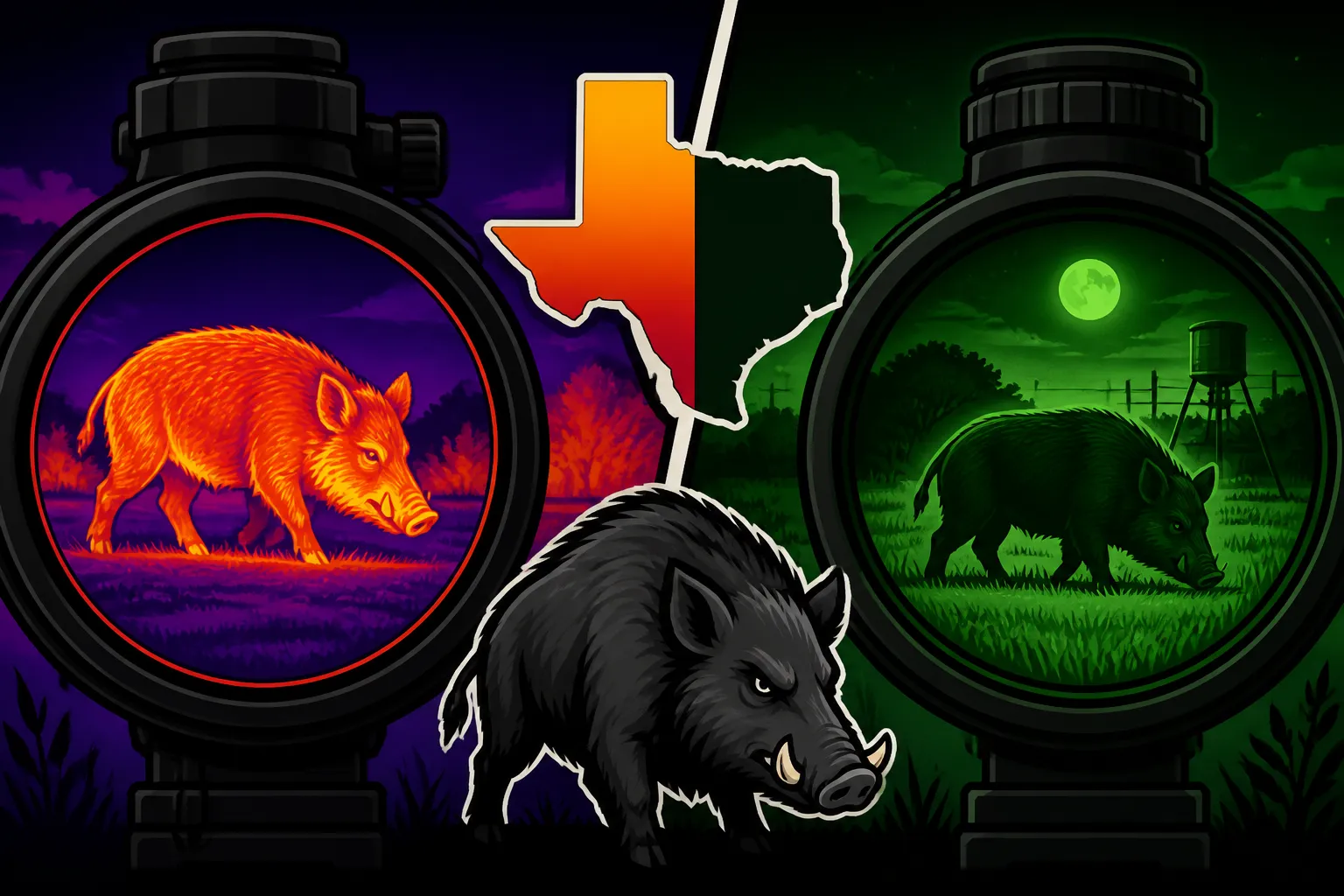
Thermal scopes don't just amplify light; they create an image based on temperature differences. Every object emits some level of infrared radiation, and a thermal sensor detects these variations, converting them into a visible spectrum on a display. This means a hog, being a warm-blooded creature, will glow brightly against the cooler background of trees, brush, and earth, even in complete darkness or obscured conditions.
The primary benefit is unparalleled detection. You can spot a hog in thick mesquite brush that would hide it from even the keenest eye, or see through light fog, smoke, or tall grass that would render other optics useless. Imagine glassing a vast pasture in South Texas, and suddenly, a bright white blob resolves into a group of hogs moving in the distance – that's the power of thermal. This capability saves you immense time and dramatically increases your ability to locate animals that are otherwise expertly concealed.
Practical Applications and Scenarios for Thermal Scopes
Thermal scopes truly shine in situations where hogs are trying to stay hidden or when conditions are less than ideal. If you're hunting in dense cover, like the senderos of the South Texas Brush Country or the thick riparian zones along a creek bed, thermal allows you to penetrate that foliage and spot hogs you'd never otherwise see. It's incredibly effective for scanning large areas, too. On a cool night, a group of hogs moving across a harvested cornfield will light up like Christmas trees at significant distances, giving you ample time to plan your approach.
For instance, consider a scenario where you're set up over a feeder. As the night progresses, you might hear rustling, but without thermal, you'd be playing a guessing game. A quick scan with your thermal scope immediately confirms if it's a coon, a deer, or a sounder of hogs. This not only improves your efficiency but also ensures you're only targeting the desired species. Many hunters also use thermal monoculars for scanning and then switch to a traditional rifle scope with an attached IR illuminator for the shot, making it a versatile tool for various hunting styles.
Downsides and Considerations for Thermal Imaging
While thermal imaging is incredibly powerful, it's not without its drawbacks. The most significant barrier for many hunters is the cost. High-quality thermal scopes can be a substantial investment, often ranging from several thousand dollars upwards. While prices have come down over the years, they still represent a higher entry point than most night vision devices.
Another consideration is the learning curve for identification. While thermal excels at detection, the image it presents is not always easily discernible for precise identification, especially at longer ranges. A hog appears as a heat signature, often a generic blob. Distinguishing between a hog and a deer, for instance, requires practice and understanding of animal shapes and movements in thermal view. You might see "something warm," but pinpointing exact species or shot placement requires experience. Battery life can also be a concern; thermal devices are power-hungry, so carrying spare batteries or a portable power bank is often essential for extended hunts.
Exploring Night Vision Technology for Texas Hogs
Night vision technology has been around for decades and, unlike thermal, works by amplifying existing light. It offers a different set of advantages and challenges when pursuing those elusive Texas hogs after dark. It's often the first step for many hunters venturing into night hunting due to its relative affordability and distinct visual output.
The Mechanics of Night Vision and Its Advantages
Night vision devices operate by collecting minuscule amounts of ambient light—from stars, the moon, or even distant city glow—and intensifying it thousands of times. This amplified light then hits a phosphor screen, creating the familiar green-tinted image we associate with night vision. More advanced digital night vision can even provide a full-color image in very low light conditions.
One of the key advantages of night vision is its ability to provide better detail and clarity for identification compared to thermal imaging, provided there's sufficient ambient light. You can often make out features, shapes, and even smaller details that are crucial for positive identification and ethical shot placement. For hunters who prioritize visual fidelity and want to truly discern the animal they're targeting, night vision can be a very appealing option. It also generally has a better battery life than thermal units, making it reliable for longer periods in the field.
Situational Effectiveness and Use Cases for Night Vision
Night vision excels in open environments with some ambient light, such as a moonlit pasture or a field under a clear, starlit sky. In these conditions, you can often achieve surprisingly good clarity, allowing for confident identification of hogs and precise shot placement. It's also effective when paired with an infrared (IR) illuminator, which acts like a flashlight that only the night vision device can see. An IR illuminator can dramatically extend the range and clarity of your night vision, even on the darkest nights.
Consider a hunt on a large hayfield near Uvalde on a clear night. With a good Gen 2 or Gen 3 night vision scope and a powerful IR illuminator, you can easily spot hogs moving across the field, differentiate them from other animals like deer, and make a clean shot. For stationary hunting from a blind overlooking a bait pile, night vision with an integrated IR illuminator can be a highly effective and relatively affordable setup for consistent hog removal.
Limitations and Challenges with Night Vision
While night vision offers great clarity in suitable conditions, it has some significant limitations. The biggest drawback is its reliance on ambient light. On cloudy, moonless nights, or in extremely dense cover where light simply can't penetrate, night vision performance drops dramatically. Without an IR illuminator, it can be almost useless in true pitch-black conditions.
Furthermore, night vision struggles with obstacles. It cannot see through fog, thick brush, or even heavy rain. These elements scatter and absorb light, making the image blurry or completely obscured. Unlike thermal, it also cannot "see" into shaded areas or behind light foliage. Another critical concern is "blooming" or "washout" if exposed to bright light sources like vehicle headlights or a direct flashlight beam, which can temporarily blind the device and potentially damage older generation sensors. This makes scanning areas with inconsistent light sources a challenge, and care must be taken to protect the device.
Direct Comparison: Thermal Scope vs. Night Vision for Texas Hogs
When it comes to outfitting yourself for Texas hog hunting after dark, the choice between thermal and night vision often boils down to a few key performance indicators. Both technologies have their place, but they excel in different areas, and understanding these differences is crucial for selecting the right tool for your specific hunting style and local terrain.
Visibility and Target Detection
For sheer target detection, especially over vast areas or in challenging environmental conditions, thermal scopes are the undisputed champions. They don't care if it's pitch black, foggy, or if the hogs are partially obscured by light brush. If it's warm, thermal will find it. This means you can scan a field or a dense thicket and almost immediately pick out any warm-bodied animal. This capability is invaluable when you're trying to locate a sounder of hogs that could be scattered across a large property.
Night vision, on the other hand, struggles with detection in less-than-ideal conditions. If there's no moon, heavy cloud cover, or dense foliage, its ability to pick up animals significantly diminishes. While a good IR illuminator can boost its performance, it still won't penetrate fog or brush the way thermal does. You might see a hog in a clear lane, but you won't detect the one hidden 10 yards deeper in the mesquite. For initial long-range scanning or finding those truly hidden hogs, thermal technology is superior.
Identification and Shot Placement
This is where the playing field levels out, and in some aspects, night vision can even pull ahead. Thermal images, while excellent for detection, often present animals as heat signatures or "blobs." While experienced thermal users can learn to distinguish species by shape and movement, identifying specific details like sex, age, or the exact vital placement for a clean shot can be challenging, especially at longer ranges.
Night vision, particularly modern digital night vision or higher-generation analog devices with an IR illuminator, often provides a much clearer, more defined image of the animal. You can see fur texture, antler points (if it were deer), and precise body outlines, making it easier to confirm your target and place your shot accurately. For ethical hunting and ensuring a quick, humane kill, clear identification is paramount. Many hunters will detect hogs with a thermal monocular and then switch to a rifle equipped with a night vision scope (often with an IR illuminator) for the final shot, leveraging the strengths of both systems.
Cost and Accessibility
Cost is often a significant factor for hunters, and here, night vision generally holds an advantage. Entry-level night vision monoculars and scopes are typically much more affordable than their thermal counterparts. You can find decent digital night vision units for a few hundred dollars, and even good Gen 1 or Gen 2 analog units are often under $1000. This makes night vision a more accessible option for hunters on a tighter budget looking to get into night hunting.
Thermal technology, due to its complex sensor array and processing power, tends to be more expensive. While budget-friendly thermal monoculars exist, a good thermal scope suitable for consistent hog hunting often starts in the $1,500 to $2,000 range and can go much higher for premium models. This higher upfront investment can be a deterrent for some, though the capabilities it unlocks often justify the cost for serious hog hunters. When considering the overall expense of a night hunting setup, remember to factor in things like Best Gear for Feral Hog Hunting in Texas, which might include accessories for either system.
Here's a quick comparison of key features to help you visualize the differences:
| Feature | Thermal Scope | Night Vision Scope |
|---|---|---|
| Detection | Excellent (heat signatures) | Fair to Good (requires ambient light, IR aids) |
| Identification | Fair (blob-like, detail requires practice) | Good (better detail with sufficient light/IR) |
| Environmental | Cuts through fog, smoke, light brush | Hampered by fog, smoke, thick brush |
| Light Needs | None (detects heat) | Requires ambient light (moon, stars, or IR) |
| Cost (Entry-Level) | Higher (typically $1,500+) | Lower (can find good units under $1,000) |
| Battery Life | Varies, often moderate (power-intensive) | Generally better (less power-intensive) |
| Day Use | Limited (some have day modes, but not primary) | Not suitable (can damage sensor if exposed to light) |
| Obscuring Factors | Heat-emitting objects only | Light-absorbing/scattering objects (foliage, fog) |
Making the Right Choice for Your Texas Hog Hunt
Deciding between thermal and night vision isn't about one being universally "better" than the other; it's about which technology best suits your specific needs, budget, and hunting environment. Many experienced hunters even integrate both technologies into their night hunting strategy for maximum effectiveness.
Budget and Frequency of Use
Your budget is often the most practical starting point. If you're just dipping your toes into night hunting for hogs and don't want to break the bank, a good quality digital night vision scope with an effective IR illuminator can be a very capable and affordable option. You can certainly be successful in removing hogs this way, especially if you focus on areas with some ambient light or use feeders to draw them in. Many hunters find that this setup, perhaps combined with an initial scouting plan from a platform like GoHunt, is sufficient for their needs.
However, if you're a dedicated hog hunter who plans on spending many nights in the field, or if hog control is a serious endeavor on your property, the investment in thermal imaging might be more justifiable. The efficiency and detection capabilities of thermal will pay dividends over time, allowing you to locate and engage more hogs, especially in those challenging conditions where night vision struggles. Consider how often you'll use the equipment and what level of performance you truly need to achieve your hog management goals.
Hunting Environment and Style
The terrain you hunt in Texas will heavily influence your choice. If your hunting grounds consist primarily of wide-open pastures, fields, or areas with minimal canopy cover, night vision can be incredibly effective, especially on moonlit nights. The ability to distinguish fine details and make precise shots will serve you well in these environments. You can easily scope out a hog under the stars with minimal issues.
However, if you're dealing with dense, brushy terrain—like the infamous South Texas mesquite thickets, heavy creek bottoms, or areas with tall grasses—thermal imaging becomes almost indispensable. Night vision simply can't penetrate these obstacles effectively, leaving you staring into an indistinguishable wall of green. Thermal, by contrast, will highlight the heat signature of a hog moving through that dense cover, giving you an advantage that no other optic can provide. Whether you prefer to stalk or How to Set Up a Box Blind Over a Feeder will also factor into how each technology benefits your particular approach.
Combining Technologies for Optimal Results
For those who are truly serious about hog eradication and have the resources, the ultimate setup often involves a combination of both thermal and night vision. This "best of both worlds" approach leverages the strengths of each technology while mitigating their weaknesses. A common strategy is to use a thermal monocular for initial detection and scanning. This allows you to quickly locate hogs, even if they're hidden in dense cover or at long distances.
Once hogs are detected, you can then switch to a rifle equipped with a night vision scope (often with an IR illuminator) for positive identification and precise shot placement. The night vision provides the clarity needed to confidently confirm the target and ensure an ethical kill, something that can be more challenging with the less detailed thermal image. Some hunters even use a thermal scope on their rifle for shooting, but carry a night vision monocular for closer range identification, or vice-versa. This dual-technology approach gives you the most comprehensive advantage when hunting feral hogs in the diverse Texas landscape. You might also want to look into How to Hunt Hogs at Night With Thermal to dive deeper into this specific method.
Disclaimer
Hunting is an inherently dangerous activity. Always prioritize safety, understand and adhere to all local, state, and federal regulations, and obtain proper training before handling firearms or engaging in hunting. The information provided in this article is for informational purposes only and should not be considered a substitute for professional instruction or official hunting regulations.