Best Thermal Monocular for Scanning in Texas
The vast expanse of Texas, with its diverse landscapes ranging from dense South Texas brush to open Panhandle plains, presents unique challenges when you're trying to spot game, especially as twilight fades or under the cloak of night. Trying to identify a heat signature in a sea of mesquite or locate a downed hog in tall grass with only a flashlight can be an incredibly frustrating and often futile endeavor. This comprehensive guide is designed to help you navigate the world of thermal monoculars, exploring why they've become indispensable for many Texas hunters and what features truly matter when you're choosing the best one for your specific hunting adventures.
Why a Thermal Monocular is a Game-Changer for Texas Hunting
Texas hunting often means dealing with low-light conditions, vast open areas, or incredibly dense cover where traditional optics fall short. This is where a thermal monocular shines, transforming the way you scout, hunt, and recover game. It's not just about hunting at night; it's about seeing what the naked eye and even traditional night vision cannot, giving you a critical advantage for safety and success.
Overcoming Low-Light and Night Hunting Challenges
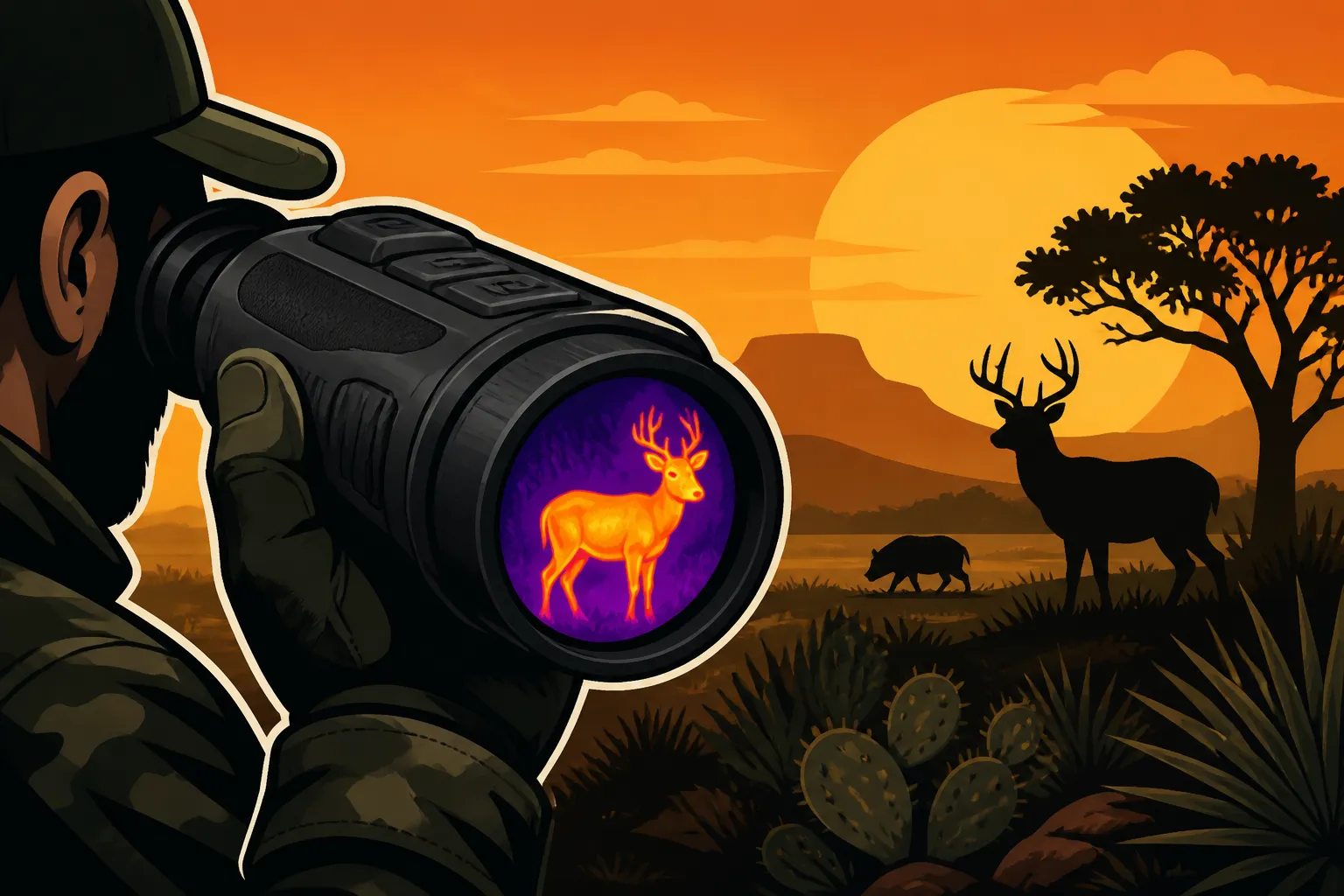
Let's be real: hunting hogs and coyotes often happens after the sun dips below the horizon, and even deer movement can pick up significantly during the early morning and late evening hours. In these conditions, traditional binoculars or even powerful rifle scopes are practically useless for scanning wide areas. A thermal monocular, however, detects heat signatures, allowing you to "see" animals against any background, day or night, fog or dust. Imagine being able to sweep an entire field or a thick stand of oaks and immediately pick out the glowing outline of a sounder of hogs or a lone coyote that would otherwise be completely invisible. This capability fundamentally changes your approach to night hunting, making it safer and vastly more effective. It also drastically reduces the chances of misidentifying a target, an all-too-common concern when visibility is poor.
Efficient Scouting and Game Recovery
Beyond active hunting, thermal monoculars are an invaluable tool for scouting. Before sunup, you can quietly observe animal movement patterns from a distance without spooking them with visible light. You can pinpoint bedding areas, travel corridors, and feeding spots by noting where heat signatures are consistently appearing. This intel, gathered discreetly, can inform your stand placement or stalking routes.
Perhaps one of the most stressful parts of hunting is tracking a wounded animal, especially in the thick Texas brush. A thermal monocular can dramatically cut down on recovery time and effort. Blood trails might be hard to follow, but a heat signature, even from a long-gone animal, can persist for a surprising amount of time on the ground or on the animal itself. Imagine having a thermal monocular with you when you're trying to locate a buck that ran into a dense cedar break. That faint heat signature, whether from the animal's body or a recent blood trail on cool ground, can make all the difference in a quick and ethical recovery. This is a crucial aspect often overlooked when discussing their benefits, but it contributes significantly to responsible hunting practices.
Key Features to Look For in a Thermal Monocular
When you're trying to pick out the best thermal monocular for scanning in Texas, you'll quickly realize that not all units are created equal. The market is flooded with options, and understanding the core specifications will help you make an informed decision that truly suits your needs and budget. It's not just about the price tag; it's about getting the right technology for the challenging environments we face here in Texas.
Sensor Resolution and Refresh Rate
These two features are arguably the most critical for image quality and smooth performance.
-
Sensor Resolution: This is expressed in pixels, like 384×288 or 640×480. A higher resolution means more detailed images. Think of it like comparing a standard definition TV to a 4K TV. While a 384×288 resolution is perfectly capable of detecting animals at reasonable distances, a 640×480 sensor will provide a much clearer, more identifiable image, especially as you zoom in or scan at longer ranges. For identifying species, distinguishing between a hog and a deer, or assessing an animal's size, the higher resolution is a significant advantage. It allows for better target discrimination and can help prevent misidentification, which is crucial for ethical hunting.
-
Refresh Rate: Measured in Hertz (Hz), this indicates how many times per second the image refreshes on the screen. A 60Hz refresh rate is considered top-tier, offering a buttery-smooth image, even when panning rapidly or tracking fast-moving targets. Lower refresh rates, like 30Hz, can exhibit choppiness or lag, especially if you're quickly sweeping an area or trying to keep up with running animals. For dynamic scanning and quick target acquisition, a 60Hz rate is highly recommended, as it significantly reduces eye strain and provides a more natural viewing experience.
Detection Range, Magnification, and Field of View
Understanding these aspects will help you match the monocular to the terrain you typically hunt.
-
Detection Range: This spec tells you how far away the device can detect a heat signature. It's important to differentiate detection from recognition or identification range. You might detect a heat source at 2,000 yards, but only be able to clearly identify it as a deer at 500 yards. For wide-open spaces like the Panhandle or South Texas senderos, a longer detection range is beneficial. However, for dense brush country or closer-range hog hunting, extreme detection range might be less critical than a wider field of view.
-
Magnification and Field of View (FOV): Monoculars come with a base optical magnification, often 1x or 2x, and then offer digital zoom. Excessive digital zoom can quickly pixelate the image, so optical magnification is always preferred. A lower base magnification usually provides a wider field of view, which is excellent for scanning large areas quickly. A narrower field of view with higher base magnification is better for detailed observation of specific, distant targets. Consider your primary use: sweeping a large pasture for coyotes will benefit from a wide FOV, while zeroing in on a particular buck from a distance might require higher magnification. Some thermal units like the Pulsar Helion or AGM Rattler series offer a good balance, but it's always a trade-off.
Battery Life and Environmental Durability
Texas weather can be extreme, and your gear needs to stand up to it.
-
Battery Life: Long battery life is crucial, especially on extended hunts or when you're deep in the field. Many thermal monoculars use proprietary battery packs, while others might run on standard CR123A or 18650 cells. Look for models that offer 6+ hours of continuous operation, and consider external power bank compatibility or easily swappable battery packs. The heat in Texas can also impact battery performance, so having extra power is always a good idea. Some units feature power-saving modes or auto-off functions, which are very useful.
-
Environmental Durability: Your monocular needs to withstand dust, moisture, and accidental bumps. Look for an IP rating (e.g., IP67 or IPX7), which indicates resistance to dust and water immersion. A rugged housing, often made of reinforced polymer or aluminum, is essential. Texas can dish out everything from driving rain to dusty winds, so gear that can handle the elements without faltering is non-negotiable. Mentioning this durability aspect is something users who research on platforms like GoHunt often prioritize when selecting gear.
Popular Thermal Monocular Brands and Models for Texas Hunters
The market for thermal monoculars has grown significantly, with several manufacturers offering excellent options tailored to various budgets and needs. When you're looking for the best thermal monocular for scanning in Texas, you'll typically find yourself comparing offerings from a few key players known for their quality and innovation. Let's dive into some of the most popular choices that consistently get high marks from hunters tackling the unique challenges of the Lone Star State.
Pulsar Thermal Monoculars
Pulsar is often considered the gold standard in thermal optics, renowned for its superior image quality, robust features, and user-friendly interfaces. Models like the Pulsar Helion and Pulsar Axion series are incredibly popular among serious Texas hunters. The Helion line, with its higher resolutions (often 640×480) and sophisticated image processing, delivers crisp, detailed thermal images that make identification much easier, even at longer distances or in less-than-ideal conditions. Hunters who frequent areas with dense cover, like the South Texas brush country, appreciate the clarity for picking out game obscured by foliage.
The Axion series, on the other hand, offers a more compact and pocket-friendly design without sacrificing too much performance. It's perfect for quick scans or hunters who need a lightweight option for long treks. While Pulsar units might sit at the higher end of the price spectrum, their reliability, intuitive controls, and advanced features like built-in video recording and Wi-Fi streaming justify the investment for many. When you're trying to spot a wily coyote on the plains or a sounder of hogs tucked away in a creek bottom, the clarity provided by a Pulsar unit can make all the difference.
AGM Global Vision and ATN Optics
These brands offer compelling alternatives that often strike a fantastic balance between performance and affordability, making them very attractive to a wide range of Texas hunters.
-
AGM Global Vision: AGM has gained significant traction with models like the Rattler TS series (which also includes monocular versions) and the Taipan line. AGM units are known for delivering solid thermal performance without breaking the bank. The Taipan monoculars, in particular, are praised for their compact size, good image quality for their price point, and reliable operation. They often feature good detection ranges and refresh rates that minimize lag, which is crucial for scanning moving targets. For a hunter looking to get into thermal without spending Pulsar-level money, an AGM Taipan or Rattler can be an excellent entry point. They're rugged enough for the Texas outdoors and offer features that are genuinely useful in the field.
-
ATN Optics: ATN has carved out its niche with feature-rich devices that integrate digital day/night capabilities, smart ranging, and ballistic calculators into some of their systems. While they are more widely known for their thermal scopes, ATN also offers monoculars that share some of their innovative features. Their focus on digital integration and a user experience akin to modern smart devices appeals to tech-savvy hunters. While some might argue that the pure thermal image quality isn't always on par with Pulsar's top-tier offerings, ATN often makes up for it with a broader suite of integrated tools. Comparing a Pulsar Thermion 2 Thermal Scope Review to an ATN ThOR Thermal Scope Review reveals different philosophies, and this extends to their monocular lines as well.
RIX Optics and Other Contenders
The market is always evolving, and newer players or those with specialized offerings are also worth considering.
- RIX Optics: RIX Optics has been making waves with its powerful and relatively new thermal offerings, often featuring impressive specifications at competitive price points. While perhaps not as ubiquitous as Pulsar or AGM yet, RIX is quickly earning a reputation for high-performance sensors and user-friendly designs. Keep an eye on their monocular lines as they continue to expand, as they may offer some of the best value for advanced features.
- Other Contenders: Brands like Infiray (sometimes re-branded under various names) also produce excellent thermal monoculars. These often focus on specific niches, such as ultra-compact designs or specialized sensor technologies. When researching, it's always a good idea to check out multiple reviews and forums (like those you might find while browsing on GoHunt or similar hunting communities) to see how different units perform in real-world Texas hunting scenarios. Don't be afraid to try out different models at a local outdoor retailer if possible, to get a feel for the ergonomics and image quality firsthand.
Real-World Scenarios and Practical Use
Having a thermal monocular is one thing; knowing how to use it effectively in the diverse Texas landscape is another. It's about more than just pointing and looking; it's about developing scanning techniques, understanding animal behavior through thermal signatures, and always keeping ethical considerations at the forefront.
Scanning Techniques for Diverse Texas Terrains
Texas offers such a variety of hunting environments, each requiring slightly different scanning approaches with your thermal monocular.
- Open Fields and Pastures: When you're looking over a wide-open field, perhaps for a sounder of hogs coming to a feeder or coyotes crossing a pasture, a slow, methodical sweep is your best friend. Start at one end, scan horizontally, and then drop down slightly to sweep back in the opposite direction, almost like mowing a lawn. Pay close attention to treelines, fence rows, and brush lines where animals often stage before moving into the open. The wide field of view offered by models like the AGM Taipan or certain Pulsar Axion versions excels here, allowing you to cover vast amounts of ground efficiently. Remember to scan the sky briefly as well; you might be surprised to pick up birds or even bats, giving you a better understanding of the ambient thermal conditions.
- Dense Brush and Timber: This is where thermal truly shines in Texas, especially in the thick mesquite and cedar breaks of South Texas or the Hill Country. Traditional optics are often useless here. With a thermal monocular, you're not looking through the brush, but rather picking up the heat signatures behind or within it. Slow down your scan even further here. Animals will often only present a small thermal outline through gaps in the foliage. Look for "blob" shapes that don't conform to the natural environment. Hogs, especially, love to bed down in the thickest stuff, and their strong heat signature will often cut right through light cover. This ability to penetrate cover is a game-changer for feral hog hunting in Texas and for tracking game that has entered heavy cover.
- Water Sources and Creeks: Animals are drawn to water, especially in the Texas heat. When scanning creek beds or stock tanks, focus on the banks and the edges of any vegetation. Thermal units can sometimes pick up the subtle temperature differences of water versus land, but their primary advantage here is revealing animals approaching or leaving the water's edge, or those bedded down in the cooler, shadier confines of a creek bottom.
Ethical Considerations and Target Identification
While thermal monoculars offer a significant advantage, they also come with a responsibility to maintain ethical hunting practices.
- Identification Before the Shot: Just because you see a heat signature doesn't mean it's your target animal, or that it's legal to harvest. Always confirm your target visually with a traditional optical scope or through the thermal scope on your rifle before taking a shot. A thermal monocular is primarily a scanning tool, excellent for detection and initial assessment, but often lacks the fine detail needed for precise species or antler identification at longer ranges. For example, distinguishing between a legal buck under Texas Antler Restrictions or a doe requires a clear visual. This is particularly true if you're not solely focused on varmints.
- Minimizing Disturbance: Use your thermal monocular to observe animals from a distance without disturbing them. This allows for more natural behavior observation and better scouting intelligence. Resist the urge to constantly shine white lights, which can stress animals and educate them to your presence. The beauty of thermal is its passive nature—it emits no light and makes no sound.
- Compliance with Regulations: Always be aware of local and state regulations regarding night hunting and the use of thermal optics. While hog hunting at night with thermal is largely legal in Texas and encouraged due to their destructive nature, rules can vary for other species or in specific areas like CWD Zones in Texas. Always consult the latest Texas Outdoor Annual or TPWD regulations. Using a thermal monocular for scanning is almost universally accepted, but the use of thermal scopes for actual shooting can have more restrictions depending on the game species and location.
Choosing the Right Thermal Monocular for Your Budget and Needs
Deciding on the "best" thermal monocular is highly subjective and depends largely on what you plan to hunt, where you hunt it, and how much you're willing to invest. There's a perfect unit out there for everyone, from the casual hunter to the dedicated nocturnal predator.
Entry-Level vs. Mid-Range vs. High-End Options
The world of thermal optics can be broadly categorized by price and performance tiers.
- Entry-Level (Under $1,500): These units typically feature lower resolution sensors (e.g., 256×192 or 384×288) and may have refresh rates of 9Hz or 30Hz. While they won't give you crystal-clear images, they are perfectly capable of detecting heat signatures at short to medium ranges. For a beginner or someone primarily hunting hogs and coyotes in smaller properties or at closer distances, an entry-level thermal monocular can be a fantastic way to get into the game without a huge financial commitment. Brands like AGM Taipan or some older ATN models often fall into this category. They offer a significant advantage over traditional night vision or flashlights for pure detection. If you're wondering, "Best Thermal Monocular Under $1500" this category is for you.
- Mid-Range ($1,500 – $3,000): This is often the sweet spot for many Texas hunters. You'll find units with 384×288 resolution sensors and a smooth 50Hz or 60Hz refresh rate. These monoculars offer a noticeable jump in image clarity, making it easier to recognize and sometimes identify animals at moderate to long distances. Detection ranges become more substantial, and features like built-in video recording, customizable color palettes, and improved battery life become more common. Many AGM Rattler or Pulsar Axion models fall here, providing excellent value for money and performance that satisfies most hunting needs. This is where you start to see real gains in performance, particularly for hunters targeting larger properties or needing better discrimination between targets.
- High-End ($3,000+): When you move into this tier, you're looking at top-of-the-line performance. These units boast 640×480 resolution sensors, 60Hz refresh rates, advanced image processing, and often come packed with additional features like precise ranging, ballistic calculations (if it's a scope/monocular combo), and robust build quality. Models like the Pulsar Helion 2 XP line or specialized units from RIX Optics provide exceptional image detail, allowing for confident identification at extended ranges and superior performance in adverse conditions. For the dedicated hunter who demands the absolute best, or for those hunting high-value exotics where precise identification is paramount, a high-end thermal monocular is an investment in unparalleled performance.
Matching Your Monocular to Your Target Species and Terrain
The ideal thermal monocular for you will depend heavily on what you're hunting and where you're hunting it.
- Hog and Coyote Hunting: Since these are year-round, often nocturnal targets in Texas, a thermal monocular is incredibly useful. For general detection and close-to-medium range engagement in brush country, a mid-range 384×288 unit from AGM or a compact Pulsar Axion is usually sufficient. If you're hunting open fields and want to spot coyotes at extreme distances, or if you're seriously into predator calling for coyotes in Texas, a higher-resolution 640×480 unit will provide better recognition capabilities. The "Best Thermal for Coyote Hunting in Texas" would certainly lean towards higher resolution for clear identification.
- Exotic Game Hunting: When hunting valuable exotics like axis deer or aoudad, especially if they are free-ranging and challenging to locate, a higher-resolution thermal monocular can be a game-changer. The ability to distinguish antler points or body characteristics at distance before making a move can be invaluable. This type of hunting often involves extensive scouting, and a quality thermal helps locate animals without disturbing them.
- Scouting and Recovery: For general scouting before hunting season or for tracking wounded game, a mid-range unit provides a great balance of detection and enough detail for recovery efforts. The ability to quickly sweep large areas and pick up faint heat trails makes recovery faster and more ethical. This ties into overall practices like Deer Hunting in Texas: Feeders, Blinds & Tactics where understanding game movement is key.
Here's a quick comparison of some popular thermal monocular characteristics:
| Feature/Brand | Entry-Level (e.g., AGM Taipan, Older ATN) | Mid-Range (e.g., AGM Rattler TS19/25, Pulsar Axion XM30/XQ30) | High-End (e.g., Pulsar Helion 2 XP50, RIX G2) |
|---|---|---|---|
| Sensor Resolution | 256×192 / 320×240 / 384×288 | 384×288 / 384×288 | 640×480 |
| Refresh Rate | 9Hz / 30Hz / 50Hz | 50Hz / 60Hz | 60Hz |
| Detection Range (Human Size) | Up to 1,000-1,200 yards | 1,200-1,800 yards | 2,000+ yards |
| Identification Range (Deer/Hog) | Up to 100-150 yards | 200-300 yards | 400+ yards |
| Typical Magnification | 1-2x optical, digital zoom | 1.5-2.5x optical, digital zoom | 2-4x optical, digital zoom |
| Battery Life | 4-6 hours | 6-8+ hours | 8-10+ hours |
| Price Range | $500 – $1,500 | $1,500 – $3,000 | $3,000+ |
| Key Benefit | Affordable entry, basic detection | Great balance of performance & value, good recognition | Elite image quality, long-range identification |
Remember, a thermal monocular is a significant investment. Take your time, do your research (platforms like GoHunt can be great for user reviews and comparisons), and consider renting or borrowing different models if possible to find the perfect fit for your Texas hunting adventures.
Maintenance and Care for Your Thermal Monocular
A thermal monocular is an investment, and like any critical piece of hunting gear, it needs proper care to ensure its longevity and optimal performance. Texas hunting conditions—dust, heat, humidity, and the occasional unexpected downpour—can be tough on electronics. A little proactive maintenance goes a long way in protecting your device and making sure it's always ready when you need it.
Cleaning and Storage Best Practices
After a long day or night in the field, especially in dusty or humid conditions, your thermal monocular will likely need a bit of attention.
- Lens Care: The germanium lens on the front of your thermal unit is highly sensitive and expensive to replace. Always use a soft lens brush or compressed air to gently remove any loose dust or debris first. Never wipe a dirty lens with a cloth, as this can scratch the delicate coating. For smudges or fingerprints, use a lens cleaning solution specifically designed for optics (not window cleaner!) and a clean, soft microfiber cloth. Wipe gently in a circular motion from the center outwards. Avoid harsh chemicals or abrasive materials at all costs.
- Body Cleaning: The housing of the monocular can usually be wiped down with a damp cloth to remove dirt, mud, or sweat. If it's heavily soiled, a mild soap solution can be used, but ensure the device's caps are securely closed, especially if it's rated for submersion. Make sure to thoroughly dry the unit before storage to prevent water spots or corrosion.
- Proper Storage: When not in use, store your thermal monocular in its protective case or a padded bag to prevent bumps and scratches. Keep it in a cool, dry place away from direct sunlight and extreme temperatures. High humidity, common in East Texas or along the coast, can lead to condensation or even fungus growth if not managed. Some hunters use desiccant packs in their storage cases to absorb moisture. Always remove batteries if you plan to store the unit for an extended period, especially non-rechargeable ones, to prevent leakage that can damage internal components.
Battery Management and Software Updates
Effective battery management is crucial, especially when you're relying on your thermal for critical tasks like How to Hunt Hogs at Night With Thermal or tracking.
- Battery Life Preservation: Always charge your rechargeable batteries fully before heading out. If your unit uses removable, non-rechargeable batteries (like CR123As), carry spares. In colder weather, keep spare batteries close to your body heat to preserve their charge. Utilize your monocular's power-saving modes, like auto-shutoff or standby, to conserve battery during periods of inactivity. If your unit allows for an external power bank connection, this can be a lifesaver for extended surveillance or multiple nights out without access to charging.
- Firmware and Software Updates: Just like your smartphone, many modern thermal monoculars receive firmware updates. These updates can improve image processing, add new features, fix bugs, or enhance battery efficiency. Check the manufacturer's website periodically for available updates and follow their instructions carefully. Typically, these involve connecting your device to a computer and running an update utility. Keeping your firmware current ensures you're getting the best performance and functionality from your unit. For example, a comparison between Pulsar vs AGM Thermal Scopes for Hogs would highlight how both brands regularly release updates to enhance user experience.
Taking these simple steps will ensure your thermal monocular remains a reliable companion for all your Feral Hog Hunting Tactics for Texas and other nocturnal adventures, year after year. It's about protecting your investment and ensuring you're always ready to spot that next heat signature in the vast Texas wilderness.
Disclaimer
Always check the latest Texas Parks and Wildlife Department (TPWD) regulations before hunting, as laws and seasons can change. This guide is for informational purposes only and does not constitute legal advice. Adhere to all local, state, and federal hunting laws.