CWD in Texas: Zones, Rules & Carcass Transport
Imagine you have finally dropped a trophy buck in the brush country after years of scouting, only to realize that one simple mistake in how you transport that animal could result in a heavy fine or the loss of your hunting privileges. The confusion surrounding Chronic Wasting Disease (CWD) regulations in Texas has turned a simple pack-out into a legal minefield. This guide provides the clarity you need to navigate CWD zones, sampling requirements, and carcass movement rules safely.
Understanding Chronic Wasting Disease in the Lone Star State
Chronic Wasting Disease is a topic that usually brings a heavy sigh to any campfire conversation in Texas. It is a fatal neurological illness that affects members of the cervid family, which in our neck of the woods includes white-tailed deer, mule deer, elk, and several exotic species like red stag and sika. Unlike a bacterial infection that you can treat with antibiotics, CWD is caused by prions—misfolded proteins that are incredibly resilient. These prions can persist in the soil for years, making the disease a long-term challenge for land management.
For the average hunter, the concern isn't just about the health of the herd, but about the survival of the Texas hunting tradition. If we don't manage the spread, we risk seeing a decline in the quality of our bucks and the eventual closure of certain hunting areas. We have seen how CWD has impacted states like Colorado and Wisconsin, and Texas Parks and Wildlife Department (TPWD) is working hard to ensure that doesn't happen here. This is why staying informed about Texas Whitetail Population & Density by Region is more than just biological curiosity; it is part of being a responsible steward of the land.
The frustration many of us feel comes from the changing nature of the rules. Just when you think you have the map memorized, a new detection occurs, and a new zone is drawn. It feels like a moving target. However, understanding the basic biology helps explain why the rules are so strict. Because the prions concentrate in the brain, spinal cord, and lymph nodes, most of the regulations you will face are designed to keep those specific parts of the animal from being moved from one county to another.
Navigating the Texas CWD Containment and Surveillance Zones
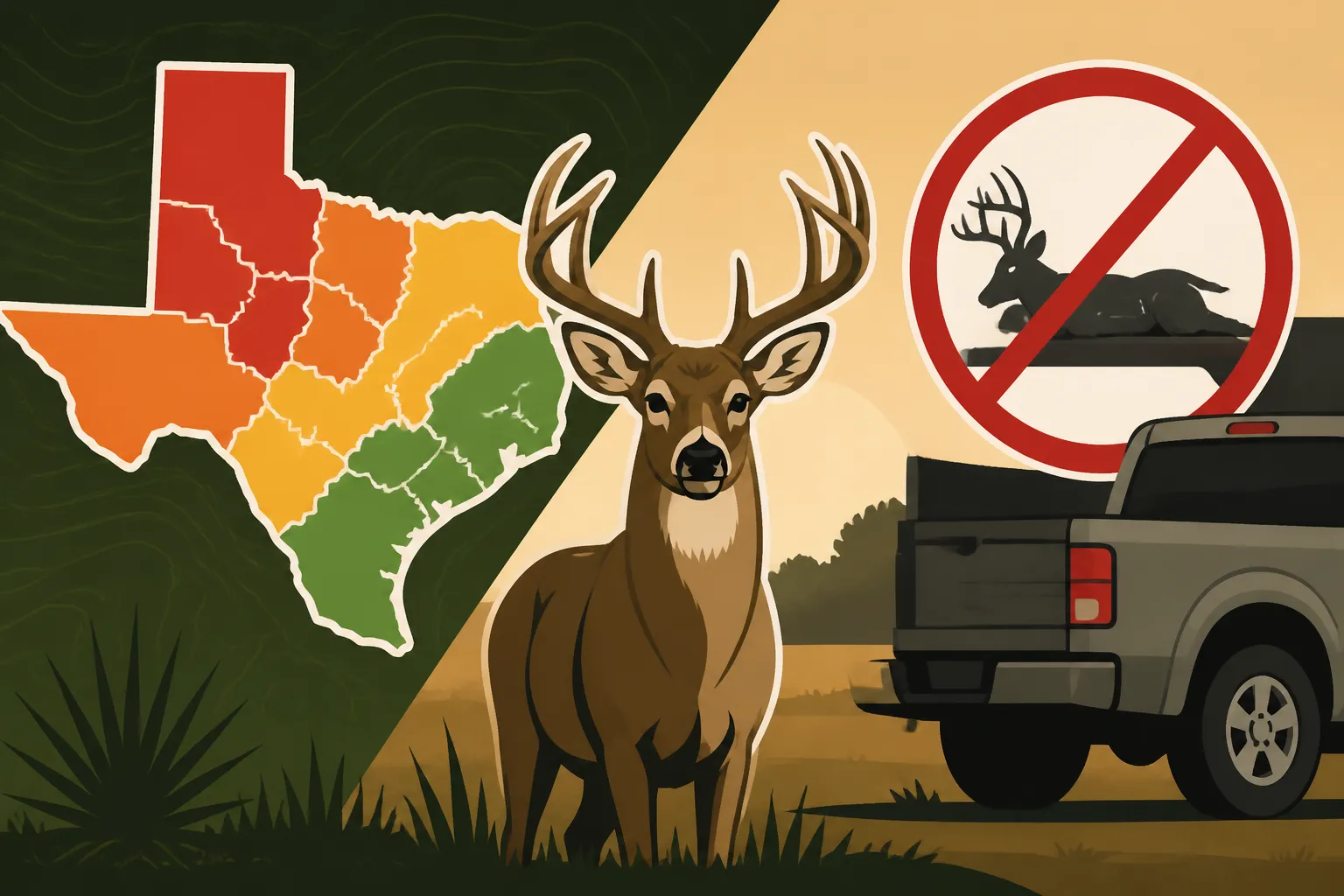
When you open the Texas Outdoor Annual, the first thing you will notice are the CWD zones. These are divided into two main categories: Containment Zones (CZ) and Surveillance Zones (SZ). A Containment Zone is the "red flag" area where CWD has been detected in the wild or in a captive facility. A Surveillance Zone is essentially a buffer around that area where TPWD is keep a very close eye on the population to see if the disease is migrating.
In the Panhandle, for example, the zones are vast because the deer—especially mule deer—travel long distances. If you are hunting near Dalhart or out toward Amarillo, you need to be hyper-aware of your exact GPS coordinates. The same applies to the Trans-Pecos, where Mule Deer Hunting in Texas: Panhandle & Trans-Pecos requires a different level of logistical planning due to the rugged terrain and the proximity of CWD-positive areas. South Texas has also seen its share of detections, particularly in Medina and Uvalde counties, which has changed how hunters on a South Texas Hunting Lease Cost & Options approach their season.
Staying updated is the hardest part. TPWD often updates these maps mid-season if a new positive is found. It is a good practice to check the "My Texas Hunt Harvest" app every time you head out. It is not just about the big trophy counties either; we are seeing detections in places like Hunt County and Gillespie County, which are heartlands for whitetail. If you are hunting a Hill Country Hunting in Texas lease, you are likely within a short drive of a surveillance zone, even if your specific gate isn't inside one yet.
| Zone Type | Primary Definition | Sampling Requirement | Carcass Movement |
|---|---|---|---|
| Containment Zone (CZ) | Area with confirmed CWD detections | Mandatory for all harvested cervids | Highly restricted; deboning usually required |
| Surveillance Zone (SZ) | Buffer area surrounding a CZ | Mandatory for all harvested cervids | Restricted; must follow zone-to-zone rules |
| Non-Zoned Area | No current CWD detections | Voluntary (highly encouraged) | Standard legal transport rules apply |
Mandatory Sampling Requirements and Check Stations
If you harvest a deer within a CZ or SZ, you are legally required to bring that animal to a TPWD check station within 48 hours. This isn't a suggestion; it’s a mandate. The process is actually fairly quick once you get there. A biologist will take a few physical measurements and then remove the medial retropharyngeal lymph nodes from the neck. These are the "gold standard" for testing for CWD prions.
Finding a check station can be a bit of a scavenger hunt if you don't plan ahead. Most are located at central hubs like feed stores, chambers of commerce, or TPWD field offices. For instance, in the Hill Country, you might find a station in Kerrville or Hondo. If you are hunting a Kerr WMA Hunting & Draw Info permit, the biologists are usually right there on-site to handle the sampling for you. They will give you a resource ID number that allows you to check your results online later, usually within two to three weeks.
For those who are tech-savvy and want to save time, TPWD has introduced DIY sampling kits and drop-off boxes in certain regions. You can learn to pull the lymph nodes yourself, place them in the provided bag with your tag information, and drop them in a cooler at a designated location. This is a lifesaver for those hunting late on a Sunday evening when the official stations might be closed or understaffed. Just make sure you follow the instructions perfectly; a mangled sample is a useless sample, and you’ll still be on the hook for the legal requirement.
Carcass Movement Restrictions: Staying Legal on the Road
This is where most hunters get into hot water. The law in Texas is clear: you cannot transport a whole carcass out of a CWD zone. The goal is to leave the "high-risk" parts—the brain and spinal column—at the site of harvest. If you are used to throwing the whole deer in the bed of the truck and heading to a processor in the city, you have to change your routine.
The "quartering" rule is your best friend here. You are allowed to move the four quarters (with the leg bone intact), the backstraps, the tenderloins, and the neck meat. All other meat must be deboned. This is especially important if you are planning on Field Dressing & Processing Game in Texas Heat, as the faster you get that meat off the bone and into a cooler, the better the quality will be anyway. If you are crossing county lines from a zone to a non-zone area, make sure your cooler only contains these approved cuts.
What about the head? This is the tricky part for trophy hunters. You can take the head out of the zone, but only if it is going directly to a taxidermist to be "caped out" or if you have already cleaned the skull plate. If you want a European mount, you should ideally boil the skull or clean it thoroughly before it leaves the zone. If you must transport the whole head to a taxidermist, it must be accompanied by a CWD permit, and the taxidermist must agree to dispose of the remains in a biohazard-approved manner.
Best Practices for Field Dressing and Processing in CWD Areas
Field dressing in a CWD zone requires a bit more intentionality than your average gut job. Since the prions are concentrated in the nervous system, you want to avoid cutting into the spinal column or the brain. Many veteran hunters in the Trans-Pecos or South Texas are moving toward the "gutless method" of processing. This allows you to remove the quarters and backstraps without ever opening the body cavity or touching the spine, which significantly reduces the risk of contaminating the meat.
Proper disposal of the remains is the next hurdle. In a CWD zone, you shouldn't just dump the carcass in a creek bed or leave it for the coyotes. While the coyotes won't get sick, they can spread the prions through their droppings. The best practice is to bury the remains deep (at least 3 feet) or, better yet, bag them and take them to a permitted landfill that accepts carcass waste. This is a hassle, no doubt, but it is the only way to ensure we aren't seeding the ground with prions for the next decade.
It is also wise to have a dedicated set of tools for CWD-zone deer. Prions are notoriously difficult to "kill." Standard bleach or boiling water doesn't always do the trick. Professional biologists often use a 50/50 bleach-to-water soak for their knives and saws for at least an hour. If you hunt in a zone frequently, consider having a "zone kit"—a specific set of knives, a gambrel, and a saw that stays at the lease or is kept separate from your other gear.
The Impact on Managed Lands and Private Leases
If you are a landowner or a member of a lease under the Managed Lands Deer Program (MLDP), CWD rules hit a little differently. MLDP properties often have their own specific testing quotas that must be met to keep their tags valid. If you are hunting on a Texas Hunting Lease vs Buying Hunting Land scenario, the lease agreement might actually mandate that every single deer harvested be tested, regardless of whether the state requires it. This is for the protection of the landowner's long-term investment.
Communication among lease members is vital. There is nothing worse than one guy on the lease ignoring the transport rules and getting the whole camp under scrutiny from a Game Warden. Everyone needs to be on the same page regarding where the gut pile goes and how the meat is being moved. If you are on a South Texas Trophy Whitetail: Brush Country Bucks hunt, the stakes are even higher because the visibility of those operations is much greater.
High-fence operations and breeders are under the most intense scrutiny. They are required to test a high percentage of their "mortalities" (deer that die of any cause). This has created a bit of a divide in the hunting community, but the reality is that CWD doesn't care about a fence. Whether you are hunting a low-fence lease in the Pineywoods & East Texas Hunting region or a high-fence ranch in the Hill Country, the biological reality of the disease remains the same.
Public Health and Eating CWD-Positive Venison
The question everyone eventually asks is: "Is it safe to eat?" As of right now, there has never been a documented case of CWD jumping from a deer to a human. However, the Centers for Disease Control (CDC) and the World Health Organization (WHO) strongly advise against eating meat from an animal that has tested positive for CWD. It is a "better safe than sorry" approach based on what we know about other prion diseases like Mad Cow Disease.
Most of us hunt to fill the freezer, and the thought of wasting meat is painful. This is why the 48-hour sampling window is so important. If you harvest a buck and it's in a zone, keep that meat on ice until the results come back. This is where How to Cool a Deer Fast in Texas Heat becomes a critical skill. If you have a good cooler and keep it drained and topped with fresh ice, venison can easily stay fresh for the two weeks it takes to get your results back.
If you do get that dreaded phone call or see a "Positive" result on the TPWD website, do not consume the meat. Most processors will not even take a deer from a CWD zone until it has been cleared, or they will process it in a way that keeps it separate from other hunters' meat. If you have a positive buck, contact your local TPWD office. They often have protocols for disposing of the meat safely and may even offer you a replacement tag for the following season depending on the current regulations and the circumstances of the harvest.
Legal Consequences and Hunter Responsibility
Texas Game Wardens take CWD regulations very seriously. We are talking about Class C misdemeanors that can escalate depending on the violation. Transporting a whole carcass across a zone line is a common citation, and it can come with a fine of several hundred dollars per occurrence. Beyond the money, there is the social cost. The hunting community in Texas is tight-knit, and being the person responsible for potentially spreading a disease to a new county is a reputation nobody wants.
It is our responsibility as hunters to be the first line of defense. We are the ones in the woods, seeing the deer, and handling the carcasses. If you see a deer that looks "off"—emaciated, stumbling, or showing no fear of humans—report it immediately. Do not shoot it and leave it. Call the TPWD dispatch. They would much rather come out and test a sick-looking deer that turns out to be fine than miss an opportunity to catch a new CWD outbreak early.
The landscape of Texas Hunting Seasons: Complete Calendar by Species is changing because of this disease. We might see shorter seasons in some areas or mandatory harvest quotas in others to thin out high-density populations where the disease spreads faster. By following the rules now, we are essentially buying time for scientists to find a better way to manage or even cure this condition. It is a small price to pay to ensure that the next generation gets to experience the thrill of a crisp November morning in a Texas deer stand.
CWD in Texas Disclaimer
This guide is intended for informational purposes only and does not constitute legal advice or an official statement of Texas Parks and Wildlife Department policy. Hunting regulations, CWD zone boundaries, and carcass transport laws are subject to frequent change. Always consult the most recent edition of the Texas Outdoor Annual and official TPWD maps before your hunt to ensure you are in compliance with all state and local laws. Failure to follow CWD protocols can lead to criminal charges and the confiscation of game.