Box Blind vs Tripod vs Ground Blind in Texas
Finding the perfect hunting setup on a Texas lease often feels like solving a complex puzzle with moving parts. Between scorching early-season heat, unpredictable thermal currents, thick brush, and hyper-vigilant game, choosing the wrong blind leaves you sweating, uncomfortable, and empty-handed. This guide breaks down the strengths, weaknesses, and ideal applications of box blinds, tripods, and ground blinds so you can make the smartest setup choice for your hunting grounds.
Box Blinds in Texas Hunting: Comfort, Scent Control, and Elevated Visibility
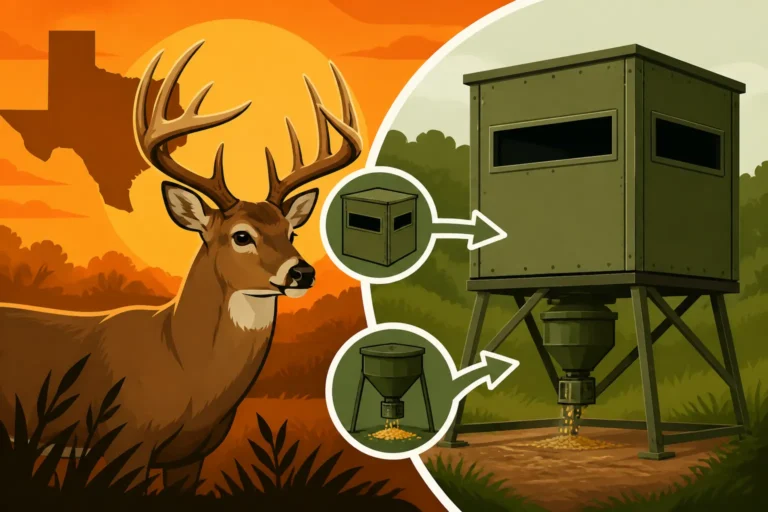
There is a reason the traditional tower or box blind is an iconic sight across the Lone Star State. From sprawling South Texas ranches to quiet Hill Country acreage, raised box blinds provide a stable, semi-permanent observation tower that allows hunters to sit comfortably for hours. When you are committing to long days during the general rifle season, having a solid roof over your head and walls to shield you from biting winds makes a world of difference. However, building or hauling a massive wooden or fiberglass elevated blind requires planning, muscle, and a clear understanding of your property’s topography.
Superior Weather Protection and Scent Containment
One of the greatest struggles Texas hunters face during early bow season and late winter freezes is extreme weather swings. An October afternoon in the brush country can easily push past ninety degrees, while a January blue norther can drop temperatures below freezing within a couple of hours. A well-built box blind offers insulated relief from both extremes. When fitted with sliding glass windows, tinted panels, and sealed seams, a box blind acts as a protective shell that keeps you dry during torrential downpours and out of the punishing sun.
Beyond physical comfort, scent containment is where enclosed box blinds truly excel. Whitetail deer rely heavily on their noses to detect danger, especially in low-lying river bottoms or thick brush where wind swirls unpredictably. Inside an enclosed box blind, your scent profile stays largely trapped within the structure. When you open a downwind window just enough to rest a rifle barrel on the ledge, you minimize the amount of human scent blowing across primary game trails. For family hunts with young kids who cannot sit perfectly still or silent for four hours, the concealed interior hides movement and dampens small noises that would otherwise send a trophy buck bounding into the mesquite.
Drawbacks of Box Blinds: Cost, Portability, and Feeder Spook
While box blinds offer unmatched comfort, they are far from a silver bullet. The most significant disadvantage is their lack of mobility. Once an elevated fiberglass or heavy wooden blind is set up on concrete blocks or welded steel legs, moving it requires a tractor, a heavy trailer, multiple adults, and a full day of backbreaking labor. If game patterns shift because of seasonal acorn drops, changing water sources, or pressure from neighboring properties, you cannot easily pivot your blind location to match the new movement.
Furthermore, introducing a massive, square structure into an open clear-cut can alarm native wildlife if done incorrectly. Mature bucks are notoriously suspicious of sudden changes in their home range. If you drop an elevated tower blind forty yards from a well-established feeding area a week before opening day, local deer will likely go nocturnal or avoid the clearing entirely. Elevated blinds require weeks or even months for the local animal population to accept them as harmless fixtures. They also demand a substantial financial investment compared to simpler hunting setups, and long-term upkeep—such as repainting wood, repairing leaky roofs, and replacing rotted flooring—is an ongoing chore. Learning how to set up a box blind over a feeder properly can help mitigate these initial challenges and ensure long-term success.
Ideal Scenarios and Terrain for Box Blind Placement
Box blinds shine brightest in wide-open country where elevated visibility gives you a distinct advantage over long distances. In regions like the Rolling Plains or open pastures in the Post Oak Savannah, sitting ten to fifteen feet above the ground allows you to glass broad senderos, pipeline rights-of-way, and agricultural field edges that would otherwise be blocked by brush.
They are also the gold standard for long-term lease investments. If you hold a multi-year contract on a property and have spent time reviewing trail camera data to identify primary travel corridors, placing a permanent box blind establishes a comfortable home base for years. They are ideally paired with broad shooting lanes, allowing you to monitor multiple directions at once without shifting your seat or drawing attention to yourself. Pairing an elevated tower with a best deer feeder setup for texas creates a predictable, highly controllable hunting scenario for rifle hunters looking to harvest mature game efficiently.
Tripod Blinds: The Mid-Level Solution for Mobile Hunters
For hunters who want the visibility of an elevated seat without the heavy, stationary footprint of a box blind, tripod stands offer an ideal middle ground. Tripods have earned a reputation as a workhorse option throughout the Texas Hill Country and South Texas brush country. Positioned anywhere from eight to sixteen feet in the air, a tripod elevates your line of sight just enough to peek over dense brush lines while remaining relatively easy to move and adjust as hunting conditions dictate.
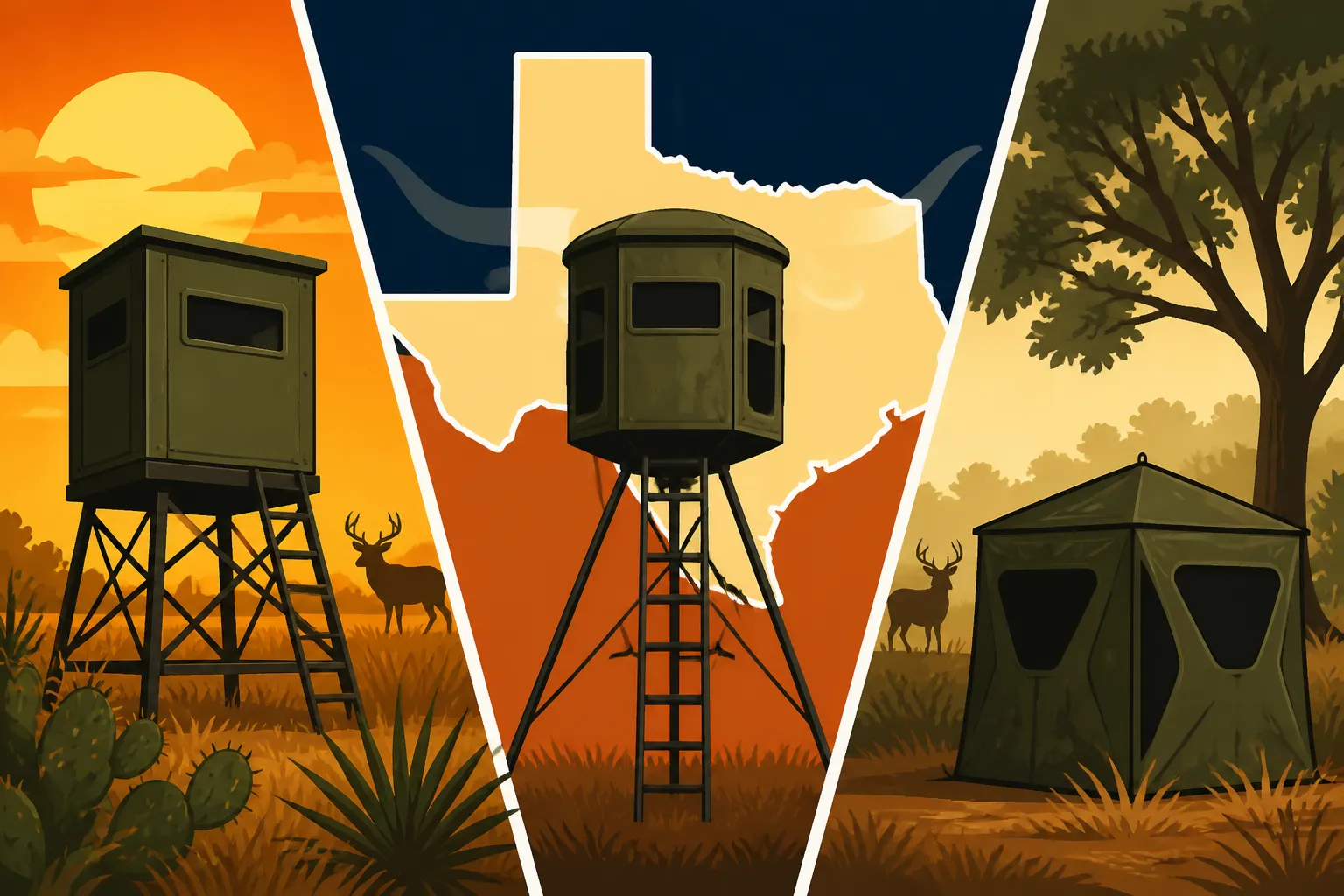
Box Blind
- Enclosed Comfort
- Scent Protection
- Stationary Base
Tripod Blind
- Elevated View
- 360-Degree Swivel
Ground Blind
- Maximum Stealth
- Ground-Level
- High Mobility
Mobility and Quick Setup in Dense Brush
The standout advantage of a tripod blind is its balance between height and portability. Most steel or aluminum tripods can be disassembled or folded down to fit in the bed of a pickup truck or on a utility trailer. Two hunters can easily relocate a tripod across a property in under an hour, making it an exceptional tool for adjusting to changing game patterns throughout the fall.
When navigating thick vegetation filled with prickly pear, agarita, and dense mesquite, a tripod allows you to tuck into small openings that would never accommodate a full-sized box blind. You can set the three legs directly into the heart of a cedar brake or weave them into a cluster of live oaks, using natural limbs as concealment. This versatility allows you to adapt quickly when a summer drought dries up a primary tank, forcing deer to use an alternate water hole, or when you notice fresh rubs along a newly discovered ridge trail.
Height Advantage Without the Heavy Footprint
Elevating your seating position by ten or twelve feet completely transforms what you can see in dense Texas vegetation. At ground level, a wall of brush limits your visual range to fifteen or twenty yards. On a tripod, you suddenly look down through the canopy, exposing hidden trails, bedding areas, and bedded game that ground hunters miss entirely. This height also helps carry your scent over the heads of approaching animals, provided you have a steady, favorable crosswind.
Additionally, most modern tripods come equipped with full three-hundred-and-sixty-degree swivel seats. This unhindered range of motion allows you to swing smoothly around to take a shot, whether a buck approaches from a sendero in front of you or sneaks up from the thick cover behind your back leg. Because the frame consists of slender metal poles rather than solid wooden walls, a tripod blends into the surrounding branches far more naturally than a bulky tower blind, requiring less break-in time for skittish game.
Weather Exposure, Wind Sensitivity, and Safety Considerations
Despite their flexibility, tripods come with obvious trade-offs—primarily complete exposure to the elements. Sitting on an open metal chair twelve feet in the air leaves you fully vulnerable to driving rain, scorching sun, and bitter winds. Early-season hunts can be grueling without an aftermarket umbrella or shade kit, and winter winds will chill you to the bone much faster than if you were tucked inside an insulated box.
Movement is another critical factor. Because you lack solid walls to block your silhouette, any careless motion—like reaching for a rangefinder, raising a binocular, or drawing a bow—can immediately expose your location to a sharp-eyed deer. Safety also demands constant attention. Climbing up and down narrow ladder rungs with muddy boots or frost-covered metal requires caution, and securing the tripod legs with heavy-duty earth anchors or T-posts is mandatory to prevent high Texas plains winds from blowing the structure over when unoccupied.
Ground Blind Uses: Tactical Stealth at Eye Level
Ground blinds have evolved significantly from crude brush piles built with a hand saw and bailing wire. Today’s pop-up hub-style blinds and modular ground shelters offer high portability, incredible stealth, and instant concealment. Whether you are chasing springtime gobblers across agricultural fields or setting up an archery ambush along a secluded creek bottom, hunting at eye level delivers an intense, heart-pounding experience that elevated stands cannot replicate.
Rapid Deployment and Extreme Portability
The primary asset of a ground blind is pure agility. Packaged inside a shoulder-slung carry bag, a quality pop-up ground blind weighs very little and can be deployed in under two minutes. This rapid setup allows hunters to adapt to real-time scouting information without making noise or disrupting the area days in advance.
If you spot a heavy pattern of fresh tracks while walking a lease road during mid-day scouting, you can pop up a ground blind nearby, brush it in thoroughly, and be hunting that very afternoon. This portability makes ground blinds an exceptional tool for mobile lease members who share land with other hunters or for public land hunters who must haul all their gear in and out every day. It also eliminates the physical demands of climbing ladder steps, making it an accessible option for hunters of all ages and physical capabilities.
Managing Scent, Eye-Level Sightlines, and Wind Direction
While ground blinds provide excellent visual concealment, hunting at ground level places you squarely in the zone of an animal’s keenest senses. Unlike an elevated stand that throws your scent over an animal’s head, a ground blind keeps your scent profile right at nose level. If the wind shifts toward an incoming trail, every deer or hog approaching from that direction will pick up your scent long before offering a shot opportunity.
Sightlines are similarly restricted. When sitting on the ground, even short native grasses, agarita, or minor topography drops can obscure your view of an animal’s vital area. You must take extra care when clearing shooting lanes with hand clippers, removing just enough vegetation to clear your arrow or bullet path without creating an obvious, artificially carved opening that alerts passing game. Pay close attention to wind direction and terrain contours when choosing where to set your blind. If you are focused on archery, practicing inside a cramped shelter is essential; reading up on a bowhunting in texas: archery season guide can give you further insight into managing tight bow shots from concealed ground spots.
Snake Safety and Brush Camouflage in Texas Environments
Hunting on the ground in Texas requires heightened situational awareness regarding local wildlife, particularly venomous snakes. During early fall, rattlesnakes, copperheads, and cottonmouths remain active across many parts of the state. Setting up a ground blind over high grass or deep leaf litter without inspecting the floor can lead to dangerous encounters. Wise hunters carry a small rake or brush tool to clear the interior down to bare dirt before stepping inside and securing the floor skirt.
GROUND BLIND SAFETY CHECKLIST
[ ] Clear interior ground down to bare dirt (remove snakes/sticks)
[ ] Secure all perimeter floor skirts with rocks or heavy soil
[ ] Cut local branches (mesquite/cedar) to break up roof outline
[ ] Black out interior back windows to prevent human backlighting
[ ] Spray floor perimeter with insect repellent for ticks/chiggers
Camouflage application is equally vital. A raw, un-brushed pop-up blind dropped into an open clearing looks like a giant black box to passing whitetails. To render a ground blind invisible, you must break up its harsh geometry using local vegetation. Weave mesquite branches, junipers, or native brush through the exterior camo loops, completely breaking up the straight edges of the roofline and walls. Ensure that the interior remains dark by keeping unused mesh windows zipped closed; if light shines straight through the blind from behind you, animals will easily spot your silhouette moving inside.
Head-to-Head Comparison: Evaluating Your Lease Needs
Choosing the ideal hunting shelter requires balancing land features, physical abilities, target game species, and financial realities. No single blind style dominates every hunting scenario across Texas. A strategy that works brilliantly on a high-plains mule deer hunt will fail miserably in the thick brush country of South Texas.
Regional Considerations Across Texas Ecosystems
Texas contains wildly diverse ecosystems, each presenting unique challenges for blind placement and hunter concealment. In the Hill Country, dense cedar breaks and shallow topsoil over limestone bedrock make digging anchor holes for heavy tower legs difficult, but the abundance of natural cover makes tripods tucked into live oaks exceptionally effective. Read more about regional terrain nuances in our guide on hill country deer hunting in texas.
In the deep brush of South Texas, high mesquite and huisache thickets demand elevation if you hope to see beyond twenty yards. However, the open, flat plains of West Texas and the Panhandle present a different challenge: elevated box blinds can stick out like a thumb on a flat horizon, making ground blinds tucked into dry creek beds or agricultural edges a far superior choice. Meanwhile, wet river bottoms and dense pine forests mean hunters often rely on mobile tripod stands or ground setups to stay flexible around changing water levels and thick timber cuts.
Blind Setup Matrix and Strategic Comparison
To help evaluate which structure best aligns with your lease requirements and hunting preferences, consider the operational trade-offs detailed in the comparison matrix below:
| Feature / Factor | Enclosed Box Blind | Swivel Tripod Blind | Pop-Up Ground Blind |
|---|---|---|---|
| Portability | Very Low (Requires heavy machinery) | Moderate (Break-down frame) | High (Fits in a backpack) |
| Scent Control | Excellent (Sealed windows/walls) | Low (Fully open air) | Moderate (Traps scent if sealed) |
| Weather Protection | Outstanding (Wind/Rain shelter) | Poor (Exposed to sun/wind) | Good (Waterproof shell) |
| Visibility Range | High (Elevated platform view) | High (360-degree elevated view) | Low (Restricted by ground brush) |
| Setup Labor | High (Requires team/anchoring) | Moderate (1-2 people, fast setup) | Low (Single person, 2 minutes) |
| Game Impact | High initial spook risk | Low-to-moderate risk | High spook risk if unbrushed |
| Best Season Use | Late Season / Winter Freezes | All-Season / Warm Weather | Early Archery / Spring Turkey |
Target Species Breakdown: Whitetail, Hogs, and Exotics
Your choice of blind should also reflect the specific sensory capabilities and behavioral traits of the game you are targeting:
- Whitetail Deer: Whitetails possess incredible eyesight and a hypersensitive sense of smell. They quickly notice new objects in their territory. Box blinds work best if installed months ahead of time. Tripods work well when hidden deep inside tree canopies, while ground blinds require heavy, native brush camouflage to prevent bucks from blowing and running off. Managing your hunt patterns using tools like a guide on how to pattern bucks with trail cameras complements any of these setups.
- Feral Hogs: Hogs have notoriously poor eyesight but an extraordinary sense of smell. Height matters less when hunting hogs than absolute scent control and sound management. A pop-up ground blind placed downwind works well, but an elevated box blind allows you to sit quietly over a wallow or feeder during late-night thermal drops without broadcasting your scent across the clearing.
- Exotic Game (Axis, Blackbuck, Aoudad): Exotic species exhibit vastly different behaviors than native whitetails. Axis deer are exceptionally skittish and sharp-sighted; they often detect subtle movements inside open-window box blinds from hundreds of yards away. Ground blinds brushed seamlessly into dense brush or low-profile tripods hidden along natural axis travel corridors offer a much higher success rate when targeting free-range exotics.
Strategic Positioning and Blind Maintenance Tips
Even the most expensive, comfortable blind will fail to yield results if it is placed in a poor location or neglected over the off-season. Strategic positioning requires a sharp eye for detail, a strong understanding of seasonal wind trends, and routine maintenance to protect your investment from harsh weather and wild pests.
Wind, Sun Angle, and Feeder Distance Tactics
The cardinal rule of blind placement in Texas is respecting the prevailing winds. Throughout most of the fall and winter hunting seasons, prevailing winds blow out of the south and south-southeast, interrupted periodically by strong north winds following cold fronts. Position your primary blind downwind of anticipated game approaches and feeding areas relative to these prevailing patterns. Ideally, set up your blind on the south or southeast side of a target area to take advantage of cold north fronts, or set it up on the north side to capitalize on standard south winds.
- Prevailing North Wind
- Expected Game Travel
- Target Feeder
- Ideal Blind Position
Sun orientation is another critical factor that hunters frequently overlook during mid-summer setups. Never place a blind facing directly east or directly west toward a feeder or trail opening. Facing directly into a rising or setting sun blinds you right during prime movement hours, while simultaneously washing out your optics and casting bright glare off your glass windows. Align your sightlines along a north-south axis whenever possible.
Regarding distance, rifle hunters should aim to place box blinds between one hundred and one hundred and fifty yards from target areas. This distance keeps you far enough away to avoid spooking game with minor sounds while keeping shots well within an ethical range. For archery ground blinds or tripods, place your setup twenty to thirty yards away from primary activity hubs, and always verify clear arrow flight paths free of small twigs and mesquite thorns. Reviewing advice on where to place a deer feeder for best results will help ensure your blind and feeder placement work together seamlessly.
Seasonal Maintenance and Pest Control Strategies
Texas outdoor equipment takes a beating from scorching ultraviolet rays, severe summer heat, and relentless native pests. Before climbing into any blind on opening morning, perform a thorough safety and pest inspection. Wasps, yellowjackets, mud daubers, and darkling beetles love to build nests inside box blinds and tripod frames during the quiet spring and summer months.
OFF-SEASON BLIND MAINTENANCE STEPS
1. Inspect leg anchors, guy wires, and foot rungs for structural decay
2. Spray interior corners with long-lasting wasp and spider killer
3. Seal window frames and door sweeps with dense foam weatherstripping
4. Clear dirt, leaves, and hornets’ nests out of leg swivel joints
- Check fiberglass or wood seams for leaks; apply fresh sealant
To keep your blind clean and safe throughout the year:
- Insect & Pest Defense: Spray the interior corners, window tracks, and roof seams with a long-lasting perimeter bug spray during your summer lease visits. Place pest-repellent strips inside enclosed box blinds, and seal every small gap or structural seam with expanding foam or silicone caulk to keep mice, snakes, and wasps out.
- Structural Integrity: Check guy wires, turnbuckles, earth anchors, and ladder rungs on elevated tripods and box stands annually. High winds can loosen anchor lines, while soil erosion around base plates can cause heavy towers to shift and lean dangerously.
- Noise Reduction: Lubricate tripod swivel seats and box blind window hinges with silicone spray or graphite powder. Avoid standard oil lubricants that leave harsh petroleum smells behind. Install heavy carpet remnants or rubber stall mats on the floor of box blinds to deaden the sound of shifting boots, dropped gear, or chair legs during crucial moments.
By carefully considering your land’s terrain, your target species, and your budget, you can choose the blind setup that best fits your hunting strategy. Whether you choose the luxury of an elevated box blind, the flexible vantage point of a swivel tripod, or the quick stealth of a ground shelter, smart positioning and proper maintenance will pay off with a successful harvest. Knowing how to field dress a deer in hot weather ensures you are fully prepared to handle your harvest when that strategic planning pays off.
Disclaimer
This article is for general informational purposes only and does not constitute professional advice. Laws, prices and regulations vary by location and change over time. Consult a qualified professional for guidance on your specific situation.