Boss Buck vs Moultrie Deer Feeders
Choosing the right deer feeder for your Texas property can feel like navigating a maze, with so many options promising the best results for your herd and your hunting success. It’s a common frustration for many hunters and land managers alike, trying to balance durability, capacity, technological features, and of course, budget, all while facing the unique challenges of the Texas climate and wildlife. This comprehensive guide will meticulously break down two of the most popular brands in the game, Boss Buck and Moultrie, exploring their strengths, weaknesses, and ideal applications so you can make an informed decision for your specific hunting and management goals.
The Foundation of Texas Deer Management: Why Feeders Matter
In the vast and varied landscapes of Texas, supplemental feeding isn't just a convenience; it's often a critical component of effective deer management and hunting strategy. Our soils, particularly in certain regions like the South Texas Brush Country or the Hill Country, can be notoriously poor in vital nutrients, and natural forage can fluctuate wildly due to drought or overgrazing. This means that deer, especially the growing bucks and lactating does, often struggle to get all the protein, vitamins, and minerals they need from natural sources alone.
The Role of Supplemental Feeding in Texas
Supplemental feeding, when done correctly and legally, can bridge those nutritional gaps, leading to healthier deer, improved fawn survival rates, and, yes, bigger antlers. It’s not just about dumping corn; it's about providing a consistent, high-quality food source that helps the entire population reach its genetic potential. Think of it as a vitamin supplement for your deer herd. When deer consistently get the right nutrition, they are more resilient to disease, better able to withstand the stresses of the rut, and can allocate more energy toward antler growth. For many land managers, it’s a long-term investment in the health and vitality of their deer population. It's especially crucial during periods of drought or when natural food sources are scarce, ensuring the deer don't suffer a major setback. You can dive deeper into the strategic benefits of supplemental feeding with guides like Corn vs Protein Feeder for Texas Deer.
Understanding Different Feeder Types
Before we dive into specific brands, it's important to understand the primary types of feeders available, as both Boss Buck and Moultrie offer variations of each. Generally, you’ll encounter three main categories: spin feeders, gravity feeders, and protein feeders.
Spin feeders, also known as automatic feeders, are the most common. They use a timer and a spinning plate to cast corn or other feed at designated times, usually for short durations in the morning and evening. They're great for attracting deer to a specific spot for hunting or for delivering a measured amount of feed. Their controlled dispersal means less waste, and with the right timer settings, you can truly dictate when the deer are visiting. Understanding the nuances of these feeders is key to maximizing their effectiveness, especially when considering Deer Feeder Timer Settings in Texas.
Gravity feeders, on the other hand, provide a continuous supply of feed, allowing deer to eat on demand. They typically consist of a hopper with multiple chutes at the bottom, from which feed flows down as animals consume it. These are excellent for year-round nutritional supplementation, as deer can access feed whenever they need it, mimicking natural grazing patterns more closely. However, they can be more susceptible to non-target animals like hogs and raccoons if not properly designed or protected.
Protein feeders are a specialized type of gravity feeder, specifically designed to dispense protein pellets, which are crucial for antler development and overall deer health. These feeders usually have smaller, hog-resistant chutes and are often used outside of the general hunting season to provide maximum nutritional benefit. Many serious wildlife managers swear by the effectiveness of protein feeding for cultivating trophy-class deer.
Diving Deep into Boss Buck Deer Feeders
Boss Buck has built a reputation as a heavy-duty, workhorse brand in the deer feeding world. When you think of Boss Buck, durability and substantial capacity often come to mind. They are engineered to withstand the harsh Texas elements and the abuse that can come from wildlife, big and small. Many hunters appreciate the robust construction, which often translates to fewer headaches and repairs in the long run.
Robust Construction and Durability
One of the standout features of Boss Buck feeders is their unyielding construction. They predominantly use heavy-duty, UV-stabilized polyethylene plastic, which is incredibly resilient to extreme temperatures, both the scorching Texas summers and the occasional freezes. This material is designed to resist cracking, fading, and degradation over time, making them a long-term investment. Unlike some metal feeders that can rust or dent, Boss Buck feeders maintain their integrity.
The design often incorporates wide, stable bases, making them less prone to being tipped over by large bucks, curious livestock, or even rambunctious feral hogs. This stability is critical, especially in areas with sandy or uneven terrain. Their feed ports are also often reinforced, intended to prevent chewing and damage. For hunters and land managers who want to "set it and forget it" for extended periods, the durability of a Boss Buck feeder means less time spent on repairs and more time focusing on other aspects of land management or hunting. It's the kind of reliability that truly pays off when you consider the cost of feed and your time.
Gravity vs. Automatic Feeding Options
Boss Buck offers both gravity and automatic spin feeder options, catering to different management philosophies. Their gravity feeders are particularly popular for year-round protein feeding. These models feature multiple adjustable feeding ports, typically four, allowing several deer to feed simultaneously. The design of these ports is often a point of pride for Boss Buck, as they are engineered to be relatively hog and coon resistant, minimizing feed waste. The feed flows freely but usually requires a deer to push its nose into the port, deterring smaller pests.
For those who prefer controlled feeding, Boss Buck's automatic spin feeders are also a strong contender. They often come with robust varmint cages and powerful motors, ensuring that feed is dispersed effectively and on schedule. The timers are typically programmable for multiple feed times per day, giving you precise control over when and how much feed is thrown. Whether you’re trying to attract deer at specific times for hunting or simply managing supplemental nutrition, their automatic systems are dependable. This flexibility allows managers to adapt their feeding strategy based on the season, hunting pressure, or even changes in wildlife behavior.
Customization and Capacity
Boss Buck excels in offering a variety of capacities and customization options. You can find models ranging from smaller 150-pound capacities suitable for a backyard setup or a smaller hunting plot, all the way up to massive 1200-pound protein feeders designed for large ranches. This extensive range means you can select a feeder that perfectly matches your specific needs, whether you're managing a small lease or a sprawling property. The larger capacities are especially beneficial in remote areas where frequent refills are impractical, saving you time and fuel.
Many Boss Buck feeders also feature modular designs, allowing you to convert them between gravity and automatic feeding systems with conversion kits. This versatility is a huge advantage, as it means your initial investment can adapt as your management goals or hunting strategies evolve. For example, you might run a protein-only gravity setup in the off-season and then switch to a spin feeder with corn during hunting season. This kind of adaptability makes Boss Buck a flexible choice for many Texas hunters, allowing them to truly fine-tune their approach to Best Deer Feeder Setup for Texas. The company also offers various accessories like leg extensions, winches for easy filling, and solar panels to keep batteries charged, further enhancing their utility.
Exploring Moultrie Deer Feeders
Moultrie is often seen as a brand synonymous with innovation, user-friendliness, and accessibility, particularly regarding automated feeding technology. They've built a reputation for integrating smart features into their feeders, often at a more approachable price point than some of their heavy-duty competitors. For many hunters, Moultrie offers an excellent balance of performance, convenience, and value.
Innovation and User-Friendly Design
Moultrie's focus is clearly on making deer feeding simpler and more effective for the average hunter. They are renowned for their integrated digital timers, which are often intuitive to program, allowing for multiple feed times and durations. This user-friendly approach extends to the design of the feeders themselves, which are often lighter and easier to transport and set up than some of the more industrial-grade options. Their goal is to take the guesswork and complexity out of supplemental feeding.
Many Moultrie feeders feature quick-lock or simple assembly systems, meaning you can get them deployed in the field without needing a workshop full of tools. This is a significant benefit for hunters who don't have permanent setups or those who frequently move their feeders. Their emphasis on ease of use makes them particularly appealing to newer hunters or those who prefer a less labor-intensive approach to their deer management. The inclusion of features like a feed-level indicator or a low-battery alert through a cellular module also adds to the overall convenience, helping hunters stay on top of their feeder maintenance remotely.
Price Point and Accessibility
One of Moultrie's biggest draws is its competitive pricing. They offer a wide range of feeders that fit various budgets, making supplemental feeding accessible to more hunters and land managers. This affordability doesn't necessarily mean a sacrifice in quality, but rather a focus on efficient design and manufacturing processes. For a hunter just starting out, or someone looking to deploy multiple feeders across a lease without breaking the bank, Moultrie presents an attractive option.
Their widespread availability through major retailers like Academy Sports + Outdoors, Bass Pro Shops, and even online marketplaces, means you can easily purchase a Moultrie feeder and quickly find replacement parts or accessories. This accessibility, combined with a reputation for reliability, positions Moultrie as a go-to brand for many recreational hunters. While they might not always boast the absolute heaviest-gauge materials, their cost-to-performance ratio is often excellent for the segment they target.
Technology Integration and Features
Moultrie truly shines in its integration of technology, especially with its cellular-enabled feeders. Their Moultrie Mobile line of feeders and trail cameras allows hunters to receive real-time updates on feed levels, battery status, and even game activity directly to their smartphone. This kind of remote monitoring is a game-changer for time-constrained hunters or those with distant leases, drastically reducing the need for physical feeder checks. Imagine knowing exactly How Much Corn Does a Deer Feeder Use? without driving out to the property.
These smart features extend beyond just notifications; some models offer remote programming capabilities, allowing you to adjust feed times and durations from anywhere. This flexibility is invaluable for adapting to changing weather patterns, hunting pressure, or deer behavior without disturbing the area. Moultrie also offers a variety of feeder kits that can convert almost any barrel or container into a functioning automatic feeder, further enhancing their versatility. For hunters who appreciate the convenience and insights that modern technology can provide, Moultrie's offerings are often at the forefront. They are constantly innovating, ensuring their feeders are not just dispensing food, but also providing valuable data for better decision-making, integrating well with tools like How to Pattern Bucks With Trail Cameras.
Side-by-Side Comparison: Boss Buck vs. Moultrie
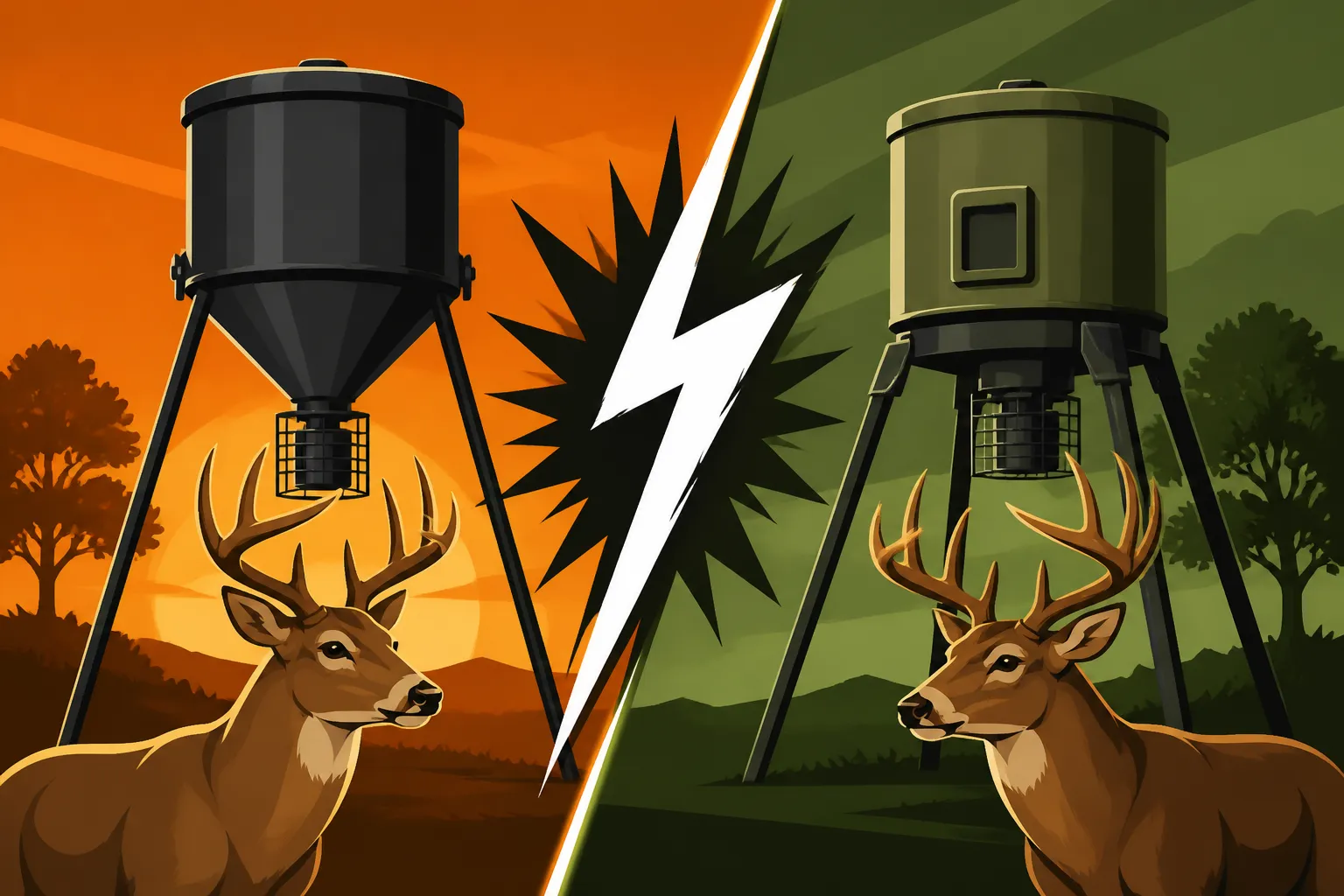
Now that we’ve looked at each brand individually, let’s put them head-to-head on some key metrics that matter most to Texas hunters. Deciding between Boss Buck and Moultrie often comes down to prioritizing either rugged, long-term durability with substantial capacity or technological convenience with a more budget-friendly approach.
Material Quality and Longevity
When it comes to raw material quality and expected longevity, Boss Buck generally takes the lead. Their use of thick, rotomolded polyethylene plastic is designed for extreme resilience. This isn't just a marketing claim; it's evident in the weight and feel of their feeders. They are built like tanks to withstand direct abuse from animals, prolonged sun exposure, and heavy winds. A Boss Buck feeder is an investment you expect to last for a decade or more with minimal fuss, assuming no major accidental damage.
Moultrie feeders, while durable in their own right, often use lighter-gauge plastics and more compact designs. This contributes to their lower price point and easier transportability. They are perfectly adequate for most hunting scenarios and will certainly last for many seasons. However, in environments with very aggressive feral hog populations or constant exposure to harsh elements, a Moultrie feeder might show signs of wear and tear, such as chewed feed ports or faded plastic, sooner than a Boss Buck. If maximum lifespan and resistance to physical abuse are your top priorities, Boss Buck has a distinct advantage here.
Ease of Setup and Maintenance
Moultrie typically excels in the ease of setup. Many of their feeders are designed for quick assembly, often featuring snap-together components or minimal hardware. This means less time struggling with instructions and more time getting your feeder deployed. Their control units are often pre-assembled and user-friendly, making timer programming straightforward. For hunters who value their time and want a hassle-free experience, Moultrie's plug-and-play approach is highly appealing.
Boss Buck feeders, given their robust construction, can sometimes be a bit more involved to assemble due to heavier components and more intricate designs, particularly with their larger models. However, once assembled, they tend to be very stable and require less frequent attention regarding structural integrity. In terms of maintenance, both brands benefit from regular cleaning and battery checks. Moultrie's cellular features can make remote monitoring of battery life and feed levels much easier, reducing the number of physical trips to the feeder, which is a significant maintenance advantage in itself.
Cost-Effectiveness Over Time
The initial cost of a Boss Buck feeder is typically higher than a comparable Moultrie model. However, when evaluating cost-effectiveness, it's crucial to consider the long-term picture. A Boss Buck, with its superior durability and resistance to wear and tear, might save you money in replacements, repairs, and lost feed over many years. If you plan to keep your feeder in the same harsh environment for a decade or more, the higher upfront cost could be justified by its extended lifespan.
Moultrie's lower initial price point makes them incredibly cost-effective for hunters on a tighter budget or those who might replace their feeders more frequently due to changing needs or technological upgrades. Their accessories, like solar panels and replacement parts, are also generally more affordable and widely available. For hunters who consider a feeder a shorter-term investment or who prioritize getting more units out for the same budget, Moultrie offers excellent value. When thinking about How High Should a Deer Feeder Be? to deter hogs, considering the cost of hog-resistant designs in either brand can impact long-term value.
Feature Sets and Advanced Options
This is where Moultrie truly shines for the tech-savvy hunter. Their Moultrie Mobile ecosystem, cellular connectivity, and remote management capabilities provide an unparalleled level of convenience and intelligence. Features like instant notifications, remote programming, and integrated cameras offer significant advantages for monitoring and managing your feeders and wildlife without stepping foot on the property. For many, this technological edge is a compelling reason to choose Moultrie.
Boss Buck, while offering reliable automatic timers and solar charging options, doesn't delve into the same level of integrated smart technology. Their strength lies in robust mechanical design rather than digital connectivity. However, Boss Buck's modular design allowing conversion between gravity and spin, and their extensive range of capacities for both corn and protein, offers a different kind of "advanced option" – the ability to highly customize your feeding strategy to specific nutritional goals, especially for serious protein feeding programs. For a dedicated Protein Feeding Deer for Bigger Antlers, Boss Buck's large gravity feeders are often preferred.
Here's a quick comparison table to summarize:
| Feature | Boss Buck | Moultrie |
|---|---|---|
| Construction Material | Heavy-duty, UV-stabilized polyethylene plastic | Lighter-gauge plastic |
| Durability | Excellent, built for extreme conditions | Good, suitable for most conditions |
| Capacity Options | Very wide range (150 lbs to 1200 lbs+), modular | Wide range (50 lbs to 300 lbs) |
| Feeder Types | Gravity (especially for protein), Automatic | Primarily Automatic, some gravity |
| Technology | Reliable digital timers, solar compatibility | Advanced cellular, remote programming, apps |
| Ease of Setup | Moderate to complex (due to heavier parts) | Easy, quick assembly |
| Price Point | Higher initial investment | More affordable, budget-friendly |
| Maintenance Needs | Low structural, regular battery/fill | Regular battery/fill, remote monitoring helps |
| Ideal User | Long-term managers, harsh environments, protein feeders | Tech-savvy, budget-conscious, remote monitoring |
Real-World Scenarios: Which Feeder Suits Your Texas Hunting Style?
The "best" feeder isn't universal; it's highly dependent on your specific hunting situation, land management goals, and budget. Let’s explore a few common scenarios in Texas and see which brand might be the better fit.
Long-Term Lease Operations
For those managing a hunting lease, especially a multi-year commitment in South Texas or the Hill Country where conditions can be brutal and hogs are rampant, Boss Buck feeders often prove to be a superior long-term investment. On a lease, you’re looking for equipment that can withstand sustained abuse, minimize maintenance headaches, and reliably deliver feed over many seasons without constant intervention. The robust construction of Boss Buck feeders means they can take a beating from the elements and persistent feral hogs, reducing the likelihood of costly repairs or complete feeder replacements.
Imagine running a protein feeding program year-round on a large lease. You need feeders with substantial capacity that can hold 600-1000 pounds of protein, reducing the frequency of refills. Boss Buck's large gravity feeders, specifically designed for protein, are ideal for this. Their hog-resistant ports and sturdy construction are invaluable when trying to keep expensive protein pellets reserved primarily for deer. While the initial outlay might be higher, the reduced downtime, minimal feed waste, and sheer durability make them a more cost-effective choice over the lifespan of a long-term lease. Furthermore, if you’re trying to implement an advanced management strategy, combining their durability with well-researched techniques for Where to Place a Deer Feeder for Best Results will yield significant benefits.
Day Hunters and Weekend Warriors
If you're a day hunter, maybe you only get out to your leased property on weekends, or perhaps you're hunting smaller, more accessible land. In these scenarios, Moultrie feeders often present a more practical and budget-friendly solution. Their ease of setup and lighter weight make them ideal for quick deployment and relocation, which can be useful if you're experimenting with different feeder locations. The lower price point means you can potentially acquire more feeders for different spots, enhancing your hunting opportunities without a massive financial commitment.
The real game-changer for weekend warriors is Moultrie's integrated technology, particularly Moultrie Mobile. Being able to check feed levels, battery status, and even trigger photos from your phone before you make the drive out saves immense time and fuel. There’s nothing worse than driving two hours to your lease only to find your feeder is empty or the battery is dead. Moultrie's remote monitoring eliminates much of that frustration, letting you maximize your limited hunting time. Plus, for those just getting into the swing of hunting over feeders, their intuitive timers are a blessing, simplifying the process of attracting deer for Best Time of Day to Hunt Whitetail in Texas.
The Serious Ranch Manager
For a serious ranch manager focused on maximizing herd health, antler quality, and overall property value, the choice might be a blend or a very specific selection. If the focus is heavily on year-round, high-volume protein supplementation and minimizing feed loss to non-target animals, then Boss Buck's large-capacity gravity protein feeders are hard to beat. Their reputation for being genuinely hog-resistant and built to endure means less time worrying about damaged feeders and more time on other management tasks. Ranch managers often run multiple feeders, and the long-term reliability of Boss Buck reduces the workload significantly.
However, a savvy ranch manager might also integrate Moultrie's cellular feeders, particularly for monitoring key areas, receiving alerts on game movement, or remotely adjusting feed schedules during specific periods like the rut. Imagine having 10 Boss Buck protein feeders across the ranch and a few strategically placed Moultrie cellular spin feeders or camera systems at critical pinch points. This hybrid approach leverages the best of both worlds: Boss Buck for robust, foundational feeding programs, and Moultrie for intelligent, remote surveillance and precise, flexible feeding for specific hunting periods. It's about optimizing efficiency and effectiveness across a diverse landscape. And for those deeply involved in conservation efforts, understanding specific regulations like Hunting Over Feeders & Corn in Texas (Legal Guide) is paramount.
Maximizing Your Feeder Investment
No matter which brand you choose, getting the most out of your deer feeder requires thoughtful planning and consistent effort. A feeder is just a tool; its effectiveness depends on how strategically you deploy and manage it.
Strategic Placement and Scent Control
Placement is paramount. Don’t just plop a feeder down anywhere. Observe natural travel corridors, bedding areas, and water sources. Placing a feeder near these natural features can significantly increase deer activity. Consider the wind direction; you don't want your scent blowing directly over the feeder where deer are likely to approach. Think about shooting lanes and where you or your hunters will be positioned. Often, positioning a feeder along a transitional edge — where thick cover meets open foraging areas — can be highly effective.
When you install or refill your feeder, practice good scent control. Wear clean clothes, gloves, and avoid touching the feeder or surrounding vegetation more than necessary. Deer have an incredible sense of smell, and leaving behind strong human odor can make them wary of the area around the feeder. Remember, the goal is to make the feeder area feel safe and inviting, not like a human intrusion. For more in-depth advice on this, check out Where to Place a Deer Feeder for Best Results.
Maintenance for Longevity
Regular maintenance will extend the life of any feeder, whether it's a Boss Buck or a Moultrie. This includes checking batteries frequently, especially with automatic feeders, and replacing them before they die. Solar panels are a fantastic investment for both brands to prolong battery life, but they still need to be cleaned periodically to ensure optimal charging. Inspect the motor, spinner plate, and timer unit for any debris, corrosion, or animal damage.
Keep the hopper clean and dry to prevent mold or clumping of feed, which can clog the feeder. If you’re feeding protein, ensure the pellets remain dry, as moisture can quickly ruin them. Check the legs and base for stability, especially after heavy rains or strong winds, as ground can soften or shift. Addressing small issues promptly can prevent them from becoming major, costly repairs down the road. Also, remember to take steps to How to Keep Hogs Out of Your Deer Feeder, as they can cause significant damage and waste.
Integrating Feeders with Trail Cameras
To truly maximize your feeder's potential, especially for hunting, integrate it with trail cameras. Both Boss Buck feeders and Moultrie feeders benefit immensely from camera surveillance. Cameras provide invaluable intelligence: they show you what deer are visiting, when they are visiting, and how many. This data helps you fine-tune your feeder settings, identify patterns, and plan your hunts. Brands like Spypoint and Tactacam offer excellent options for monitoring your feed sites.
For example, if your camera intel reveals that mature bucks are primarily visiting at night, you might adjust your feeding times to just before dawn or after dusk to align with legal hunting hours. Or, if a specific quality buck is regularly visiting, you can track its movements and approach patterns. Moultrie's cellular feeders, with their integrated cameras, take this a step further by providing real-time photo and video directly to your phone. However, even with non-cellular feeders, a separate trail camera setup is incredibly beneficial for understanding game behavior and optimizing your strategy. This data can inform your decision on the Best Corn for Deer Feeders in Texas or if you need to switch to protein.
Disclaimer
Please remember that hunting regulations, seasons, and licensing requirements in Texas are subject to change. Always consult the most current Texas Parks and Wildlife Department (TPWD) Outdoor Annual or their official website before engaging in any hunting activities. This guide is for informational purposes only and does not supersede state laws or regulations.