How to Hunt Mule Deer in the Panhandle
The vast, rugged landscapes of the Texas Panhandle can feel like a world away from the familiar brush country of South Texas, and mule deer hunting here presents its own unique set of challenges and rewards. It's a land of wide-open spaces, stark beauty, and deer that are truly a product of their environment—wary, tough, and often spread across immense distances. If you've been dreaming of chasing these magnificent animals in Texas's high plains and canyon lands, but aren't sure where to even begin with scouting, gear, or tactics, you're not alone. This comprehensive guide is designed to cut through the mystery, offering practical, boots-on-the-ground advice for successfully hunting mule deer in the challenging yet incredibly rewarding Texas Panhandle.
Understanding the Panhandle Mule Deer Habitat
Hunting mule deer in the Texas Panhandle isn't like hunting whitetails in a dense forest. Here, the landscape itself dictates everything, from where the deer live to how you'll need to hunt them. It's a vast region defined by dramatic changes in elevation, from flat agricultural fields to deep, carved canyons. Ignoring these nuances means you'll be spending a lot of time in the wrong places, scratching your head.
The Lay of the Land: Canyons, Mesas, and Breaks
When most people think of the Texas Panhandle, they picture endless flat plains. And while there's certainly plenty of that, the true gems for mule deer hunting lie in the intricate network of canyons, mesas, and river breaks that dissect this seemingly uniform terrain. Areas like the Palo Duro Canyon and Caprock Canyon are massive scars on the landscape, providing the cover, water, and varied forage that mule deer depend on. These aren't just pretty spots for tourists; they are critical sanctuaries and travel corridors for these animals. You'll find mule deer utilizing the steep, rocky slopes for bedding, especially on north-facing slopes for shade in warmer months and south-facing slopes for warmth in winter. The less dramatic "breaks" – eroded areas often bordering agricultural fields or rangeland – also offer excellent bedding and travel routes, even if they don't look as impressive as the major canyons. Learning to "read" these breaks and understand how deer move through them is crucial.
Vegetation and Food Sources
The sparse, often arid vegetation of the Panhandle might not look like much at first glance, but it provides a surprising variety of food for mule deer. They are browsers, and their diet here includes a mix of forbs, browse, and some grasses. Shin oak, mesquite, hackberry, and various kinds of sumac are vital browse species that offer both sustenance and cover. During different times of the year, they'll target specific forbs that emerge after rain, providing much-needed protein and moisture. Agriculture, particularly irrigated fields of wheat, corn, or milo, also plays a significant role, especially in late fall and winter. Mule deer will often travel considerable distances from their bedding cover in the breaks and canyons to feed in these fields under the cover of darkness. Understanding these seasonal food preferences and how they relate to available water and cover is key to patterning deer movements.
Water Sources and Their Importance
In a landscape as dry as the Texas Panhandle, water is an absolute lifeline, and it profoundly influences where mule deer live and travel. Natural springs, seepages along canyon walls, playas (ephemeral lakes that fill after rain), and stock tanks are all critical. While mule deer are incredibly adaptable to arid conditions and can get a lot of moisture from the plants they eat, they still need to drink, especially during hotter periods or when forage is dry. Hunting near reliable water sources can be incredibly productive, particularly during the early season or drought years. Keep an eye out for game trails leading to water, fresh tracks in the mud around tanks, and rub lines or scrapes near these vital areas. Don't underestimate the power of even a small, isolated seep in an otherwise dry drainage; it can be a magnet for deer.
Scouting Strategies for Panhandle Muleys
Scouting for mule deer in the vastness of the Panhandle can feel overwhelming, but it's arguably the most critical component of a successful hunt. These aren't deer you just stumble upon; you have to actively seek them out, often over immense distances. It requires a blend of modern technology and old-fashioned boots-on-the-ground effort.
Pre-Season Reconnaissance: Maps and Digital Tools
Before you ever set foot in the field, you should be spending hours behind a screen. Topographic maps are your best friend, allowing you to identify drainages, high points for glassing, potential bedding areas on steep slopes, and travel corridors between different features. Satellite imagery, available through apps like onX Hunt or HuntStand, takes this a step further, showing you actual vegetation, agricultural fields, and even faint game trails. Look for transitions in terrain, areas with denser cover, isolated pockets of browse, and the paths that connect them. Identify potential water sources, too. Mark promising spots on your digital map—potential glassing knobs, likely bedding areas, and pinch points where deer might be funneled. This digital scouting saves you countless hours of unproductive walking once you're on the ground. When it comes to understanding land boundaries, these apps are indispensable, especially when hunting public land or a large lease. For more detailed information, check out our guide on the Best Hunting Apps for Texas (onX, HuntStand & More).
Glassing Techniques for Vast Landscapes
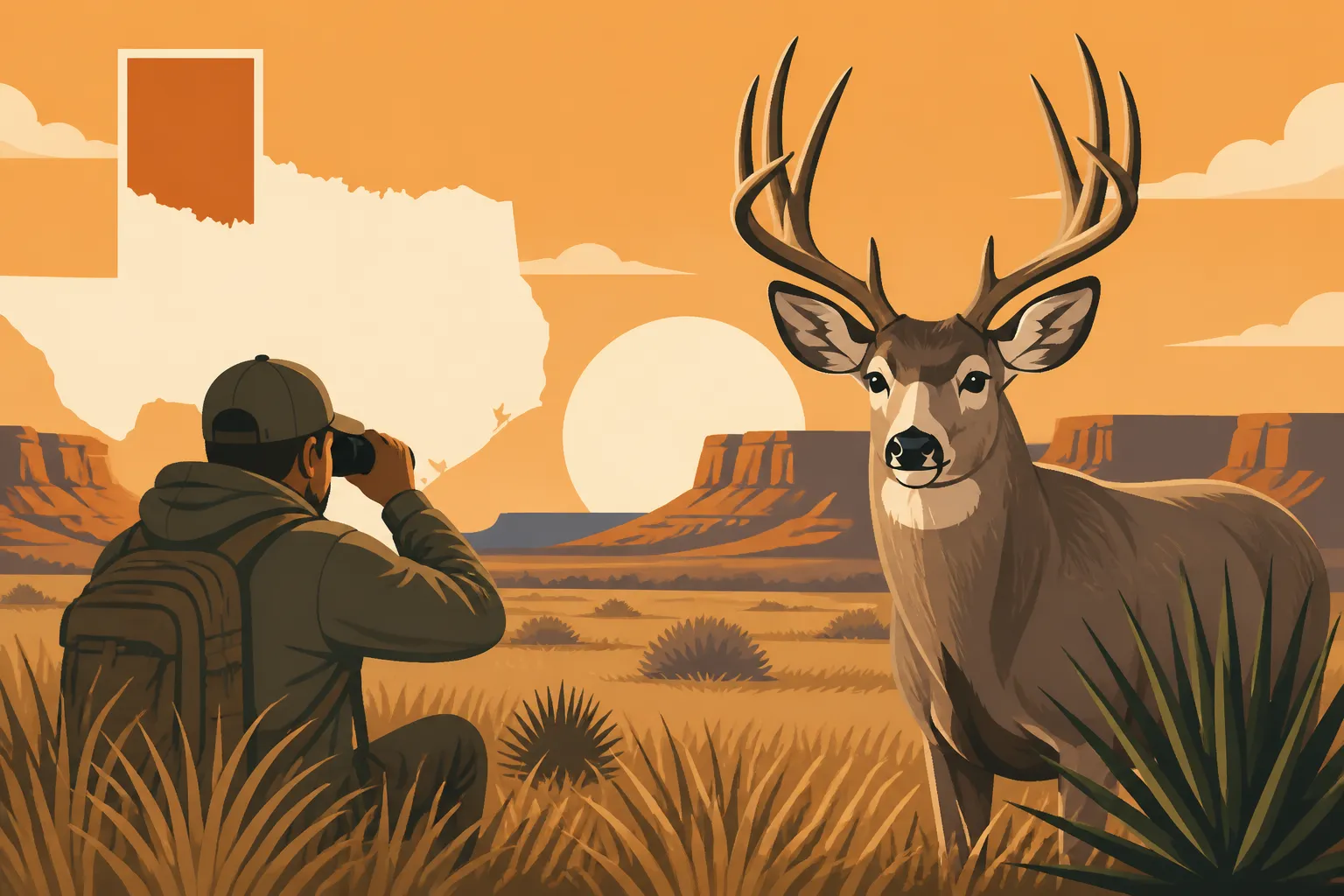
Once you're in the field, your binoculars and spotting scope are your most vital tools. Forget still-hunting through thick brush; this is a game of spotting deer from a distance. Invest in the best optics you can afford—10x or 12x binoculars are standard, but a high-quality spotting scope (20-60x or higher) on a sturdy tripod is non-negotiable for effectively picking apart distant hillsides. The key is patience and systematic scanning. Find a high vantage point that gives you a panoramic view of the canyons, breaks, and distant plains. Set up your spotting scope and slowly, methodically scan section by section, looking for any anomaly: a horizontal line in a vertical landscape, a flicker of movement, or the tell-tale ear or antler tines. Early mornings and late evenings are prime times, as deer are often moving between feeding and bedding areas. Don't just scan quickly; let your eyes linger, especially in shaded areas or against broken backgrounds. Mule deer are masters of camouflage, and what looks like a rock at first glance might just be a bedded buck.
Reading Sign: Tracks, Rubs, and Scrapes
Even though you'll be covering vast distances, paying attention to traditional deer sign remains important. Tracks can tell you a lot about the size of deer in an area and how recently they've passed through. Look for bigger, blunter tracks for mature bucks. Rubs—where bucks rub their antlers on small trees or shrubs—and scrapes—where they clear a patch of ground and urinate—are indicators of buck activity, especially as the rut approaches. In the Panhandle, you might not find the dense rub lines seen in forested areas, but isolated rubs on mesquite or shin oak can still signal a buck's presence. Scrapes might be less obvious in sandy or rocky soil but can still be found. Pay particular attention to these signs near water sources, travel corridors between bedding and feeding, and at the edges of cover. Fresh sign means you're in an active area, increasing your odds.
Essential Gear for Panhandle Mule Deer Hunting
Hunting mule deer in the Panhandle demands specific gear that can withstand the elements and help you cover ground efficiently. This isn't a casual stroll; it's a physically demanding hunt where the right equipment can make or break your experience.
Optics: Your Most Important Tool
As touched on in scouting, your optics are paramount. You simply cannot effectively hunt mule deer in this open country without quality glass. A pair of 10x or 12x binoculars are essential for initial scanning and getting a closer look. For serious long-distance spotting, a high-power spotting scope (20-60x or even 80x) mounted on a sturdy tripod is indispensable. This allows you to differentiate between a doe and a buck from miles away, or to evaluate a buck's antlers without spooking him. Rangefinders are also critical, not just for shot placement but for judging distances across vast, featureless terrain. The distances can be deceiving, and knowing the exact yardage will build confidence when it's time to take a shot.
| Gear Item | Recommended Specification | Purpose in Panhandle |
|---|---|---|
| Binoculars | 10×42 or 12×50 | General scanning, closer identification of deer |
| Spotting Scope | 20-60x80mm or higher | Detailed evaluation of distant animals, antler judging |
| Tripod | Lightweight, sturdy carbon fiber | Stable platform for spotting scope and binocular adapter |
| Rangefinder | Laser, accurate to 1000+ yards | Precise distance measurement for shot placement |
Rifles and Ammunition: Long-Range Considerations
The open nature of the Panhandle means that shots can often be at longer distances than what many whitetail hunters are accustomed to. While ethical hunting dictates knowing your limitations, being prepared for a 200-400 yard shot isn't uncommon. A flat-shooting caliber known for its accuracy and downrange energy is advisable. Popular choices include .270 Win, 7mm-08, .308 Win, 30-06, and various magnum cartridges like the 7mm Rem Mag or .300 Win Mag. More recently, cartridges like 6.5 Creedmoor have gained popularity for their precision. Focus on high-quality, bonded or monolithic bullets designed for controlled expansion and deep penetration at various ranges. Practice shooting from various field positions, including prone and using a bipod or shooting sticks, as bench rest shooting won't prepare you for real-world hunting scenarios in the field.
Footwear, Clothing, and Backpacks
Your feet will take a beating, so investing in comfortable, durable, and well-broken-in hiking boots is crucial. Look for boots with good ankle support for navigating uneven terrain and reliable traction. Waterproofing is a plus, especially if you might encounter wet conditions or dew-covered grass. The Panhandle weather can be notoriously unpredictable, swinging from bitter cold to mild, so layering your clothing is the smart move. Start with a moisture-wicking base layer, add insulating layers, and top with a quiet, windproof, and waterproof outer shell. Early season hunts might call for lighter, breathable camo. A reliable backpack is essential for carrying your water, snacks, extra layers, first-aid kit, game bags, and eventually, meat. Look for a pack with a good frame system that can comfortably carry a heavy load, as you might be packing out an entire mule deer over several miles.
Effective Hunting Tactics for the Texas Panhandle
Mule deer hunting in the Panhandle isn't about sitting in a blind over a feeder; it's a much more active and engaging pursuit. The vast, open terrain lends itself to one primary method: spot-and-stalk. Mastering this technique is the cornerstone of success here.
Spot-and-Stalk: The Primary Method
Spot-and-stalk is exactly what it sounds like: you use your optics to find a deer from a distance, then meticulously plan and execute an approach to get within shooting range. This is where all your scouting and gear choices truly pay off. Once you've spotted a potential target, the real work begins. You need to analyze the terrain, considering every rise, dip, and patch of cover. Most importantly, you need to understand the wind. Mule deer have incredible noses, and if they catch your scent, the game is over. Always approach from downwind or crosswind. Use the terrain to your advantage, staying low in drainages, behind ridges, or using sparse brush for concealment. It's a slow, deliberate chess match against a wary opponent. You might spend hours watching a deer, waiting for it to move into a more favorable position or for a cloud to obscure the sun, giving you a chance to close the distance. This style of hunting demands immense patience and discipline. For more general advice on this technique, you might find our guide on Spot-and-Stalk Hunting in Texas (Exotics & Mule Deer) helpful.
Using Natural Cover and Terrain
Unlike the dense cover often found in East Texas or the thick brush of the South, the Panhandle offers subtle, often sparse, cover. Learning to maximize it is crucial. A small rise, a shallow drainage, or even a few scattered mesquite bushes can be enough to break up your outline and allow you to advance. When stalking, always move with the terrain, not against it. If you need to cross an open area, time your movement with when the deer is feeding, has its head down, or is otherwise occupied. Sometimes, using an animal (like cattle or even other deer) as a "natural decoy" can help mask your movement, though this requires careful observation. The shadows cast by the sun, especially early and late in the day, can also be your friend, offering patches of darkness to move through undetected. It's all about minimizing your visual footprint and blending in with the environment.
Patience and Persistence
Mule deer hunting in the Panhandle is as much a mental game as it is a physical one. You will spend hours, perhaps days, glassing without seeing a single deer. You will make stalks that end in failure, with a spooked deer bounding over the horizon. The key is not to get discouraged. Every failed stalk is a learning experience. Analyze what went wrong: was it the wind? Your approach angle? Did you move too fast? Persistence is what separates successful hunters from those who go home empty-handed. Keep glassing, keep hiking, and keep believing that the next ridge will reveal the buck you've been searching for. The rewards—a mature mule deer buck earned through hard work and strategic hunting—are incredibly satisfying precisely because of the effort involved.
Navigating Regulations and Seasons
Understanding the rules and dates is non-negotiable for a legal and ethical mule deer hunt in the Texas Panhandle. Regulations can change, so always consult the most current Texas Parks and Wildlife Department (TPWD) Outdoor Annual before you head afield.
Texas Mule Deer Season Dates and Zones
Mule deer in Texas are primarily found in the Panhandle and Trans-Pecos regions. The season dates are usually quite specific to these areas and differ significantly from the statewide whitetail deer season. Generally, the Panhandle (often referred to as the Panhandle/Trans-Pecos or West Texas zone for mule deer) has a shorter season, typically running from mid-November through early December for firearms. Archery season usually precedes the general firearms season. It is vital to confirm the exact dates for the upcoming 2026-2027 season as they are officially released. These dates ensure you're hunting within legal timeframes and help you plan your trip effectively. For a broader overview of all hunting seasons, refer to the Texas Hunting Seasons: Complete Calendar by Species.
Permits, Tags, and Harvest Reporting
To hunt mule deer in Texas, you'll need a valid hunting license, typically the Super Combo or an equivalent license that covers resident or non-resident general hunting. In addition to your license, you'll need a valid deer tag. For mule deer, these tags are usually specific to the Panhandle/Trans-Pecos region and have specific bag limits. You must immediately tag your harvested animal and then report it to the TPWD within 24 hours via the My Texas Hunt Harvest app or website. This reporting is not just a formality; it provides crucial data for wildlife management. Make sure you understand the correct tagging and reporting procedures before you go, as mistakes can lead to fines. Our guide on Texas Hunting License: Cost, Types & How to Buy (2026) provides more details, as does Texas Hunting Tags & Harvest Reporting (My Texas Hunt Harvest).
Mule Deer Antler Restrictions
Texas has specific antler restrictions for mule deer designed to promote buck age structure. Unlike the "13-inch rule" for many whitetail counties, mule deer in the Panhandle/Trans-Pecos typically have a "20-inch rule," meaning a legal buck must have at least one unbranched antler, or an inside spread of 20 inches or greater. This regulation is critical to understand and apply accurately in the field. Judging antler spread at a distance can be challenging, but it's essential to avoid illegally harvesting a deer. Practice judging antler width on known animals or use rangefinding binoculars that can estimate width at distance. This rule helps ensure that younger bucks have a chance to mature and contribute to the herd's overall health and genetics. You can find specific details on Texas Mule Deer Antler Restrictions (20-Inch Rule) within our resource library.
Post-Harvest Considerations in the Panhandle
The shot is just the beginning of the work when you're hunting mule deer in the remote Panhandle. Field dressing, meat care, and transport are critical, especially given the challenging terrain and often warm Texas temperatures.
Field Dressing in Remote Areas
Once you've harvested a mule deer, the clock starts ticking, especially if temperatures are mild. Prompt and thorough field dressing is paramount to preserving the meat quality. In remote Panhandle areas, you're unlikely to have immediate access to a truck or processing facility. This means you'll need to be prepared to gut the animal where it falls. Carry a sharp, reliable hunting knife and, if possible, a bone saw or specialized gutting tool. Remove all internal organs, taking care not to puncture the stomach or intestines. You'll want to get the hide off as quickly as possible, too, as this significantly aids in cooling the carcass. Elevate the carcass if you can, allowing air to circulate around it. If you're planning a full pack-out, consider quartering the animal in the field. Our comprehensive guide on Field Dressing & Processing Game in Texas Heat offers detailed, step-by-step instructions that are highly relevant to this region.
Meat Care and Transport
Given the distances often involved in Panhandle hunts and the potential for warm weather, proper meat care is vital. After field dressing and skinning (if practical), the goal is to cool the meat down as rapidly as possible. If you've quartered the animal, place the quarters into breathable game bags. These bags protect the meat from flies and dirt while allowing air to circulate. If you have a substantial hike out, a sturdy pack frame designed for hauling meat will be your best friend. Once you reach your vehicle, immediately get the meat on ice in coolers. Don't let the meat sit in standing water; use ice packs or drain the coolers regularly. If you have a long drive home, ensure you have enough ice to keep the meat cold. Planning for this logistics aspect before the hunt will save you a lot of headache and potentially spoiled meat.
Respecting the Land and Other Hunters
Whether you're hunting on a private lease or public land, always practice ethical hunting and respect the environment and others. This means packing out everything you pack in—no trash left behind. If you're on public land, be mindful of other hunters, giving them ample space and avoiding interference. On private land, always respect property boundaries, gates, and the landowner's rules. Leaving the land better than you found it, adhering to all regulations, and treating your fellow outdoorsmen with courtesy helps ensure that the opportunity to hunt mule deer in the Texas Panhandle remains for future generations. It’s about more than just filling a tag; it’s about upholding the integrity of the sport.
Disclaimer
Please note that hunting regulations, season dates, and license requirements can change. Always consult the most current Texas Parks and Wildlife Department (TPWD) Outdoor Annual or official website for the most up-to-date and accurate information before planning your hunt. This guide is for informational purposes only and does not supersede official state regulations.