Sandhill Crane Decoy Setup in Texas
Chasing sandhill cranes in Texas can be one of the most exhilarating hunts, but few things are more frustrating than spending hours setting up a decoy spread only to watch birds flare at 100 yards, never committing. These majestic "ribeye of the sky" birds are incredibly intelligent and wary, making a well-executed decoy setup absolutely critical to success. This comprehensive guide will walk you through everything you need to know to create a convincing sandhill crane decoy spread that will bring these wary giants into shooting range consistently.
Understanding Sandhill Cranes in Texas
Hunting sandhill cranes in Texas isn't like chasing ducks or doves; these birds are in a league of their own. They possess an uncanny ability to spot anything out of place, making them a true challenge for even seasoned hunters. Before you even think about placing your first decoy, it's vital to understand what makes these birds tick.
Crane Behavior and Habitat Preferences
Sandhill cranes are long-distance travelers, and their behavior is heavily influenced by their migration patterns and feeding habits. In Texas, we primarily see the Lesser Sandhill Crane, which winters across much of the state, especially in the western and central regions. They are creatures of habit, often returning to the same fields day after day to feed, preferring agricultural fields like corn, milo, wheat, and even peanuts. They also gravitate towards shallow sheet water or isolated ponds where they can roost safely at night.
During the day, you'll find them in large, open fields, often mixed with other cranes, foraging for grain. They have excellent eyesight and will typically circle high above a potential feeding or resting area multiple times, scrutinizing every detail before committing to land. They feel safest in wide-open spaces where they can see predators coming from a mile away. This wariness is precisely why a convincing decoy spread, mimicking a relaxed, feeding flock, is paramount. Understanding their daily routines – when they leave roosts in the morning, where they feed throughout the day, and when they return to roosts in the evening – is the first step in successful hunting. For more general insights into crane hunting, check out our guide on Sandhill Crane Hunting in Texas (Ribeye in the Sky).
Why Decoys Are Crucial for Crane Hunting
Given their exceptional eyesight and cautious nature, decoys aren't just an option for sandhill cranes; they are a non-negotiable requirement. You simply won't consistently pull these birds into gun range without them. A well-placed spread acts as a visual magnet, signaling to passing cranes that the area is safe and productive. They're looking for signs of other cranes comfortably feeding, a clear indication that no danger lurks.
Imagine trying to call a flock of cranes into a barren field; it's like asking them to land in a parking lot. They'll pass right over, searching for the tell-tale signs of their own kind. The decoys essentially create a natural-looking "welcome mat" that overrides their inherent suspicion. Without a realistic spread, your calls, no matter how perfect, will likely fall on deaf ears or, worse, make them even warier. Decoys provide the visual confirmation that the area is secure, turning a high-flyer into a committed landing bird.
Essential Decoy Types for Sandhill Cranes
Just like with duck or dove hunting, there isn't a single "best" type of sandhill crane decoy; rather, it's about deploying a mix to achieve the most realistic effect. Each type serves a specific purpose, contributing to the overall illusion of a thriving, unthreatened flock.
Full-Bodied Decoys: Realism and Impact
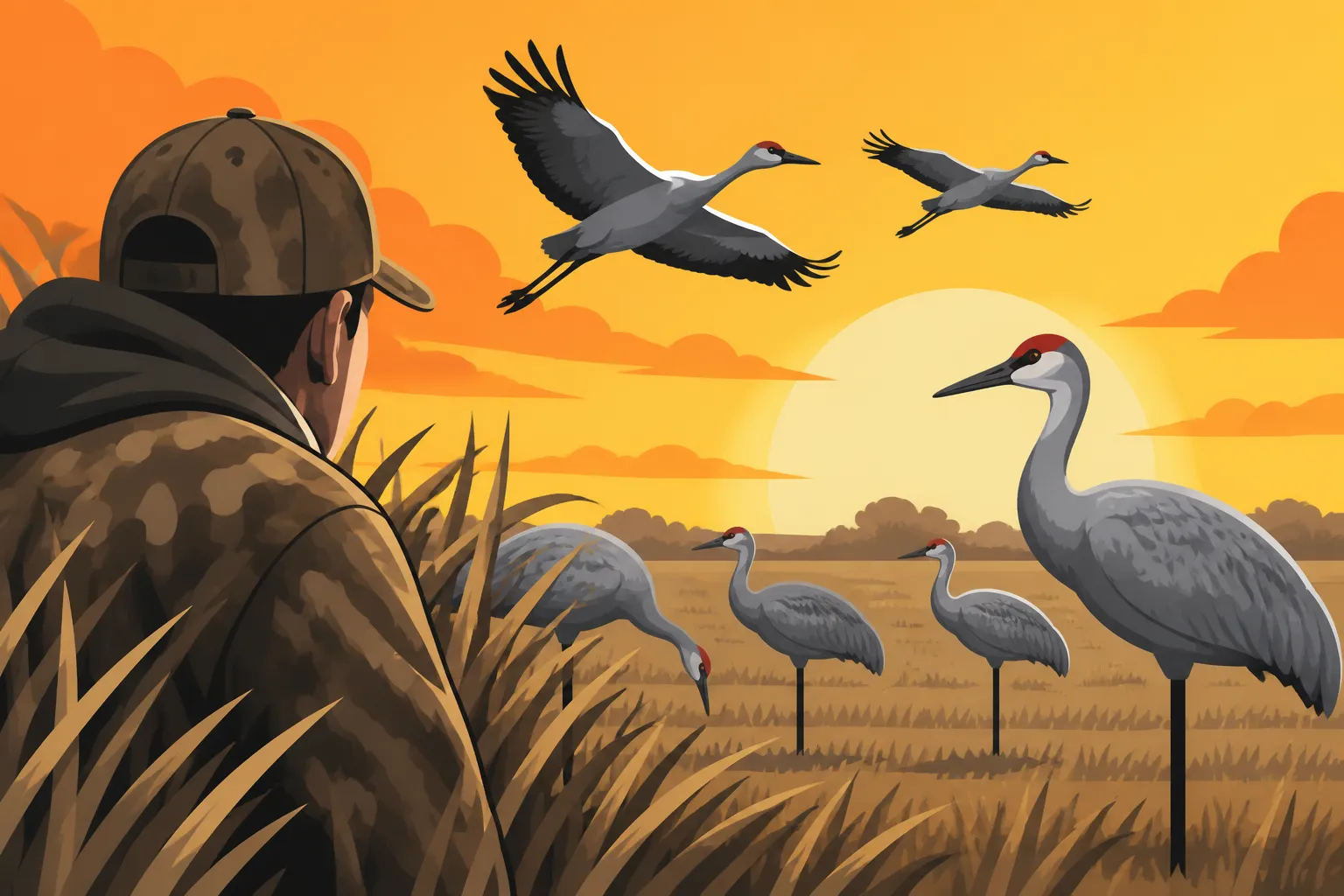
Full-bodied decoys are the workhorses of any serious crane spread. Their three-dimensional form, realistic paint schemes, and accurate postures give them an unparalleled level of realism. When cranes are circling overhead, these are the decoys that truly convince them. They provide the depth and natural appearance that silhouettes alone cannot.
Many hunters use a mix of feeding, sentry (upright), and resting postures to simulate a dynamic, natural flock. A feeding posture signals contentment and safety, while an upright sentry crane adds to the illusion that the flock is vigilant but not panicked. The sheer size of sandhill cranes means that even a small spread of full-bodied decoys can make a significant visual impact from a distance. Brands like Avian-X and Tanglefree offer highly detailed full-bodied crane decoys that are worth the investment for their ability to draw in the wary birds. While they can be cumbersome to transport and more expensive, their effectiveness in sealing the deal makes them indispensable, especially in areas with heavily pressured birds.
Silhouette Decoys: Portability and Numbers
Silhouette decoys, often made from corrugated plastic, are the unsung heroes for building out a large, convincing spread without breaking the bank or your back. While they lack the three-dimensionality of full-bodied decoys, they excel at creating the illusion of numbers, especially from a distance or when cranes are flying high. Their flat profile makes them incredibly lightweight and easy to carry, allowing you to deploy a significant number quickly.
The key to using silhouettes effectively is to have a lot of them. Cranes often gather in massive flocks, and a few full-bodies can look sparse without the bulk provided by silhouettes. They are perfect for extending the edges of your spread, making it appear much larger and more attractive. Mix up the postures even with silhouettes – some feeding, some standing – to enhance the realism. When placed correctly, especially perpendicular to the flight path, they catch the light and mimic the dark, distinct shape of a crane against the horizon, convincing passing birds that a large flock is on the ground.
Flyer Decoys and Motion Decoys: Adding Life to Your Spread
Once you have your static full-bodies and silhouettes in place, it's time to add movement. Nothing screams "realism" to a circling crane more than visible motion. This is where flyer decoys and motion decoys come into play. Flyer decoys, often lightweight full-bodies or silhouettes mounted on poles that can be swayed by hand or wind, simulate cranes landing or taking off. This motion is a powerful visual cue that tells incoming birds, "Others are already here and actively moving about."
Spinning wing decoys, while more common in duck hunting, can also be adapted for cranes, though giant flapping wing decoys specifically designed for cranes are often more effective. These battery-operated devices provide constant, realistic wing motion that is highly visible from a distance. They mimic the natural wing beat of a bird coming in for a landing, acting as a beacon for high-flying cranes. Whether it's a simple pole-mounted flag or a sophisticated spinning wing setup, adding motion breathes life into your spread, making it exponentially more believable and irresistible to sandhill cranes. Remember, the goal is to create a scene that looks as natural and bustling as possible.
Crafting Your Decoy Spread: Strategies and Formations
Setting up your decoys isn't just about throwing them out in a field; it's an art form based on understanding crane behavior. The formation, density, and placement of your decoys relative to your blind and the wind direction are all critical elements that dictate success.
The Feeding Flock: A Natural Attraction
The most effective sandhill crane decoy setup mimics a relaxed, feeding flock. This posture communicates safety and abundance to wary birds. Cranes spend a large portion of their day foraging, so presenting a spread that looks like a group happily chowing down is incredibly inviting.
Typically, you'll want to scatter your decoys in loose groups, avoiding perfectly straight lines or overly symmetrical patterns that look unnatural. Think of how real cranes spread out in a field – they move as a unit but maintain personal space, often in smaller family groups or loosely associated individuals. Place the majority of your full-bodied feeding decoys towards the center of your spread, creating the core attraction. Mix in a few upright, sentry-style decoys on the fringes to simulate alert birds, but don't overdo it, as too many sentries can signal alarm. The goal is to convey a sense of calm and routine. Remember that cranes will often feed into the wind, so consider this when placing your feeding birds to make the scene as authentic as possible. This approach is similar to how you might think about a good Dove Field Setup: Where to Stand to maximize your chances.
The Landing Zone: Giving Them a Place to Come In
Just as important as a realistic feeding flock is providing a clear, inviting landing zone. Cranes, especially large flocks, need ample space to touch down. If your decoys are too dense or spread out haphazardly, incoming birds won't have a natural path to glide in.
The ideal landing zone is typically a large "U" or "J" shape within your spread, or simply a wide, open pocket. This opening should be directly upwind from your blind. Cranes will almost always land into the wind, using it to slow their descent. If your blind is also positioned correctly relative to the wind, the incoming cranes will be flying directly towards you, offering prime shooting opportunities. The landing zone shouldn't be entirely empty; placing a few scattered, feeding decoys or even a pair of "flyer" decoys at the very back of the U can help guide their eyes and confidence without obstructing their flight path. The edges of your landing zone should be defined by your full-bodied and silhouette decoys, guiding the birds right where you want them.
Considering Wind Direction and Sun Position
Ignoring wind direction and sun position is a rookie mistake that can ruin an otherwise perfect spread. These two natural elements are non-negotiable considerations for any successful crane hunt.
Wind Direction: As mentioned, cranes always land and take off into the wind. Your blind should be placed downwind of your decoy spread, with your landing zone upwind, ensuring that incoming birds present broadside or slightly angled shots as they cup their wings to descend. This also means that if the wind shifts, you might need to quickly adjust your blind and spread. Always keep an eye on the forecast, but be prepared for unexpected changes.
Sun Position: The sun can be your best friend or worst enemy. Positioning the sun at your back means that incoming cranes will be looking directly into it as they approach your spread and blind. This makes it incredibly difficult for them to see your concealment and gives you a significant advantage. If the sun is in front of you, it can cast harsh shadows on your blind, making it more visible, and will make it harder for you to see the incoming birds clearly. Always scout your location with the sun's path in mind, aiming to have it at your back during the prime hunting hours.
| Decoy Type | Pros | Cons | Best Use |
|---|---|---|---|
| Full-Bodied | Highly realistic, great visual impact | Expensive, bulky, heavier | Core of your spread, primary attraction points |
| Silhouette | Lightweight, portable, affordable | Less realistic up close, two-dimensional | Building numbers, extending edges of spread |
| Flyer/Motion | Adds crucial movement, highly visible | Can be mechanical, requires batteries/manual | Landing zones, drawing distant attention |
Setting Up Your Blind and Calling Tactics
Even the most perfect decoy spread can be undermined by poor concealment or ineffective calling. Once your decoys are strategically placed, your attention must turn to disappearing into the landscape and communicating with the cranes.
Blending In: Choosing the Right Blind
Sandhill cranes have eyesight that rivals a hawk's, meaning your blind needs to be virtually invisible. A popup blind in the middle of a sparse field will get you busted every time. Instead, think about natural concealment. If you're hunting in a cut grain field, a layout blind covered heavily with stubble from the surrounding field is often the most effective. These blinds allow you to lie flat, breaking up your outline against the ground. Ensure that the blind material matches the natural vegetation perfectly.
For fields with taller cover, like standing wheat or taller weeds, a natural brush blind constructed from local materials can work wonders. The key is to make it look like just another part of the environment, not a foreign object. Avoid bright colors, reflective surfaces, or anything that stands out. Remember to trim any vegetation that might block your line of sight for shooting, but do so subtly. A common mistake is to over-trim, making the blind appear too "clean" and unnatural. The birds are looking for anything out of place, so meticulous attention to detail in concealment is paramount. If you're setting up a box blind over a feeder for deer, for instance, you'd apply the same principles of blending into the surroundings.
Mastering the Call: Attracting Cranes to Your Spread
Calling sandhill cranes is an art, not a science, and it takes practice to get it right. Crane calls are distinctive and can carry over long distances. Most hunters use either mouth calls or electronic calls. The primary goal of calling is to replicate the contented chatter of a feeding flock or the distinct "garoo" call of a flying crane.
When cranes are distant, a louder, more drawn-out "garoo-garoo" can grab their attention. As they get closer and begin to circle, transition to softer, more contented clucks and purrs, mimicking a flock happily feeding. This tells them, "Everything is good here, come on down!" It's crucial to listen to the birds and respond accordingly. If they seem hesitant, back off the calling; if they seem interested, give them a little more encouragement. Too much aggressive calling can sometimes spook them. There are many excellent Best Game Calls for Texas Hunting available, but practice is what truly makes the difference. Learning to properly use your call, understanding the different crane vocalizations, and knowing when to call and when to remain silent will significantly increase your success rate.
Advanced Decoy Setup Tips and Common Mistakes
Even with the best gear and a basic understanding, there are always ways to refine your approach and pitfalls to avoid when setting up for sandhill cranes. These advanced tips can make the difference between a good hunt and a truly exceptional one.
Scouting and Adaptability: The Key to Success
The single most critical factor for consistent sandhill crane hunting success is thorough and continuous scouting. You can have the most expensive decoys and the best calls, but if you're not where the birds want to be, it's all for naught. Cranes are habitual, but their habits can change based on food availability, weather, and hunting pressure.
Spend time driving rural roads, watching where cranes are feeding and roosting. Identify their flight paths between these locations. Pay attention to the exact type of field they prefer on a given day – sometimes it's corn stubble, other times it's freshly planted wheat. Once you've identified a hot field, observe which parts of the field they prefer to use. Are they closer to a tree line, or out in the wide open? Are they near a water source? This information will dictate your decoy placement and blind location. Be ready to move your entire setup if the birds shift their patterns or if an unexpected wind change renders your initial setup ineffective. Adaptability, informed by diligent scouting, is the hallmark of a successful crane hunter. These scouting principles are just as important as when you're trying to How to Scout for Deer Before Season in Texas.
Avoiding Common Decoy Setup Errors
Several common mistakes can quickly doom a crane hunt, even for experienced hunters. Being aware of these can save you a lot of frustration.
First, not enough decoys. Cranes are social birds and feel safer in numbers. A sparse spread looks unnatural and signals vulnerability. Aim for a minimum of 2-3 dozen decoys, but more is always better if you can manage it.
Second, unnatural patterns. Avoid perfectly spaced, grid-like formations. Real birds feed in loose, irregular groups. Randomness looks natural.
Third, poor blind concealment. Any exposed skin, bright clothing, or an improperly brushed blind will be instantly spotted by overhead cranes. Ensure you and your hunting partners are completely concealed.
Fourth, ignoring the wind. We've discussed this, but it bears repeating. Cranes will land into the wind. If your spread isn't set up for this, they'll land awkwardly or simply pass by.
Fifth, using dirty or damaged decoys. Fading paint, broken stakes, or unnatural sheen can all be red flags to wary birds. Keep your decoys clean and in good repair.
Finally, static spreads with no motion. The lack of movement makes the spread look lifeless. Even a simple flag can make a huge difference in drawing attention.
Legalities and Regulations for Sandhill Crane Hunting in Texas
Before you even step foot in a field with a crane decoy, it's absolutely essential to be well-versed in the specific regulations governing sandhill crane hunting in Texas. These migratory birds are subject to federal and state laws, and violations can carry hefty penalties.
Permits, Seasons, and Bag Limits
In Texas, hunting sandhill cranes requires more than just a standard hunting license. You'll also need a Texas hunting license, a migratory game bird endorsement, and most importantly, a free federal sandhill crane permit. This permit is crucial and must be obtained before you go hunting. You can usually get this permit online through the Texas Parks and Wildlife Department (TPWD) website or wherever hunting licenses are sold. This is in addition to the mandatory HIP (Harvest Information Program) certification required for all migratory bird hunters. Make sure you understand all the requirements for a Texas Migratory Bird Endorsement & HIP Certification.
Sandhill crane seasons in Texas are divided into three zones (Zone A, B, and C), with different dates and bag limits for each. Zone A generally has the earliest season, often starting in late October or early November, while Zones B and C typically open later. It's vital to consult the current year's Outdoor Annual or the TPWD website for the exact dates for the zone you plan to hunt, as these can change annually. Bag limits usually range from 2 to 3 birds per day, with possession limits typically twice the daily bag. Always confirm the current Texas Sandhill Crane Season & Free Permit before your hunt.
Understanding Equipment Restrictions
There are also specific equipment restrictions to be aware of when hunting sandhill cranes in Texas. Like most migratory birds, shotguns must be plugged to limit their capacity to no more than three shells (one in the chamber, two in the magazine). This is a federal regulation that applies to all migratory game bird hunting.
The use of electronic calls is generally allowed for sandhill cranes in Texas, unlike for some other migratory species like waterfowl. This can be a huge advantage for hunters, especially those new to crane calling, as it allows for realistic and consistent sounds. However, always double-check the latest regulations in the Outdoor Annual, as rules can occasionally change. It’s also important to remember that hunting from a motorized vehicle is generally prohibited, as is the use of baiting (placing feed specifically to attract birds). Ensure your hunting practices adhere to all state and federal guidelines to avoid any legal issues.
Disclaimer
Please note that hunting regulations, seasons, and licensing requirements can change. Always consult the most current Texas Parks and Wildlife Department Outdoor Annual or their official website for the definitive and most up-to-date information before planning your hunt. This guide is for informational purposes only and does not constitute legal advice.