Pulsar vs AGM Thermal Scopes for Hogs
Hunting feral hogs in Texas can feel like a never-ending battle, especially when they’re wreaking havoc on your property or lease. These notoriously intelligent and nocturnal creatures often move under the cover of darkness, making traditional hunting methods incredibly challenging. That's where thermal scopes come into play, offering a revolutionary edge. This guide will take a deep dive into two of the most popular thermal scope brands on the market, Pulsar and AGM, helping you understand their strengths and weaknesses so you can make an informed decision for your next hog hunt.
The Challenge of Hog Hunting in Texas and the Thermal Solution
Texas is home to an estimated 3.4 million feral hogs, and they’re not just a nuisance; they’re an ecological and agricultural disaster. They destroy crops, damage land, and outcompete native wildlife for resources. Traditional hunting methods during daylight hours often only scratch the surface of the problem, as these animals quickly adapt to pressure and become almost entirely nocturnal. This is where the right gear, specifically thermal optics, truly shines.
Why Thermal is a Game-Changer for Feral Hogs
Imagine trying to spot a black hog in a dark field or dense South Texas brush under the cloak of night. It’s nearly impossible with conventional optics or even night vision, which still requires some ambient light. Thermal scopes, however, don't rely on visible light at all. Instead, they detect the heat signatures emitted by animals, even in complete darkness, fog, or light cover. This ability to "see" heat allows you to locate hogs that would otherwise be invisible, giving you a significant advantage. This technology has become so critical that many hunters now consider it essential for effective hog control. If you're wondering, "Is Thermal Hunting Legal in Texas?", the answer is a resounding yes, and it's highly encouraged by the state due to the hog problem. Many hunters are turning to "How to Hunt Hogs at Night With Thermal" as their primary method.
Key Considerations for a Texas Thermal Scope
When you're out in the diverse landscapes of Texas, from the wide-open plains of the Panhandle to the dense brush country of the South, your thermal scope needs to perform under various conditions. A few critical factors should always be on your mind:
- Detection Range: How far out can the scope pick up a heat signature? For open fields, longer range is crucial.
- Identification Range: Can you not only detect a heat source but also clearly identify it as a hog (and not, say, a deer or a javelina)? This requires good resolution and image processing.
- Image Quality: A clearer, crisper image makes target acquisition and shot placement much easier, especially when you're dealing with moving targets or trying to differentiate between multiple animals.
- Battery Life: Texas hunts can be long. You don't want your thermal scope dying on you when the action starts. External battery options or long internal battery life are a huge plus.
- Durability and Weather Resistance: Texas weather can be unpredictable. Your scope needs to withstand dust, humidity, and the occasional downpour without skipping a beat.
- Ease of Use: In the heat of the moment, you need to be able to operate your scope instinctively. A user-friendly interface is vital.
Considering these points will help you narrow down your choices when looking at premium options like Pulsar or more budget-friendly yet capable alternatives like AGM.
Deep Dive into Pulsar Thermal Scopes
Pulsar has carved out a reputation as a premium brand in the thermal optics world. They’re known for pushing the boundaries of technology, often incorporating cutting-edge sensors and software into their devices. For many serious hog hunters, Pulsar represents the pinnacle of performance, offering features that can significantly enhance your night hunting success.
Pulsar's Reputation and Core Strengths
When you talk about Pulsar, the first thing that often comes to mind is superior image quality. Their thermal scopes, like the popular Thermion and Talion series, consistently deliver some of the clearest, most detailed thermal images available on the market. This clarity isn't just a luxury; it's a practical advantage. Being able to discern anatomical details on a hog at extended ranges means more confident shot placement and fewer wounded animals. Imagine being able to clearly see the outline of a hog's shoulder through thick brush – that’s the kind of detail Pulsar aims to provide.
Beyond image quality, Pulsar scopes are celebrated for their advanced features. We’re talking about high-resolution sensors, powerful germanium lenses, and sophisticated image processing algorithms that work tirelessly to present you with a crisp, fluid picture. Their digital zoom capabilities are often very refined, maintaining usable image quality even at higher magnifications, which is a common pitfall for many thermal devices. Hunters often refer to "Pulsar Thermion 2 Thermal Scope Review" articles to truly appreciate the depth of features offered. The robust build quality of Pulsar devices is another major selling point. They are built to withstand the rigors of the field, from accidental bumps to harsh weather conditions, ensuring reliability when you need it most.
Noteworthy Features for Texas Hog Hunters
For a Texas hog hunter, several Pulsar features truly stand out. Their industry-leading NETD (Noise Equivalent Temperature Difference) values, often below 25mK, mean their sensors are incredibly sensitive to minute temperature differences. This translates directly to better detection and identification, especially in environments where heat signatures might be partially obscured or when you’re dealing with small temperature contrasts, like a hog partially hidden in tall grass on a cool night.
The battery systems in Pulsar scopes are also noteworthy. Many models feature dual battery systems (internal and external) or quick-change battery packs, offering extended runtimes that can easily cover an all-night hog hunt. The Pulsar Thermion 2, for instance, integrates an internal battery with an external, interchangeable one, giving you hours of uninterrupted operation. This is a huge relief when you're deep in the brush and don't want to fumble with battery changes.
Furthermore, Pulsar's user interfaces are generally intuitive and well-designed, allowing for quick access to essential functions like various color palettes (black hot, white hot, rainbow, sepia, etc.), digital zoom, and video recording. Being able to switch thermal palettes on the fly can make a huge difference in different conditions, highlighting hogs more effectively against varying backgrounds. Recording your hunts directly onto the device, sometimes with sound, means you can review your shots, share your adventures, and even help verify your success. For those looking to upgrade their arsenal, understanding the capabilities of a Pulsar Thermion 2 Thermal Scope Review can be incredibly helpful.
Exploring AGM Thermal Scopes
AGM Global Vision has emerged as a formidable contender in the thermal optics market, particularly for hunters who demand robust performance without breaking the bank. While Pulsar often sits at the premium end, AGM aims to provide accessible yet highly capable thermal solutions that get the job done efficiently, making them a popular choice for many Texas hog hunters.
AGM's Value Proposition and Ruggedness
AGM scopes, like their popular Rattler and Adder series, are known for striking an excellent balance between cost and performance. They democratize thermal hunting by offering dependable technology at a price point that's more attainable for a wider range of hunters. This isn’t to say they skimp on quality; rather, AGM focuses on practical features and rugged construction, ensuring their devices can stand up to the challenging Texas environment.
The "value proposition" of AGM thermal scopes lies in their ability to provide clear detection and reliable performance without unnecessary bells and whistles that might drive up the price. They are often praised for their straightforward operation and durability. Many AGM units are built with tough, impact-resistant housing, often meeting IP67 waterproofing standards, meaning they can handle dust, moisture, and even a brief dunk in water – crucial for those unpredictable Texas weather swings. Hunters often seek out an "AGM Rattler V2 Thermal Scope Review" to get a sense of its robust capabilities. These scopes are designed to be tools that perform consistently, rather than fragile pieces of high-tech equipment.
Practical Advantages for Texas Conditions
For hunters tackling the vast, varied terrain of Texas, AGM thermal scopes offer several practical advantages. Their ease of use is a major plus; the controls are typically intuitive, allowing hunters to quickly learn the ropes and focus on the hunt rather than fiddling with settings. When you're trying to quickly acquire a group of hogs moving through dense brush or an open field, simple, responsive controls are invaluable.
Battery solutions in AGM scopes are also geared for extended use. While some models might rely on standard CR123A batteries, many also offer compatibility with rechargeable 18650 batteries or even integrated, long-lasting battery packs like the Adder series, which boasts up to 15 hours of continuous operation. This kind of battery life is a massive benefit for all-night hunts, minimizing the need to carry bulky external power banks. If you're comparing thermal options, diving into an "AGM Rattler V2 Thermal Scope Review" can provide valuable insights into its real-world performance.
The ruggedness of AGM scopes makes them an ideal choice for the realities of hunting in Texas. From navigating thorny mesquite to trudging through muddy fields, your gear takes a beating. AGM's robust construction means you can have confidence that your scope will continue to function reliably, even after being subjected to the bumps and scrapes that are part and parcel of a demanding hog hunt. These scopes provide the necessary capabilities for effective hog control without requiring a second mortgage, making them a popular option for those committed to reducing the feral hog population.
Head-to-Head Comparison: Pulsar vs. AGM
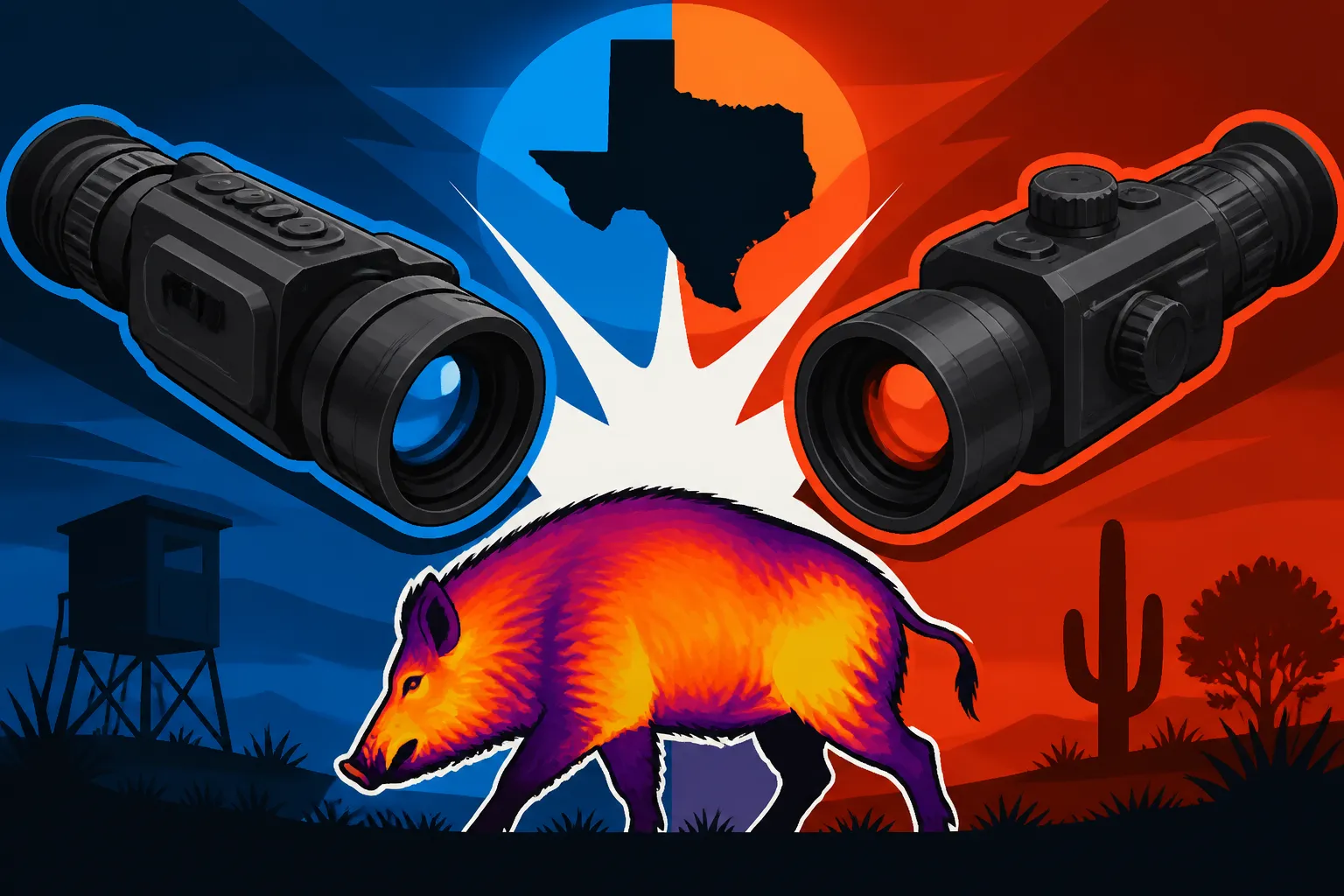
Choosing between Pulsar and AGM can feel like a classic dilemma: do you invest in the premium, feature-rich option, or go with a dependable, cost-effective workhorse? Both brands offer excellent thermal scopes, but they cater to slightly different needs and budgets. Let's break down where they shine and where one might have an edge over the other.
Image Quality and Detection Range
When it comes to raw image quality and the ability to detect and identify targets at long ranges, Pulsar generally holds an edge. Their higher-resolution sensors (often 640×480 or even 1024×768 pixels) combined with lower NETD values and sophisticated image processing software deliver a noticeably clearer, more detailed picture. This means you can often detect a hog at 2,000 yards and confidently identify it at 500-800 yards, depending on the model and conditions. For discerning hunters who operate in vast open areas like the Texas Panhandle or need precise identification in thick brush, this can be a significant advantage.
AGM, while still offering very capable thermal imaging, typically sits a step below Pulsar in this specific area. Their more popular models often feature 384×288 resolution sensors, which are excellent for detection out to 1,500 yards and identification in the 200-400 yard range. For the majority of hog hunting scenarios, especially those at typical shooting distances on a Texas Hunting Lease vs Buying Hunting Land or over a feeder, this level of performance is more than adequate. If you’re hunting in dense cover where shots are usually under 150 yards, the difference in extreme long-range identification might be less critical.
Features, User Experience, and Durability
Pulsar scopes are packed with advanced features. You'll find things like built-in laser rangefinders, ballistic calculators, Wi-Fi connectivity for streaming to a phone, customizable reticles, and multiple observation modes. Their user interfaces are often highly customizable, allowing you to fine-tune settings to your exact preferences. While impressive, this suite of features can sometimes lead to a slightly steeper learning curve for new users. Pulsar's durability is excellent, typically featuring magnesium alloy housings and high shock resistance, designed for professional use.
AGM, on the other hand, often focuses on a more streamlined, user-friendly experience. Their menus are generally simpler to navigate, and the controls are intuitive. While they might not have every cutting-edge feature found in a Pulsar, they provide all the essentials for effective thermal hunting: multiple color palettes, digital zoom, and video recording. Their durability is also a strong suit, with robust, often rubberized housings that can take a beating in the field. They might not boast the same luxurious feel as some Pulsar models, but they are built for hard work, making them ideal for the rugged demands of Best Gear for Feral Hog Hunting in Texas.
Price Point and Value for Money
This is where the distinction between the two brands becomes most apparent. Pulsar operates at the premium end of the market. You can expect to pay anywhere from $2,500 to $6,000+ for their higher-end thermal rifle scopes. This price reflects their superior image quality, advanced features, and cutting-edge technology. For hunters who demand the absolute best performance and have the budget for it, Pulsar is a top-tier choice.
AGM shines in the value-for-money category. Their popular thermal rifle scopes typically range from $1,500 to $3,500, making them significantly more accessible. For this price, you get a highly capable thermal device that will reliably detect and allow you to take down hogs. For many hunters, especially those just getting into thermal or those who don't need extreme long-range identification, AGM offers an unbeatable performance-to-cost ratio. If you're on a budget and looking for the "Best Budget Thermal Scope Under $2000", AGM frequently offers compelling options.
Here's a quick comparison table to help visualize the differences:
| Feature | Pulsar Thermal Scopes | AGM Thermal Scopes |
|---|---|---|
| Image Quality | Excellent (higher resolution, lower NETD) | Good (solid resolution, higher NETD than Pulsar) |
| Detection/ID Range | Superior (longer detection, clearer identification) | Very Good (reliable detection, good identification) |
| Advanced Features | Extensive (LRF, ballistic, Wi-Fi, custom UI) | Practical (core palettes, zoom, recording) |
| User Experience | Feature-rich, customizable (some learning curve) | Straightforward, intuitive (easier for beginners) |
| Durability | Excellent (premium materials, high shock resistance) | Very Good (rugged, impact-resistant, weather-sealed) |
| Price Point | Premium ($2,500 – $6,000+) | Mid-range ($1,500 – $3,500) |
| Typical Use Case | Professional, long-range, high-demand, tech-savvy | Enthusiast, mid-range, value-focused, reliable |
Making Your Choice: Which Thermal Scope is Right for You?
Deciding between a Pulsar and an AGM thermal scope ultimately comes down to a few personal factors: your budget, your specific hunting style, and what features you prioritize. Both brands will undoubtedly help you manage the feral hog population on your property, but one might simply be a better fit for your individual needs.
Budget and Hunting Style
Let's be real, budget is often the biggest factor. If you have a generous budget and you're looking for the absolute best thermal performance, longest detection range, and all the bells and whistles, then a high-end Pulsar like the Thermion 2 XP50 Pro is probably going to be your dream scope. It’s ideal for hunters who frequent vast, open tracts of land in West Texas or the Panhandle, where spotting and identifying hogs at extreme distances is a regular occurrence, or for those who plan to use it intensively for professional hog eradication. For those serious about improving their success, checking out Best Thermal Scopes for Hog Hunting in Texas can further refine your choice.
However, if you're like many Texas hunters, you might be looking for a fantastic thermal scope that delivers excellent performance without requiring you to sell a kidney. This is where AGM truly shines. An AGM Rattler TS35-384 or an Adder TS50-384 will give you exceptional capabilities for most hog hunting scenarios, especially in the denser brush country of South Texas or the Post Oak Savannah, where typical shooting distances are shorter. For hunters who mainly hunt over feeders, knowing the Best Setup for Hunting Hogs Over a Feeder, an AGM thermal scope will absolutely get the job done. It's also a great entry point for those new to thermal hunting, offering reliable performance with a simpler interface. Many Texas outfitters even equip their clients with AGM scopes for guided night hunts, proving their effectiveness.
Consider your primary hunting locations. Are you in a wide-open field where maximum identification range is paramount? Pulsar might be worth the investment. Are you navigating dense mesquite and cedar, where quick target acquisition at closer ranges is more important than extreme distance? An AGM will likely serve you just as well, if not better, given its robust build and user-friendly interface for dynamic situations. It's worth noting that even platforms like GoHunt often feature forums and user reviews that can provide real-world insights into how these scopes perform in various Texas environments.
Essential Accessories and Setup Tips
Once you've made your choice, remember that the scope is just one part of the equation. Having the right accessories and knowing how to set up your thermal effectively can drastically improve your success.
- Mounts: A solid, repeatable mount is critical. Whether you're using a quick-detach (QD) mount for swapping between rifles or a fixed mount, ensure it's robust and holds zero. Brands like ADM or LaRue Tactical offer excellent QD mounts that hold up to heavy recoil.
- External Battery Packs: Even with good internal battery life, an external battery pack can be a lifesaver on extended hunts. Many scopes can be powered via USB-C, so a small power bank is a smart addition.
- Zeroing: Take the time to properly zero your thermal scope during daylight using a thermal target. This might seem obvious, but proper zeroing ensures your shots go where you intend them to.
- Recording: If your scope has recording capabilities, invest in a good quality micro SD card. Capturing your hunts is not only fun for sharing but can also be valuable for reviewing your shots and improving your technique.
- Cleaning Kit: Keep your thermal lens clean. Dust, fingerprints, and smudges can significantly degrade image quality. Use proper lens cleaning solutions and cloths.
Ultimately, both Pulsar and AGM offer excellent tools for the dedicated hog hunter in Texas. Your ideal choice will align with your hunting style, budget, and desired level of technological sophistication. Researching specific models, reading comprehensive reviews, and perhaps even visiting a local sporting goods store to handle both brands can really help cement your decision. You might even find useful community discussions and gear comparisons on resources like GoHunt that cater to the Texas hunting community.
Disclaimer
Hunting is an inherently dangerous activity. Always prioritize safety, understand and follow all local, state, and federal hunting regulations, and ensure you have the appropriate licenses and permits. The information provided in this guide is for informational purposes only and should not be considered a substitute for professional instruction or official regulations.