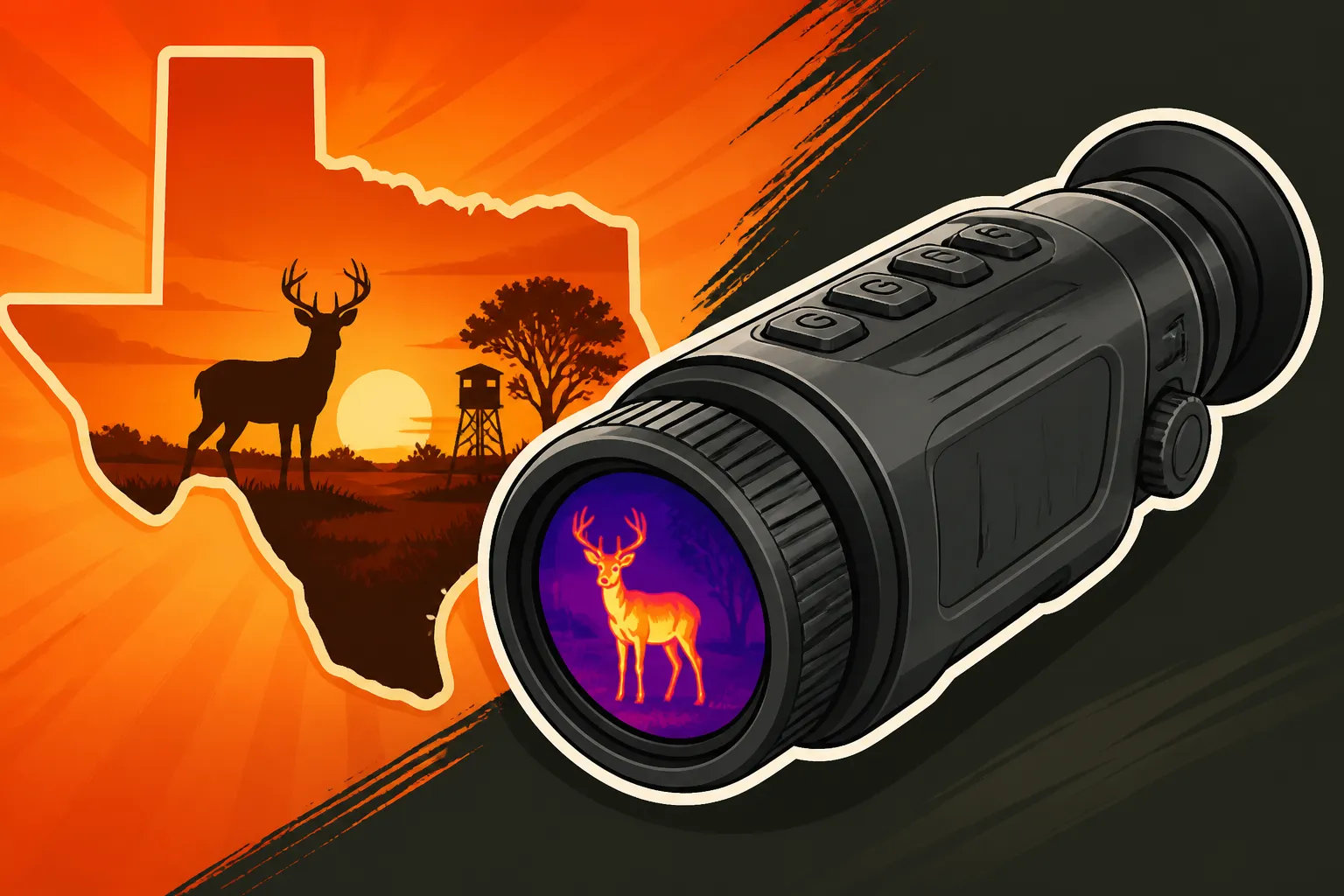
Best Thermal Monocular Under $1500
Hunting in Texas, especially for those elusive hogs and predators under the cover of darkness, can feel like you're constantly fighting against the unknown. You know thermal technology is a game-changer, offering an unparalleled advantage for spotting, tracking, and recovery, but the price tags on some units can feel like they're designed for astronauts, not avid hunters. This guide is here to cut through the confusion and show you that you don't need to empty your bank account to get a high-performing thermal monocular that truly makes a difference in the Texas brush, focusing on excellent options available for under $1500.
Why a Thermal Monocular is a Game Changer for Texas Hunters
Let's be real, a good chunk of what we hunt in Texas — think feral hogs, coyotes, and other varmints — are most active when the sun goes down or in dense cover where traditional optics just can't cut it. Thermal monoculars don't rely on light; they detect heat signatures, essentially painting a picture of warmth against a cooler background. This gives you a massive advantage, transforming frustrating hunts into successful outings and making you a more efficient hunter, day or night.
Unveiling the Night: Spotting Hogs and Predators
Trying to spot a black hog in a dark pasture or a coyote slipping through dense mesquite at midnight with a regular pair of binoculars or even night vision can be like trying to find a needle in a haystack. The thermal monocular changes that entirely. It makes those warm bodies glow against the cooler landscape, whether they're hidden behind light brush, camouflaged by shadows, or simply too far away for the naked eye. This capability isn't just about identifying targets; it's about confirming they're actually there, allowing you to plan your stalk or shot more effectively. Imagine sweeping a field and instantly seeing the tell-tale heat bloom of a sounder of hogs feeding in the darkness, where you'd typically see nothing but black. This technology truly illuminates the night, giving you eyes when you'd otherwise be blind. For more on maximizing your night hunts, check out our guide on how to hunt hogs at night with thermal.
Tracking and Recovery: Finding What You've Shot
Even the most seasoned hunter can make a less-than-perfect shot, and recovering game, especially in the thick Texas terrain, can be a real challenge. A thermal monocular becomes an invaluable tool for tracking. A wounded animal will often leave a clearer heat signature than a blood trail might offer, particularly if it's bedded down in thick brush or grass, or if the ground is dry and hard. You can scan wide areas much faster, picking up residual heat from a fresh track or the actual body heat of a downed animal. This dramatically increases your chances of a quick, humane recovery, reducing wasted game and minimizing the time spent agonizing over a lost animal. It’s a peace of mind feature that’s hard to put a price on, but thankfully, you can get it for less than you think.
Scouting Smart: Beyond Just Hunting
Beyond the thrill of the hunt, a thermal monocular is also a fantastic scouting tool. You can use it before a hunt to understand game movement patterns without disturbing the animals. Sweep fields at dawn or dusk to see where deer are emerging from cover, or monitor water sources to see what species are visiting. Even during daylight, if an animal is bedded down in deep shade or heavy cover, its heat signature can sometimes be detected. Furthermore, if you’re using a mapping system like GoHunt to mark potential game trails or feeding areas, a quick scan with your thermal can confirm if animals are actually utilizing those spots at various times, adding another layer of intelligence to your pre-season planning. Understanding animal behavior year-round makes you a far more successful hunter when the season officially opens.
What to Look For in a Thermal Monocular Under $1500
When you're trying to get the best bang for your buck, you need to know which specifications truly matter and where you can compromise without sacrificing essential performance. For a budget under $1500, you're looking for that sweet spot where clarity meets durability, especially with the unique demands of Texas hunting.
Sensor Resolution and Refresh Rate
These are arguably the two most critical specs for any thermal device. Sensor resolution, often expressed as 256×192 or 384×288, dictates how clear and detailed your thermal image will be. Higher numbers mean more pixels and a sharper image, allowing you to distinguish between a hog and a deer, or even recognize antler points on a whitetail at a distance. For under $1500, a 256×192 sensor is perfectly adequate for detection and basic identification, but if you can find a 384×288, that's a significant upgrade in image quality.
The refresh rate (usually 9Hz, 25Hz, 30Hz, or 50Hz) refers to how many times the image updates per second. A low refresh rate (like 9Hz, common in some entry-level models) can result in a choppy, lagging image, especially when panning quickly or tracking moving game. This can be incredibly frustrating when you're trying to follow a fast-moving hog or coyote. Aim for at least 30Hz for a smooth viewing experience. A 50Hz refresh rate is even better, offering near real-time fluid motion, which is ideal for dynamic hunting situations. This smoothness prevents motion sickness and allows for quicker, more accurate target acquisition.
Detection Range and Magnification
Detection range tells you how far away the device can detect a heat source the size of a human or animal. While you won't be identifying species at maximum range, a good detection range means you'll know something is out there. For under $1500, many quality monoculars offer detection ranges from 500 to 1,500 yards, which is more than enough for most hunting scenarios in Texas. Understanding the terrain on your hunting lease, perhaps by using aerial maps available through platforms like GoHunt, can help you gauge what detection range is truly necessary for your specific hunting grounds.
Magnification, on the other hand, determines how "zoomed in" you are. Thermal monoculars often have a base optical magnification (e.g., 1.5x) and then digital zoom capabilities (e.g., 2x, 4x). While digital zoom can help you get a closer look, remember that it often degrades image quality. The higher the digital zoom, the more pixelated the image becomes, especially with lower resolution sensors. Prioritize a monocular with a decent base optical magnification and a clear image at its native setting, relying on digital zoom only for confirmation at closer ranges rather than primary identification at extreme distances.
Battery Life and Durability
Long nights in the field demand excellent battery life. Imagine finally spotting that elusive hog only for your thermal to die on you! Look for devices with stated battery lives of at least 5-6 hours, or those that support easily replaceable batteries (like CR123A or 18650s) or external power banks via USB-C. Being able to swap out batteries or plug into a portable charger is a huge advantage, especially during extended scouting trips or multi-day hunts in remote areas of West Texas.
Texas weather can be unpredictable, ranging from scorching heat to sudden downpours, not to mention the dust and rough brush. Your gear needs to be tough. Look for an IP rating, which indicates resistance to dust and water. An IP67 rating, for instance, means the device is dust-tight and can withstand immersion in water up to 1 meter for 30 minutes. This level of durability is crucial for peace of mind when you're out in the elements, crawling through the brush, or caught in an unexpected rain shower.
Top Thermal Monocular Options Under $1500 for Texas Hunters
Finding the sweet spot between performance and price can be a challenge, but several brands have stepped up to offer excellent thermal monoculars that won't break the bank. Here are some of the standout options that generally fall within the sub-$1500 range, offering great features for the dedicated Texas hunter.
AGM Taipan TM15-256 and TM19-256
AGM Global Vision has become a strong contender in the affordable thermal market, and their Taipan line is particularly popular among budget-conscious hunters. The AGM Taipan TM15-256 and TM19-256 models typically fall comfortably under the $1500 mark. These units feature a 256×192 resolution sensor, which provides a surprisingly clear image for their price point, allowing for good detection and reasonable identification at medium ranges. The 15mm and 19mm lenses offer different fields of view, with the TM15 providing a wider view for scanning and the TM19 a slightly tighter view with marginally better magnification.
Both models boast a 25Hz refresh rate, which is a significant improvement over 9Hz, providing a relatively smooth image for tracking moving targets. Battery life is solid, often exceeding 7 hours, and they are lightweight and compact, making them easy to carry on long treks through the thick brush of South Texas. They also offer useful features like a stadiametric rangefinder, hot spot tracking, and Wi-Fi connectivity to stream video to your phone. For hog and coyote hunting, these Taipan models are a fantastic entry point into thermal technology, giving you the ability to identify targets and recover game without overspending.
Pulsar Axion XM22/XM30F (When on Sale)
Pulsar is a top-tier brand known for its high-quality thermal optics, and while many of their units exceed our $1500 budget, the Pulsar Axion XM series, particularly the XM22 or XM30F, can sometimes be found on sale within this price range. If you catch one at the right time, these offer exceptional value. They typically feature a higher resolution 320×240 or 320×240 (microbolometer) sensor (for XM22) and 320×240 for XM30F with a 50Hz refresh rate, providing a significantly clearer, smoother image than many competitors in this price bracket. The image processing is often superior, leading to better detail and less pixelation when digitally zoomed.
The Axion series is incredibly compact and rugged, built to withstand the rigors of serious hunting. Their magnesium alloy housing ensures durability, and their quick-change APS3 battery system allows for easy battery swaps in the field, extending your hunting time. While their base price might nudge past $1500, actively watching for sales or refurbished units can land you a top-tier device with performance that punches well above its weight class for this budget. Keep an eye out for these, as they represent a substantial upgrade in image quality and overall user experience if you can snag one within budget.
ATN OTS LT 160 2-4x (and other entry-level ATN models)
ATN (American Technologies Network) has a broad range of thermal optics, and their OTS LT 160 series is designed to be a very accessible entry point into thermal monoculars. The OTS LT 160 2-4x model, for example, is typically well under the $1500 mark, making it an attractive option for those new to thermal or on a very strict budget. It features a 160×120 resolution sensor and a 60Hz refresh rate, which provides a fluid, albeit lower-resolution, image.
While the 160×120 resolution won't offer the same detail as a 256×192 or 320×240 sensor, it is perfectly capable of detecting heat signatures at respectable ranges and can help with identification at closer distances. The 60Hz refresh rate ensures very smooth panning and tracking, minimizing any choppiness. One of ATN's strengths is often user-friendly interfaces and robust feature sets, even in their entry-level models. These units are generally lightweight and have decent battery life. For hunters focused primarily on detection and basic target acquisition, especially within closer ranges common in dense brush hunting, the ATN OTS LT 160 line offers a functional and affordable solution to get into the thermal game without a huge investment.
Comparative Overview of Affordable Thermal Monoculars
Here’s a quick glance at how some of these options stack up, keeping in mind that prices can fluctuate, so always check current deals.
| Feature | AGM Taipan TM15/TM19-256 | Pulsar Axion XM22/XM30F (on sale) | ATN OTS LT 160 2-4x |
|---|---|---|---|
| Sensor (Res.) | 256×192 | 320×240 | 160×120 |
| Refresh Rate | 25Hz | 50Hz | 60Hz |
| Detection Range | 750m – 950m (approx. 800-1000yds) | 950m – 1200m (approx. 1000-1300yds) | 535m (approx. 580yds) |
| Optical Zoom | 1.0x (TM15), 1.6x (TM19) | 2.0x (XM22), 2.5x (XM30F) | 2.0x |
| Digital Zoom | 1x, 2x, 4x, 8x | 1x, 2x, 4x | 1x, 2x |
| Battery Life | 7.5 hrs (internal) | 4 hrs (replaceable APS3) | 9+ hrs (internal) |
| Weight | ~270g / 9.5oz | ~250g / 8.8oz | ~340g / 12oz |
| Key Advantage | Excellent value, good features, compact | Superior image, ultra-compact, rugged | Very affordable, high refresh rate |
| Ideal For | General hog/predator hunting, entry-level | Serious hunters seeking best image, compact | Beginners, close-range detection |
Note: Specifications and prices are approximate and subject to change based on model variations, sales, and retailers. Always verify current details before purchase.
Maximizing Your Thermal Monocular’s Performance
Getting your hands on a thermal monocular is just the first step. To truly get the most out of your investment and enhance your hunting success in Texas, there are some practices and accessories that can significantly boost your experience. Remember, even the best gear needs a smart operator.
Understanding Settings and Modes
Thermal monoculars come with various color palettes and settings designed for different situations. Most units offer "White Hot," "Black Hot," and several color modes (like "Red Hot," "Fusion," or "Rainbow"). White Hot typically shows hotter objects as white and cooler areas as black, which is excellent for general detection and often preferred for rapidly scanning large areas. Black Hot reverses this, which some hunters find less fatiguing on the eyes over long periods. Color palettes assign different colors to temperature ranges, which can sometimes help differentiate subtle temperature variations or pinpoint specific details. Experiment with these modes at different times of day and in varying environments to see which works best for your eyes and the conditions you're hunting in. The contrast and brightness settings can also be tweaked to sharpen the image based on ambient temperature and humidity, which are constantly changing in Texas.
Many thermal monoculars also have a "picture-in-picture" (PIP) function. This displays a small, magnified section of your target in a window at the top of the screen, allowing you to maintain a wide field of view while simultaneously getting a closer look at a potential target. This is incredibly useful for identification without losing situational awareness. Learning these settings and how they impact your view will turn your thermal monocular from a simple gadget into a powerful scouting and hunting tool.
Pairing with Other Essential Gear
While a thermal monocular is powerful, it's not a standalone solution for every hunting need. It truly shines when integrated with other gear. For instance, while your thermal helps you spot hogs at night, a good pair of binoculars is still crucial for daylight scouting and detailed identification of deer or other game. For target acquisition and shooting, pairing your monocular with a thermal scope or traditional night vision scope on your rifle is the logical next step for actual engagement. Our guide on thermal scope vs night vision for hog hunting can provide more insight into making that choice.
Don't forget the power of a good mapping app like GoHunt. You can use your thermal to identify areas of activity, then mark those spots on your GoHunt app for future reference. This creates a powerful scouting feedback loop, allowing you to build an intelligent database of game movement on your property or public land. A reliable headlamp (preferably with a red or green light option to preserve night vision) is also indispensable for navigation once you've spotted something and are ready to move in. Finally, always carry extra batteries or a power bank, as consistent use of thermal can quickly drain power.
Ethical Considerations and Practice
With great power comes great responsibility, and thermal monoculars offer a significant advantage. It's crucial to always hunt ethically and within the bounds of Texas hunting regulations. Just because you can see something at 800 yards doesn't mean you should take a shot without positive identification and a clear, ethical kill zone. Use your thermal for detection and scouting, and only when you've closed the distance and can definitively identify your target with the aid of other optics or your shooting system should you consider taking a shot.
Practice is key. Spend time familiarizing yourself with your thermal monocular in different environments and conditions. Learn to identify common animals by their thermal signatures, distinguish between an opossum and a coyote, or a deer and a hog. Practice panning smoothly and using the digital zoom without getting disoriented. The more time you spend with your thermal monocular, the more proficient you'll become, and the more effective it will be in enhancing your hunting experience and increasing your success rate. For those looking into more advanced tactics, consider reading up on predator calling for coyotes in Texas, where thermal can be exceptionally useful for spotting incoming targets.
Disclaimer
Please note that hunting regulations, seasons, and licensing requirements in Texas can change. Always consult the most current Texas Parks and Wildlife Department (TPWD) Outdoor Annual before any hunting activity. This article is intended for informational purposes only and does not constitute legal advice. It is the individual hunter's responsibility to know and abide by all applicable laws and regulations. Product specifications and prices mentioned are subject to change by manufacturers and retailers.