How Much Corn Does a Deer Feeder Use?
Oh, the age-old question that plagues every Texas hunter with a feeder: "How much corn does this thing actually eat?" It’s not just about attracting deer; it's about budgeting for your lease, managing your time, and honestly, trying to figure out where all that golden goodness goes! There's nothing more frustrating than filling a 300-pound feeder only to find it practically empty a week later, leaving you scratching your head about whether the deer are having a feast or if every critter in the county has been invited to an all-you-can-eat buffet. This guide is here to unravel the mystery of corn consumption, helping you understand the many variables at play and giving you some real-world strategies to make your deer feeder more efficient.
Understanding the Variables That Impact Corn Usage
It’s easy to think a feeder just dispenses a set amount of corn, but in reality, there are so many moving parts that dictate how quickly that feed disappears. From the type of feeder you're running to the sheer number of critters visiting, every detail can have a big impact on your corn bill.
Feeder Type and Settings
Let's be honest, not all feeders are created equal, and neither are their settings. The kind of feeder you use and how you program it are probably the biggest immediate factors in how fast you go through corn.
Spin Feeders: The Most Common Culprit
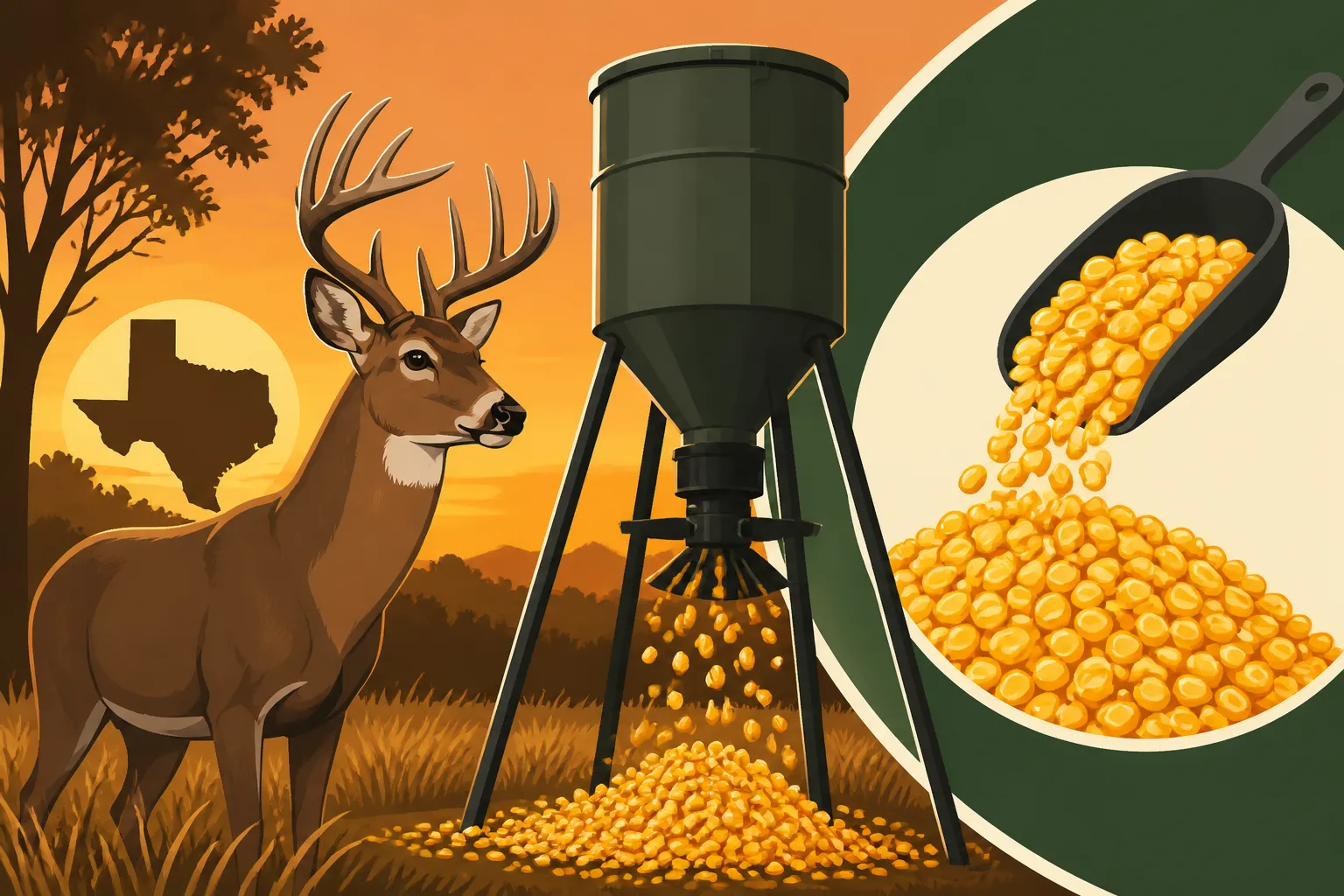
Most folks in Texas run spin feeders, and for good reason—they're relatively affordable, easy to set up, and broadcast corn over a wide area, which can be great for spreading out deer. However, they're also notorious for corn consumption. A standard spin feeder, depending on the motor strength and plate design, can throw anywhere from a quarter-pound to well over a pound of corn per second. Think about that for a moment. If your timer is set to spin for 5 seconds, twice a day, you could be throwing 5-10 pounds of corn daily without even realizing it. And if you’ve got a stronger motor or a more aggressive plate, that number can climb even higher.
The key here is your timer settings. Are you dispensing once a day, twice, or even more? How long are those spin times? Many hunters set their timers to go off for 3-5 seconds in the morning and again in the evening, aiming to catch deer at prime feeding times. But those seemingly short bursts add up quickly. A shorter duration, say 2-3 seconds, might be enough to get the deer what they need without excessive waste or feeding every squirrel and coon in the zip code. You really have to dial in those settings. For a deeper dive into optimal schedules, check out our guide on Deer Feeder Timer Settings in Texas.
Gravity Feeders: A Different Beast
Gravity feeders, on the other hand, operate completely differently. There's no motor, no timer; the corn simply flows out as animals consume it from ports at the bottom. This sounds like it would be more efficient, as only the animals present can eat. And in many ways, it is, especially for protein pellets. But with corn, a few things can happen. If the ports are too low or too wide, or if the feeder isn't secured, critters like hogs can easily root around and spill a significant amount of corn, making a mess and wasting feed. Also, a constant supply means that if animals are present around the clock, they can technically eat all the corn in a shorter period compared to timed spin feeders. While they eliminate mechanical failures and battery issues, the lack of portion control can be a double-edged sword when it comes to corn.
Deer Population and Activity
This one is a no-brainer, right? More deer equals more corn eaten. But it's not just about the sheer number of deer. Their activity levels, influenced by natural food sources, time of year, and even the weather, play a huge role.
Population Density on Your Lease
If you're hunting a lease in the famed South Texas brush country, known for its high deer density, your feeders are naturally going to see more traffic than a lease in, say, the Panhandle where mule deer populations are generally sparser. A small family group of three or four deer might visit a feeder regularly, but a whole herd of 10-15 deer, plus their bachelor groups, can empty a feeder in a flash.
It’s also about what else is available. During lush springs and summers, when natural forage is abundant, deer might only snack at your feeders. But come the dry, lean months of late summer or the cold snaps of winter, your feeders become a vital food source, and consumption can skyrocket. Understanding the natural forage available on your specific property is crucial for anticipating demand.
The Influence of Rut Season
Ah, the rut! Texas deer season is often dictated by this frantic period. During the peak of the rut, bucks are more focused on chasing does than on eating. Does, however, might still visit feeders to maintain energy. Pre-rut and post-rut can see increased feeder activity as deer try to pack on calories or recover from the exhaustion of breeding. So, your corn usage might fluctuate wildly throughout the season. You might see less activity during the most intense parts of the rut, only for it to pick back up significantly once the breeding slows down and deer need to refuel. If you're looking to understand the timing of these patterns, our guide on The Texas Rut: When Do Bucks Rut by Region? can be incredibly helpful.
Weather's Impact on Feeding Patterns
A sudden cold front can drive deer to feeders more frequently, as they need extra calories to stay warm. Conversely, heavy rains can make roads impassable, preventing you from refilling, or even wash away corn that's been scattered. Drought conditions, a common occurrence in many parts of Texas, will also increase reliance on supplemental feed, meaning you'll burn through corn much faster. Keeping an eye on the weather forecast isn't just for planning your hunt; it's also for planning your feeder refills.
Presence of Other Wildlife
This is where the frustration really sets in for many Texas hunters. You put out corn for deer, but it often feels like you’re feeding every other creature with four legs and a keen sense of smell.
Feral Hogs: The Ultimate Corn Bandits
If there's one animal that can drain a feeder faster than a thirsty hunter on a hot day, it's the feral hog. These intelligent, prolific animals are absolute corn magnets. A sounder of hogs can easily clear out a 300-pound feeder in a single night if given unrestricted access. They'll root around, knock feeders over if they're not secured, and generally make a huge mess. Mitigating hog presence is paramount to efficient corn usage. Many hunters build hog panels or use specific feeder designs to deter them. For comprehensive strategies on dealing with these nuisance animals, check out our piece on How to Keep Hogs Out of Your Deer Feeder.
Raccoons, Squirrels, and Other Opportunists
While not as destructive as hogs, raccoons and squirrels are relentless. Raccoons are masters at climbing feeder legs and reaching into spin plates or gravity feeder ports. Squirrels, bless their tiny hearts, will chew through plastic components, jump onto feeder cages, and grab every kernel they can. Even birds, especially wild turkeys, can make a noticeable dent over time if they constantly peck at the scattered corn. These smaller animals might not empty a feeder in one go, but their cumulative efforts over a week or two can significantly reduce the amount of corn available for your target deer.
Estimating Corn Consumption for Your Setup
So, how do you get a handle on all this? It starts with some estimation and careful observation. While there's no magic formula that works for every single feeder on every single acre in Texas, you can absolutely get a much clearer picture.
Calculating Daily and Weekly Averages
Let's talk numbers, or at least how to get a good ballpark figure for your own setup.
Start with Your Feeder Settings
The easiest place to begin is by knowing exactly how much corn your feeder dispenses per second. This often requires a little test. Grab a bucket, set your feeder timer for a short burst (say, 5 seconds), and catch all the corn. Weigh it. Divide that weight by the number of seconds, and you've got your "corn per second" rate.
Let's say your feeder throws 0.8 pounds per second.
If you set it for 4 seconds in the morning and 4 seconds in the evening:
Total seconds per day = 4 + 4 = 8 seconds
Daily corn dispensed = 8 seconds * 0.8 lbs/second = 6.4 lbs
Now, let's factor in other animals. If you know you have hogs or raccoons, you might reasonably estimate that 20-50% (or more!) of that corn is not going to deer. Let's say you're losing 30% to non-target animals:
Effective corn for deer = 6.4 lbs * 0.70 = 4.48 lbs per day.
This is a starting point. Real-world usage will fluctuate, but this gives you a baseline to measure against. For a typical 300-pound feeder, if you're throwing 6.4 lbs per day, it would theoretically last about 46-47 days (300 / 6.4). But if you factor in the critter tax, it might only be truly available to deer for a shorter period, or simply empty faster due to all the mouths.
Monitoring Techniques for Accuracy
The best way to get accurate data is to monitor. Trail cameras are your best friends here. Place a camera facing your feeder, ideally in a spot where it captures animals visiting the spin plate or gravity ports. Over a few weeks, review your footage. Are hogs dominating the nighttime? Are raccoons having a field day? Are deer showing up primarily at dawn and dusk? This visual data is invaluable. Our guide on How to Pattern Bucks With Trail Cameras offers tips that can easily be adapted for feeder monitoring.
Another simple monitoring technique is to mark your feeder with a piece of tape or a permanent marker on the hopper as you fill it. Note the date. Then, after a week, check the level again. This can give you a rough weekly consumption rate. It’s not scientific, but it’s practical for a busy hunter.
Factors Affecting Seasonal Usage
Corn consumption isn't a static number; it ebbs and flows with the seasons and the deer's biological needs.
Early Season (September/October)
In the early season, especially for bowhunters, deer might not be hitting feeders as hard. Natural food sources like acorns, persimmons, and green browse are often abundant. Deer will certainly visit feeders, but they might not rely on them as heavily. You might find you can get away with shorter spin times or less frequent dispensing. However, if it's a dry early season, deer could be on your feeders heavily, seeking any available moisture and calories.
Rut Season (October-December, depending on region)
As mentioned, the rut is a tricky time. Bucks are focused on does and often travel widely, making them less predictable at feeders. Does, however, might visit more frequently to maintain energy levels. Your usage could decrease slightly during the most intense breeding phase for bucks, but overall activity around feeders might remain steady or even increase for does.
Late Season (January/February)
This is often when deer hit feeders the hardest. Natural forage is typically depleted, and deer are recovering from the rut, needing to replenish fat reserves for winter. Cold weather also increases their caloric needs. If you want to see deer consistently in the late season, keeping those feeders running, and potentially increasing corn output, is often necessary. This is also a critical time for deer nutrition, especially for does carrying fawns.
Year-Round Supplemental Feeding (Not just for hunting)
Some landowners and leaseholders feed year-round, not just during hunting season. This is particularly true for those participating in programs like the Managed Lands Deer Permit (MLDP) or simply trying to improve the health and antler quality of their herd. In these scenarios, corn is often supplemented with protein pellets, especially from spring through late summer. Year-round feeding will naturally lead to higher overall corn usage, but it's part of a broader management strategy. Our article on Protein Feeding Deer for Bigger Antlers goes into this in more detail.
The Cost of Corn: A Practical Look
Let's face it, corn isn't free, and the cost can add up quickly, becoming a significant part of your hunting budget.
Average Corn Prices in Texas
Corn prices fluctuate based on agricultural markets, fuel costs, and even regional supply. However, in Texas, you can typically expect to pay anywhere from $7 to $12 for a 50-pound bag of whole kernel corn. Buying in bulk, such as by the pallet or by the ton, will generally bring the per-pound cost down. A ton (2,000 pounds) of corn might run you anywhere from $250 to $400, sometimes more.
Let’s put that into perspective. If your feeder goes through 6.4 lbs of corn a day, that’s about 192 lbs a month. At $10 per 50-pound bag (or $0.20 per pound), you're looking at roughly $38.40 per month per feeder just for the corn. If you have multiple feeders on your lease, say three, that's over $115 a month, or nearly $700 for a six-month hunting season. That’s a real chunk of change! And this doesn’t even account for the gas money to haul it, the time spent, or the battery costs for your feeder.
Budgeting for Your Hunting Lease
When you’re figuring out your overall hunting lease costs, don't just think about the annual lease fee. Factor in your corn budget, especially if you're running multiple feeders for an extended period. Many hunters find that the corn bill rivals or even exceeds other expenses like blinds, cameras, and vehicle maintenance over the course of a year. It’s essential to be realistic about how much you need to spend to achieve your hunting goals versus how much you’re willing to spend on supplemental feeding.
Strategies to Optimize Corn Usage and Reduce Waste
Okay, so you understand the problem. Now, what can you actually do about it? There are several practical steps you can take to ensure more of your expensive corn goes to the deer you're targeting and less goes to waste or other critters.
Feeder Placement and Security
Where you put your feeder and how well you secure it can make a world of difference.
Strategic Feeder Placement
Don't just plop a feeder down anywhere. Think about the deer's natural travel corridors, bedding areas, and water sources. Placing a feeder along a well-used game trail, near a dense thicket for cover, or within easy reach of a water source will naturally increase deer visits and make the corn more accessible to them. If deer feel exposed or have to travel far out of their way, they might not visit as consistently. For more insights into optimal placement, consider our guide on Where to Place a Deer Feeder for Best Results.
Another critical aspect of placement is the terrain itself. If you're broadcasting corn, ensure the area beneath the feeder is relatively flat and free of thick brush or standing water. Corn landing in deep grass or muddy puddles is wasted. A cleared patch of ground or even a gravel pad can make a huge difference in corn recovery for deer and prevent waste.
Feeder Pens and Hog Panels: Your Best Defense
This is, hands down, the most effective way to protect your corn from hogs and other large non-target animals. A well-built feeder pen, usually made from hog panels (16-foot sections of 34-inch tall livestock panel) arranged in a circle or square around your feeder, can drastically reduce or even eliminate hog access. The key is to make it tall enough (34 inches is usually sufficient for hogs, as they won't jump it, but deer will easily step over it) and wide enough (a minimum of 20 feet in diameter) to allow deer to comfortably jump in and out. Securing the panels firmly to the ground with T-posts is crucial, as hogs are incredibly strong and persistent.
While a feeder pen won't stop raccoons or squirrels (they'll just climb the T-posts or feeder legs), it will protect the bulk of your corn from the biggest culprits. It's an initial investment in time and material, but it pays for itself quickly in saved corn and reduced frustration.
Alternative Feeding Methods and Supplements
Sometimes, corn alone isn't the most efficient or even the best approach for deer health and hunting.
Introducing Protein Feeders
If your goal is year-round deer health and antler growth, especially in the off-season, protein feeders are often a much better investment than corn-only feeders. Protein pellets are formulated with higher protein content (typically 16-20%) and essential minerals that are crucial for antler development and overall body condition. While more expensive than corn per bag, protein is less attractive to hogs (though they will eat it if desperate) and specifically targets deer. Many hunters switch from corn to protein once hunting season ends, or run both concurrently, with corn primarily as an attractant during hunting season. Our article on Corn vs Protein Feeder for Texas Deer delves into this comparison.
Food Plots: A Natural Supplement
Food plots offer a more natural and sustainable way to supplement deer diets and attract them to specific areas. While they require land preparation, planting, and rainfall, a successful food plot can provide high-quality forage that deer prefer and consume over a longer period than a quick feeder visit. In Texas, you'll need to choose drought-tolerant and heat-resistant varieties like clovers, winter wheat, oats, or specific deer blends. A well-maintained food plot can reduce your reliance on feeders and save you a lot of corn in the long run. If you're interested in establishing one, check out our guide on Food Plots in Texas: What Works in the Heat.
Mineral Supplements
Providing mineral supplements, either in block form or as loose minerals, can also contribute to deer health. While not directly replacing corn, a healthy deer herd that is getting adequate nutrition from other sources might be less intensely reliant on your corn feeder.
Monitoring and Adjusting Your Setup
The work isn't over once your feeder is placed and filled. Continuous monitoring and adjustment are key to long-term efficiency.
The Indispensable Role of Trail Cameras
We talked about using trail cameras for estimating usage, but they're just as vital for ongoing management. Check your cameras regularly. Are your spin times too long? Are deer showing up and leaving quickly, or are they lingering? Are hogs still finding ways in, or have your feeder pens held up? Pictures and videos don't lie. They provide real-time intelligence on what's happening at your feeder, allowing you to make informed decisions. This real-world feedback is far more valuable than any theoretical calculation.
Fine-Tuning Timer Settings
Based on your camera observations, don't be afraid to adjust your feeder timer settings. If you notice deer are only visiting for a short period and a lot of corn is left on the ground, shorten your spin times. If deer seem to be clearing the corn quickly and still lingering, consider adding another short spin time or slightly increasing the duration. The goal is to dispense enough corn to attract and hold deer without excessive waste. This often means experimenting throughout the season. What works in early fall might be completely different from what's needed in the dead of winter.
Regular Feeder Maintenance
This might seem obvious, but a poorly maintained feeder can waste corn. Check for leaks in the hopper, ensure the spin plate isn't bent or clogged, and keep your battery charged to avoid erratic dispensing. A feeder that isn't working correctly can over-dispense, under-dispense, or simply break down, leaving your deer without a food source and your corn sitting unused.
Comparative Look at Feeder Usage
To help visualize how different factors influence corn consumption, here's a simple comparison table. Keep in mind, these are generalized estimates for a 300-lb capacity feeder and can vary wildly based on your specific conditions.
| Feeder Type & Setup | Daily Corn Dispensed (Est. lbs) | Typical Duration (300 lbs) | Primary Corn Thieves | Optimization Strategy |
|---|---|---|---|---|
| Spin Feeder (No Pen) | 6-12+ lbs (2x 4-5 sec spins) | 25-50 days | Hogs, Raccoons, Deer | Build hog panel, reduce spin time, higher feeder |
| Spin Feeder (With Hog Pen) | 4-8 lbs (2x 3-4 sec spins) | 37-75 days | Raccoons, Squirrels, Deer | Anti-coon baffles, monitor for overfeeding |
| Gravity Feeder (No Pen) | 8-15+ lbs (constant access) | 20-37 days | Hogs, Raccoons, Deer | Build hog panel, ensure ports are high/secure |
| Gravity Feeder (With Hog Pen) | 5-10 lbs (constant access) | 30-60 days | Raccoons, Squirrels, Deer | Anti-coon baffles, consider port size |
| Spin Feeder (Low Deer Density) | 3-6 lbs (1x 3 sec spin) | 50-100 days | Critters, Deer (less often) | Monitor, reduce frequency/duration further |
| Spin Feeder (High Deer Density) | 8-15+ lbs (2x 5 sec spins) | 20-37 days | Deer, Hogs, Raccoons | Increase capacity, consider protein, adjust timing |
Remember, these are rough guidelines. Your experience will depend heavily on the specifics of your hunting area and wildlife population.
The amount of corn a deer feeder uses isn't a simple equation. It's a dynamic interplay of your equipment, the wildlife, and environmental conditions. By understanding these variables and implementing smart strategies like feeder pens, careful placement, and diligent monitoring with trail cameras, you can make your corn go further. It’s all about working smarter, not just harder, to get those deer hitting your feeders consistently without breaking the bank. Happy hunting, and may your corn last longer this season!
Disclaimer
Hunting regulations and best practices can change. Always consult the most current Texas Parks and Wildlife Department (TPWD) Outdoor Annual for the latest rules and seasons before engaging in any hunting activities. This content is for informational purposes only and does not constitute professional advice.