Texas Duck & Waterfowl Season 2026: Zones
Trying to figure out the exact boundary lines for waterfowl zones in Texas can feel like reading a coded map while standing knee-deep in a swamp. Every year, hunters miss out on the best migration days simply because they were a few miles on the wrong side of a highway or miscalculated a split date. This guide breaks down the complex zone structures, specific season dates, and legal requirements to ensure you are in the right place at the right time.
Understanding the Texas Waterfowl Zone System
The geography of Texas is so vast that a single season for the entire state would be a disaster for both the hunters and the birds. To manage this, the Texas Parks and Wildlife Department (TPWD) uses a multi-zone system that follows the migration patterns from the High Plains down to the Gulf Coast. If you have spent any time looking at the map, you know that the "flyway" through Texas isn't a straight shot; it is a complex web of river basins, playa lakes, and coastal marshes.
The High Plains Mallard Management Unit
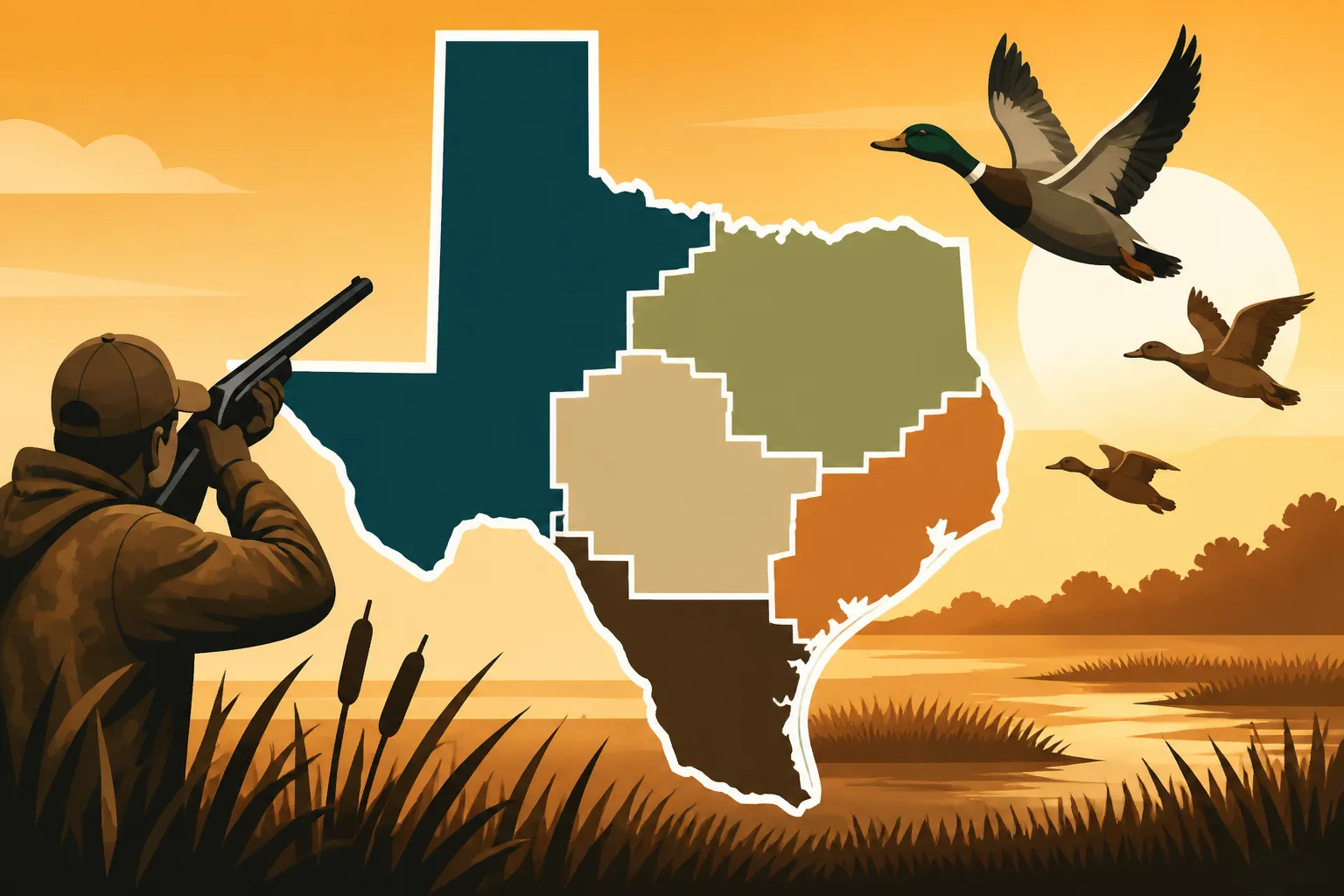
The High Plains Mallard Management Unit, or HPMMU, is often the first place to see significant numbers of birds. This zone covers the western part of the state, primarily the Panhandle and parts of the South Plains. The boundary is generally defined by the line following the Continental Divide from the New Mexico border, but for most of us on the ground, we think of it as everything west of a line running from the Oklahoma border down through Vernon, then south toward Del Rio.
Hunting in the HPMMU is a different beast entirely. You are dealing with playa lakes—shallow, rain-fed depressions that can be dry one year and teeming with pintails the next. Because this area is further north and at a higher elevation, the birds arrive earlier and the water freezes faster. This is why the HPMMU season often starts and ends on a different schedule than the rest of the state. It is critical to understand Texas Duck Zones Explained (High Plains, North, South) because a mistake here means hunting while the season is closed, which is a quick way to lose your license and your gear.
The North Zone vs South Zone Split
For the rest of the state, the map is divided into the North and South Zones. The dividing line is famous among Texas duck hunters. It generally follows Interstate 10 from the Louisiana border over to the intersection with Highway 90 at San Antonio, and then follows Highway 90 west to Del Rio. This line isn't just a legal boundary; it often marks a transition in habitat. North of I-10, you are looking at timber-lined reservoirs, river bottoms, and stock ponds. South of that line, you are heading into the rice prairies and the coastal salt marshes.
The North Zone tends to hold birds that are looking for acorns in the flooded timber or corn in the agricultural fields. The South Zone is the wintering home for millions of redheads, pintails, and teal that are looking for the shallow, saline waters of the Laguna Madre. Understanding where you stand on that I-10 corridor is the difference between a legal limit and a visit from a game warden. If you are scouting a new lease near the coast, you need to be very familiar with Duck & Waterfowl Hunting in Texas to know which side of the highway your blind sits on.
Why Migration Timing Matters for Your Setup
The reason these zones exist is to maximize hunter opportunity based on when the birds are actually present. In the HPMMU, the birds might be thick in November, but by late December, if a hard freeze hits the Panhandle, those birds are gone. Conversely, the South Zone might be quiet in early November, but by January, it is the center of the waterfowl universe.
When you are planning your season, you have to look at the "splits." Most Texas seasons have a first half and a second half, separated by a week or two of closure. This split is designed to let the birds rest and to time the second opening with the arrival of the "big ducks" like Mallards and Canvasbacks. If you are a serious hunter, you might start your season in the North Zone, and then travel south during the North Zone split to keep hunting in the South Zone where the season might still be open.
Texas Duck Season Dates for 2026
The 2026 calendar brings some interesting timing for the splits. Every year, hunters wait for the official proclamation, but the patterns usually hold steady. You are looking at a calendar that aims to catch the peak of the migration while protecting the breeding populations. Missing the opener is a tragedy, but hunting during the split is a legal nightmare.
Early Teal Season in September
Before the big ducks show up, we have the blue-winged teal migration. The September Teal Season Dates in Texas are the first real chance to get back in the water. This season is usually a 16-day window in mid-to-late September. It is a high-speed, high-heat affair. You are going to be fighting mosquitoes and humidity just as much as you are fighting the birds.
Blue-winged teal are the "early birds" of the migration, often heading south to Mexico and Central America before the first real cold front even hits Texas. Because they move so fast and in such large numbers, this special season allows for a higher bag limit specifically for teal. However, you have to be extremely careful with bird identification. If a stray shoveler or a lingering wood duck flies over your spread during teal season, you have to keep your safety on. Identifying birds in the low-light "grey duck" hours of the morning is a skill every Texas hunter must master.
Regular Season Windows by Zone
The regular duck season usually opens in late October or early November. In the North Zone, the first split typically runs through late November, followed by a closure of about 12 days, and then a second split that carries through the end of January. The South Zone usually mirrors this but often starts a week later to account for the later arrival of birds on the coast.
For 2026, you can expect the Texas Duck Season Dates 2026 to focus heavily on that late January window. The "Late Season" is when the Mallards are fully plumed and the Pintails have their long sprigs. This is also when the weather in Texas finally turns cold. A north wind in January can push thousands of birds into the coastal marshes in a matter of hours. If you are hunting the coast, you need to have your Best Duck Decoy Spread for Texas Coast ready for when those birds arrive hungry and tired.
Youth and Veteran Special Hunting Weekends
Texas provides special weekend windows for youth hunters (typically 15 and younger) and for active-duty military and veterans. These weekends usually happen a week before the regular season opens or a week after it closes. It is a fantastic way to introduce a kid to the sport without the pressure of a crowded public marsh.
For veterans, these weekends are a well-deserved thank you, providing a quieter environment to enjoy the birds. During these weekends, the bag limits remain the same as the regular season, but the lack of "high-lining" and boat traffic makes for a much more productive hunt. If you are taking a young hunter out, make sure they have gone through their hunter education requirements, even if they are hunting under the "deferred" status or with an adult.
| Zone | Primary Habitat | Common Species | Split Strategy |
|---|---|---|---|
| HPMMU | Playa Lakes, Corn Fields | Pintail, Mallard, Wigeon | Hunt early before the freeze. |
| North Zone | Reservoirs, Timber, Ponds | Wood Duck, Mallard, Gadwall | Target acorns in flooded timber. |
| South Zone | Coastal Marsh, Rice Fields | Redhead, Pintail, Teal | Focus on late-season cold fronts. |
Bag Limits and Species Restrictions for 2026
If you think the zones are complicated, wait until you start counting birds in your bag. Texas follows the federal framework, but with specific tweaks for our resident and migratory populations. The daily bag limit is generally six ducks, but you can't just shoot six of whatever flies by. There are "sub-limits" that you must know by heart before you pull the trigger.
The Six-Bird Daily Limit Explained
The 2026 season will likely maintain the standard six-duck limit, but within those six, you are restricted on specific species. For example, you are usually limited to only two mallards (and only one of those can be a hen). This is to protect the breeding hens that are the future of the population. Wood ducks are usually capped at three, and Redheads at two.
The "pintail problem" is something every Texas hunter talks about. Despite seeing thousands of them on the coast, the federal limit has often been restricted to just one or two birds per day due to national population models. It is incredibly frustrating to have 500 pintails circling your blind and have to stop shooting after your first bird of the morning. To stay legal, you must study the Texas Duck Bag Limit & Species Rules before every hunt. A single extra bird in your bag can result in a heavy fine and the loss of your harvest.
Possession Limits and Transporting Your Harvest
A common mistake hunters make occurs after the hunt is over. Your "daily bag limit" is what you can kill in one day. Your "possession limit" is typically three times the daily bag limit. If you are on a three-day hunt in South Texas, you can have 18 ducks in your cooler on the way home, but only if they are properly tagged.
If you are transporting birds for someone else, or if you are leaving birds at a processing plant, they must have a "wildlife resource document" attached. This document includes your name, address, hunting license number, the date the birds were killed, and the location. Even if you are just driving home with your own birds, you must leave one fully feathered wing or the head attached to the carcass for identification purposes until you reach your final destination.
Identification in the Field
The hardest part of waterfowl hunting is identification on the wing. In the early morning light, a Gadwall and a Wigeon can look remarkably similar. A hen Mallard and a Mottled Duck are almost identical to the untrained eye. In Texas, the Mottled Duck is a protected species with very restrictive limits (often zero or one depending on the year).
Before the season starts, spend some time with a bird ID book or an app. Look at the wing patches (speculums). Look at the shape of the bill and the way the bird sits in the water. If you aren't 100% sure what the bird is, don't shoot. It isn't worth the legal trouble, and more importantly, it isn't fair to the resource. Most veteran hunters will tell you that the best way to learn is by How to Hunt Ducks in Texas (Step by Step) where you spend time observing the birds before you even start calling.
Goose Hunting Seasons and Light Goose Conservation Order
While ducks get most of the glory, goose hunting in Texas is a massive industry. From the massive "tornadoes" of snow geese in the rice prairies to the loud honking of Canadas in the Panhandle, geese provide a scale of hunting that you just can't get with ducks.
Canada, White-Fronted, and Snow Goose Windows
Geese are managed differently than ducks. They are generally categorized into "Dark Geese" (Canadas and White-fronted/Speckleberry) and "Light Geese" (Snows, Blues, and Ross's). The seasons for these birds are much longer than the duck seasons, often running from November straight through early February.
In the Panhandle, the Canada goose is king. These birds are big, smart, and require massive decoy spreads to fool. On the coast, the Speckleberry is the prize. They are widely considered the best-tasting goose and have a very distinct, laughing call. The limits for these birds are much lower than for light geese, so you have to be careful when the flocks are mixed.
The Light Goose Conservation Order
Once the regular waterfowl seasons end, Texas enters the Light Goose Conservation Order (LGCO). This is not technically a "hunting season" but a management action aimed at reducing the overpopulated snow goose numbers that are destroying the Arctic tundra. During the LGCO, the rules change drastically. You can use electronic callers, you don't have to have a plug in your shotgun (allowing for more than three shells), and there is no bag limit.
The LGCO is grueling. You are often out in muddy fields with 500 to 1,000 decoys. The goal is sheer volume. While it sounds like a free-for-all, it is actually quite difficult. Snow geese are some of the smartest birds in the sky, and after being shot at from Canada down to Texas all winter, they are extremely wary. If you are going to tackle this, you need the Best Gear for Duck Hunting in Texas because your standard duck setup won't cut it for a massive snow goose spread.
Sandhill Crane Season Basics
We can't talk about Texas waterfowl without mentioning the "ribeye in the sky." Sandhill Cranes are migratory birds that require a special (but free) permit from the TPWD. The season is usually divided into three zones (A, B, and C). Zone A, which covers the Panhandle and West Texas, is the most popular.
Hunting cranes is more like hunting deer than hunting ducks. They have incredible eyesight and are very wary of anything that looks out of place. You need specialized crane decoys—which are much larger than duck decoys—and you have to be perfectly concealed. If you've never tried it, look into a Sandhill Crane Decoy Setup in Texas to see how the pros do it. The reward is some of the best-tasting wild game meat on the planet.
Essential Licensing and Legal Requirements
Texas game wardens are notoriously thorough, especially when it comes to migratory birds. Because waterfowl are governed by both state and federal law, the paperwork is double. One missing stamp or an unsigned permit can result in a citation that costs more than your shotgun.
Federal Duck Stamp and Migratory Bird Endorsement
Every waterfowl hunter age 16 or older must have a Federal Duck Stamp. You can buy these at the post office, at many sporting goods stores, or online. The most important thing: you must sign the face of the stamp in ink. If it isn't signed, it isn't valid. In 2026, the electronic version of the stamp (E-Stamp) is valid for 45 days, but you will eventually receive the physical stamp in the mail, which you must carry and sign.
In addition to the federal stamp, you need the Texas Migratory Bird Endorsement. This is a state-level requirement that funds habitat conservation within Texas. When you buy your "Super Combo" license, this is usually included, but if you buy a standard hunting license, you have to add it on. This endorsement covers ducks, geese, and even mourning dove.
HIP Certification and Harvest Reporting
When you buy your license, you will be asked a series of questions about how many birds you killed the previous year. This is the Harvest Information Program (HIP) certification. It is a federal requirement used to track bird populations and hunting pressure. You will see "HIP Certified" printed on your license.
Many hunters treat these questions as a nuisance, but the data is used to set the very seasons and bag limits we've been discussing. If you don't have the Texas Migratory Bird Endorsement & HIP Certification on your license, you are hunting illegally. It is a quick process, but it is a vital one for the future of the sport.
Public Land Access and Permits
Most of the best waterfowl hunting in Texas is on private land—rice leases, coastal marshes, or Panhandle ponds. However, if you don't have a lease, the TPWD offers access to Wildlife Management Areas (WMAs) and other public lands through the Annual Public Hunting (APH) permit.
This $48 permit gives you access to over a million acres of land. Some of the coastal WMAs, like Mad Island or J.D. Murphree, offer world-class duck hunting. However, these areas often have specific rules: no gasoline motors, specific entry times, and sometimes "draw-only" morning hunts. Before you head out, check the Duck Hunting in Texas: Decoys & Blinds requirements for the specific WMA you plan to visit, as some require you to use portable blinds or only hunt from certain stakes.
Strategy and Gear for Texas Waterfowl
You can have the best spot in the state, but if your gear is failing or your strategy is off, you'll be watching birds flare all morning. Texas waterfowl hunting is diverse, ranging from the freezing Panhandle to the salt-spray of the coast, and your gear needs to reflect that.
Decoy Spreads for Coastal vs Inland Water
Inland pond hunting is often about "finesse." You might only need a dozen high-quality mallard and teal decoys to get birds to commit to a small stock tank. The goal here is to look like a small, safe group of birds. If you use too many decoys in a small area, it can actually look unnatural and scare birds away.
Coastal hunting, on the other hand, is a game of "numbers." On the Laguna Madre, you are competing with rafts of thousands of real ducks. To get their attention, you often need 5, 10, or even 15 dozen decoys. Most of these should be Redheads or Pintails, as their white and grey bodies show up from a long distance against the blue water. Using a Best Duck Decoy Spread for Texas Coast means incorporating "confidence decoys" like herons or seagulls to tell the incoming ducks that the area is safe.
Calling Tactics for Texas Divers and Puddle Ducks
The biggest mistake new hunters make is calling too much. In the early season, birds are often young and responsive. By January, they have heard every bad duck call from North Dakota to Texas. In the late season, "less is more."
If you are hunting puddle ducks (Mallards, Wigeon, Gadwall), a few soft quacks and whistles are usually enough. If the birds are committed and coming in, stop calling. Let them finish. If you are hunting divers (Redheads, Bluebills), you don't really "quack" at them; you use a "purr" or a "flutter" sound. Many veteran Texas hunters rely heavily on a whistle call, which can mimic Teal, Wigeon, and Pintails all with one tool. It is much harder to mess up a whistle than a mallard hen call.
Dealing with Texas Weather and Habitat
The weather in Texas is the ultimate wild card. A "Blue Norther" can drop temperatures 40 degrees in two hours. This is great for moving birds, but it is dangerous for hunters. You need high-quality waders that won't leak when you are breaking ice, and you need a boat that can handle the "chop" of a coastal bay when the wind kicks up.
Habitat also changes rapidly. In a drought year, your favorite pond might be a dust bowl. In a flood year, the birds might be scattered in the "sheet water" of the cow pastures rather than on the big reservoirs. Successful Texas hunters are always scouting. They are driving the backroads, looking for where the birds are feeding and where they are roosting. If you are just starting out, follow the steps in How to Hunt Ducks in Texas (Step by Step) to learn how to adapt your strategy to the current water levels.
Where to Hunt: Top Regions for Waterfowl in Texas
Texas is essentially four different states when it comes to habitat. Each region offers a unique experience and requires a different approach to the season.
The Texas Gulf Coast Marsh
The coast is the wintering home for the bulk of the Central Flyway's birds. From Beaumont down to Brownsville, the coastal marshes and bays are legendary. Here, you will find the highest concentrations of Pintails and Redheads in the country.
The challenge of the coast is the environment. Saltwater is brutal on gear—your shotgun, your outboard motor, and your decoys will all corrode if not washed meticulously. The tides also play a huge role. A spot that has two feet of water in the morning might be dry mud by noon. If you are hunting this region, you need to be prepared for the logistics of boat travel and the specialized Best Gear for Duck Hunting in Texas that can survive the salt.
Panhandle Playa Lakes
This is the "top of the funnel." Birds coming out of the Central Plains hit the Panhandle first. When the playa lakes are full of rainwater, the hunting is spectacular. You'll see massive flocks of Wigeon, Teal, and Mallards.
The Panhandle is also the best place in the state for goose hunting. The vast corn and peanut fields provide endless food for Canadas and Snows. The hunting here is often "dry field" hunting, meaning you are lying in a layout blind in the middle of a dirt field rather than sitting in a swamp. It is a cold, windy, and exhilarating experience that every waterfowl hunter should try at least once.
Central Texas Stock Ponds and Reservoirs
For many hunters in Dallas, Austin, or San Antonio, the "tank" hunt is the standard. Small stock ponds (tanks) scattered across the Hill Country and North Texas can be surprisingly productive. These spots are often used as "loafing timber" where birds come to rest during the middle of the day.
The key to reservoir hunting—like Lake Fork or Lake Ray Hubbard—is finding the shallow "fingers" of the lake where aquatic vegetation is growing. These areas are often crowded with public hunters, so the secret is to get away from the boat ramps. A kayak or a small mud boat can get you into the backwaters where the big mallards hide. For these inland hunts, the Duck Hunting in Texas: Decoys & Blinds strategy usually involves blending into the natural brush or cattails rather than building a permanent structure.
Texas Hunting Regulations Disclaimer
This guide is intended for informational and educational purposes only. Hunting regulations, including season dates, bag limits, and zone boundaries, are subject to change by the Texas Parks and Wildlife Department and federal authorities. Always consult the official Texas Outdoor Annual and federal migratory bird regulations before heading into the field. It is the responsibility of the hunter to be aware of all local, state, and federal laws. Failure to comply with hunting regulations can result in criminal penalties, fines, and the loss of hunting privileges. All information provided here is based on the 2026 projected framework and should be verified prior to the start of the season.