Texas Turkey Season 2026: Spring & Fall Zones
Trying to navigate the patchwork of Texas turkey zones can feel like reading a map in a windstorm. Between the North and South Rio Grande zones, the sensitive Eastern turkey counties, and varying bag limits, many hunters accidentally miss their season opener or fail to report a harvest correctly. This guide breaks down the Texas Turkey Season 2026: Spring & Fall Zones to ensure you stay legal and successful in the field.
Understanding the Rio Grande vs. Eastern Turkey Landscape
Texas is uniquely blessed with a massive population of wild turkeys, but they aren't all the same. To hunt them effectively and legally, you first have to understand the two primary subspecies we have here. The Rio Grande turkey is the king of the state, boasting a population of over 500,000 birds spread across the majority of our central and western counties. They are famous for their gregarious nature and their willingness to respond to a call, making them the favorite of most Texas hunters.
The Eastern turkey, however, is a different story. Found primarily in the humid, heavily timbered regions of East Texas, these birds are much more elusive. Their population is smaller and more sensitive to hunting pressure, which is why the regulations in East Texas are significantly stricter. If you are hunting in the Pineywoods, you are playing a different game entirely than someone sitting in a blind in the Hill Country.
Rio Grande Turkeys The Backbone of Texas Hunting
The Rio Grande turkey is what most people picture when they think of a Texas gobbler. These birds thrive in the scrub brush, mesquite flats, and riparian corridors of the state. You’ll find them in massive numbers from the Rolling Plains down through the South Texas Brush Country. Because their numbers are so robust, the state allows for a more liberal hunting season and higher bag limits. In most Rio Grande counties, the seasonal limit is four birds, which provides ample opportunity for hunters to fill their freezers.
When you are out in the field, Rios are known for their lighter, buff-colored tips on their tail feathers. They are incredibly hardy birds, capable of traveling miles in a single day to find water or a suitable roost tree. For many of us, the sight of a Rio strutting across a dusty senderos is the highlight of the spring. If you want to master the art of bringing these birds in, you should check out Turkey Calling & Tactics for Texas Rios to understand the specific vocalizations that trigger a big tom's interest.
Eastern Turkeys The East Texas Challenge
Hunting Eastern turkeys in the Pineywoods is often described as "turkey hunting on hard mode." These birds inhabit the thick forests and bottomlands near the Louisiana border. Because the habitat is so dense, hearing a gobble is one thing; actually getting a clear shot through the undergrowth is another. The Texas Parks and Wildlife Department (TPWD) monitors these populations closely. In many Eastern turkey counties, the season is shorter, and you are strictly limited to one gobbler for the entire season.
The Eastern subspecies is generally larger than the Rio and has darker, chocolate-brown tips on its tail feathers. They are also notoriously "tight-lipped" compared to their western cousins. A tom might gobble once on the roost and then go silent as he works his way toward you. This requires a high level of patience and woodsmanship. If you are planning a trip to Nacogdoches or Lufkin for a bird, make sure you have your Texas Hunting License: Cost, Types & How to Buy (2026) sorted out well in advance, as you’ll need specific endorsements.
Identifying the Differences in the Field
It is crucial to know which bird you are chasing, not just for the sake of the hunt, but for legal compliance. While the zones generally separate the subspecies, there are "overlap" areas where you might find birds that look like hybrids. The most reliable way to tell them apart is the color of the upper tail coverts—the feathers just above the main tail. In Rios, these are tan or light buff. In Easterns, they are dark brown or bronze.
Beyond physical traits, their behavior differs. Rios tend to gather in larger winter flocks and stay together longer into the spring. Easterns are more solitary and territorial. This affects your decoy strategy and how aggressively you call. To get a head start on your preparation, reading through How to Hunt Rio Grande Turkey in Texas (Step by Step) can help you visualize the different approaches needed for these distinct landscapes.
Texas Spring Turkey Season 2026: North, South, and One-Gobbler Zones
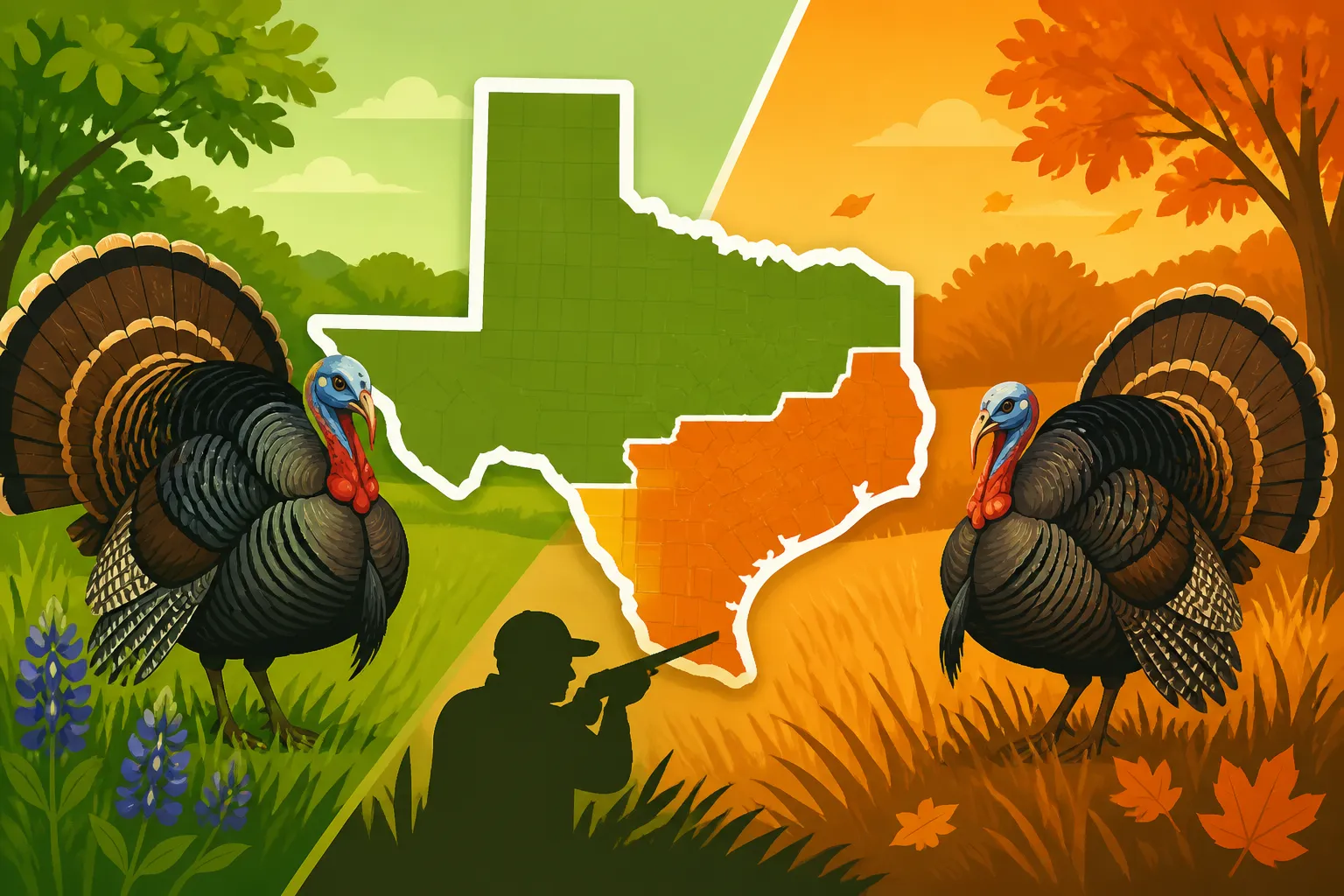
The 2026 spring season is the "main event" for most turkey enthusiasts. In Texas, the state is divided into a North Zone and a South Zone for Rio Grande turkeys to account for the difference in nesting cycles as you move across the latitudes. Additionally, there are the "One-Gobbler" counties which include both Rio and Eastern populations that require mandatory reporting. Knowing exactly which side of the fence line you are on is vital because the start dates can differ by two weeks or more.
Missing the opener in the South Zone because you thought you were in the North Zone is a heartbreaking mistake. Likewise, hunting too early in the North Zone can lead to a heavy fine and a confiscated bird. Always consult the TPWD zone map, but as a general rule, the line follows major highways like US 90 and I-10.
South Zone Dates and Dynamics
The South Zone typically opens in mid-March, catching the birds as they begin their peak breeding activity. For 2026, the South Zone Rio Grande season is expected to run from March 21 to May 3. This region includes the legendary South Texas Deer Hunting: Brush Country Guide territory, where the brush is thick and the gobblers are plentiful. The early start date is due to the warmer climate, which triggers the "strutting" behavior much earlier than in the Panhandle.
Hunting the South Zone often involves dealing with rapidly rising temperatures. By mid-morning, it can be 85 degrees, and the birds will head for the thickest shade they can find. Success here often depends on catching them in the first two hours of daylight as they fly down from their roosts in the tall oaks or hackberry trees along the creek beds. Because the vegetation can be so dense, many hunters prefer using a Best Gear for Rio Grande Turkey Hunting in Texas setup that includes high-visibility decoys to pull birds out of the brush into a clearing.
North Zone Dates and Expectations
The North Zone covers the vast majority of the state, including the Hill Country, the Cross Timbers, and the Rolling Plains. For 2026, the North Zone Rio Grande season is slated for April 4 through May 17. This later start date aligns with the green-up of the pastures and the peak of the hen's receptivity. The Hill Country, in particular, is a favorite for North Zone hunters due to its incredibly high bird density. If you are looking for a lease in this area, you might find Hill Country Hunting in Texas to be a great resource for identifying the best counties.
Expect the North Zone birds to be very vocal in early April. However, as the season progresses into May, the foliage gets thicker and the birds become "henned up," meaning they already have a harem and won't easily leave them for your calls. Late-season hunting in the North Zone requires a more subtle touch, often involving "cold calling" near known water sources or travel corridors rather than aggressive yelping and cutting.
The One-Gobbler Special Counties
Certain counties in East Texas and a few in the North-Central region are designated as One-Gobbler counties. For 2026, this season typically runs from April 1 to April 30. These are the areas where turkey populations are either being restored or are carefully managed to prevent over-harvesting. If you hunt in these counties, you cannot take more than one bird for the entire spring season, regardless of how many tags you have on your license.
Furthermore, these counties require mandatory harvest reporting. In the past, you could simply tag a bird and go home. Now, you must use the "My Texas Hunt Harvest" app or the TPWD website to report your bird within 24 hours. This data is critical for biologists to track the health of the population. For more details on this process, see Texas Hunting Tags & Harvest Reporting (My Texas Hunt Harvest). Failure to report is a class C misdemeanor, so don't let a great hunt end with a legal headache.
Fall Turkey Season 2026: Rules, Dates, and Strategies
While the spring is about the thrill of the call, the fall turkey season in Texas is often a "hunt of opportunity." Most fall turkeys are harvested by deer hunters who happen to see a flock move past their blind while waiting for a buck. However, dedicated fall turkey hunting is a unique challenge that requires an entirely different mindset. In the fall, turkeys are focused on food and flocking together for the winter rather than breeding.
The fall season generally runs concurrently with the general white-tailed deer season. For 2026, this means the season will likely open on November 7 and run through early January 2027. It’s a long window, but the rules regarding hens vary significantly by county, so you must check the specific regulations for your lease or hunting area.
Fall Season Structures and Zones
The fall season is primarily available in the Rio Grande turkey range. Most counties in the Edwards Plateau (Hill Country) and the Rolling Plains have a fall season. Conversely, the Eastern turkey counties do not have a fall season at all. This is to protect the hens and the next year’s poult production. If you are on a lease in Mason or Llano, you are in the heart of fall turkey country.
The zones for the fall are essentially the same as the spring, but the behavior of the birds is different. They aren't responding to hen yelps to find a mate; they are responding to "kee-kee" calls to find their lost flock. If you scatter a flock in the fall, you can sit down, wait fifteen minutes, and start calling to bring the young birds and hens back to your position. It is an exciting, fast-paced way to hunt that many Texans overlook.
Bag Limits and Regulations for the Fall
The bag limit for the fall season is cumulative with the spring season. In most Rio Grande counties, the limit is four turkeys in the aggregate for the entire license year (September 1 to August 31). This means if you shoot two birds in the fall, you only have two tags left for the spring. It is a common mistake for hunters to use up all their tags in November and then realize they have nothing left for the "big show" in April.
In many fall-season counties, the harvest of "either-sex" birds is allowed. This means you can legally take a hen. However, many landowners and hunters choose to stick to "bearded birds only" to ensure the local population remains strong. If you do take a hen, it still requires a tag from your license. Always refer to the Texas Hunting Seasons: Complete Calendar by Species to ensure you aren't exceeding the daily or seasonal limits for your specific county.
Hunting Fall Turkeys vs. Spring Turkeys
The biggest difference in the fall is the use of feeders. In Texas, it is perfectly legal to hunt turkeys over corn or protein feeders. Since turkeys are highly motivated by food in the cooler months, they will often frequent the same feeders as the deer. This makes the fall harvest much more predictable. If you have a trail camera on your feeder, you can easily pattern exactly what time the flock arrives each day.
However, if you want to hunt them "fair chase" without bait, you need to look for mast-producing trees like pecans and oaks. Turkeys will spend hours scratching through the leaves for acorns. Finding a "scratching" area is the fall equivalent of finding a strutting zone in the spring. It takes more scouting and patience, but the reward of outsmarting a wary old hen or a fall gobbler in the timber is immense.
Tagging, Licensing, and Reporting Requirements for 2026
Texas takes its wildlife regulations seriously, and turkey hunting has some of the most specific tagging requirements in the state. Every year, game wardens write hundreds of tickets for "improperly tagged" turkeys. Usually, it's not because the hunter was trying to cheat, but because they didn't understand the nuances of the law. The process remains largely the same as previous years, but with an even greater emphasis on digital reporting.
Before you ever step into the woods, you must have a valid Texas hunting license. For most residents, the "Super Combo" is the best value, as it includes all the necessary endorsements. If you are a non-resident, you need to ensure you have the "Migratory Game Bird" endorsement if you plan to hunt other species, but for turkey, the upland game bird endorsement is what matters most.
Mandatory Harvest Reporting (The My Texas Hunt Harvest App)
As mentioned earlier, mandatory reporting is now the law for all Eastern turkeys and any turkey harvested in a "One-Gobbler" county. Even if you are in a standard four-bird county, TPWD strongly encourages all hunters to report their harvest via the app. This helps the state track things like the age of the birds being killed and the overall success rate by county.
The process is simple: after you kill the bird and attach your physical tag, you open the app, select the species, the county, and the type of land (public vs. private). You’ll also need to specify if the bird was a gobbler, a jake, or a hen. If you are in a remote area with no cell service, the app will save your report and upload it automatically once you get back to civilization. For a step-by-step walkthrough, check out How to Report Your Harvest in Texas.
License Requirements and Endorsements
To legally hunt turkey in Texas, you don't just need a basic license; you need the Upland Game Bird Endorsement. This endorsement is included in the Super Combo and the Senior Super Combo licenses, but if you buy a standard resident hunting license, you’ll need to add it separately. The funds from this endorsement go directly toward turkey habitat restoration and public hunting land acquisition.
If you are a young hunter, Texas offers significant discounts. Texas Youth Hunting Weekend Dates often provide a special window for kids to get out before the general season opens. During these weekends, a youth license is all that is required, and they are still eligible for the same bag limits as adults, provided they are accompanied by a licensed adult. It is a fantastic way to introduce the next generation to the heritage of Texas hunting.
Understanding the Turkey Bag Limit
The statewide annual bag limit for turkeys is four, but—and this is a big "but"—only one of those can be an Eastern turkey. You could kill four Rios, or three Rios and one Eastern, but you can never kill two Easterns in a single year. Furthermore, many counties have a "seasonal" limit that might be lower than four. For example, some counties in the North Zone may only allow two birds during the spring season.
Your license comes with specific turkey tags. These tags are not interchangeable with deer tags. When you harvest a bird, you must immediately cut out the month and day of the kill on the tag and securely attach it to the bird's leg. It must stay attached until the bird reaches its final destination and is processed. If you are transporting the bird, keep the beard or a feathered wing attached as proof of sex, especially in gobbler-only seasons.
Youth Seasons and Special Hunting Opportunities
Texas is a leader in promoting youth involvement in the outdoors. To give kids a head start and a pressure-free environment, TPWD schedules youth-only hunting weekends for turkey. These usually take place the weekend before the North and South zones open. For 2026, the South Zone Youth Weekend is expected to be March 14-15, and the North Zone Youth Weekend will be March 28-29.
These weekends are a golden opportunity. The birds haven't been called to yet, and they are often much more aggressive and forgiving of a child's movement in the blind. It’s also a great time for mentors to focus entirely on the youth's experience without the distraction of trying to fill their own tags.
Spring Youth-Only Weekends
The Spring Youth Weekend is magical. In the South Zone, the woods are already waking up, and in the North Zone, the first signs of spring are appearing. Any hunter 16 years of age or younger is eligible to participate. They must be accompanied by a person 17 or older who possesses a valid hunting license and the required endorsements.
The key to a successful youth hunt is comfort. Since Texas springs can be unpredictable—chilly mornings followed by hot afternoons—layers are essential. A ground blind is almost always better for kids than sitting against a tree, as it hides the inevitable fidgeting that comes with being ten years old. Using a How to Call Rio Grande Turkeys in Texas strategy that involves frequent, exciting calling can keep a child engaged even if the birds are taking their time to come in.
Fall Youth-Only Opportunities
The fall youth turkey season typically runs concurrently with the youth-only deer season. This usually happens in late October and again in early January. While turkey isn't always the primary target during these weekends, having a turkey tag in the pocket of a young hunter can turn a slow deer hunt into a lifelong memory.
In the fall, youth can often harvest hens in the same counties where adults are allowed to do so. This increases the odds of success significantly. If a large flock of fifty birds comes to a feeder, a youth hunter has a very high probability of making a clean shot. Just be sure to practice "flock safety"—teach the child to wait until one bird is clearly separated from the group to avoid hitting multiple birds with one shot.
Tips for Taking Kids Turkey Hunting in Texas
- Keep it Short: Don't force a child to sit for six hours. If the action dies down by 9:00 AM, go back to camp for breakfast and a nap.
- Bring Snacks: A hungry kid is a grumpy hunter. Pack plenty of water and quiet snacks.
- Focus on the "Why": Explain the sounds of the woods, the way the sun hits the dew, and why we respect the animal.
- Let them Call: Give them a simple push-button caller. Even if they don't sound perfect, the feeling of "talking" to a turkey is what hooks them for life.
Summary Table of 2026 Turkey Dates and Limits
To help you plan your season, here is a quick-reference guide for the projected 2026 dates. Always verify with the TPWD Outdoor Annual before heading out, as dates are subject to minor adjustments by the commission.
| Zone / Region | Season Type | Projected 2026 Dates | Annual Bag Limit | Mandatory Reporting? |
|---|---|---|---|---|
| Rio Grande South | Spring | March 21 – May 3 | 4 Birds (Aggregate) | No (Encouraged) |
| Rio Grande North | Spring | April 4 – May 17 | 4 Birds (Aggregate) | No (Encouraged) |
| Eastern Turkey | Spring | April 22 – May 14 | 1 Bird | Yes (Required) |
| One-Gobbler Rio | Spring | April 1 – April 30 | 1 Bird | Yes (Required) |
| Rio Grande Fall | Fall | Nov 7 – Jan 3 (2027) | 4 Birds (Aggregate) | No (Encouraged) |
| South Zone Youth | Spring | March 14 – 15 | 4 Birds (Aggregate) | No |
| North Zone Youth | Spring | March 28 – 29 | 4 Birds (Aggregate) | No |
Top Texas Regions for Turkey Hunting
If you don't already have a spot to hunt, you’re probably wondering where the best action will be in 2026. Texas is massive, but turkeys are not distributed equally. Some regions are literally crawling with birds, while others require miles of walking just to hear a single distant gobble. Depending on the kind of experience you want—mountainous hiking, brush country stalking, or river bottom sitting—different regions will appeal to you.
The Hill Country (Turkey Mecca)
The Edwards Plateau, commonly known as the Hill Country, has the highest density of Rio Grande turkeys in the world. Counties like Llano, Gillespie, Mason, and San Saba are legendary for their turkey numbers. The terrain is characterized by rolling hills, limestone outcroppings, and thick live oak mottes. Turkeys love roosting in the tall pecans along the Llano and Colorado Rivers and then spending their days feeding in the open cedar breaks.
The sheer volume of birds here means that even if you mess up a call or spook a bird, there’s likely another one just over the next ridge. This is the best place for a beginner to start. The birds are generally very responsive to calls, and the habitat provides enough cover to move around if you need to reposition. Many of the best Hill Country Hunting in Texas outfits specialize in spring turkey packages that are very affordable compared to trophy deer hunts.
South Texas Brush Country
The "Wild Horse Desert" and the brush country of South Texas offer a completely different vibe. Here, the turkeys live among the mesquite, prickly pear, and ebony trees. This is a land of extremes—hot, dry, and thorny. The birds here are often larger-bodied than their Hill Country counterparts, and they have to be tough to survive the predators and the climate.
Hunting here often revolves around water. In a dry year, finding a windmill or a cattle tank is a guarantee of seeing turkeys. The birds will travel great distances to reach a reliable water source. Because the terrain is so flat, your calls will carry for a long way, but you have to be careful with your silhouette. A turkey’s eyesight is its greatest defense, and in the sparse brush of South Texas, they can spot a hunter from hundreds of yards away.
Rolling Plains and Cross Timbers
The northern part of the state, from Abilene up to the Oklahoma border, is the Rolling Plains. This is big country with wide-open wheat fields and deep red-dirt canyons. The turkeys here roost in the cottonwoods along the draws and then head out into the fields to feed. This is some of the best "spot and stalk" turkey hunting you can find.
In the Cross Timbers region, which runs through North-Central Texas, you get a mix of oak forests and prairies. This is a transition zone where the turkeys have plenty of cover but also access to rich agricultural lands. If you can find a property with a mix of timber and cultivated winter wheat, you are in for a treat. The birds here are often very healthy and sport impressive beards due to the high-protein diet available to them.
Essential Gear and Tactics for a Successful Texas Turkey Hunt
You don't need a mountain of gear to kill a turkey, but you do need the right gear. A common mistake is over-complicating the hunt. At its core, turkey hunting is about patience and camouflage. However, because Texas can be brutal on equipment—thanks to the thorns, the heat, and the dust—buying quality gear will save you money and frustration in the long run.
Your shotgun is your most important tool, but your choice of choke and load is what actually finishes the job. Many Texas hunters are moving toward TSS (Tungsten Super Shot) loads, which allow for incredibly dense patterns at longer ranges. This is particularly helpful in the wide-open spaces of the Rolling Plains where a bird might hang up at 45 yards.
Calling Strategies for Rio Grandes
Rios are social birds. In the spring, they want to be part of the crowd. This means you can often be more aggressive with your calling than you would be with a wary Eastern bird. A mix of loud "cutting"—a sharp, staccato series of yelps—can often trigger a "shock gobble" from a tom that was previously silent.
Once you have a bird's attention and he’s moving your way, tone it down. Use soft clucks and purrs to convince him that the "hen" he’s looking for is content and relaxed. One of the best tactics in the Hill Country is to use a wing bone call or a slate call to mimic the sound of a hen scratching in the leaves. That natural, non-vocal sound is often the final trigger that brings a big tom into range.
Decoy Setups for Texas Fields
In the wide-open pastures of Texas, decoys are essential for giving the turkey something to look at besides you. A lone hen decoy is the standard, but adding a "jake" (young male) decoy can provoke an older tom’s territorial instincts. He sees a youngster near his woman and comes in looking for a fight.
However, be careful with full-strut decoys. While they can be effective, they can also intimidate subordinate birds. If you are hunting an area with a lot of jakes or two-year-old birds, a full-strutter might actually scare them away. A "feeding hen" paired with a "semi-strut jake" is a versatile combo that works in almost every Texas zone.
Shot Placement and Archery Tactics
If you are hunting with a shotgun, the goal is always the head and neck. You want to aim where the feathers meet the skin of the neck. This ensures a quick, ethical kill and prevents damaging the breast meat. If you are bowhunting—which is becoming increasingly popular in Texas—the "vitals" are much smaller.
A turkey's heart and lungs are about the size of a fist, tucked high and tight under the wing butt. Many bowhunters prefer to take a "Texas heart shot" (aiming at the base of the tail when the bird is facing away) or a head shot with a specialized wide-diameter broadhead. If you’re interested in this challenge, Bowhunting in Texas: Archery Season Guide covers the nuances of taking birds with a stick and string.
Disclaimer
The information provided in this guide is for educational and informational purposes only. While we strive to provide the most accurate and up-to-date details regarding Texas turkey seasons and regulations for 2026, hunting laws are subject to change by the Texas Parks and Wildlife Department (TPWD) at any time. It is the responsibility of the individual hunter to consult the official TPWD Outdoor Annual, verify county-specific regulations, and ensure they have the proper licenses and permissions before engaging in any hunting activities. Always prioritize safety and legal compliance in the field.