Texas Deer Bag Limit by County
You are standing in the middle of a cedar break in the Hill Country or staring across a vast South Texas sendero, and the big question isn't just whether a buck is legal, but whether you even have a tag left for that specific county. Navigating the Texas Parks and Wildlife Department (TPWD) regulations can feel like deciphering a secret code, and getting it wrong can lead to heavy fines and a sour end to a season. This guide meticulously breaks down the Texas deer bag limit by county, explaining exactly how to interpret the rules so you can focus on the hunt instead of the paperwork.
Understanding the Foundation of Texas Deer Bag Limits
Texas is a massive state with wildly varying ecosystems, from the piney woods of East Texas to the high deserts of the Trans-Pecos. Because deer populations fluctuate based on habitat quality and hunting pressure, the state does not have a "one size fits all" bag limit. While your hunting license comes with a standard set of tags, those tags act as a maximum potential rather than a guaranteed right to harvest in any single location. Understanding this distinction is the first step for any hunter who wants to stay on the right side of the law.
The Statewide Maximum vs Individual County Limits
Every standard Texas Hunting License: Cost, Types & How to Buy (2026) comes with five white-tailed deer tags. However, it is a common misconception among beginners that you can shoot five deer in any county you choose. In reality, the state dictates a maximum bag limit for each specific county, and you must never exceed the statewide limit of five deer in total, regardless of where you hunt.
For example, if you hunt in a county with a five-deer limit and harvest three, you only have two tags left for the rest of the state. If you then move to a county with a three-deer limit, you can still only take two more deer there, because your personal statewide total cannot exceed five. This requires a bit of mental bookkeeping, especially for those of us lucky enough to have access to multiple leases or public land across different regions. It is always wise to keep a log of your harvests and ensure you are familiar with How to Read the Texas Outdoor Annual before the season opener.
Identifying Your Specific Zone and County Rules
TPWD divides the state into different zones—North and South—which primarily affects the timing of the season, but bag limits are strictly a county-level affair. Before you ever chamber a round, you need to verify the specific bag limit for the county where your feet are planted. You can find this in the Outdoor Annual, but you should also be aware that limits can change from year to year based on survey data from biologists.
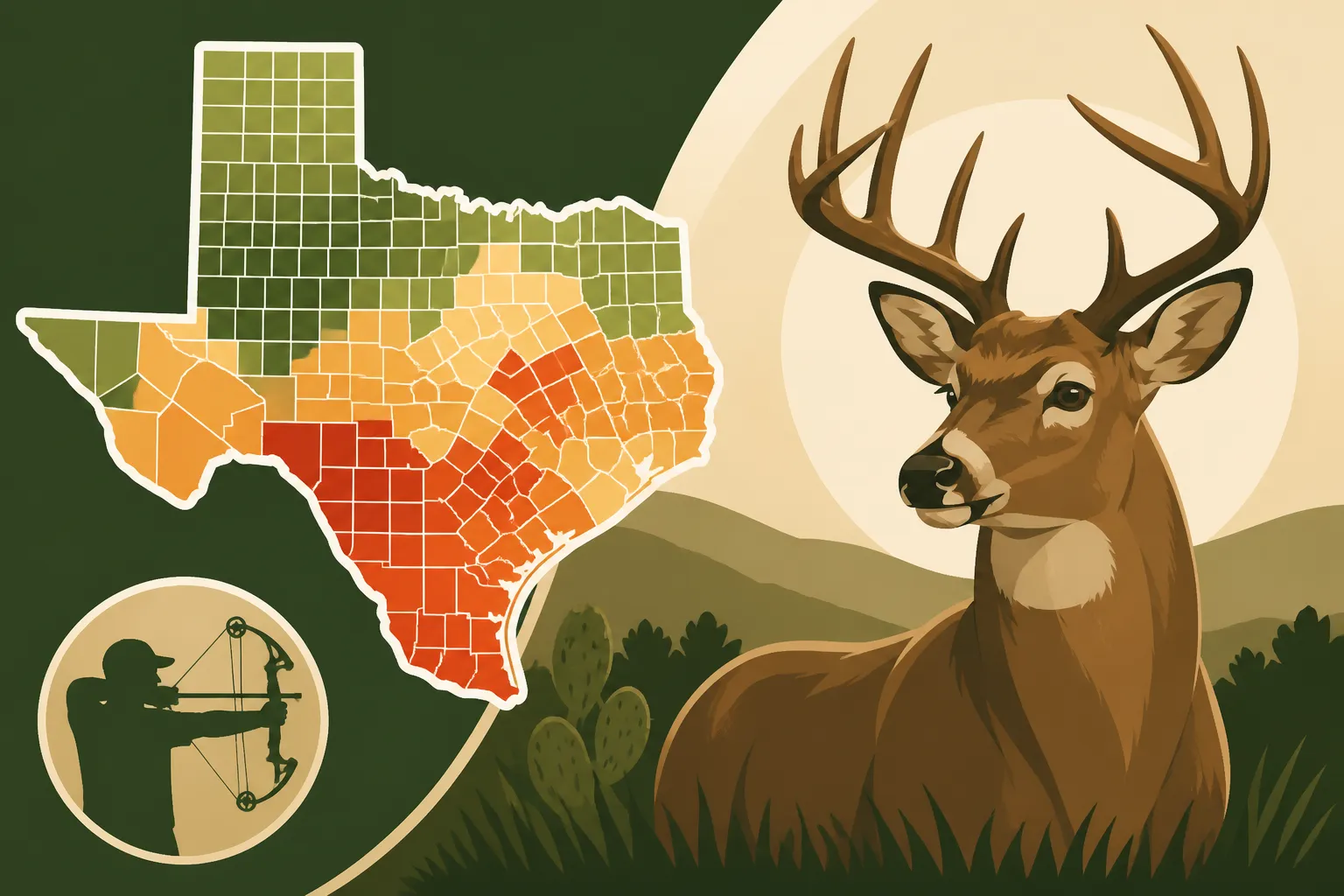
In most of the high-density areas, like the Edwards Plateau, the limit is five deer, with no more than two being bucks. In other areas, particularly in the Eastern part of the state or the Panhandle, the limit might be restricted to three or four deer total. Knowing these nuances is essential because a "legal" buck in one county might be an over-limit violation if you've already filled your buck tags elsewhere. For a deeper dive into the geographical splits, check out Texas Deer Zones: North vs South Explained.
The High-Density Five Deer Counties
If you are looking to fill the freezer, you want to find yourself in a five-deer county. These are the regions where the deer population is so robust that biologists actually encourage a higher harvest to maintain the health of the herd and prevent overgrazing. These counties are predominantly found in the central and southern portions of the state, where the "Texas style" of hunting over corn is most prevalent.
The Hill Country Hotspots
The Texas Hill Country is famous for having some of the highest deer densities in the nation. In counties like Llano, Gillespie, and Mason, it is not uncommon to see thirty or forty deer in a single sitting. Because of this, Hill Country Deer Hunting in Texas almost always falls under the five-deer limit. Usually, this is structured as "five deer, no more than two bucks."
However, even within these high-density areas, there are specific rules to follow. For instance, Llano County Antler Restriction & Bag Limit details how the two-buck limit is further constrained by antler quality. You can't just take any two bucks; usually, one must have at least one unbranched antler, or both must meet specific width requirements. This management strategy ensures that while we are reducing the overall population, we are also allowing younger bucks to reach maturity.
South Texas Brush Country Limits
Further south, the "Golden Triangle" counties like Webb, Dimmit, and La Salle also typically enjoy a five-deer bag limit. This region is managed for trophy quality, and the high bag limit allows land managers to cull inferior genetics or overabundant does. In these counties, the focus is often on the quality of the bucks rather than just the number, but the flexibility of five tags is a major draw for hunters.
In South Texas, the environment is harsh, and the deer have to compete for every bit of protein. By allowing a five-deer limit, the state helps keep the population in balance with the carrying capacity of the brush. If we didn't harvest enough does in these areas, the entire herd would suffer during the frequent droughts that plague the region.
Restricted Limits in the Post Oak Savannah and East Texas
As you move east, the landscape changes from open brush and rolling hills to dense timber and piney woods. In these regions, deer are harder to count and harder to hunt. Consequently, the bag limits are often more conservative to protect the herd from overharvest in areas where the population isn't quite as explosive as it is in Central Texas.
Three and Four Deer Counties
Many counties in the Post Oak Savannah and the Pineywoods have a four-deer limit. Often, this is broken down into "four deer, no more than two bucks, and no more than two antlerless." This is a crucial distinction. In a five-deer county, you might be able to take five does if you don't want any bucks. In a restricted county, you are capped on both ends.
If you are hunting in these areas, you must be extremely careful with your tag usage. If you shoot two does early in the season, you are done with antlerless deer for that county, even if you still have "antlerless" tags left on your license. This is where Texas Antlerless Deer Permits & Doe Days come into play. In some East Texas counties, you can only harvest does during specific "doe days" or with special permits, making the bag limit even more restrictive than it appears at first glance.
The Impact of Antler Restrictions on Your Bag
In over 117 Texas counties, antler restrictions are in place to improve the age structure of the buck population. This heavily influences how you use your bag limit. Typically, in an antler-restricted county, the limit is two bucks, but only one can have an inside spread of 13 inches or greater. The other buck must have at least one unbranched antler (a "spike").
This means that even if the county bag limit says "two bucks," you cannot legally harvest two 15-inch eight-pointers. If you do, you have violated the Texas Antler Restrictions: 13-Inch Rule & Counties regulations. This rule has been incredibly successful in increasing the number of mature bucks across the state, but it requires the hunter to be much more disciplined and skilled at field-judging deer before pulling the trigger.
Mule Deer and Cross-Over County Bag Limits
Texas isn't just about whitetails. In the western half of the state and the Panhandle, whitetail ranges often overlap with mule deer. This creates a complex situation where you might have separate bag limits for different species in the same county.
Navigating the Species Split
In counties where both species exist, you must be very careful not to confuse your tags. A mule deer tag cannot be used on a whitetail, and vice versa. Furthermore, mule deer limits are almost always much more restrictive. In many Trans-Pecos counties, the limit is one mule deer buck, period. You cannot take a second mule deer buck anywhere else in the state, even though your license might have multiple buck tags.
Understanding the Mule Deer vs White-Tailed Deer in Texas differences is vital. Mule deer are a different species with different biological needs and a much lower reproductive rate in the desert environment. Because of this, the state manages them with extreme care. If you are lucky enough to hunt these regions, you should double-check the Texas Mule Deer Season Dates by Region as they are much shorter than the whitetail seasons.
The Panhandle and Trans-Pecos Bag Limits
In the Panhandle, you might find a county where the limit is "five deer, no more than one mule deer buck." This means you could potentially take four whitetails and one mule deer buck, or five whitetails and zero mule deer. The interaction between these two species and the specific county limits requires a hunter to be an amateur biologist of sorts. Always ensure you are tagging your animal correctly and recording the harvest immediately to avoid any confusion with game wardens during a check.
Special Management Programs and Reporting
For many hunters on private land, the standard county bag limits might be overridden by special state-sponsored management programs. These programs are designed to give landowners more flexibility in managing their specific deer herds based on professional biological surveys.
MLDP Tags and Your License
The Managed Lands Deer Program (MLDP) is a game-changer for bag limits. If a property is enrolled in MLDP, the standard county bag limits and season dates often don't apply. Instead, the landowner is issued a specific number of "MLDP tags" based on a biologist's recommendation.
When you hunt an MLDP property, you do not use the tags off your hunting license. Instead, you use the tags provided by the landowner. These deer do not count against your county bag limit, though they still count toward your statewide limit of five deer. This is a complex system, so if you're invited to hunt a new ranch, always ask if they are on MLDP Tags in Texas: How They Work. It could mean the difference between being "done for the year" and having a few more hunts left in your season.
Reporting Requirements and My Texas Hunt Harvest
In recent years, TPWD has implemented mandatory harvest reporting in certain counties, particularly those with specific management goals or those in CWD (Chronic Wasting Disease) zones. Even if you are within your bag limit, failing to report the harvest can lead to legal trouble.
The Texas Hunting Tags & Harvest Reporting (My Texas Hunt Harvest) system is an easy-to-use app that allows you to log your kills in real-time. In some counties, this is the only way to legally finalize your bag limit. It's a good habit to get into regardless of where you hunt, as it provides the state with much-needed data to keep our bag limits as generous as possible in the future.
Comparative Summary of Key Texas County Bag Limits
The table below provides a snapshot of how bag limits can vary across different popular hunting regions. Please note that you should always verify the current year's Outdoor Annual for the most up-to-date specifics.
| Region | Example Counties | Total Bag Limit | Buck Limit | Antler Restrictions |
|---|---|---|---|---|
| Hill Country | Llano, Gillespie, Mason | 5 Deer | 2 Bucks | Yes (13-inch rule) |
| South Texas | Webb, La Salle, Dimmit | 5 Deer | 2 Bucks | Usually No* |
| East Texas | Harrison, Marion, Cass | 4 Deer | 2 Bucks | Yes (13-inch rule) |
| North Texas | Grayson, Collin, Rockwall | 5 Deer | 2 Bucks | Yes (Archery Only) |
| Panhandle | Briscoe, Hall, Childress | 5 Deer | 1 Muley / 2 WT | Species Specific |
| Trans-Pecos | Brewster, Presidio | 4 Deer | 1 Muley / 2 WT | Species Specific |
*Note: While many South Texas counties do not have the state-mandated 13-inch rule, most high-end leases have much stricter private antler restrictions.
Final Thoughts on Managing Your Tags
Managing your bag limit is about more than just staying legal; it is about being a responsible steward of the resource. If everyone in a three-deer county decided to "fudge" the numbers and take five, the population would collapse within a few seasons. We have the incredible hunting opportunities we do in Texas because of the balance between hunter harvest and biological data.
Always take the time to double-check your location. With apps like onX or HuntStand, there is no excuse for not knowing which county you are in. If you are hunting a property that straddles a county line, be aware that the bag limit is determined by the exact spot where the deer was standing when you pulled the trigger. It seems like a small detail, but in the eyes of the law, it's the only detail that matters.
Disclaimer
This guide is intended for informational purposes and reflects general hunting regulations as of the 2026 season. Texas hunting laws are subject to change by the Texas Parks and Wildlife Department at any time. Always consult the official TPWD Outdoor Annual and local county regulations before beginning your hunt to ensure you are in full compliance with current bag limits, season dates, and reporting requirements.