What Counties Require Harvest Reporting in Texas?
There is nothing quite like the adrenaline rush of a successful hunt, but that excitement can quickly turn into a stressful scramble when you realize you aren't sure about the legal paperwork. Many hunters in the Lone Star State find themselves staring at a harvested animal, wondering if they are in one of the specific zones that require immediate digital reporting. This guide clarifies exactly which counties and species demand mandatory harvest reporting so you can stay legal and focused on the meat.
The Shift Toward Mandatory Harvest Reporting in Texas
For decades, Texas hunters relied solely on the physical tag attached to their hunting license. You’d notch the month and day, tie it to the carcass, and go about your business. However, the Texas Parks and Wildlife Department (TPWD) has been moving toward a more data-driven approach. This shift isn't just about making things more difficult for us; it’s about real-time population management. When the state knows exactly how many deer are coming out of a specific county in a single weekend, they can adjust bag limits and season lengths with much higher precision than the old mail-in surveys ever allowed.
Why Digital Reporting is Replacing Traditional Methods
The move toward digital reporting is largely fueled by the need for speed. In the past, biological data was often a year or two behind. By the time TPWD realized a population in a specific county was struggling or over-abundant, the information was already stale. Digital reporting, primarily through the My Texas Hunt Harvest app, gives biologists an immediate snapshot of the season as it unfolds. For those of us hunting on a budget or trying to maximize our time in the field, understanding How to Report Your Harvest in Texas is now as essential as knowing how to zero your rifle.
The Impact of CWD and Disease Management
Chronic Wasting Disease (CWD) has drastically changed the landscape of Texas hunting. In many areas, mandatory reporting isn't just a suggestion; it’s a frontline defense against the spread of disease. When you report a harvest in a CWD Zones in Texas: Map & Restrictions area, you are often providing the first point of contact for testing and monitoring. It’s a bit of a hassle when you’re tired and covered in blood, but it’s the only way we keep the herds healthy for the next generation of hunters.
Balancing Hunter Privacy and Conservation Data
A common frustration I hear at the campfire is the concern over "big brother" knowing exactly where your honey hole is located. It’s a valid concern for any veteran hunter who has spent years scouting. However, the reporting requirements are generally focused on the county and property type rather than specific GPS coordinates. The goal is to track regional trends, not to steal your secret spot. Understanding the Texas Hunting Tags & Harvest Reporting (My Texas Hunt Harvest) system helps demystify what data is actually being collected and why it stays within the department for conservation purposes.
Counties Requiring Mandatory Whitetail Reporting
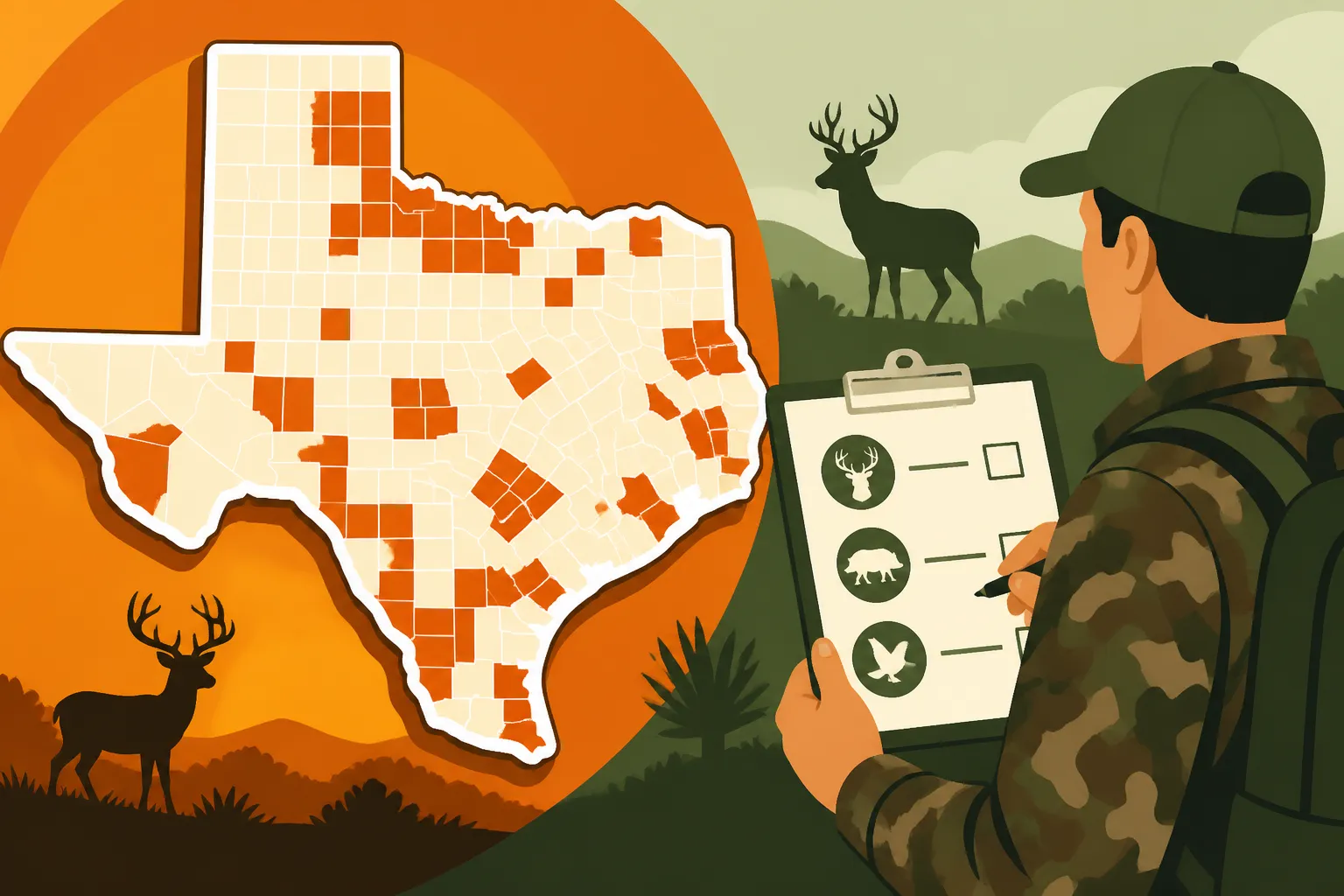
While whitetail deer are the most hunted big game in the state, mandatory reporting is not yet universal across all 254 counties for every deer taken. Instead, TPWD has implemented mandatory reporting in specific regions where they are conducting intensive research or managing specific antler restrictions. Most notably, this includes several counties in South-Central and Southeast Texas. If you are hunting in counties like Austin, Bastrop, Caldwell, Colorado, DeWitt, Fayette, Gonzales, Guadalupe, Karnes, Lavaca, Lee, Waller, Washington, or Wilson, you must report your harvest.
The Southeast Texas Mandatory Reporting Zone
This specific cluster of counties in Southeast Texas is under a mandatory reporting rule for all antlerless deer harvests. This is part of a long-term study to see how doe harvests affect the overall population in areas with high hunting pressure and fragmented land. If you drop a doe in Lavaca County, for instance, you have 24 hours to get that harvest logged in the app. This is a big shift from the old "doe days" system, and failing to do so can result in a hefty fine if a Game Warden stops you on the way to the processor.
Reporting Requirements for Antler Restriction Counties
Many hunters assume that because their county has a 13-inch rule, they must report the buck. This isn't always the case. While you should always check the Texas Antler Restrictions: 13-Inch Rule & Counties list, the mandatory reporting is often separate from the antler restriction itself. However, in the "experimental" counties mentioned above, both bucks and does may require reporting depending on the specific season. For example, if you are hunting during the Texas Muzzleloader Season & Counties window in a mandatory reporting county, the rules still apply regardless of the weapon used.
Mandatory Reporting on Managed Lands
If you are lucky enough to be hunting on a property enrolled in the Managed Lands Deer Program, the rules change entirely. In these cases, you aren't using the tags from your license; you are using MLDP Tags in Texas: How They Work. Because these tags are property-specific and designed to help landowners hit specific management goals, reporting is mandatory for every single animal taken on that land. The landowner or hunt manager usually handles the bulk of the paperwork, but as the hunter, you are responsible for ensuring the data is captured correctly before the meat leaves the gate.
| Species | Reporting Requirement | Method | Deadline |
|---|---|---|---|
| Whitetail (Selected SE Counties) | Mandatory | My Texas Hunt Harvest App / Web | 24 Hours |
| Eastern Turkey | Mandatory (All Counties) | My Texas Hunt Harvest App / Web | 24 Hours |
| Rio Grande Turkey | Mandatory (Selected Counties) | My Texas Hunt Harvest App / Web | 24 Hours |
| Mule Deer (Experimental Areas) | Mandatory | My Texas Hunt Harvest App / Web | 24 Hours |
| All Species (on WMA) | Mandatory | On-site Check Station or App | Before Leaving WMA |
Turkey Harvest Reporting Requirements
Turkey hunting in Texas is a tale of two subspecies: the Rio Grande and the Eastern. Because the Eastern turkey population is much more fragile and localized to the Pineywoods, the reporting rules are much stricter. If you are heading out for a spring gobbler, you need to be very aware of your location. Every single Eastern turkey harvested in Texas must be reported. There are no exceptions, and there are no "voluntary" counties when it comes to the Eastern subspecies.
The One-Gobbler Rule and Reporting in East Texas
In the counties where Eastern turkeys are hunted, such as those covered in the Texas Eastern Turkey Hunting Regulations 2026, the season is short and the limit is usually just one bird. Because the population is so carefully monitored, TPWD uses mandatory reporting to decide if a county will even stay open the following year. If you find yourself in the woods of East Texas, make sure your phone is charged. You’ll need to report that bird through the app or a designated site within 24 hours.
Rio Grande Turkey Reporting in Specific Zones
For the Rio Grande turkey, which dominates the Texas Rio Grande Turkey Season Dates 2026, reporting was voluntary for a long time. However, mandatory reporting has been expanded into several North Texas counties to monitor population declines in those specific riparian corridors. Counties like Bastrop, Caldwell, Colorado, Fayette, and others now require Rio Grande harvests to be logged. It can be confusing because you might be able to hunt without reporting in the Hill Country, but once you cross a county line toward the coast, the law changes. Always double-check the Texas Turkey Season 2026: Spring & Fall Zones map before you head out.
Physical vs. Digital Proof of Harvest
Even if you report your turkey digitally, you are still required to keep the "proof of sex" attached to the bird until it reaches its final destination. For a turkey, this is usually the patch of skin with the beard attached. I’ve seen hunters get into hot water because they thought the digital report replaced the need for physical evidence. It doesn't. Think of the digital report as the "data" and the beard/tag as the "legal evidence." Both are required to be 100% compliant when hunting Turkey Calling & Tactics for Texas Rios.
Mule Deer and Experimental Seasons
Mule deer are the icons of the Panhandle & Trans-Pecos Hunting in Texas, but they face unique challenges compared to whitetails. Because their numbers are lower and their habitat is more specific, TPWD uses mandatory reporting to manage "experimental" seasons. These are often short windows of time where hunters can take antlerless mule deer in counties that were previously buck-only.
Mandatory Reporting in the Panhandle
In certain Panhandle counties, TPWD has introduced antlerless mule deer permits that require mandatory reporting. This allows biologists to see if removing a certain number of does helps or hurts the overall buck-to-doe ratio in real-time. If you are participating in these hunts, you have to be meticulous. The Texas Mule Deer Hunting Regulations 2026 will specify if your county is part of this experimental group. Often, these tags are issued to specific properties, but even if they are "point of sale" tags, the reporting requirement follows the animal.
Trans-Pecos Reporting and CWD
The Trans-Pecos region is the heart of Texas mule deer country, but it is also a hotspot for CWD monitoring. While not every county in the West requires digital reporting for every deer, many of the Black Gap WMA Hunting (South Texas) areas and other public lands require you to check in your harvest at a physical station or through the app. This is often more about disease sampling than just counting heads. If you are hunting near the New Mexico border, expect mandatory reporting to be the norm rather than the exception.
The 20-Inch Rule and Data Collection
Some mule deer counties have a specific antler restriction known as the 20-inch rule. While this rule is designed to protect younger bucks, TPWD often asks for voluntary or mandatory reporting in these areas to see if the rule is actually producing the "trophy" class of deer they expect. When you are out in the wide-open spaces of West Texas, it’s easy to forget about paperwork, but keeping up with Mule Deer Hunting Tactics for Texas means also keeping up with the legal requirements that ensure those big desert bucks stay around for years to come.
Public Land and WMA Reporting
If you are hunting on public land, the rule of thumb is simple: always report. Whether it is a squirrel, a hog, or a trophy buck, the Texas Parks and Wildlife Department requires meticulous data from our Wildlife Management Areas (WMAs). This is because public lands are the most heavily pressured hunting areas in the state, and biologists need to know exactly how many animals are being removed to prevent over-harvesting.
Using the On-Site Check Station
Many of the premier WMAs, like the Chaparral WMA Hunting (South Texas), still utilize physical check stations. When you harvest an animal, you must bring it to the station before you leave the property. The biologists there will often take measurements, pull teeth for aging, and sometimes take CWD samples. In these locations, the physical check-in counts as your reporting requirement. It’s actually a great experience for a hunter; you get to see how your deer compares to others taken that weekend and get some expert insight into the health of the herd.
The Annual Public Hunting (APH) Permit Requirements
For those using the Annual Public Hunting Permit: What It Covers to hunt on smaller tracts or leased "Type II" land, you generally use the My Texas Hunt Harvest app. Because there isn't a biologist standing at the gate of a 500-acre dove field in North Texas, the responsibility is entirely on you. If you are hunting Mourning Dove Hunting Tactics for Texas, you might not need to report every bird, but for big game on these lands, the app is your best friend.
Reporting "Non-Game" on Public Lands
One thing that surprises many newcomers to the Texas Drawn Hunts & Public Hunt Draw 2027 system is that you often have to report "non-game" species like feral hogs or coyotes when taken on a WMA. While these animals have no season or limit on private land, they are still part of the biological data on public land. If you take a hog while deer hunting at a WMA, make sure you check your permit instructions. You’ll often find that the state wants to know about that harvest too, as it helps them manage the impact of invasive species on the native habitat.
Consequences of Non-Compliance
It is easy to view harvest reporting as just another piece of "red tape," but the legal consequences of ignoring these rules are real. Game Wardens in Texas have broad authority, and in the age of digital integration, they can see if you've reported a harvest almost as soon as you hit "submit." If you are caught with a harvested animal in a mandatory reporting county without a corresponding entry in the system, you aren't just looking at a small ticket; you could be facing a Class C misdemeanor and the loss of your harvest.
Common Reporting Mistakes and How to Fix Them
The most common mistake is waiting too long. Most mandatory reporting rules require the harvest to be logged within 24 hours. If you lose cell service at camp, you need to make a plan to get to a signal before that clock runs out. Another common error is reporting the animal under the wrong license type. If you are using a Texas Super Combo License, make sure you select the correct tag in the app. If you realize you’ve made a mistake, don't panic. You can usually contact TPWD's licensing division to correct a duplicate or erroneous report, but doing it sooner rather than later is key.
Game Warden Field Checks and Digital Receipts
When a Game Warden pulls you over or visits your camp, they will often ask to see your "harvest confirmation number." When you successfully report through the app, it generates a unique code. I always recommend taking a screenshot of that confirmation screen. Cell service in places like the Hill Country Hunting in Texas can be spotty at best, and having that screenshot saved to your photos can save you twenty minutes of frustration trying to get the app to load while a Warden stands by his truck.
The Long-Term Impact on Your Hunting Rights
Texas takes its wildlife laws seriously. Repeated failure to follow harvest reporting requirements can lead to the suspension of your hunting privileges. Under the Interstate Wildlife Violator Compact, a suspension in Texas can follow you to 48 other states. It’s simply not worth the risk. Beyond the legalities, reporting is our way of "paying it forward." The data we provide directly influences the Texas Hunting Seasons: Complete Calendar by Species, ensuring that we don't over-hunt an area to the point of closure.
Summary of Mandatory Reporting Counties for Whitetail
If you are hunting whitetail deer, keep this specific list of counties in mind for mandatory antlerless reporting. This list can expand, so always check the current Outdoor Annual before your first sit of the season.
- Austin
- Bastrop
- Caldwell
- Colorado
- DeWitt
- Fayette
- Gonzales
- Guadalupe
- Karnes
- Lavaca
- Lee
- Waller
- Washington
- Wilson
In these counties, the data collected is helping TPWD understand the transition from "doe days" to a more flexible harvest system. By participating, you’re helping prove that hunters can responsibly manage the herd without the need for overly restrictive, old-school calendar dates. Whether you are Bowhunting in Texas: Archery Season Guide or waiting for the general opener, your smartphone has become as vital a tool as your skinning knife.
Disclaimer
Texas hunting regulations are subject to change annually by the Texas Parks and Wildlife Commission. While this guide provides an overview of reporting requirements, hunters should always consult the official Texas Outdoor Annual or the TPWD website for the most current county-specific rules, bag limits, and emergency orders before heading into the field. Failure to comply with state laws can result in criminal penalties and the loss of hunting privileges.