Texas Mule Deer Hunting Regulations 2026
Hunting in Texas can sometimes feel like navigating a legal labyrinth, especially when you're targeting a specific species like mule deer, which have unique regulations compared to the widespread whitetail. It’s easy to get turned around with differing bag limits, antler restrictions, and regional zones. This comprehensive guide will clear up the fog surrounding the Texas Mule Deer Hunting Regulations, helping you plan a successful and compliant hunt in the vast, beautiful landscapes of the Lone Star State.
Understanding Texas Mule Deer Regions and Seasons
Texas offers some incredible opportunities for mule deer, but their presence is largely concentrated in specific parts of the state. Knowing these regions and their associated seasons is the first step toward a legal and rewarding hunt.
Panhandle and Trans-Pecos Zones
When we talk about mule deer in Texas, we're primarily looking at two distinct geographical areas: the Panhandle and the Trans-Pecos regions. These vast, often rugged landscapes are home to the vast majority of our free-ranging mule deer populations.
The Trans-Pecos is arguably the quintessential mule deer country in Texas. Think big mountains, sprawling mesas, and deep canyons, stretching from El Paso east to about the Pecos River. Counties like Hudspeth, Culberson, Jeff Davis, Presidio, Brewster, and Terrell are prime examples of this rugged terrain. Here, mule deer thrive in the arid, high-desert environment, often blending seamlessly with the rocky outcrops and sparse vegetation. The sheer scale of this country means that finding and pursuing mule deer can be a physically demanding but incredibly rewarding experience.
Further north, the Panhandle offers a different kind of challenge, with its vast plains, canyons, and agricultural lands. Counties like Dallam, Hartley, Oldham, Randall, Potter, and even areas around Palo Duro Canyon host healthy mule deer herds. While not as mountainous as the Trans-Pecos, the breaks and river bottoms here provide excellent cover and forage. Hunters often find mule deer in unexpected places, sometimes even venturing into farmland or along creek beds that offer relief from the open country. Understanding the specific topography of these zones is crucial for effective scouting and hunting.
Key Season Dates for Mule Deer
While specific dates for 2026 will be officially released by the Texas Parks and Wildlife Department (TPWD) later in the year, the season structure for mule deer in Texas is remarkably consistent year after year. Hunters should always consult the most current Texas Outdoor Annual for precise dates, but here's what you can typically expect.
The general mule deer season for firearms usually runs for a relatively short period, often spanning about two weeks in late November and early December. This timing is strategic, often coinciding with or just after the peak of the rut in many areas, which can make bucks more active and visible. For example, in recent years, the Panhandle and Trans-Pecos general seasons have started around the Saturday before Thanksgiving and run for approximately 16 days. This compact season window emphasizes the need for thorough preparation and efficient hunting strategies.
For those who prefer a more primitive challenge, archery season typically precedes the general firearms season, often beginning in late September or early October and running for several weeks. This gives bowhunters an earlier crack at mule deer before the main rifle pressure hits. Additionally, there are often special youth hunting weekend dates that allow young hunters to experience mule deer hunting with adult supervision before or after the general season, fostering the next generation of ethical hunters. It's vital to check the specific county regulations, as some areas might have slightly adjusted dates or special late-season opportunities, particularly on Managed Lands Deer Program (MLDP) properties.
Comparing Mule Deer Zones with Whitetail Areas
It's important to remember that mule deer hunting in Texas is distinct from hunting white-tailed deer, which are far more widespread across the state. While whitetails can be found in virtually every corner of Texas, mule deer are habitat-specific to the western and northern arid and semi-arid regions. This distinction also means the regulations, especially regarding antler restrictions, are tailored differently. Unlike the often complex Texas Deer Zones: North vs South Explained for whitetails, mule deer management zones are more straightforward, focusing primarily on the Panhandle and Trans-Pecos. This regional concentration simplifies, yet makes more critical, the understanding of mule deer-specific rules.
Mule Deer Bag Limits and Antler Restrictions in Texas
One of the most critical aspects of mule deer hunting in Texas is understanding the bag limits and, perhaps even more importantly, the antler restrictions. These rules are in place to manage the population sustainably and promote the harvest of mature bucks.
Statewide Bag Limits and Special Provisions
For mule deer in Texas, the bag limit is usually very conservative, reflecting the lower population density compared to white-tailed deer. Typically, the statewide bag limit for mule deer is one buck per person per license year. This is a hard and fast rule that hunters absolutely must adhere to. Unlike whitetail, where you might have multiple tags for bucks and does depending on the county and license type, mule deer hunters generally get one shot at a buck.
Doe tags for mule deer are exceedingly rare for public hunters and are usually only available through specific permits issued to landowners or Managed Lands Deer Program (MLDP) participants who are actively managing their herds. If you are hunting on a private lease, ensure you understand any specific landowner tags or MLDP permits that might be in play for does, but for the average hunter, anticipate a "one buck only" scenario. This makes every mule deer hunt a significant undertaking, demanding careful consideration and shot placement.
The 20-Inch Rule and How It Works
Texas is famous for its antler restrictions, and mule deer have their own specific set of rules, often referred to as the "20-inch rule." While white-tailed deer typically have a "13-inch rule" in many counties, mule deer buck harvest is usually restricted to those with an outside antler spread of at least 20 inches.
Here’s how to understand and apply the 20-inch rule:
- Outside Antler Spread: This measurement is taken at the widest point between the main beams of the antlers, perpendicular to the centerline of the skull. Imagine drawing a straight line from the outside of one main beam to the outside of the other at their widest point. That measurement must be 20 inches or greater.
- Why 20 Inches? This restriction is designed to protect younger, genetically superior bucks and allow them to mature, contributing to the herd's health and increasing the odds of hunters encountering larger, older animals. It's a key management tool for improving herd quality over time.
- Judging in the Field: This is where the challenge comes in. Accurately field-judging a 20-inch spread can be difficult, especially in the vast, open terrain where mule deer are often encountered at longer distances. Hunters should practice estimating antler spread on live animals or photos, using body cues and ear-tip measurements as reference points. A mule deer's ears, when alert and facing forward, are typically about 20-22 inches wide from tip to tip. This can be a helpful guide, though not foolproof, for estimating antler spread. When in doubt, it's always best to pass on a buck rather than risk violating regulations.
It's critical to be absolutely sure of your target and its legal antler size before taking a shot. Ignorance of the law is no excuse, and wardens take these regulations very seriously.
Reporting Your Mule Deer Harvest
Just like with white-tailed deer, reporting your mule deer harvest is a mandatory requirement in Texas, especially for public land hunts or in specific counties. This data is vital for TPWD to monitor mule deer populations, track harvest rates, and make informed management decisions.
The easiest and most common way to report your harvest is through the My Texas Hunt Harvest app, available for both iOS and Android devices. This app allows you to digitally log your harvest information, including species, sex, antler points (if a buck), and the county of harvest, directly from your phone in the field. This significantly simplifies the process compared to the old paper tag system. For more details on the process, refer to the guide on Texas Hunting Tags & Harvest Reporting (My Texas Hunt Harvest).
When you harvest a mule deer, you'll generally need to:
- Tag the animal: Immediately upon harvest, fill out your specific mule deer tag (if applicable, typically part of your hunting license) and attach it to the animal.
- Report the harvest: Within 24 hours (or before processing the animal or leaving the state), report the harvest via the My Texas Hunt Harvest app or the TPWD website.
This mandatory reporting helps biologists understand population trends, hunter success rates, and the overall health of the mule deer herds, ensuring sustainable hunting opportunities for future generations.
Licensing, Permits, and Other Essential Regulations
Beyond the specific game regulations, there are overarching requirements related to licensing, permits, and disease prevention that every mule deer hunter in Texas must be aware of.
Required Licenses and Endorsements
To legally hunt mule deer in Texas, you'll need the appropriate hunting license. For most residents, the Super Combo License is the go-to option, as it bundles a general hunting license, migratory bird stamp, upland game bird stamp, and a freshwater fishing stamp. It's a comprehensive package that covers nearly all hunting activities in Texas. For non-residents, a valid Texas Non-Resident Hunting License is required.
In addition to your general hunting license, there might be other endorsements depending on what else you plan to hunt or where. However, for mule deer specifically, the general hunting license is the primary requirement. Always ensure your license is valid for the current hunting year and that you carry it with you while hunting. You can learn more about purchasing options and types in the article, Texas Hunting License: Cost, Types & How to Buy (2026).
It's also crucial to remember that if you were born on or after September 2, 1971, you must complete a certified hunter education course to hunt in Texas, unless you are hunting under the direct supervision of a licensed hunter (for those 17 years of age or older) or are exempt (e.g., active duty military).
CWD Zones and Carcass Movement Restrictions
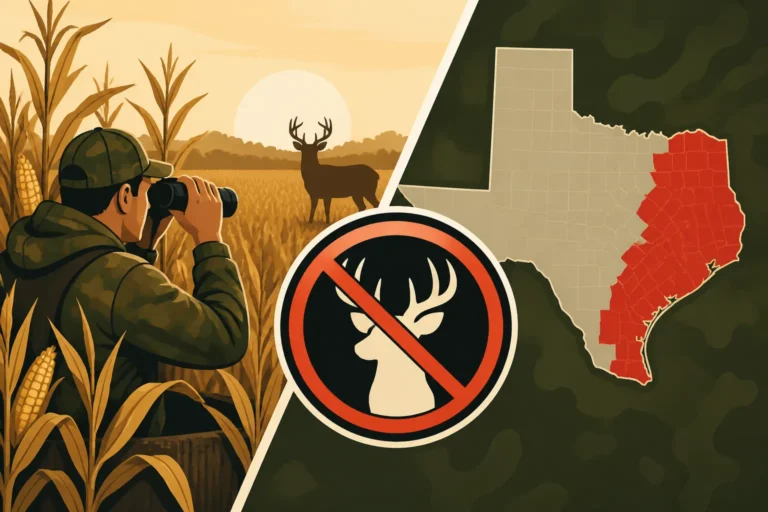
Chronic Wasting Disease (CWD) is a serious neurological disease affecting deer and elk, and it has been detected in wild deer populations in Texas, including mule deer in the Trans-Pecos and Panhandle. To combat its spread, TPWD has implemented CWD in Texas: Zones, Rules & Carcass Transport regulations.
If you are hunting in a designated CWD Zone, there will be specific requirements that impact your hunt:
- Mandatory Sampling: Any mule deer harvested within a CWD Zone may require mandatory CWD testing. This means you must take your harvested animal (or specific parts like the head) to a check station within a designated timeframe for sampling. TPWD provides locations and hours for these stations.
- Carcass Movement Restrictions: To prevent the spread of CWD, there are strict rules about moving deer carcasses out of a CWD Zone. Typically, you can only transport:
- Boned-out meat
- Cut and wrapped meat
- De-boned meat
- Quarters or other portions of meat with no part of the spinal column or head attached
- Hides with no head attached
- Skulls with antlers attached (after cleaning all brain and nervous tissue)
- Antlers, or a clean skull plate with antlers attached
- Finished taxidermy products
These regulations are critical, and non-compliance can result in significant penalties. Before heading out, always check the latest CWD maps and rules published by TPWD to see if your hunting area falls within a CWD Zone.
Public vs. Private Land Regulations
Texas is predominantly private land, meaning the vast majority of mule deer hunting occurs on private leases or ranches. However, there are some excellent public hunting opportunities available, primarily through the Texas Drawn Hunts & Public Hunt Draw 2026 and the Annual Public Hunting (APH) Permit system on Wildlife Management Areas (WMAs).
- Private Land: When hunting on private land, you are subject to statewide regulations (bag limits, antler restrictions, CWD rules, licensing) and any additional rules set by the landowner or lease manager. This often includes specific instructions on where you can hunt, types of weapons allowed, access roads, and harvest reporting for their records. Many private ranches operate under the MLDP, which can grant extended seasons or different bag limits, so always clarify these details with your outfitter or lease manager.
- Public Land (WMAs, Drawn Hunts): Public hunting on WMAs or through drawn hunts often comes with its own set of very specific regulations that can be even more restrictive than statewide rules. These might include:
- Specific Hunt Dates: Drawn hunts have exact dates, often only a few days long.
- Bag Limits: May be different from statewide limits, sometimes limiting harvest to only one buck or one doe.
- Weapon Restrictions: Some hunts may be archery-only or muzzleloader-only.
- Permit Requirements: You'll need an APH Permit in addition to your license for most WMA hunting, or a specific drawn hunt permit.
- Check-in/Check-out: Mandatory check-in and check-out procedures are common, where you present your game for biological data collection.
It is absolutely crucial to read and understand the specific hunt rules for any public land you intend to hunt. The "Annual Public Hunting Permit: What It Covers" can provide more insights into this avenue.
Practical Considerations and Ethical Hunting for Mule Deer
Beyond the legalities, a successful and ethical mule deer hunt in Texas demands careful planning, respect for the land, and a commitment to responsible hunting practices.
Scouting and Preparation for Mule Deer Hunting
Mule deer hunting in Texas, especially in the rugged Trans-Pecos or vast Panhandle, is often about covering ground and glassing. Effective scouting is paramount and begins long before opening day.
- Pre-Season Reconnaissance: If you have access, spending time in your hunting area in the off-season can reveal migration patterns, water sources, bedding areas, and travel corridors. Look for rub lines, old scrapes, and distinct trails. Pay attention to how the deer use the landscape during different parts of the day. Utilize tools like mapping apps such as onX Hunt or HuntStand, which are considered some of the Best Hunting Apps for Texas (onX, HuntStand & More), to mark potential hotspots, property lines, and access points.
- Glassing Techniques: In open country, good binoculars and a spotting scope are your best friends. Invest in quality optics, as you’ll be spending hours behind them. Learn to systematically glass hillsides, canyon rims, and distant valleys. Don't just scan; slowly pick apart the landscape looking for an ear flick, a patch of antler, or a deer's silhouette against the skyline. Often, it's the subtle differences in texture or color that give away a bedded deer.
- Understanding Mule Deer Behavior: Mule deer tend to be creatures of routine, but they adapt quickly to pressure. Learn about their seasonal movements, feeding habits, and how they react to weather changes. They often move more during the cooler parts of the day – dawn and dusk – but can be found bedded on sunny slopes to warm up or in shaded draws to cool down, depending on the temperature. Understanding how to pattern deer with trail cameras can also be invaluable, as discussed in "How to Pattern Bucks With Trail Cameras." This strategic insight is particularly important in the challenging terrain mule deer inhabit.
Shot Placement and Field Dressing in Remote Areas
Taking an ethical shot and properly field dressing your mule deer are critical responsibilities that take on even greater importance in remote Texas mule deer country.
- Ethical Shot Placement: Always strive for a clean, humane kill. For mule deer, the vitals (heart and lungs) are located behind the front shoulder. A broadside shot, aiming approximately one-third up the body directly behind the shoulder, is usually ideal. Practice shooting from various positions and distances to ensure accuracy. If you’re hunting in areas with long-range shot opportunities, make sure your rifle and scope are sighted in perfectly, and always know your limits. Avoid risky shots that could wound an animal, leading to prolonged suffering and potentially a lost deer in vast, unforgiving terrain. The article "Best Shot Placement for Whitetail Deer" offers relevant principles for all deer species.
- Field Dressing in the Heat: Texas weather can be notoriously warm, even in late fall. Rapidly cooling your game is essential to preserve the meat, especially for a large animal like a mule deer. Immediately after the shot, field dress the animal to remove the internal organs and allow the carcass to cool.
- Ventilation: Prop the body cavity open with a stick or spreader to maximize airflow.
- Shade: Move the deer to the shade immediately.
- Ice: If possible, place bags of ice in the chest cavity, especially if you have a long retrieve or drive ahead.
- Expedited Transport: Plan your retrieval method beforehand. A game cart can be a lifesaver for hauling out a big mule deer from difficult terrain.
The detailed guide on "How to Field Dress a Deer in Hot Weather" provides excellent, practical advice for these challenging conditions.
Respecting Landowner Rights and Regulations
Hunting mule deer in Texas often means hunting on private land, which comes with a significant responsibility to respect the landowner, their property, and any specific rules they have in place.
- Communication is Key: Always maintain clear and respectful communication with the landowner or lease manager. Understand their expectations regarding gates, fences, roads, and non-hunting areas.
- Leave No Trace: Pack out everything you pack in. Avoid littering, clean up your camp, and leave the property in better condition than you found it. This helps build goodwill and ensures future hunting opportunities.
- Vehicle Use: Stick to designated roads and trails to avoid tearing up pastures or getting stuck. Be mindful of dust, especially when approaching hunting areas.
- Ethical Behavior: Demonstrate sound judgment and ethical behavior at all times. This includes respecting wildlife, making clean kills, and promptly retrieving game. Your actions reflect not only on you but on all hunters. Adhering to these principles is essential for maintaining access to the private lands that provide the backbone of Texas hunting opportunities.
By focusing on these practical and ethical considerations, you not only increase your chances of a successful mule deer hunt but also uphold the proud tradition of responsible hunting in Texas.
| Region | Typical General Firearms Season Dates | Bag Limit | Antler Restriction | Special Considerations |
|---|---|---|---|---|
| Panhandle | Late Nov – Early Dec (approx. 16 days) | 1 Buck | 20-inch Outside Spread (min) | CWD Zones possible, check TPWD annually |
| Trans-Pecos | Late Nov – Early Dec (approx. 16 days) | 1 Buck | 20-inch Outside Spread (min) | CWD Zones common, mandatory testing may apply |
Note: Season dates are projections based on historical TPWD calendars for 2026. Always verify exact dates and regulations with the official Texas Parks and Wildlife Department Outdoor Annual for the current year.
Disclaimer
Please remember that hunting regulations can change. While every effort has been made to provide accurate and up-to-date information, this guide is for informational purposes only. Always consult the official Texas Parks and Wildlife Department (TPWD) Outdoor Annual or their website for the most current and legally binding regulations before you head out into the field.