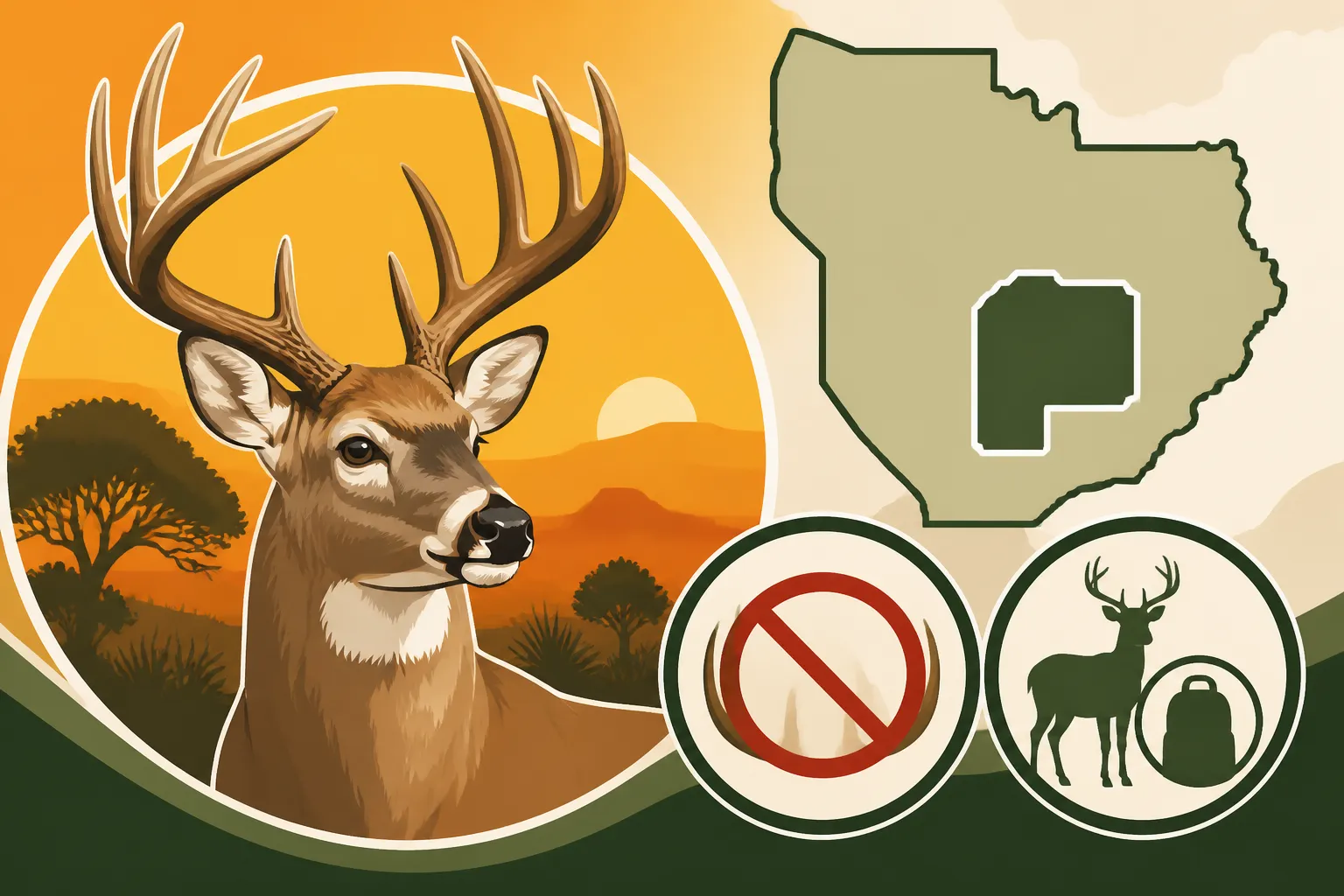
McMullen County Antler Restriction & Bag Limit
It’s easy to feel overwhelmed by the ever-changing and often county-specific hunting regulations here in Texas, especially when it comes to antler restrictions and bag limits for white-tailed deer. You might be scratching your head, wondering if that buck you're seeing through your binoculars is legal to harvest, or how many deer you can actually take home. This guide is here to untangle the specifics for McMullen County, ensuring you understand the rules and can hunt confidently and responsibly.
Decoding Texas Antler Restrictions for White-tailed Deer
Navigating the various antler restriction (AR) rules across Texas can feel like trying to solve a complicated puzzle, especially when you cross county lines. What might be legal in one county could get you a ticket in another. It's not just about the size of the rack; it's about helping the deer herd thrive.
The Statewide vs. County-Specific Antler Restriction Divide
For many years, hunters in Texas followed fairly straightforward rules: a certain number of bucks and does, with little differentiation based on antler size beyond "forked horn" or "spike." However, wildlife biologists and landowners began noticing a skewed buck-to-doe ratio and a lack of mature bucks in many areas. The goal was to allow younger bucks a chance to mature and to improve the overall genetic health and age structure of the deer herd.
This led to the implementation of the statewide 13-inch antler restriction rule in many counties, designed to protect yearling and two-year-old bucks. This rule typically dictates that a legal buck must have an inside spread of 13 inches or greater OR have at least one unbranched antler (often called a spike). But here's where the confusion really kicks in: not all counties follow this exact rule, or they have additional criteria. This variation is a direct result of tailored wildlife management plans for specific regions, taking into account local deer populations, habitat, and harvest data. It's why it's absolutely crucial to check the regulations for the specific county you're hunting in, every single season. For a deeper dive into the broader picture, you might want to read our comprehensive guide on Texas Antler Restrictions: The 13-Inch Rule Explained.
The Rationale Behind Antler Restrictions
At its core, the implementation of antler restrictions is a wildlife management strategy aimed at enhancing the quality of the deer herd. The idea is simple: if hunters primarily harvest mature bucks and a limited number of younger bucks that don't meet specific criteria, more young bucks will survive to older age classes. This increases the likelihood of a healthier, more balanced deer population, both in terms of age structure and genetic diversity.
For example, by protecting most 1.5 and 2.5-year-old bucks, these deer have the opportunity to reach their prime, not only growing larger antlers but also contributing to the breeding pool for more seasons. This selective harvesting helps prevent over-harvesting of young, genetically superior bucks that could otherwise contribute significantly to the herd. It’s about managing for long-term health, not just short-term trophy hunting, although bigger antlers are often a welcome byproduct. These regulations are a key component of what biologists refer to as quality deer management (QDM), ensuring sustainable hunting for generations to come.
McMullen County Specific Antler Restrictions & Bag Limits
McMullen County, nestled deep in the heart of South Texas, is renowned for its incredible deer hunting. However, to maintain the quality of its whitetail herd, it operates under specific antler restrictions and bag limits that differ from some other parts of the state. It's a critical area for serious hunters, so understanding these nuances is paramount.
The Unique Antler Rules of McMullen County
Here's the crucial detail you need to know for McMullen County: it falls under the South Texas Antler Restriction program. This means the rules for what constitutes a legal buck are quite specific and sometimes misunderstood.
In McMullen County, you can harvest two buck deer. However, there's a vital distinction:
- Only one buck harvested in McMullen County may have an inside spread of 13 inches or greater.
- The other buck (if you choose to harvest a second one) must have at least one unbranched antler (a spike). This means it cannot be a multi-pointed buck with less than a 13-inch spread; it must have a spike.
This specific rule is designed to accomplish a couple of things. Firstly, it allows hunters to take a mature, wider-racked buck, which aligns with traditional trophy hunting values in South Texas. Secondly, by limiting the second buck to a "spike," it protects the vast majority of young, genetically promising bucks that might have a small, narrow rack but are only 1.5 or 2.5 years old. These protected bucks are the future of the herd, given another year or two to grow. This regulation aims to funnel hunter pressure towards older, mature bucks and those younger bucks with less desirable antler genetics (spikes). You really need to be certain before you squeeze that trigger, as misjudging can lead to hefty fines.
Interpreting "Legal Buck" in the Field
Field judging can be challenging, even for seasoned hunters. In McMullen County, with its unique "one wide, one spike" rule for bucks, the pressure to accurately assess a deer can be high. When you spot a buck, the first question is whether it has an inside spread of 13 inches or more. This often requires considerable practice and a keen eye. Many hunters use the deer’s ears as a benchmark; typically, a mature whitetail’s ears, when alert, will measure about 15-16 inches from tip to tip. So, if the main beams extend significantly outside the ears, it's a good indicator it might meet the 13-inch spread requirement.
The second part of the rule, regarding the "spike" buck, is usually easier to identify. A "spike" means a hardened antler with no branching points. It’s critical to remember that if you've already harvested your "13-inch or greater spread" buck, your second buck must be a spike. You cannot take another narrow-racked, young buck with multiple points, even if it looks small. This is where patience and careful observation come into play. Always be sure before taking the shot, and when in doubt, let that deer walk. Learning How to Field Judge a 13-Inch Buck can be incredibly helpful for this specific scenario.
Understanding Deer Bag Limits for McMullen County
Beyond the antler restrictions, knowing your total bag limit for white-tailed deer in McMullen County is equally important. Texas Parks and Wildlife Department (TPWD) sets these limits to ensure a sustainable harvest across different regions. For McMullen County, as part of the South Texas deer zone, the general bag limit for white-tailed deer is 4 deer total, with specific allowances:
- No more than 2 bucks. As detailed above, these two bucks are subject to the specific antler restrictions (one with 13+ inch spread, one spike).
- No more than 2 antlerless deer. This means does. However, there's a crucial caveat: all antlerless deer must be tagged with an Antlerless Deer Tag or be harvested during a special antlerless-only season (like some youth hunts) or on a Managed Lands Deer Program (MLDP) property.
On many private leases in McMullen County, especially those enrolled in the MLDP, you might find different bag limits and tagging requirements. MLDP properties often have an extended season and more flexible tagging rules, sometimes allowing for more antlerless deer to be harvested directly with landowner-issued tags, without using your general hunting license tags for does. Always confirm these specific rules with your landowner or lease manager. It's a system designed to help landowners better manage their local deer populations for optimal health and balance. For more general information on this, check out Texas Whitetail Bag Limit & Buck Rules.
Practical Application and Ethical Hunting in McMullen County
Hunting responsibly in McMullen County isn't just about understanding the regulations; it's about applying them ethically and ensuring you contribute positively to the rich hunting heritage of Texas. This means being prepared, patient, and precise in your actions, both in the field and after the harvest.
Best Practices for Field Judging Bucks
Field judging can make or break your hunt, especially with strict antler restrictions. You might be shaking with buck fever, but that's precisely when you need to slow down and verify your target. When you spot a buck, immediately reach for your binoculars or spotting scope. Don't rush. The first buck you see might not be the last, and rushing a shot is how mistakes happen.
Focus on the inside spread: visually compare the main beams to the ear tips. If the ears are alert and measuring around 15-16 inches, then anything inside those tips is likely under 13 inches. If the antlers clearly extend beyond the ears, you're likely good on the spread. Next, check for branching. Does it have at least one unbranched antler? Or does it have multiple points on both sides? Remember, the McMullen County rule means only one buck can be 13 inches or greater spread; the other must be a spike. If you've already taken your wide buck, you must wait for a spike for your second buck. Practice with photos or videos of deer before the season begins. There are great resources online that show deer with various antler configurations to help sharpen your eye. Consider setting up How to Pattern Bucks With Trail Cameras to get a better idea of the deer on your property before the season even starts.
Tagging and Reporting Requirements in McMullen County
Once you've successfully harvested a deer in McMullen County, your responsibilities don't end there. Proper tagging and harvest reporting are legal requirements and crucial for wildlife management. Immediately upon harvesting, you must complete the appropriate tag from your Texas hunting license, detaching it and attaching it to the deer. The tag needs to be filled out legibly with the date and time of harvest, and the county where it was taken (McMullen County, in this case).
After tagging, the next step is harvest reporting. All white-tailed deer harvests in Texas must be reported through the My Texas Hunt Harvest app or online. This applies to bucks and antlerless deer alike, even if harvested on an MLDP property where you used a landowner tag. This data is invaluable to TPWD biologists for assessing deer populations, understanding harvest pressure, and making informed decisions about future regulations. You have 24 hours to report your harvest after reaching a final destination or checking in at a check station (if applicable). Don't delay, as failing to report can lead to legal penalties. For detailed instructions, refer to Texas Hunting Tags & Harvest Reporting (My Texas Hunt Harvest).
| Category | McMullen County Regulations | General South Texas Zone (Example) |
|---|---|---|
| Buck Bag Limit | 2 bucks per season | 2 bucks per season |
| Buck Antler Rules | 1st buck: Inside spread 13 inches or greater | 1st buck: Inside spread 13 inches or greater |
| 2nd buck: Must have at least one unbranched antler | 2nd buck: Must have at least one unbranched antler | |
| Antlerless Bag Limit | 2 antlerless deer | 2 antlerless deer |
| Antlerless Tags | Requires Antlerless Deer Tags, MLDP tags, or special season | Requires Antlerless Deer Tags, MLDP tags, or special season |
| Total Deer Limit | 4 deer total (no more than 2 bucks, 2 does) | 4 deer total (no more than 2 bucks, 2 does) |
Note: Always consult the current year's Texas Parks and Wildlife Department Outdoor Annual for the most up-to-date and complete regulations, as rules can change annually.
Beyond the Rules: Ethical Considerations in McMullen County
While adhering to the letter of the law is a must, true ethical hunting extends beyond legal requirements. In a county like McMullen, known for its outstanding whitetail, it's about respecting the resource, the land, and the future of hunting. This means making responsible shot placements to ensure a quick and humane harvest, minimizing the chance of wounding a deer. It also means thorough tracking, even if you think you made a perfect shot, to recover every animal.
Furthermore, ethical hunting encompasses respecting private property, being a good steward of the land if you're on a lease, and always being considerate of other hunters. Your actions reflect on the entire hunting community. By understanding and following the specific antler restrictions and bag limits in McMullen County, and by approaching your hunt with respect and ethical mindfulness, you're not just securing a harvest; you're actively participating in the conservation efforts that make Texas hunting so special. For more insights into how to make your hunt even better, consider exploring Deer Hunting in Texas: Feeders, Blinds & Tactics or our detailed South Texas Deer Hunting: Brush Country Guide.
Disclaimer
Please remember that hunting regulations are subject to change annually. While this guide aims to provide accurate and up-to-date information for McMullen County, it is essential to consult the official Texas Parks and Wildlife Department (TPWD) Outdoor Annual for the current year before you head out into the field. The information provided here is for general guidance and informational purposes only and does not constitute legal advice. Always prioritize safety and legal compliance.