Rut Hunting Tactics: Rattling & Grunting in Texas
There is nothing quite as frustrating as sitting in a blind, watching a corn feeder spin for the hundredth time, while mature bucks completely ignore the grain and disappear into the dense brush. During the breeding season, food takes a back seat to natural instincts, leaving standard feeder setups feeling completely lifeless. Master the art of calling, grunting, and rattling to challenge aggressive bucks, pull hidden trophies out of thick cover, and transform your hunting season.
Understanding the Texas Whitetail Rut Cycle Across Regions
Regional Timelines and Peak Breeding Windows
The Texas whitetail breeding season is notoriously diverse, behaving almost like several different states packed into a single set of borders. If you try to rattle bucks in South Texas during late October using tactics meant for East Texas, you will likely sit in silence all day. In the Pineywoods and East Texas, the rut kicks off surprisingly early, often peaking in late October or very early November. Bucks in those thick river bottoms begin actively searching for does while the weather is still uncomfortably warm, making vocalizations and soft social calling far more effective than heavy, violent antler clashes.
Moving west into the Texas Hill Country, the breeding timeline shifts slightly later into November. Here, high deer densities create intense competition among young and middle-aged bucks, resulting in a prolonged, highly visible pre-rut phase. You will see bucks constantly chasing does through cedar brakes and live oak draws, reacting enthusiastically to grunt calls and moderate rattling. Understanding this regional progression is crucial because calling success relies entirely on matching your vocalizations to the specific behavioral mindset of the local herd at that exact moment in the season. To better map out your calendar, review The Texas Rut: When Do Bucks Rut by Region? before planning your vacation days.
Down in the legendary South Texas Brush Country, the magic happens much later than anywhere else in North America. The breeding window usually peaks in mid-to-late December and can stretch well into early January. The arid landscape and sparse rainfall dictate a survival strategy where does come into estrus later, ensuring fawns are born when spring rains bring fresh green growth. Because South Texas often maintains a balanced adult sex ratio with a high concentration of mature bucks, the competition here is fierce. When you smash a set of real antlers together in Webb, Dimmit, or La Salle County during December, mature bucks do not just look in your direction; they sprint in ready for a brawl.
The Pre-Rut, Peak Rut, and Post-Rut Behaviors
Recognizing the subtle shifts between the three distinct phases of the rut will make or break your calling strategy. The pre-rut phase is widely considered the absolute golden window for aggressive calling tactics. During this period, bucks are surging with testosterone, their necks are swollen, and they are actively establishing the dominance hierarchy for the upcoming breeding window. They are roaming widely, making rub lines and scraping frenziedly along field edges. Because receptive does are not yet fully available, bucks are hyper-responsive to any sound that suggests another buck is intruding on their territory or courting a local doe.
When the peak rut actually arrives, the dynamic changes dramatically in ways that confuse many hunters. This is often referred to as the lockdown phase. Mature bucks have successfully isolated receptive does and will stay glued to their side in dense mesquite thickets, creek bottoms, or heavy brush for 24 to 48 hours at a time. During peak rut, rattling success can drop significantly because a buck who already has a doe in his possession has very little motivation to leave her side to investigate a fight. Grunt calls and subtle tending vocalizations remain useful now, as you are attempting to trick an attending buck into thinking a rival is stealing his doe right under his nose.
The post-rut period brings a second wave of intense action that many hunters overlook due to fatigue or tag fulfillment. By late December or early January, depending on the region, the majority of does have been bred, but a few unbred adult does or early-maturing fawn does come into a secondary estrus cycle. Surviving mature bucks are exhausted, battle-scarred, and desperate to find these last remaining breeding opportunities. Calling during the post-rut requires patience. While there are fewer active bucks roaming the woods, the ones remaining are mature survivors who will respond to soft grunts and short, realistic rattling sequences that signal a late-season competition.
Weather Impacts and Temperature Inversions in Texas
Texas weather is notoriously unpredictable, presenting sudden shifts from lingering summer heat to dramatic arctic cold fronts known as Blue Northers. Weather plays a massive role in how sound travels through the brush and how eager bucks are to move. High temperatures are the ultimate enemy of the calling hunter. When midday temperatures climb into the eighties, bucks restrict their movement almost entirely to the cool hours of darkness. Trying to rattle in sweltering heat usually results in zero responses, or worse, educates bucks that come in quietly downwind under the cover of thick vegetation without ever revealing themselves.
A sudden cold front completely flips this script. As the barometric pressure rises and temperatures drop twenty or thirty degrees in a matter of hours, deer activity explodes across the state. The morning after a cold front passes is prime time for calling. The cold, dense air allows sound waves from antler crashes and wooden grunt tubes to travel much farther across open pastures and senderos. Bucks feel energized by the chilly air and are far more willing to exert the massive energy required to fight or aggressively investigate rival vocalizations.
Temperature inversions, which frequently occur on clear, still mornings in valleys and low-lying draws, require careful tactical planning. In an inversion, cold air gets trapped near the ground while warmer air sits above it, causing thermal air currents to carry your scent downward toward riverbeds or senderos. If you are calling from an elevated ridge into a draw, your calling sounds may carry beautifully, but your wind will drop straight down into the nostrils of incoming deer. Always monitor local wind directions and thermal shifts closely when selecting a stand location for a calling session, ensuring that your sound reaches the buck before your smell does.
Essential Gear for Calling Texas Bucks
Real Antlers versus Synthetic Rattling Systems
The debate between using real whitetail antlers versus engineered synthetic rattling devices is as old as Texas deer hunting itself. Real antlers offer an authentic, sharp, bone-on-bone crispness that synthetic materials struggle to replicate perfectly. The natural porous interior and hard outer enamel of genuine shed antlers produce specific high-frequency tones and deep cracks that resonant perfectly through the Texas brush. Many veteran hunters prefer a medium-sized shed rack from an eight or ten-point buck, taking care to saw off the brow tines to protect their knuckles during aggressive clashing sessions.
However, real antlers come with distinct drawbacks, primarily weight, bulk, and potential brittleness. In the arid Texas climate, real antlers can dry out over time, becoming brittle and hollow-sounding, or even cracking upon hard impact. Synthetic rattling bags, plastic antlers, and rattling sticks offer a compact, lightweight, and extremely durable alternative. Rattling bags, which contain hardwood or plastic rods inside a heavy canvas pouch, allow for easy one-handed operation. This is a massive advantage if you are hunting alone and need to keep your primary hand on your rifle or bow while generating realistic rubbing and clicking sounds.
Modern high-end synthetic antler systems have closed the realism gap significantly. Made from high-density polymers engineered to match the weight and acoustic resonance of natural bone, these systems can project sound across massive distances on windy days. If you hunt vast landscapes like South Texas or the Panhandle, where you need maximum volume to reach bucks bedded a quarter-mile away, high-volume synthetic racks or heavy real antlers are superior. If you are tucked into tight cover in East Texas where subtle, close-range sounds are required, a soft wooden rattling bag gives you precise control over your acoustic footprint.
Vocalization Calls: Grunt Tubes, Bleat Cans, and Snort-Wheezes
A comprehensive vocalization kit is just as critical as your rattling setup. The core of your calling arsenal should be an adjustable grunt tube capable of producing a range of frequencies, from the low, raspy tone of a dominant old buck to the higher-pitched sound of a young buck. Rubber-bodied grunt tubes are generally preferred over hard plastic models because they do not make loud clanking noises if accidentally bumped against your rifle stock or stand frame. Look for grunt tubes with flexible expander hoses, which allow you to change the direction and pitch of the call mid-breath, mimicking a buck turning his head while walking through the brush.
The estrus bleat call, often housed in a simple turn-over canister design, introduces the female dynamic to your setup. A bleat simulates an estrus doe signaling her readiness to breed or calling out to a nearby buck. When combined with buck grunts, the estrus bleat creates a convincing audio narrative of a buck actively trailing or tending a doe. The sound is high-pitched, nasal, and emotional, often cutting through ambient wind noise when low-frequency grunts fail to carry.
Finally, the snort-wheeze is the most aggressive vocalization in the whitetail language, requiring no fancy equipment at all. Produced naturally by forcing air sharply through squeezed nostrils and lips in a three-note rhythm, this call represents a direct, face-to-face challenge from one buck to another. While you can purchase mouth-operated snort-wheeze calls, practicing the sound naturally using your own breath gives you unmatched versatility. The snort-wheeze should be used sparingly, reserved primarily for when you spot a mature buck who is ignoring other calls or when you want to trigger an immediate territorial response from a known alpha buck.
Scent Control and Wind Strategy in Dense Cover
No amount of world-class calling skill will save your hunt if an incoming buck catches your scent. Whitetails possess an acute sense of smell, and their immediate natural reaction to hearing a fight or a courting buck is to swing downwind of the sound before committing visually. They want to smell who is fighting before they walk into an ambush. Therefore, every calling setup must be built around a strict wind strategy. You must anticipate the exact path an incoming buck will take to get the wind in his favor, and position yourself so that his downwind path forces him into an open shooting lane.
Scent control gear plays a supporting role, but it never replaces intelligent wind management. Washing clothes in scent-free detergents, storing gear in sealed plastic bins with native cedar or sage sprigs, and spraying down liberally before walking into the field help reduce your overall odor footprint. When calling in dense mesquite, thorn scrub, or river bottoms, your scent can collect in heavy pockets rather than dispersing cleanly. Using natural cover scents derived from local flora, such as crushed junipers or mesquite leaves, can provide a momentary distraction if a buck catches a faint whiff of human presence.
Always carry a lightweight wind-checker bottle filled with odorless powder or use a natural feather tied to your gear to monitor micro-drafts. In hilly terrain, air currents can swirl unpredictably, carrying your scent in completely different directions than the overarching ambient wind. If the wind shifts unexpectedly mid-hunt and starts blowing directly into the bedding cover you are targeting, abort the calling session immediately. Calling a buck into your scent plume educates him permanently, making him call-shy and far more cautious for the rest of the season.
Rattling Strategies and Techniques That Trigger Attacks
The Initial Contact Sequence: Volume, Tempo, and Cadence
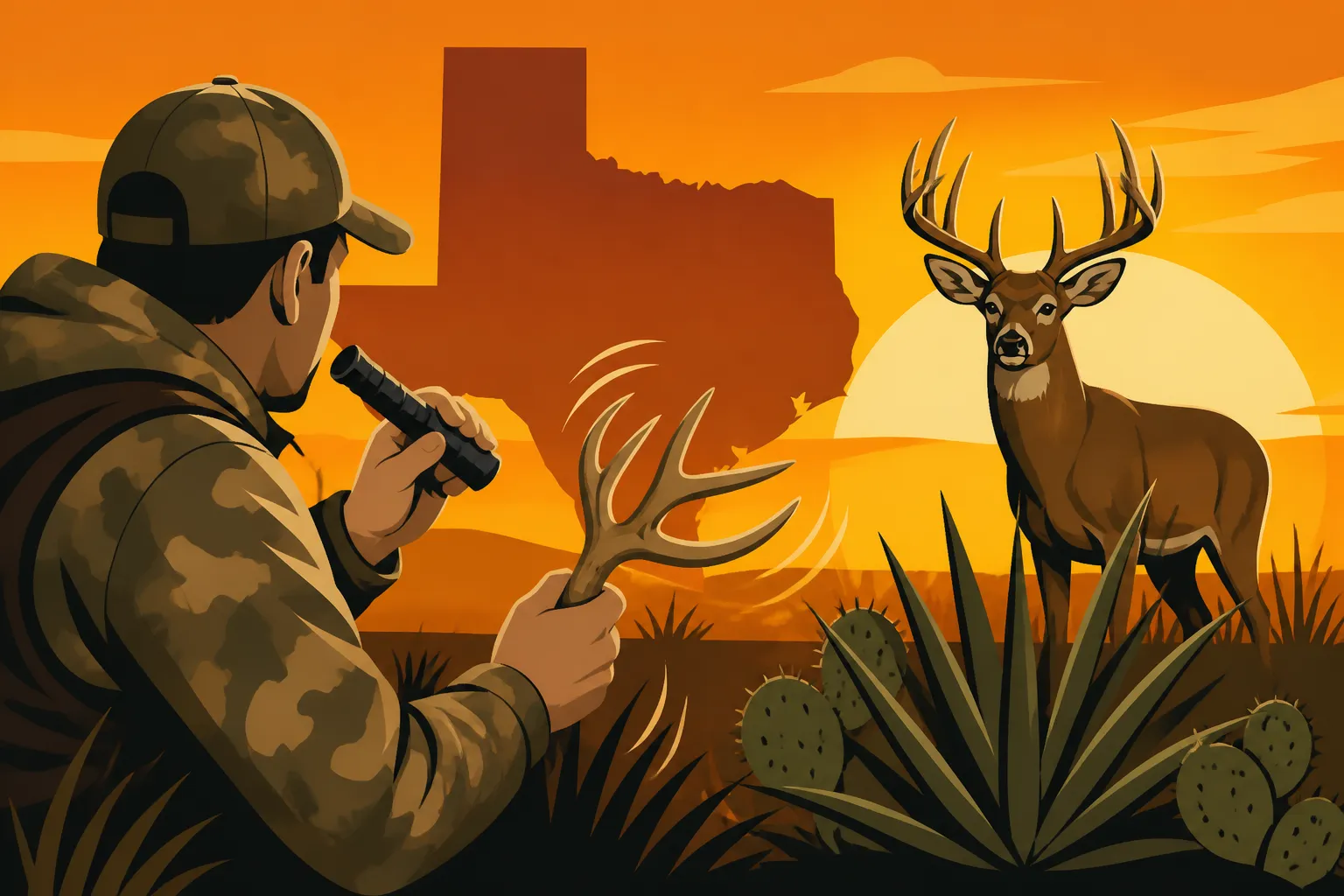
A successful rattling sequence tells a convincing story through sound. Simply banging two antlers together at random rarely deceives a veteran Texas buck. Your initial contact sequence should begin with intent and energy. Start by cracking the main beams together forcefully to simulate the sudden, violent clash of two heavy bucks colliding at full speed. Follow this initial impact immediately with rapid, aggressive grinding and twisting of the tines. Real buck fights involve massive twisting leverage as two animals lock antlers and attempt to throw each other off balance.
Varied tempo and cadence are what separate amateur callers from seasoned experts. A real fight is not a continuous, monotonous noise; it moves in violent bursts separated by short pauses where the bucks lock up, strain against each other, and catch their breath. Your sequence should reflect this natural rhythm. Rattle violently for fifteen to twenty seconds, pause for three seconds while maintaining pressure on the antlers to make subtle clicking noises, and then explode back into a furious grinding sequence. Keep your hands moving aggressively, changing the pitch and angle of the antlers to simulate two heads shifting position continuously.
Volume control must be adjusted based on terrain, wind speed, and target distance. On calm mornings in tight timber, an overly loud initial clash can startle nearby deer and send them running in panic. In these stealthy situations, begin your sequence with a subtle, low-volume tickling of the tines, simulating two young bucks lightly sparring. If nothing responds after ten minutes, step up the intensity. Conversely, on vast prairie leases or open brush country on a windy day, throw caution to the wind and smash the horns as loudly as physically possible right from the first second to ensure the sound breaks through the noise of the wind.
Blind Rattling vs Sight Calling Scenarios
Blind rattling refers to calling into cover where you suspect a buck might be bedded or traveling, even though you cannot physically see him. This is the most common form of rattling in Texas, especially when working from elevated stands overlooking dense brush or along creek edges. Blind rattling requires exceptional discipline and mental patience. Because you cannot see the approaching animal, you must assume that a buck is stealthily slipping through the cover toward your position after every single sequence. You must keep movement to an absolute minimum and maintain total focus on your surroundings for at least twenty to thirty minutes after finishing a sequence.
Sight calling, on the other hand, is one of the most thrilling experiences in white-tailed deer hunting. This scenario occurs when you spot a buck cruising across a senderos, pasture, or ridge at a distance, and you use your calls to intercept him. When sight calling, you have the immense advantage of reading the deer’s body language in real time. As soon as you crack the antlers or blow the grunt call, watch his reaction closely through your binoculars. If he stops, snaps his head up, cups his ears toward you, and drops his tail, he is interested. Hit him again immediately to lock his attention, then lower your hands and prepare for the approach.
If a buck you are sight calling looks toward you briefy and then continues walking away, you need to radically alter your strategy. Increase the aggression immediately. Hit him with a louder, harsher rattling burst or blow a sharp snort-wheeze. You have nothing to lose at this point since he is already leaving your area. Often, a mature, dominant buck that ignores soft grunts will instantly spin on his hooves and charge back if he feels his dominance is being directly challenged by a brazen trespasser on his turf.
Pairing Ground Debris and Bush Thrashing with Antler Contact
Antlers hitting each other represent only fifty percent of the total noise generated during an actual deer fight. When two powerful bucks engage in combat, their hooves tear up the turf, low-hanging branches are snapped, and nearby brush is furiously thrashed. To make your calling setup sound undeniably real, you must incorporate ground debris and vegetation into your routine. This is why ground-level hunting or calling from lower tripods often yields such dramatic results compared to sitting high in a box blind.
While clashing the antlers with one hand or between your knees, use your free hand or foot to kick dirt, stomp leaf litter, and crush dry twigs on the ground. Reach out with the tips of the antlers and aggressively rake them through nearby mesquite limbs, cedar boughs, or tall grass. This simulates a buck rubbing his forehead gland against brush or violently pushing his opponent through the understory. The combination of hollow wood breaking, foliage rustling, and heavy antler clashing creates a rich, three-dimensional soundscape that removes any doubt in an approaching buck’s mind.
If you are hunting from an elevated blind where you cannot reach the ground, bring a small dry oak or cedar branch into the blind with you. During your rattling sequence, break the sticks violently over your knee and rake the dry leaves against the wall or frame of the blind. This simple addition introduces the vital organic crunch of wood and foliage that completes the illusion of a full-scale battle happening in the brush.
Vocalization Tactics: How and When to Grunt
Social Grunts vs Contact Grunts vs Aggressive Tending Grunts
Understanding the distinct tone, pitch, and meaning behind white-tailed deer vocalizations allows you to communicate with surgical precision. A social or contact grunt is short, soft, and relatively high in pitch. Bucks use this gentle vocalization year-round simply to announce their presence to other herd members or to signal non-threatening movement through thick cover. Soft contact grunts are fantastic for early-season hunts or during calm, quiet mornings when you want to subtly draw a nearby buck out of a bedding thicket without alarming him or making him expect a fight.
A tending grunt is entirely different in sound, cadence, and emotional intensity. This is the rhythmic, repetitive vocalization a buck utters while actively trailing a doe in estrus. It sounds like a rhythmic series of staccato burps or heavy panting grunts, uttered with nearly every step the buck takes: burp… burp… burp… burp. When you throw a sequence of tending grunts into the woods, you are telling every buck within earwood that a receptive female is on her feet and currently being pursued. A mature buck hearing this will often break into a trot to intercept the pair and steal the doe for himself.
To execute an effective tending grunt sequence, adjust your grunt tube to a mid-to-low pitch. Inhale deeply and blow short, controlled bursts of air into the call, spacing them roughly one second apart. Continue this sequence for ten to fifteen seconds while turning your head slowly from side to side to make the sound appear as though a buck is walking through the timber. Pair this sequence with an occasional estrus bleat to complete the narrative. To refine your calling strategy based on specific regional deer behavior, check out our detailed guide on How to Grunt and Rattle Whitetail in the Hill Country.
The Snort-Wheeze: Challenging Dominant Bucks
The snort-wheeze is the ultimate power move in whitetail communication. It is an unreservedly aggressive vocalization reserved almost exclusively for dominant mature bucks challenging rivals for breeding rights. The call consists of two short, rapid puffs of air followed by one long, drawn-out, high-pressure wheeze: phft-phft-phhhhhhhht. It sounds remarkably like a steam valve releasing pressure on an engine. Because this sound is born purely out of high aggression and dominance, it carries extreme risk and extreme reward.
When a dominant buck hears a snort-wheeze, his reaction is rarely neutral. If he is indeed the king of that particular woods, his fur will bristle, his tail will flare, and he will drop his head into an aggressive charge toward the sound. However, if the buck hearing the call is a subordinate, young, or non-confrontational deer, a snort-wheeze will likely terrify him and send him running for the next county. Therefore, you should never blindly throw out snort-wheezes unless you know for a fact that a mature, aggressive buck is operating in your immediate area.
The absolute best scenario for employing the snort-wheeze is when you have a mature buck hung up in the brush out of range. If he has responded to your rattling or standard grunting, but stops eighty yards out, staring intently into your cover without advancing any further, he is waiting for visual confirmation. Hit him with a sharp snort-wheeze right at that moment. This aggressive vocal insult often pushes him past his threshold of caution, provoking an immediate, angry march right into your shooting lane.
Combining Estrus Bleats with Deer Calls
Using a single call type in isolation can certainly produce results, but combining multiple vocalizations creates a dynamic acoustic story that is vastly more persuasive. A buck trailing a doe is a standard daily occurrence during November and December, and replicating that specific interaction is one of the safest and most effective calling setups available. The sequence begins with the female component: the estrus bleat. Turn your bleat canister upside down twice to emit two long, mournful bleats that signal a doe seeking company.
Immediately following the estrus bleat, grab your grunt tube and blow a sequence of three to five short, anxious tending grunts. This signals to any surrounding deer that a buck is directly behind that receptive doe, keeping close tabs on her movement. To add an extra layer of realism, finish the sequence by lightly tickling your rattling antlers or rattling bag for three seconds, simulating the trailing buck lightly shoving smaller branches out of his way or sparring briefly with a young buck trying to cut in on his action.
This multi-faceted calling story appeals simultaneously to a buck’s breeding drive and his territorial jealousy. A cruising buck hears not only a female ready to breed, but also a rival male who is currently monopolizing her. This combination removes the suspicion often associated with random, standalone grunt calls. Repeat this combined sequence every fifteen to twenty minutes while staying hyper-vigilant, as bucks approaching a simulated courting pair will often circle tightly downwind to smell the estrus doe before stepping into view.
Setup and Land Considerations Across Texas Ecosystems
South Texas Brush Country Tactics
The South Texas Plains present an iconic hunting landscape characterized by sprawling pastures of mesquite, acacia, blackbrush, prickly pear cactus, and straight, bulldozed senderos. Because the vegetation in South Texas is extremely dense at ground level, visual distance is highly restricted unless you are looking down a clear cut lane. This creates an ideal scenario for calling, as deer are forced to travel close to investigate sounds rather than surveying the landscape from afar. However, the thick thorn scrub also gives approaching bucks endless opportunities to approach undetected using brushy corridors.
When setting up a calling spot in South Texas, position yourself on the downwind edge of a major brush thicket or near the intersection of two prominent senderos. Ground blinds, low tripods, or natural brush blinds tucked neatly into mesquite trees are far superior to towering box stands for aggressive calling sessions. Elevated stands can cause your rattling sounds to project over the heads of bedded deer or bounce unnaturally off the hard dirt, whereas ground-level calling sounds authentic and grounded. To explore deeper tactics tailored specifically to this region, read our comprehensive article on When to Rattle for Bucks in South Texas.
In South Texas, mature bucks are notoriously heavy and aggressive. When they come into a rattle, they do not linger; they often walk or trot straight toward the sound with their heads held high and bristles raised. Ensure your weapon is resting safely on a shooting stick or bipod before you make your first clash of the horns. You will often have only a few brief seconds to judge the buck’s frame, check for legal maturity, and make a clean shot before he realizes there are no two bucks fighting on that sendero. For broader insight into hunting this world-famous region, check out South Texas Trophy Whitetail: Brush Country Bucks.
Hill Country Live Oak Draw Setups
The Texas Hill Country features terrain dominated by limestone bluffs, rolling hills, dense cedar brakes, and fertile river draws lined with massive live oak and pecan trees. Unlike South Texas, the Hill Country boasts incredible deer densities, meaning you are rarely far from an active buck during the rut. However, high deer populations also mean that mature bucks have higher numbers of young contenders to deal with daily. This makes Hill Country bucks hyper-tuned to vocalizations, though they can easily become call-shy if every lease hunter in the county is blowing a grunt tube all weekend.
The key to calling in the Hill Country is utilizing topography to your tactical advantage. Position your calling setup near the head of a drainage draw or along a limestone bench that overlooks a bedding valley. Bucks naturally travel along these elevation contours to conserve energy while scent-checking the wind rising from the low country below. By sitting slightly above a cedar brake and calling down into the valley, your sounds will naturally float down the elevation, luring bucks up the slope directly toward your position.
Because the Hill Country contains high densities of oak trees, acorn crops heavily influence deer movement during the rut. Setting up your calling station near a active patch of producing white oak trees embedded within heavy cedar cover offers a double draw. Bucks will use these oak groves to forage and check for receptive does. A sequence of subtle grunts combined with light antler rubbing against live oak bark in these feeding corridors will routinely lure secretive mature bucks out of the dark mountain cedars. If you are planning a trip to this popular region, take a moment to review Hill Country Deer Hunting in Texas.
Pineywoods River Bottoms and East Texas Cutovers
Hunting the dense Pineywoods of East Texas presents a stark contrast to the open landscapes of the west. Here, massive loblolly pines, dense hardwood river bottoms, thick briar thickets, and expansive timber cutovers define the terrain. Sound travels very differently in the Pineywoods. The dense pine straw underfoot muffles footsteps, while the thick canopy of trees and heavy hardwood foliage can absorb and deaden high-frequency sounds surprisingly fast. Calling here requires precise placement near known high-traffic funnel points.
Clear-cuts, logging roads, and hardwood bottoms where oak trees drop acorns along creek beds are prime calling locations in East Texas. When calling near a young pine plantation or clear-cut, set up along the subtle transition zone where the thick regrowth meets mature timber. Bucks love to bed inside the impenetrable briars of a three-year-old clear-cut, using the edge to monitor open timber. A deep, resonant grunt call blown directly into the thick edge of a cutover can startle a bedded buck into stepping out to inspect his border.
Visibility in East Texas is often limited to thirty or forty yards in the creek bottoms. This tight cover requires total silence and stillness on your part. When you rattle in the Pineywoods, avoid excessive high-volume clashing that can echo harshly off tall pine trunks and sound unnatural. Instead, focus heavily on realistic vocalizations, subtle antler tickling, and heavy ground debris scraping. A big East Texas buck will often slip through the palmettos and hardwood thickets like a ghost, appearing suddenly without making a single sound.
Common Mistakes When Calling Whitetails in Texas
Over-Calling and Educating Local Bucks
The single most widespread error hunters commit during the rut is over-calling. It is easy to get impatient when sitting in a stand, leading hunters to blow grunt tubes every five minutes or smash rattling antlers together continuously for hours on end. White-tailed deer are extremely intelligent creatures with exceptional auditory memory. If a buck hears a constant, unnatural barrage of aggressive rattling coming from the exact same oak tree every twenty minutes, he will quickly identify it as a human trap and avoid that entire parcel of land.
Restraint is the hallmark of a master caller. A standard calling session should consist of a single, realistic three-to-five-minute sequence, followed by at least twenty to thirty minutes of total, absolute silence. Give the woods time to settle down and absorb the vocalizations you just released. Remember that a buck bedded half a mile away might take twenty minutes to navigate dense brush, cross fences, and circle downwind to reach your setup. If you start smashing horns again right as he is sneaking into range, the sudden spike in volume will shock him and trigger an immediate retreat.
Furthermore, match your calling frequency to the specific hunting pressure on your property. On heavily pressured public land or small leases where multiple hunters are active, tone down your calling significantly. Bucks on high-pressure lands quickly become educated to loud, aggressive rattling. In these high-pressure scenarios, soft, subtle social grunts or isolated estrus bleats blow far fewer alarms and yield vastly superior results compared to violent antler battles.
Ignoring the Downwind Approach
It cannot be overstated: white-tailed deer survive by their noses. Ninety percent of mature bucks responding to a call will not walk straight toward the source of the sound in a direct line. Instead, they will approach in a wide arc, aiming to hit the downwind plume of the sound roughly fifty to one hundred yards away from where the noise originated. Once they reach that downwind vector, they will stop, raise their noses into the air, and test for scent. If they smell human, they quietly slip away into the brush, leaving the hunter completely unaware that a deer was even there.
Failing to account for this downwind arc when choosing a blind location is a critical error. Never set up with your back directly against a massive open field or impenetrable fence if you expect the wind to blow straight toward it. Always ensure you have a clear, shootable lane positioned directly covering the downwind side of your calling location. If the wind is blowing from the north to the south, expect the buck to approach from the east or west and swing around to your south. Position your stand so your shooting vector covers that southern sector perfectly.
To solve this problem when hunting with a partner, try using a tandem caller-shooter setup. Position the caller thirty yards downwind of the shooter. When the caller executes a rattling or grunting sequence, an incoming buck attempting to swing downwind of the sound will walk directly past the shooter, who remains hidden and downwind of the calling source. This simple tactical adjustment accounts for natural buck behavior and dramatically increases your shot opportunities.
Bad Timing and Misinterpreting Buck Body Language
Throwing calls at a deer without first analyzing his current mood and body language often ends in failure. Every time you see a buck in the field, take a brief moment to evaluate his behavior through your optics before reaching for a call. Is he walking purposefully with his nose to the ground? Is he relaxed and casually browsing on acorns? Or is he high-strung, alert, and looking around nervously? Reading these visual cues tells you exactly which call to select, or whether you should refrain from calling altogether.
If a buck is actively trailing a doe who is walking steadily past your stand, calling to the buck is usually a waste of effort. He is hyper-focused on the live female right in front of him and will rarely abandon a confirmed estrus doe to investigate an audio signal. In this scenario, calling to the doe with a soft fawn distress or bleat call is actually a far better tactic. If you can cause the doe to stop or change direction toward your stand, the trailing buck will follow her blindly like a caboose on a train track.
Conversely, if a buck is cruising casually across an open pasture, stopping occasionally to scent-check limbs, he is actively looking for action and is in the perfect frame of mind for calling. Hit him with a medium-volume grunt. If he stops instantly, locks his eyes in your direction, and stiffens his body, stop calling immediately and drop your hand to your rifle. For additional guidance on selecting the ideal timing for your hunts, consult Best Time of Day to Hunt Whitetail in Texas.
Regional Texas Rut Timing and Calling Method Comparison
| Texas Eco-Region | Peak Rut Window | Recommended Calling Method | Primary Terrain Feature | Ideal Wind Setup |
|---|---|---|---|---|
| South Texas Brush Country | Mid-Dec to Early Jan | Aggressive Heavy Rattling & Snort-Wheeze | Mesquite Thickets & Senderos | Crosswind along sendero edges with clear downwind lanes |
| Texas Hill Country | Early Nov to Mid-Nov | Moderate Rattling & Tending Grunts | Cedar Brakes & Live Oak Draws | Above drainage draws with rising morning thermals |
| Pineywoods (East Texas) | Late Oct to Early Nov | Soft Grunts, Estrus Bleats & Light Rubbing | Hardwood River Bottoms & Clear-Cuts | Downwind of young timber transition edges |
| Panhandle & Rolling Plains | Mid-Nov to Late Nov | High-Volume Rattling & Loud Grunts | Cottonwood Creeks & Canyons | Overlooking canyon funnels with downwind sightlines |
| Post Oak Savannah | Early Nov to Mid-Nov | Estrus Bleat & Buck Grunt Combinations | Oak Groves & Pasture Margins | Set up inside oak timber downwind of bedding brush |
Tactical Adjustments by Eco-Region
As highlighted in the matrix above, adapting your equipment and physical volume to the specific eco-region you are hunting is vital. In wide-open landscapes like the Panhandle or Rolling Plains, sound dissipates quickly across vast expanses of agricultural fields, deep canyons, and prairie grass. Here, subtle grunts will rarely cut through the constant plains wind. You must use high-volume rattling antlers and loud grunt tubes, directing your sound down deep canyon funnels where bucks bed away from the sweeping prairie winds.
Contrast this with the Post Oak Savannah or Pineywoods, where dense timber stands and heavy leaf canopies act as acoustic baffles. High-volume clashing in these tight timber environments often sounds harsh, metallic, and unnaturally loud to nearby deer. Success in timbered regions relies on mimicking natural social sounds. Use soft estrus bleats paired with gentle contact grunts, and focus your efforts on transition zones between feeding oak groves and dense bedded cover.
In every region, local vegetation should be actively incorporated into your physical setup. In South Texas, use mesquite branches to conceal your ground frame and scrape dried brush across dirt roads. In the Hill Country, tuck your blind deep into dense cedar brakes to break up your human silhouette completely. By seamlessly blending your visual profile and your vocalizations into the specific native habitat, you create an environment where approaching bucks feel completely safe stepping into shooting range.
Reading the Local Age Structure and Population Ratios
Your calling success is directly tied to the underlying herd dynamics of the specific property you are hunting. Properties with a balanced adult sex ratio (roughly one buck to every one or two does) produce intense, explosive calling action during the rut. When competition for females is high, bucks must actively fight and defend territory to secure breeding opportunities. In these balanced environments, aggressive rattling and snort-wheezing work like an absolute charm.
On the other hand, if you are hunting a lease with an imbalanced sex ratio—where does outnumber bucks four-to-one or higher—bucks have zero reason to fight each other. Why would a mature buck risk broken tines or severe physical injury battling a rival when he can easily find an unattended, receptive doe in every corner pasture? On properties overpopulated with does, aggressive rattling often fails completely, as bucks simply ignore fights and stick close to the endless supply of females.
If you suspect your property has an overabundance of does, shift your tactic entirely away from rattling and focus exclusively on female vocalizations and soft social grunts. Using estrus bleats simulates an unbred doe signaling for attention, which can lure a cruising buck even when overall male competition is low. Understanding your local herd dynamics allows you to adjust your strategy realisticly, saving you time and preventing unnecessary frustration in the field.
Step-by-Step Execution for Your Calling Stand
Entering and Setting Up the Blind or Calling Spot
Executing a flawless calling session begins long before you hit your first set of antlers together. Your approach to your calling location must be conducted with extreme stealth. Park your vehicle or UTV at least a half-mile away from your target calling stand, and walk in silently using the prevailing wind to mask your approach. Avoid shining high-powered flashlights across brush thickets or slamming truck doors at the camp sight, as mature bucks bedding nearby will instantly note the disturbance and go on high alert.
When selecting your specific blind or ground setup, prioritize visual concealment and clear shooting lanes over personal comfort. If you are using a ground setup, sit with your back firmly pressed against a trunk wider than your shoulders, such as a mature oak or thick cedar base. This breaks up your outline completely and prevents a buck coming from behind from picking out your silhouette. Ensure that your immediate shooting lanes are completely clear of tiny, stray twigs that could deflect a rifle bullet or bow arrow. For a detailed breakdown on choosing the right blind style for your terrain, check out Box Blind vs Tripod vs Ground Blind in Texas.
Arrange your calling gear methodically within arm’s reach so you can transition between tools without making unnecessary physical movements. Hang your grunt tube around your neck on a lanyard, secure your estrus bleat canister in an easily accessible breast pocket, and keep your rattling antlers safely resting on a soft jacket beside your seat. If you have to dig around in a noisy nylon backpack to locate a call after spotting a deer, the movement will catch his eye long before you ever get a chance to raise your rifle.
The Complete 30-Minute Calling Cycle
To maximize your efficiency on every stand, execute a disciplined, standardized thirty-minute calling cycle. This structured timeline prevents over-calling while ensuring you give every responding deer adequate time to approach safely.
- Minute 0 to 2: Settle into your stand silently. Sit completely still for two full minutes to observe your surroundings and allow the immediate area to quiet down after your physical entry. Check the wind direction one final time with your powder bottle.
- Minute 2 to 5: Begin your primary calling sequence. Start with two soft estrus bleats, followed immediately by three to four low-pitch buck grunts. Wait thirty seconds, then initiate a moderate, fifteen-second antler clash, mixing in twig breaking and brush scraping. Finish the sequence with a single, sharp tending grunt.
- Minute 5 to 25: Total, absolute stillness and vigilant observation. Scan the brush slowly using your eyes and binoculars, paying meticulous attention to dense cover along your downwind flank. Do not check your smartphone, shift your seating position, or make unnecessary adjustments. Assume a buck is actively sneaking toward you.
- Minute 25 to 27: If no deer have appeared, execute a secondary, higher-volume calling sequence. If you are targeting a mature buck, consider adding a sharp snort-wheeze at the end of this sequence to challenge any nearby dominant animals holding back in thick cover.
- Minute 27 to 30: Spend the final three minutes scanning the cover intensely. If no response occurs by minute thirty, you can either wrap up the stand to move to a new location or settle in for a quiet, prolonged wait without calling further.
What to Do When a Buck Approaches
The moment a buck breaks out of the brush in response to your calls, your adrenaline will spike, but maintaining total mental discipline is vital. Immediately stop calling. Do not make another sound once a buck is actively walking toward your position and looking in your direction. His ears are locked onto your location, and if you blow a grunt tube while he is staring straight at your stand, he will pinpoint your exact spot down to the inch and spot your physical outline.
Slowly raise your firearm or bow into position only when the buck’s head moves behind a thick tree trunk, a brush pile, or when he turns his head entirely away from your stand. If he stops in the open and stares intently toward you, freeze completely. Do not move a muscle, blink excessively, or alter your breath frame. Wait patiently for him to lower his head to smell the ground or resume walking toward your shooting lane before making your final mechanical preparations.
If the buck enters your shooting lane but continues walking briskly without giving you a stationary target, use a vocal freeze signal. Make a short, sharp mouth-bleat sound—Baaaa!—with your natural voice. This sudden, non-threatening animal sound will almost always cause a walking buck to lock his hooves and freeze in his tracks for two to three critical seconds. Take a steady breath, settle your crosshairs cleanly on the vitals, and execute a smooth trigger pull. To ensure a quick, ethical harvest once your target stops, consult our guide on Best Shot Placement for Whitetail Deer.
Once your hunt comes to a successful conclusion and your tag is notched, remember that Texas heat can present immediate challenges for preserving your venison. Always have a clear plan for cold storage before pulling the trigger on a warm rut afternoon. For detailed advice on keeping your meat pristine in warm conditions, read our complete guide on Field Dressing & Processing Game in Texas Heat.
By mastering regional rut timings, employing realistic gear, and executing structured, wind-smart calling sequences, you can turn slow days in the blind into intense, face-to-face encounters with mature Texas bucks.
Disclaimer
This article is for general informational purposes only and does not constitute professional advice. Laws, prices and regulations vary by location and change over time. Consult a qualified professional for guidance on your specific situation.