Texas Dove Zones Map (North, Central, South)
Every year, thousands of Texas hunters find themselves staring at a county map, scratching their heads over a highway boundary that determines if their season starts today or two weeks from now. It is a frustrating reality of our massive state that the North, Central, and South zones can feel completely arbitrary. This guide provides a deep dive into the Texas dove zones map, clarifying exactly where those lines fall so you can stay legal and find the birds.
Understanding the Texas Dove Zones
The Texas Parks and Wildlife Department (TPWD) does not draw these lines just to make our lives difficult, though it certainly feels that way when you realize your favorite sunflower field is literally a hundred yards on the wrong side of a zone boundary. These zones are biologically driven, designed to align hunting pressure with the natural migration patterns of mourning and white-winged doves. Because Texas stretches nearly 800 miles from top to bottom, the weather patterns and peak migration times in Amarillo are vastly different than those in McAllen.
When you look at the Texas Dove Season 2026: Zones & Dates schedule, you will notice that the openers are staggered. This allows hunters to theoretically follow the migration southward, starting in the cooler Panhandle and ending in the brush country of South Texas. Understanding these zones is not just about staying out of trouble with a game warden; it is about understanding the rhythm of the Texas outdoors.
Why the Zones Exist
Doves are migratory birds, and their movement is dictated by photoperiod (day length) and cold fronts. In the North Zone, the birds often begin to "push" as soon as the first cool snap hits in late August. If the season opened state-wide on the same day as the South Zone, hunters in the Panhandle might miss the bulk of the local birds before they head south. By splitting the state into three distinct zones, the state manages the harvest more effectively while maximizing the opportunity for hunters regardless of their zip code.
The biological data suggests that mourning doves, in particular, move in waves. A heavy rain in Central Texas might push the resident birds out, but a week later, a fresh flight of "northern birds" will drop in to replace them. The zone system ensures that the seasons are open when the highest density of birds is likely to be present in each specific geographic region. This is especially true when considering Mourning Dove Hunting Tactics for Texas, where timing is everything.
How the Zones Are Divided
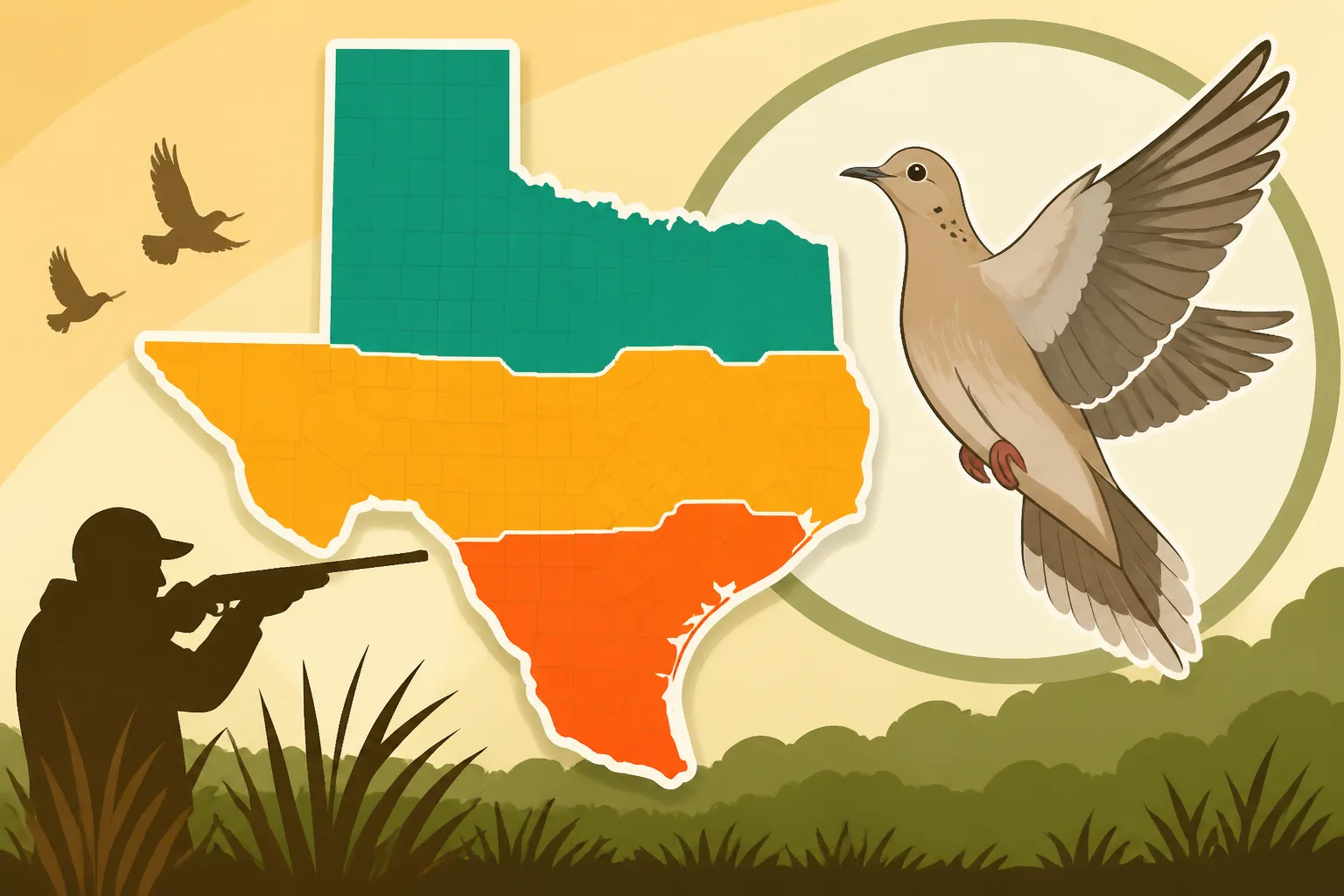
The boundaries are almost always defined by major highways or well-known geographical markers. This is meant to provide a "hard line" that is easy to identify on the ground. However, these lines have shifted slightly over the decades. Currently, the lines roughly follow I-20 and I-10 corridors, though there are specific deviations that can trip up the unwary.
For instance, the line between the North and Central zones largely follows Highway 180 and I-20. If you are hunting a property that spans both sides of a county road that serves as a zone boundary, you must be extremely careful. You cannot shoot a limit in the Central Zone and then move across the road to keep shooting if the North Zone season has not yet opened. Legally, the bird is "taken" where it is shot, and your possession limit is tied to the zone in which you are physically standing.
The North Dove Zone Breakdown
The North Zone is the traditional home of the "early" opener. This region encompasses the High Plains, the Rolling Plains, and the northern reaches of the Pineywoods. If you are hunting near cities like Lubbock, Amarillo, Wichita Falls, or even the northern suburbs of Dallas-Fort Worth, you are likely in the North Zone. The hunting here is often characterized by wide-open grain fields—specifically wheat stubble and sunflowers.
Hunting the North Zone is a unique experience because you are often dealing with "resident" birds that haven't seen much pressure yet. These birds are predictable, moving between roosting trees and watering holes with military precision. However, once the first real "blue norther" blows through, those birds can disappear overnight, replaced by the faster, more erratic migrants coming down from Oklahoma and Kansas.
Geographic Boundaries and Landmarks
The southern boundary of the North Zone is the primary point of confusion. It generally follows a line starting at the New Mexico border, moving along US Highway 180 East to Albany, then following US Highway 283 North to Sagebrush, and then following Highway 6 to Eastland. From there, it picks up I-20 and carries it all the way to the Louisiana border.
This means that towns like Abilene are effectively split-zone areas depending on which side of the highway you are on. If you are planning to How to Hunt Dove in Texas (Step by Step) in this region, you need to verify your exact GPS coordinates. Many hunters use digital mapping tools to ensure they aren't trespassing or hunting out of season. It is common to see birds stacked up on a wire on the North side of the highway while the season is only open on the South side, which can be an exercise in extreme patience.
Hunting the High Plains and Rolling Plains
In the High Plains, dove hunting is often centered around water. Because the landscape can be so arid, a single "dirt tank" or a leaking irrigation pivot can attract thousands of birds. The North Zone also features vast acreages of CRP (Conservation Reserve Program) land, which provides excellent nesting habitat.
Hunters in this zone should look for "flyways"—natural corridors between feeding and watering areas. Since the terrain is relatively flat, doves will use tree lines, fence rows, or even old farmsteads as navigational markers. Setting up near a lone mesquite tree in the middle of a cut wheat field is a classic North Texas tactic that rarely fails during the first week of September.
The Central Dove Zone Breakdown
The Central Zone is perhaps the most popular region for dove hunting in the entire state. It covers the heart of Texas, including the Hill Country, the Blackland Prairie, and the highly productive agricultural lands surrounding Austin, San Antonio, and Waco. This zone typically shares the same opening date as the North Zone, which usually falls on September 1st, making it the epicenter of the Texas hunting tradition.
What makes the Central Zone special is the diversity of the habitat. You can find yourself hunting over a manicured sunflower field in the morning and a rocky, cedar-choked draw in the afternoon. The birds here are a mix of resident mourning doves and a massive population of white-winged doves, particularly in urban-adjacent areas.
Navigating the Middle Ground
The boundaries for the Central Zone are sandwiched between the I-20 corridor to the north and the I-10 corridor to the south. The southern line is where most people get turned around. It starts at the Rio Grande river in Del Rio, follows US Highway 90 East to San Antonio, and then picks up I-10, following it all the way to the Louisiana border.
This creates a massive "middle" section of the state. If you are hunting in the Hill Country, such as near Fredericksburg or Llano, you are firmly in the Central Zone. These areas are legendary for their dove numbers, often fueled by the abundance of native sunflowers and croton (also known as goatweed). For those who want to How to Hunt Dove Without a Field, the Central Zone offers the best opportunities to hunt water holes or "graveling" areas where birds go to find grit for digestion.
Key Cities and Terrain Features
The Central Zone includes major metropolitan hubs, which significantly impacts the types of doves you will see. White-winged doves have expanded their range drastically over the last twenty years. They were once confined to the Rio Grande Valley, but now they are common sights in San Antonio, Austin, and even as far north as Waco.
These "city birds" fly out to the surrounding agricultural fields to feed every morning and evening. If you can find a field on the outskirts of a major city that is planted in sunflowers or silage corn, you are in for a world-class shoot. The terrain in this zone can be rugged, so wearing Best Early-Season Camo for Texas Heat is essential, as temperatures in September routinely exceed 100 degrees.
| Dove Zone | General Opening Date | Primary Species | Key Geographic Markers |
|---|---|---|---|
| North Zone | September 1 | Mourning Dove | I-20, Hwy 180, High Plains |
| Central Zone | September 1 | Mourning & White-winged | I-10, Hwy 90, Hill Country |
| South Zone | Mid-September | Mourning & White-winged | South of Hwy 90, Brush Country |
| Special White-winged Days | Early September | White-winged (Specific Rules) | Entire South Zone |
The South Dove Zone Breakdown
The South Zone is the land of legends for Texas wingshooters. This area encompasses the "Brush Country" or "Monte" of South Texas, as well as the fertile Rio Grande Valley. Because the climate is significantly warmer, the season here usually opens about two weeks later than the North and Central zones. This delay allows the birds to concentrate and provides a "second opener" for hunters willing to travel.
One of the biggest draws to the South Zone is the Special White-winged Dove Days. These are specific half-days (usually the first two weekends of September) where hunters can target white-winged doves before the regular season officially opens. It is a high-volume, high-excitement event that draws people from all over the country to towns like Uvalde, Hondo, and McAllen.
The Special South Texas Zone Rules
The South Zone regulations are a bit more complex due to these special days. During the Special White-winged Dove Days, hunting is only permitted from noon to sunset. There are also specific bag limit restrictions; while you can shoot a total of 15 birds, no more than two can be mourning doves. This requires a high level of bird identification skill in the heat of the moment.
The boundary for the South Zone is anything south of the Highway 90/I-10 line mentioned previously. This includes the vast ranches of Webb, La Salle, and Dimmit counties. If you are looking at Best Gear for Dove Hunting on a Texas Lease, you’ll need to account for the intense South Texas sun and the potential for afternoon thunderstorms that can turn the caliche roads into a muddy mess.
Brush Country and Coastal Hunting
Hunting in the South Zone often involves targeting "tanks" (ponds) surrounded by thick mesquite and prickly pear cactus. Doves in this region rely heavily on these water sources, especially during the dry September months. The birds will often "pitch" into these tanks in the final thirty minutes of legal shooting light, providing some of the fastest action you will ever experience.
Near the coast, the hunting shifts toward the grain sorghum (milo) fields. These fields can attract tens of thousands of birds. The coastal breeze helps keep the heat manageable, but the humidity can be brutal. Many hunters in this region utilize How to Use Decoys for Dove Hunting to pull birds into specific gaps in the brush or over a particular corner of a field.
Crucial Regulations for All Texas Dove Hunters
Regardless of which zone you choose to hunt, there are several "non-negotiable" rules that apply state-wide. The most common citation issued during dove season is for an "unplugged" shotgun. Your shotgun must be physically incapable of holding more than three shells (one in the chamber and two in the magazine). Even if you only put three shells in, if the magazine can hold more, you are in violation.
Another common pitfall is the "waste of game" rule. You must make a reasonable effort to retrieve every bird you shoot. This can be challenging in thick South Texas brush or tall Central Texas sunflowers. A good retriever is worth their weight in gold, but if you don't have a dog, you need to be disciplined about marking your birds and walking straight to them the moment they hit the ground.
Bag Limits and Possession Rules
The daily bag limit for doves in Texas is almost always 15 birds in the aggregate, which means your total count of mourning, white-winged, and white-tipped doves cannot exceed 15. The possession limit is three times the daily bag limit (45 birds). It is important to remember that these limits apply to the individual, not the group. "Party hunting"—where a group shoots until the total number of birds equals 15 times the number of hunters—is illegal.
Also, be aware of the "Eurasian Collared-Dove" exception. These are an invasive species and do not count toward your daily bag limit. They are larger than mourning doves and have a distinct black ring on the back of their neck. You can shoot as many as you want, provided you leave a feathered wing on the bird for identification purposes while in transport. This is a great way to extend your hunt after you've reached your limit of native birds.
The Migratory Bird Endorsement Requirement
Before you head into the field, you must ensure your license is up to date with the Texas Migratory Bird Endorsement & HIP Certification. The HIP (Harvest Information Program) certification is a brief series of questions about your previous year's hunting success. It is mandatory for anyone hunting migratory birds, including doves, ducks, and geese.
Failing to have this endorsement is an easy way to end a hunt with a fine. Most sporting goods stores will ask you the HIP questions when you buy your license, but if you buy yours online, you must ensure you check the box and answer the survey. It is also a good idea to keep a digital copy of your license on your phone, though a physical copy is still the safest bet in areas with poor cell service.
Planning Your Texas Dove Season
Planning a successful season starts with choosing the right zone for your schedule and your preferred hunting style. If you want the traditional September 1st experience with big crowds and social barbecues, the Central Zone is your best bet. If you prefer a more rugged, remote experience with the potential for high-volume white-winged dove shooting, wait the extra two weeks for the South Zone opener.
Keep in mind that many hunters choose to hunt multiple zones. You can start the season in a North Zone wheat field and, three weeks later, head down to Uvalde for the South Zone opener. This "Texas Two-Step" is a favorite tradition for many veteran wingshooters, as it effectively doubles the "opening day" excitement.
Choosing the Right Zone for Your Hunt
When deciding where to go, consider the local agricultural conditions. A drought in the South Zone might make the birds scarce, while a timely rain in the North Zone could produce a bumper crop of native sunflowers. Scouting is key. If you can, drive out to your hunting area a few days before the opener. Watch the birds in the evening—see which fields they are feeding in and which direction they are flying when they head to the roost.
If you are a beginner, the Dove Hunting Tactics: Field Setup & Shooting guide can help you understand where to sit in relation to the sun and the wind. Generally, you want the sun at your back so the birds are illuminated and you aren't squinting into the glare. In the Central and South zones, finding a "shade tree" is not just about comfort—it is a safety necessity in the Texas heat.
Managing the Texas Heat in September
Dove season in Texas is notoriously hot. It is not uncommon to see temperatures hitting 105 degrees during the afternoon "flight." Hydration is the most critical part of your gear list. You should be drinking water and electrolytes long before you step into the field.
Furthermore, keep an eye on your dog. Labradors and other retrievers will literally work themselves to death in the Texas heat because they want to please their owners. Bring a collapsible bowl and plenty of extra water specifically for them. If your dog starts wobbling or their tongue becomes dark red or purple, get them into the shade and onto a cool surface immediately. A successful hunt is never worth the life of a four-legged hunting partner.
Texas Dove Zone Mapping Disclaimer
This guide is intended for informational purposes and provides a general overview of the Texas dove zones based on historical data and current TPWD guidelines. However, hunting regulations and zone boundaries can be subject to annual changes by the Texas Parks and Wildlife Department. Always consult the official Texas Outdoor Annual or the TPWD website before your hunt to verify the exact boundary lines, season dates, and bag limits for the current year. It is the responsibility of the individual hunter to stay informed of and comply with all state and federal migratory bird laws.