Mourning Dove Hunting Tactics for Texas
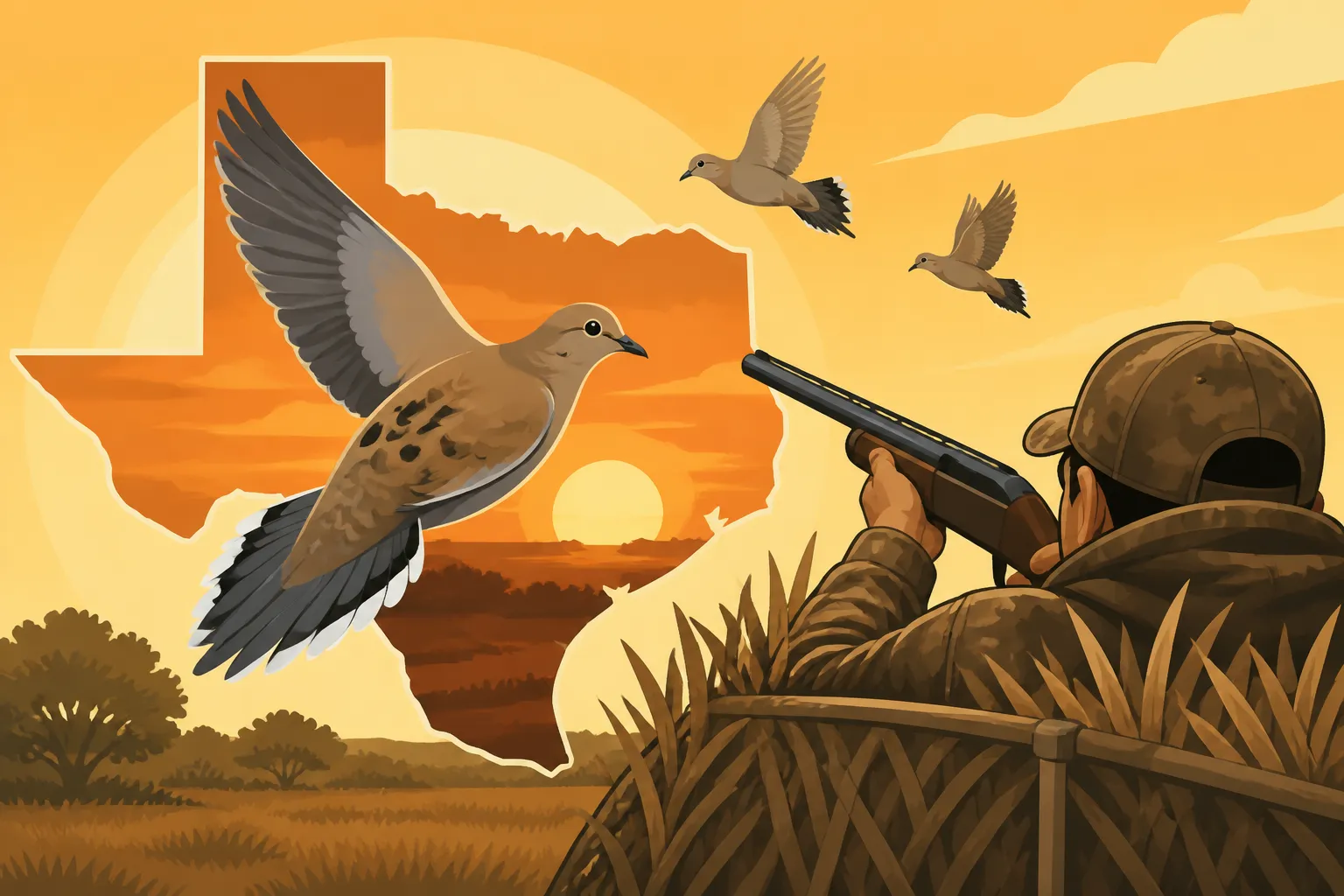
September in Texas is a brutal test of endurance where the heat index often hits triple digits, yet thousands of us still trek into dusty sunflower fields at dawn. The frustration of watching fast, erratic "gray ghosts" fly just out of reach while you bake in the sun is a rite of passage. This guide provides the specific field setups, regional movement patterns, and shooting tactics you need to consistently limit out on Mourning Doves across the Lone Star State.
Understanding Mourning Dove Behavior in Texas
To hunt Mourning Doves successfully, you have to stop thinking like a target shooter and start thinking like an avian strategist. These birds are creatures of habit, driven by a very specific daily cycle of feeding, watering, and resting. In the Texas heat, their movements are dictated by the sun. They typically feed in the early morning, seek water by mid-morning, loaf in the shade of mesquite or motts during the heat of the day, and then repeat the feeding and watering cycle in the late afternoon.
Scouting is the single most important factor in a successful hunt. You cannot simply pull up to any gate and expect birds to be there. Doves are notorious for being in a field one day and gone the next, often pushed out by a minor cold front or a change in local food availability. When scouting, look for "lines." Doves love to follow physical landmarks like fence lines, power lines, and creek beds. If you see birds consistently crossing a specific corner of a field, that is where you need to be, regardless of where the shade is.
Understanding the timing of the migration is also critical. While local birds are present year-round, the bulk of the hunting pressure relies on North American migrants pushing south. It is essential to keep an eye on the Texas Dove Season 2026: Zones & Dates to ensure you are timing your hunt with the peak of the migration in your specific area. A field that is empty on Monday can be buzzing with thousands of birds by Friday if a front moves through the Panhandle.
The Importance of Water and Grit
Doves have a unique digestive system that requires them to consume small bits of gravel or sand, known as grit, to help grind up the hard seeds they eat. This is why you often see them on the shoulders of caliche roads or in the middle of bare dirt patches within a field. If you find a field with a mix of sunflowers and exposed, sandy soil, you have found a goldmine. They don't like thick, matted grass because they are ground feeders; they need to be able to walk around and see their food.
Water is the other non-negotiable. However, Mourning Doves are picky drinkers. They rarely use water holes with thick vegetation right up to the edge because they fear predators like hawks or coyotes. They prefer "tank" edges with wide, open banks where they can land several feet from the water and walk in. If you are hunting over water in the afternoon, look for the flattest, barest bank on the pond. You can find more specific advice on this in our guide on How to Hunt Dove Without a Field.
Preferred Texas Forage
In Texas, the "Big Three" for dove food are sunflowers, croton (also called goatweed), and grain sorghum (milo). Native sunflowers are the gold standard, especially in Central and North Texas. If you are lucky enough to have a lease with managed sunflowers, the birds will stay as long as there is seed on the ground. In South Texas, croton is often the primary draw, especially in overgrazed pastures where the plant thrives.
When the native sunflowers begin to dry out and drop their seeds, the doves will swarm. However, if a heavy rain hits, it can wash the seeds into the dirt or cause them to rot, sending the birds elsewhere. This is why many hunters choose to supplement their land. If you are interested in managing your own property, you should look into How to Make Your Own Dove Field to understand the planting cycles required to have a crop ready by September 1st.
Choosing the Right Field Setup
Setting up in a dove field is an art form that requires balancing concealment with visibility. If you are too hidden, you won't be able to swing your shotgun freely. If you are too exposed, the birds will flare 60 yards out. The best strategy is to find a "soft" break in the skyline. A lone mesquite tree, a clump of prickly pear, or even a standing patch of sunflowers can provide enough cover to break up your silhouette.
Always pay attention to the wind. Like most birds, doves prefer to land and take off into the wind. If the wind is at your back, the birds will be flying toward you, which usually results in easier "incoming" shots. If the wind is blowing in your face, the birds will be zooming past you with a tailwind, making them incredibly difficult to lead. Position yourself so the sun is at your back whenever possible; this makes it harder for the birds to see your movement and much easier for you to track them against the sky.
Standing in the Right Spot
The "sweet spot" in a field is rarely in the dead center. Doves are "edge" flyers. They prefer to navigate the perimeter of a field before committing to a landing spot. Look for a "pinch point," such as a gap in a treeline or a spot where two different types of crops meet. This is the core of Dove Field Setup: Where to Stand. Often, the best shooters on a lease are the ones who sat 20 yards inside the brush line rather than out in the open.
If you are hunting with a group, communication is vital. Doves will often circle a field multiple times. If one hunter shoots too early, they may flare the birds away from the rest of the group. Space yourselves out at least 50 to 75 yards apart for safety and to ensure everyone has a clear "lane" of fire. This spacing also helps in bird recovery, as you can help each other mark where a bird fell in thick brush.
Using Decoys Effectively
Decoys are a game-changer for Mourning Doves. While they are social birds, they are also competitive. Seeing other "birds" on a fence line or a bare branch signals to them that the area is safe and full of food. Stationary clip-on decoys work well on barbed wire fences or dead tree limbs. However, nothing beats the drawing power of a spinning-wing decoy. The flickering motion mimics a bird landing and can be seen from hundreds of yards away.
When using spinning-wing decoys, place them about 15 to 20 yards in front of your position. You want the birds to be looking at the decoy, not at you. If the birds are flaring away from the decoy, it might be because the batteries are low and the wings are spinning too slowly, or the birds have become "decoy shy" due to heavy hunting pressure. In these cases, try moving the decoy further away or turning it off entirely for a while. For more advanced setups, check out How to Use Decoys for Dove Hunting. You can often find affordable spinning-wing decoys and extra batteries on Amazon if you need to gear up quickly before the weekend.
| Setup Component | Best Location | Why it Works |
|---|---|---|
| Spinning Decoy | 15-20 yards out, facing wind | Mimics landing bird; draws eyes away from hunter. |
| Stationary Decoy | Fence lines or dead branches | Provides a sense of "safety" and long-term loafing. |
| Hunter Position | Back to the sun, under shade | Conceals movement and improves visibility. |
| Water Source | Bare, flat banks | Allows doves to land and walk to water without fear. |
| Food Source | Shredded sunflowers or disked grain | Makes seeds accessible on bare ground. |
Essential Gear and Shooting Fundamentals
Dove hunting is perhaps the most gear-intensive "simple" hunt there is. Because of the heat, your gear needs to be functional and breathable. A heavy hunting vest will lead to heat exhaustion in the Texas sun. Instead, many veteran hunters opt for a lightweight mesh belt or a specialized dove bucket that holds shells, birds, and water. You can find various lightweight mesh vests available on Amazon that allow for maximum airflow while still providing enough pockets for your limits.
Before you head out, make sure you are legal. Check How Much Is a Texas Hunting License? and ensure you have your migratory bird endorsement. Also, remember that you must have a plug in your shotgun, limiting it to three shells total (one in the chamber, two in the magazine). Game wardens in Texas are very active during dove season, and a missing plug is one of the most common citations issued.
Shotgun and Load Selection
Most Texas dove hunters prefer a 12-gauge or a 20-gauge shotgun. While the 12-gauge offers a denser shot string, the 20-gauge is much lighter to carry and has less recoil, which is a blessing when you are shooting multiple boxes of shells in an afternoon. For Mourning Doves, #7.5 or #8 lead shot is the standard. If you are hunting on public land or certain managed areas, you may be required to use non-toxic (steel) shot, in which case you should move up to #6 or #7 steel to maintain similar ballistics.
Choke selection is also vital. Early in the season, when birds are flying low and slow over the sunflowers, an Improved Cylinder choke is usually sufficient. As the season progresses and the birds become more "skittish" and fly higher, you may want to switch to a Modified choke to keep your pattern tight at longer ranges. You can find comprehensive gear lists in our article on Best Gear for Dove Hunting in Texas. Don't forget ear protection; you can find decent electronic ear protection on Amazon that allows you to hear your buddies talking while still blocking out the muzzle blasts.
Managing the Texas Heat
We cannot overstate the danger of the Texas sun in September. Hydration starts 24 hours before the hunt. If you are thirsty in the field, you are already dehydrated. Bring twice as much water as you think you need. A large, insulated cooler in the truck is a necessity for keeping drinks cold and for preserving your harvested birds. You should also consider the Best Way to Hunt Hogs in Summer for additional tips on staying cool in extreme environments.
If you are bringing a dog, you are responsible for their safety. Doves are hunted in the heat of the day, and a hard-working retriever can overheat in minutes. Bring a collapsible bowl and plenty of extra water specifically for them. If the dog starts seeking shade and refusing to retrieve, it’s time to head to the truck. For those who hunt on managed properties, you might also want to look into Best Gear for Mourning Dove on a Texas Lease to see what professional outfitters recommend for high-heat scenarios. Those cooling towels you see on Amazon are a lifesaver when draped around your neck between flights.
Tactics for Different Texas Regions
Texas is a massive state, and a dove hunt in the Panhandle looks nothing like a hunt in the Rio Grande Valley. The birds behave differently based on the available cover and the local climate. Understanding the Texas Dove Zones Map (North, Central, South) is the first step in planning your seasonal travel.
In the North and Central zones, you are primarily hunting agricultural ties. Corn, wheat stubble, and sunflowers are the primary draws. The birds here often travel in large "flights" during the morning and evening. In South Texas, the hunting is often more spread out, focusing on "watering holes" and native brush. The heat here is even more extreme, so the "loafing" period during mid-day is much longer.
North and Central Texas Grain Fields
In these regions, doves rely heavily on harvested grain fields. If a farmer harvests corn or wheat just before the season opens, every dove within ten miles will find that field. The tactic here is to find the "flight path" from the roosting trees to the feeding field. Doves will often use a specific line of trees or a creek bed as a highway.
If you find yourself in a large, open field without much luck, look for the highest point. Doves love to "recon" a field from a high vantage point before landing. A lone dead tree on a hill is a magnet for Mourning Doves. For more on the specific rules of these regions, see Texas Mourning Dove Hunting Regulations 2026.
South Texas Brush and Water Holes
South Texas is famous for its "white-wing" hunting, but Mourning Doves are just as prevalent in the thorny brush. In the Brush Country, the birds often feed on native seeds and then head to "tanks" (ponds) to water. Hunting a water hole in the late afternoon is one of the most exciting ways to spend an evening in Texas. The action is fast and furious as birds drop in from the sky at high speeds.
Because it is so hot, you must process your birds quickly. Leaving a pile of doves in the sun for three hours is a recipe for spoiled meat. Take a small cooler into the field or at least keep your birds in the shade. If you are used to big game, the principles in How to Field Dress a Deer in Hot Weather regarding temperature control actually apply to small game as well. Keep them cool, keep them dry, and get them on ice as soon as possible.
Texas Hunting Disclaimer
Hunting regulations in Texas are subject to change by the Texas Parks and Wildlife Department (TPWD). Always consult the current version of the Texas Outdoor Annual before heading into the field. This guide is for informational purposes and does not supersede state or federal law. Ensure you have all required licenses, endorsements, and that your firearm is legally configured for migratory bird hunting. Respect private property and always practice safe firearm handling.