Best Thermal for Coyote Hunting in Texas
There's nothing quite like the rush of a coyote hunt, but if you've ever tried chasing these wily predators at night in the vast Texas landscape with traditional optics, you know the frustration. The darkness swallows them whole, and by the time you pinpoint a set of eyes, they're often long gone. This guide is all about cutting through that darkness, showing you how thermal optics can transform your night hunting success for coyotes across Texas.
Why Thermal is a Game-Changer for Coyote Hunting in Texas
For generations, hunting coyotes in Texas after dark was a game of spotlights, red lenses, and keen eyesight, often ending in disappointment. Those days, while still effective for some, can feel like trying to find a needle in a haystack, especially when you're dealing with intelligent, wary predators like coyotes. Thermal technology has truly revolutionized night hunting, turning previously impossible scenarios into routine successes.
The Frustration of Traditional Night Hunting
Think about it: you're out there, glassing the brush line with a powerful spotlight, hoping to catch a glint of an eye. The moment that beam hits them, a coyote often bolts, or worse, "lamps up" and stares, giving you a split second to make a shot before disappearing. The effective range is limited, identifying targets quickly can be a challenge, and the bright light itself can spook other game you might be targeting, or even alert distant coyotes to your presence. The constant sweeping of a spotlight can be exhausting, and the limited field of view means you're often missing movement just outside your illuminated circle. Plus, trying to call in a smart coyote only to have them hang up just outside your visible range is a soul-crushing experience many Texas hunters know all too well.
Unmasking the Elusive Predator in the Dark
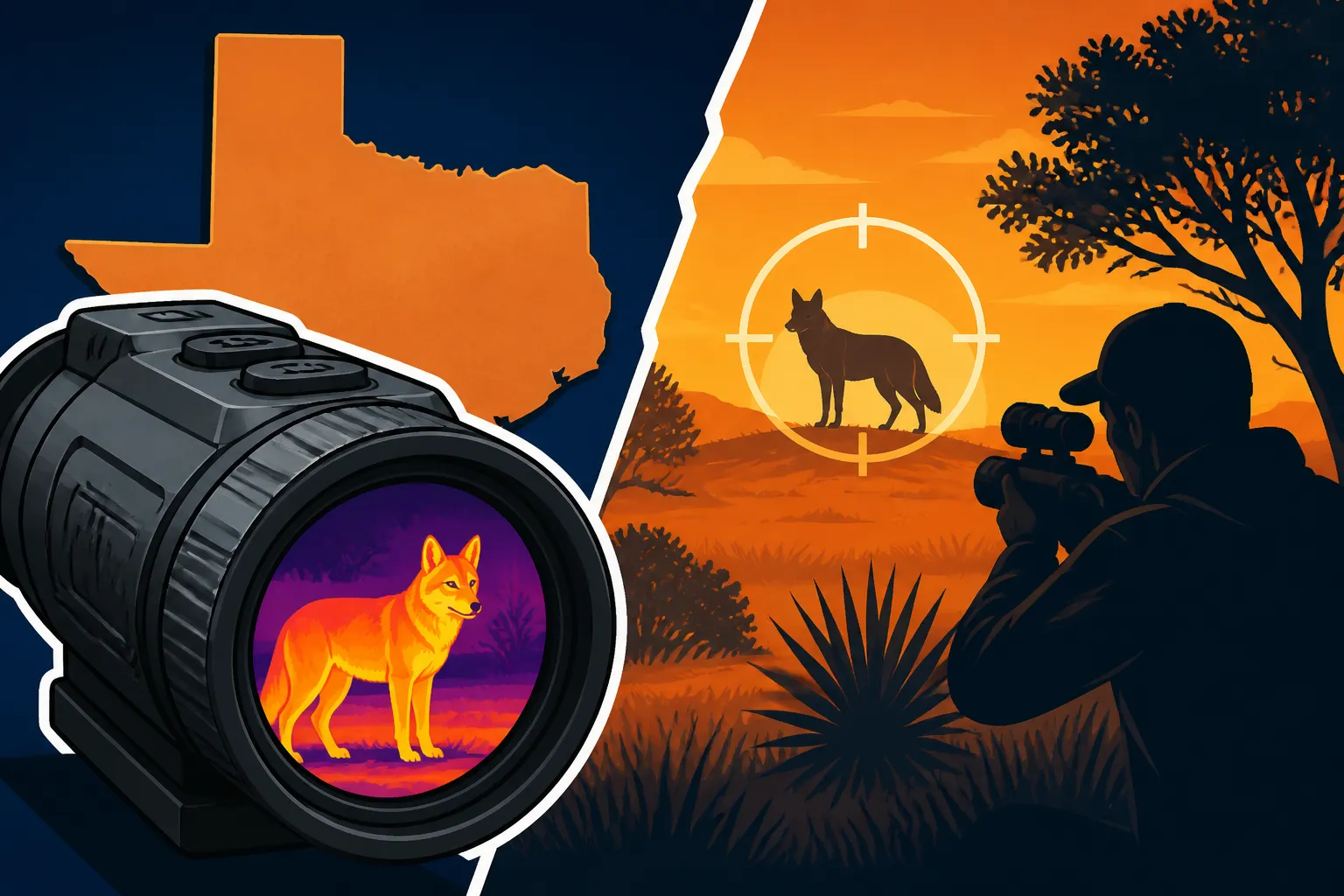
Thermal optics completely bypass these traditional frustrations by detecting heat signatures instead of ambient light. This means a coyote, whether it's skulking through thick brush, hiding in tall grass, or running across an open pasture, stands out like a beacon against the cooler background. You're not relying on moonlight or artificial illumination; you're seeing the animal's own body heat. This capability is absolutely crucial in Texas, where dense mesquite, prickly pear, and tall native grasses provide endless cover for coyotes.
With thermal, you can scan vast areas quickly and effectively, detecting animals that would be completely invisible to the naked eye or even advanced night vision. This significantly increases your detection range and allows for much earlier identification, giving you more time to set up for a shot or adjust your calling sequence. No more guessing if that distant shape is a deer, a hog, or your target coyote. The distinct heat signature quickly clarifies. This early detection and positive identification are the core reasons why thermal is a true game-changer, giving you an unfair advantage over these notoriously clever canids. If you're serious about taking down more coyotes, thermal is no longer a luxury; it's a necessity.
Key Features to Look for in a Thermal Scope for Coyotes
When you're shelling out good money for a thermal optic, especially for something as demanding as coyote hunting, you want to make sure you're getting the best bang for your buck. There are a few critical features that separate the "meh" from the "wow" when it comes to picking the right thermal for those Texas nights.
Clarity and Detail: Resolution and Pixel Pitch
The heart of any thermal imager is its sensor, and its quality is largely defined by its resolution and pixel pitch. Think of resolution like the megapixel count on your phone camera – higher numbers generally mean more detail. For thermal, resolutions like 384×288 or 640×480 are common. A 640-resolution unit will give you a significantly sharper, more detailed image, allowing you to not just detect a heat source, but to recognize it as a coyote (and not a badger or a rabbit) at greater distances. This is crucial for ethical shots and avoiding mistaken identity.
Pixel pitch refers to the size of individual pixels on the sensor, typically measured in micrometers (µm). Smaller pixel pitches (e.g., 12µm vs. 17µm) mean more pixels can be packed into the same sensor size, contributing to a crisper image and often better magnification capabilities without as much pixelation. In the vast, open spaces or dense brush of Texas, being able to clearly distinguish a coyote from afar is paramount. You need that clarity to make informed decisions and confident shots, especially when coyotes are notorious for hanging up at 200+ yards.
Smooth Tracking: Refresh Rate and Latency
Imagine trying to track a running coyote through a thermal scope that updates slowly, like a choppy video game. It's frustrating, and you'll likely miss your shot. This is where refresh rate comes in, typically measured in Hertz (Hz). A refresh rate of 30Hz is generally acceptable, but 50Hz or 60Hz is where things really smooth out. A higher refresh rate means the image you're seeing is updated more frequently, providing a much more fluid and natural view of moving targets.
Lower latency also contributes to this smooth tracking. Latency is the delay between what the sensor "sees" and what you see on the screen. While not always explicitly advertised, it's often better on higher-end units with faster processors. When a coyote is circling your call or making a quick dash across a field, every millisecond counts. A thermal with a high refresh rate and low latency ensures you can keep a steady bead on your target, making follow-up shots or tracking running animals much more manageable. This smoothness reduces eye strain during long scanning sessions and gives you a much better chance at successful shot placement.
Seeing the Distance: Detection and Recognition Range
The stated detection, recognition, and identification ranges are vital for coyote hunting, especially when you consider how skittish these animals can be. Detection range tells you how far away the optic can detect a heat source – basically, seeing a blob that indicates something is there. Recognition range means you can discern the animal's shape and size, allowing you to tell, for example, that it's a four-legged animal, not a person. Identification range is where you can confidently say, "That's a coyote, and it's facing away from me."
For Texas coyote hunting, you want a thermal with excellent recognition and identification ranges, pushing out past 200-300 yards. This gives you the lead time to react, confirm your target, and prepare for the shot before the coyote gets too close and potentially spooks. You might be working a large pasture or a brushy senderro, and spotting a heat signature far off allows you to assess the situation, adjust your calling, or initiate a stalk. Many higher-end thermals boast detection ranges exceeding a mile, which is fantastic for initial scanning, but focus on the practical recognition range for actual hunting scenarios.
Powering Your Hunt: Battery Life and Options
There's nothing worse than having your thermal unit die on you when the coyotes are howling. Battery life is a critical factor, especially during extended night hunts or weekend trips where charging might be limited. Look for units that offer 4-6 hours of continuous use as a minimum. Many modern thermal scopes come with internal rechargeable batteries, which are convenient but mean you're out of luck if they die mid-hunt.
Consider models that use replaceable batteries (like CR123A or 18650s) or have the option to connect to an external power bank via USB-C. This flexibility is a lifesaver. Carrying spare charged battery packs or a robust power bank ensures your thermal stays powered throughout the night. Even better are units that allow you to quickly swap out an internal battery pack. When you're in the field, sometimes far from a power outlet, having reliable, long-lasting power, or the means to quickly replenish it, is non-negotiable.
Thermal Monoculars vs. Thermal Scopes: What's Best for You?
When diving into the world of thermal optics for coyote hunting, one of the first big decisions you'll face is whether to invest in a thermal monocular or a dedicated thermal scope. Both have their distinct advantages, and understanding these differences will help you make the best choice for your hunting style here in Texas.
Scanning with a Monocular: The Spotter's Edge
A thermal monocular is a handheld device, much like a traditional spotting scope, but it detects heat. These are absolutely invaluable for scanning the landscape. Instead of constantly swinging your rifle around, which can be tiring and sometimes unsafe, a monocular allows you to silently and efficiently sweep fields, tree lines, and dense cover for heat signatures. They are lightweight, compact, and often have a wider field of view than a scope, making them perfect for quickly locating animals over broad areas.
Many experienced night hunters in Texas use a thermal monocular as their primary scanning tool, even if they have a thermal scope mounted on their rifle. This "spotter" role is crucial, especially when working with a partner. One person can constantly scan with the monocular, identifying coyotes, hogs, or other targets, while the other prepares for the shot with their rifle-mounted optic. Brands like Pulsar, AGM, and ATN offer excellent thermal monoculars that provide clear images and long detection ranges, allowing you to find those elusive coyotes before they even know you're there. The ability to identify movement and then point your shooter in the right direction without creating unnecessary movement with your weapon is a huge advantage.
Precision with a Scope: The Shooter's Advantage
A thermal scope, on the other hand, is designed to be mounted directly onto your rifle, replacing your traditional daytime optic. Its primary purpose is precise target acquisition and shot placement. These scopes are built for durability, recoil resistance, and most importantly, repeatable zero. Once zeroed, a good thermal scope allows you to see the heat signature, aim, and take the shot, all through the same device. This eliminates any transfer time or potential for error when switching between a monocular and a traditional scope in the dark.
For solo hunters, a thermal scope is often the go-to choice, as it combines the spotting and shooting functions into one unit. While scanning with a rifle can be cumbersome, modern thermal scopes often feature quick-detach mounts, allowing for some flexibility. However, their primary strength lies in their ability to provide a clear, magnified image of the target with a reticle superimposed, ensuring accurate shot placement under challenging low-light conditions. When you're trying to make a clean, ethical shot on a coyote, that precision is paramount.
The Hybrid Approach: Best of Both Worlds
For many serious Texas coyote hunters, the ideal setup involves both a thermal monocular and a thermal scope. This "hybrid approach" offers the best of both worlds and significantly enhances efficiency and safety. The monocular acts as your scout, constantly sweeping the terrain, identifying targets, and communicating their location to the shooter. This keeps the rifle pointed safely downrange until a target is acquired.
Once a coyote is spotted with the monocular, the shooter can then bring their rifle-mounted thermal scope to bear, quickly acquiring the target and taking the shot. This method reduces fatigue, conserves battery life on the scope (which can then be dedicated solely to shooting), and provides a much wider situational awareness. It also allows for more fluid teamwork. If you're hunting with a partner, one can be the designated scanner with a Best Thermal Monocular for Scanning in Texas while the other is ready on the rifle. For those looking to maximize their effectiveness and enjoy the benefits of both dedicated tools, investing in both a quality thermal monocular and a robust thermal scope is a strategy that pays dividends in the Texas brush country.
Understanding Thermal Technology: The Science Behind the Heat
It might feel like magic when you first look through a thermal device and see the world in shades of heat, but there's some fascinating science at play. Understanding the basics of how thermal technology works can help you appreciate what makes a good unit and why certain features are so important for hunting elusive creatures like coyotes.
Uncooled Microbolometers: How They Work
The core component of most commercially available thermal optics, including those used for hunting, is an uncooled microbolometer. Unlike traditional cameras that detect visible light, microbolometers are designed to detect infrared radiation, or heat. Every object with a temperature above absolute zero emits some form of thermal radiation. The hotter an object, the more infrared radiation it emits.
The microbolometer array consists of thousands of tiny heat-sensitive resistors. When infrared radiation hits these resistors, their temperature changes, which in turn changes their electrical resistance. This change in resistance is then measured and converted into an electrical signal. A sophisticated processor then takes these signals and creates an image, mapping different temperatures to different colors or shades of gray that you see on the device's display. This process happens incredibly fast, allowing for real-time video feeds. The beauty of uncooled microbolometers is that they don't require cryogenic cooling, making them much more practical, compact, and affordable than their cooled predecessors.
NETD (Noise Equivalent Temperature Difference): The Sensitivity Factor
While resolution and pixel pitch describe the clarity of the image, NETD (Noise Equivalent Temperature Difference) tells you about the sensitivity of the thermal sensor. Measured in millikelvins (mK), NETD indicates the smallest temperature difference a thermal imager can detect. Simply put, a lower NETD value means a more sensitive sensor.
For coyote hunting in Texas, especially on cooler nights or when animals are partially obscured by brush, a low NETD is incredibly beneficial. A highly sensitive sensor can pick up subtle heat differences, allowing a coyote's heat signature to stand out more clearly against a background that might be only slightly cooler. For example, a thermal with an NETD of <25mK (millikelvins) will generally provide a much crisper image with better target-to-background contrast than one with an NETD of <40mK, particularly when the ambient temperatures are closer to the animal's body temperature. This enhanced sensitivity means you can detect and recognize coyotes at longer distances, even when environmental factors like humidity or light fog might make it harder for less sensitive units to perform. It helps cut through the "noise" and present a cleaner, more discernible thermal image.
Digital Zoom vs. Optical Zoom: What Matters
When you look at the magnification capabilities of a thermal optic, it's important to distinguish between digital zoom and optical zoom. Optical zoom, which is inherent in the design of the lens, provides true magnification without any loss of image quality. It's like moving closer to the object. Most thermal scopes have a base optical magnification (e.g., 2.5x, 3.5x).
Digital zoom, on the other hand, is essentially cropping and enlarging a portion of the image. While it can make a distant target appear larger in your field of view, it doesn't add any new detail. Instead, it magnifies the existing pixels, leading to pixelation and a degradation of image quality the higher you go. Imagine zooming in on a digital photo on your phone; eventually, it becomes blocky. For thermal optics, this means that while 8x digital zoom might make a coyote look huge, the image could be so pixelated that you lose critical detail needed for identification or precise shot placement.
For effective coyote hunting, prioritize a thermal scope with a good base optical magnification that suits your typical hunting distances, and use digital zoom sparingly, primarily for confirmation once the target is already recognized. Over-reliance on digital zoom can lead to frustratingly unclear images and missed opportunities. Look at the balance between the base optical magnification and the maximum digital zoom, as well as the underlying resolution, to understand the true magnification capabilities of any given unit.
Top Thermal Brands and Models for Texas Coyote Hunters
Navigating the market for thermal optics can feel overwhelming with so many brands and models promising the moon. However, a few names consistently rise to the top for their reliability, performance, and innovation, making them solid choices for serious Texas coyote hunters. When you're investing in this kind of gear, checking out detailed reviews and comparisons on platforms like GoHunt's forums can be incredibly helpful for making an informed decision.
High-Performance Picks for Serious Hunters
For those who demand the absolute best in image quality, advanced features, and rugged reliability, brands like Pulsar and Trijicon often lead the pack.
- Pulsar: With lines like the Thermion and Helion (monocular) series, Pulsar has cemented itself as a top-tier brand. The Pulsar Thermion 2 XP50 Pro, for instance, offers a stunning 640×480 resolution, a sub-25mK NETD sensor, and a high refresh rate, all encased in a traditional rifle scope housing. This means incredible detail, even at extended ranges, and a familiar feel on your rifle. Their advanced image processing and robust construction make them favorites among hunters who often deal with diverse Texas weather conditions, from scorching summer nights to chilly winter mornings. The Pulsar vs AGM Thermal Scopes for Hogs article offers a great comparison, much of which applies directly to coyote hunting, highlighting why Pulsar often comes out on top for raw performance.
- Trijicon: Known for their military-grade durability and exceptional optics, Trijicon's thermal scopes, such as the IR-Hunter or REAP-IR lines, are truly battle-tested. While often at the higher end of the price spectrum, their build quality, intuitive controls, and superior image processing provide an unmatched user experience. Trijicon thermals are renowned for their crisp images and reliable performance, even in the harshest environments. For hunters who want a "buy once, cry once" solution and cannot compromise on performance, Trijicon is a powerful contender. GoHunt often features deep dives into these premium optics, detailing their specific advantages for different hunting scenarios.
Mid-Range Workhorses
For many Texas hunters, a mid-range thermal optic strikes the perfect balance between high-end performance and a more accessible price point. These units offer fantastic capabilities without breaking the bank, providing excellent value.
- AGM Global Vision: AGM has rapidly gained popularity with models like the Rattler TS series. The AGM Rattler TS35-384 or TS35-640 (depending on desired resolution) offers impressive performance for its price. They feature good resolution, solid refresh rates, and user-friendly interfaces. The Rattler line is particularly well-regarded for its robust construction and reliability, making it a great option for the bumps and scrapes that come with hunting in the rugged Texas terrain. They're often seen as an excellent entry point into quality thermal optics.
- ATN Corp: ATN's ThOR series, particularly the ThOR 4, stands out with its feature-rich offerings. While ATN has sometimes been criticized for its user interface complexity in the past, their newer models offer smart features like a ballistic calculator, video recording, and a smart rangefinder, all integrated into the scope. This makes them highly versatile. While perhaps not always matching the raw image quality of a Pulsar or Trijicon, the sheer number of integrated tools and the competitive pricing make ATN an attractive option for hunters who appreciate technological advancements in their gear. For those looking for the Best Thermal Scope for Hogs Under $3000 that offers plenty of features, ATN often fits the bill.
Budget-Friendly Options That Still Perform
Even on a tighter budget, it's possible to find thermal optics that will significantly improve your coyote hunting success. While you might sacrifice some high-end features or ultimate image clarity, these options still offer the crucial ability to detect heat signatures in total darkness.
- InfiRay Outdoor (iRay): InfiRay has emerged as a strong contender in the thermal market, offering excellent performance across various price points. Their Rico Series or BOLT Series thermal scopes provide impressive image quality and features that often punch above their weight class. For those looking for a capable and reliable thermal without the absolute top-tier price tag, InfiRay offers a compelling balance of technology and value. Many hunters praise InfiRay for its clear images and intuitive operation.
- Smaller Brands & Entry-Level Models: Companies like Sightmark or even some entry-level models from the brands mentioned above, can offer passable performance for coyote hunting. For instance, a Sightmark Wraith digital night vision scope, while not true thermal, offers decent capabilities for those on a very strict budget, or a more basic thermal monocular from a less known brand can be a good starting point for scanning. While these might not have the extreme detection ranges or the crispness of higher-end units, they will still allow you to detect heat and give you a significant advantage over traditional visible-light methods. It's always a good idea to research extensively, perhaps through forums where GoHunt community members share real-world experiences with various models, to ensure any budget-friendly option meets your specific needs for Feral Hog Hunting Tactics for Texas or coyote control.
Here’s a quick overview of some popular options:
| Model | Resolution | NETD (mK) | Base Mag. | Price Range (Approx.) | Key Feature Highlight |
|---|---|---|---|---|---|
| Pulsar Thermion 2 XP50 Pro | 640×480 | <25 | 2.5x | $4,500 – $5,500 | Traditional form factor, ultra-sensitive sensor |
| Trijicon REAP-IR | 640×480 | N/A | 2.5x | $7,000+ | Rugged, intuitive controls, military-grade |
| AGM Rattler TS35-640 | 640×512 | <35 | 2.5x | $2,800 – $3,500 | Excellent value, durable, popular mid-range option |
| ATN ThOR 4 4.5-18x | 384×288/640×480 | N/A | 4.5x | $2,000 – $3,500 | Feature-rich, ballistic calculator, video recording |
| InfiRay Outdoor Bolt TL35 | 384×288 | <40 | 3.1x | $2,500 – $3,000 | Traditional design, good image clarity for resolution |
Note: Prices are estimates and can vary significantly based on retailer, promotions, and specific model iterations.
Tactics for Using Thermal in Texas Coyote Hunting
Having the best thermal gear won't guarantee success if you don't combine it with smart hunting tactics. Coyotes are incredibly intelligent and wary animals, and thermal, while a huge advantage, still requires a thoughtful approach. Integrating your new thermal capabilities into your hunting strategy will exponentially increase your odds.
Mastering the Scan: Locating Critters in the Brush
The first step with thermal is to efficiently locate your target. Texas landscapes, with their diverse topography ranging from dense South Texas brush to open Panhandle plains, demand a systematic scanning approach. Don't just randomly sweep your monocular or scope. Instead, divide your hunting area into sectors and methodically scan each one, looking for tell-tale heat signatures. Pay extra attention to transitions—where a treeline meets a field, along fencelines, drainage ditches, and around water sources.
Coyotes often move along these natural travel corridors. Look for movement, of course, but also for static heat blobs that might indicate a bedded animal. Remember, a coyote's heat signature is typically smaller and more defined than a hog's or deer's. Practice identifying different animals through your thermal so you can quickly distinguish a coyote from other nocturnal creatures. Use your thermal monocular for wide-area scanning, keeping your rifle-mounted scope ready for when a target is acquired. This constant, methodical scanning is the foundation of successful thermal coyote hunting. Many hunters find that combining thermal scanning with effective Predator Calling for Coyotes in Texas helps to draw coyotes out of cover, making them easier to spot.
The Stalk and Setup: Getting Into Position
Once you've detected a coyote with your thermal, the real work begins. Your goal is to get into a position for an ethical shot without being detected. This means playing the wind meticulously. Coyotes have an incredible sense of smell, and even with thermal, if your scent drifts their way, they'll be gone. Always approach from downwind, or at least crosswind. Use the terrain to your advantage – rise and fall in the landscape, dense vegetation, or even man-made structures can provide crucial cover for your approach.
Consider your calling strategy. If you're calling, set up where you have good visibility with your thermal, ensuring any approaching coyote has to come into an open area before getting too close. Place your caller (if using an e-caller) at a distance that draws the coyote past you or into a clear shooting lane. When setting up for a shot, brace yourself against a tree, tripod, or use shooting sticks for maximum stability. Range the area beforehand if possible, marking potential shooting lanes or landmarks with your rangefinder, so you know precise distances when the moment of truth arrives.
Ethical Shot Placement at Night
Just because you can see an animal with thermal doesn't mean you can always take an ethical shot. Identifying your target clearly is one thing, but knowing where to place your shot at night is another challenge. Thermal images, while showing heat, don't always provide the same level of anatomical detail as daylight optics. Practice with your specific thermal unit to understand how different animals' heat signatures appear at various angles and distances.
For coyotes, aim for the vitals: a broadside shot in the chest, just behind the shoulder. Avoid headshots unless the animal is extremely close and you are absolutely confident in your ability, as headshots offer a very small margin for error and can lead to wounded animals. If a coyote is quartering away or facing directly at you, consider waiting for a better angle. Always know your personal effective range with your thermal setup. If the image quality degrades past a certain distance, or if you can't confidently identify the exact location of the vitals, it's better to hold off. A responsible hunter ensures a clean kill, even in the darkness. Remember, ethical hunting extends beyond just the legal aspects; it's about respecting the animal and ensuring a humane harvest.
Legal Considerations for Thermal Hunting in Texas
Texas has some of the most hunter-friendly regulations when it comes to predatory animals like coyotes, and that generally extends to the use of advanced technology. However, it's always crucial to understand the specific rules to ensure you're hunting legally and responsibly. The Texas Parks and Wildlife Department (TPWD) Outdoor Annual is your bible for all regulations, and it's highly recommended to consult it directly each year as rules can change. You can find up-to-date information on the Texas Hunting Regulations Changes for 2026 page.
The Texas Advantage: Night Hunting Legality
One of the biggest advantages for coyote hunters in Texas is that there is no closed season and no bag limit on coyotes (or feral hogs, for that matter) on private land. This means you can hunt them year-round, day or night. Furthermore, Texas law specifically permits the use of artificial lights, including thermal and night vision devices, for hunting predatory animals like coyotes on private property. This is a significant distinction from deer hunting, where the use of artificial lights is generally prohibited.
This broad legality makes thermal optics incredibly powerful for coyote control, especially given their nocturnal habits. You don't need any special permits beyond a valid Texas hunting license (unless exempt) to use thermal at night for coyotes on private land. However, even with this freedom, always prioritize safety and identify your target positively before taking a shot. While Is It Legal to Hunt Hogs at Night With Thermal is a common question with a similar answer, always check the specific rules for the species you are targeting.
Private Land Permissions and Public Land Restrictions
While the rules for private land are quite generous, the situation changes dramatically when it comes to public lands in Texas. Hunting on public land, such as Wildlife Management Areas (WMAs) or National Forests, is much more restrictive and typically requires specific permits, draw hunts, and adherence to very strict regulations regarding methods, seasons, and equipment.
Generally, night hunting and the use of thermal or artificial lights are prohibited on most public lands managed by TPWD or other state/federal agencies. There might be rare exceptions for specific depredation hunts or drawn hunts, but these are few and far between and will be explicitly stated in the hunt details. Always consult the specific regulations for the WMA or public land you intend to hunt. For example, some WMAs might have specific rules for predator control that differ from general regulations.
If you are hunting on private land, ensure you have explicit written permission from the landowner. Trespassing, even on seemingly abandoned land, is illegal and can lead to serious consequences. Clear communication with landowners about your intentions to hunt at night with thermal is essential for maintaining good relationships and ensuring everyone's safety. Always carry your Texas Hunting License: Cost, Types & How to Buy (2026) when hunting, regardless of the time of day or species.
Disclaimer
Please remember that hunting regulations can change, and it is every hunter's responsibility to know and follow all current laws and regulations. Always consult the latest Texas Parks and Wildlife Department Outdoor Annual or contact TPWD directly for the most up-to-date information before heading into the field. This guide is for informational purposes only and should not be considered legal advice. Stay safe, hunt ethically, and enjoy your time in the Texas outdoors!