Best Optics for Hunting Exotics in Texas
Hunting exotics in Texas is an experience unlike any other, offering thrilling challenges across a vast and diverse landscape. From the dense South Texas brush to the rugged mountains of the Trans-Pecos, each pursuit demands a keen eye and precise equipment. The frustration often lies in investing in optics that simply don't perform when it matters most, leaving you scrambling when that magnificent Axis buck or elusive Aoudad appears. This guide will walk you through selecting the absolute best optics to ensure you're prepared for every unique scenario Texas exotic hunting throws your way, making your next hunt a success.
Understanding the Unique Demands of Exotic Hunting in Texas
Texas is a veritable melting pot of exotic game species, each with its own preferred habitat and behavior patterns. This incredible diversity means that a one-size-fits-all approach to hunting optics just won't cut it. What works perfectly for a Whitetail in the dense East Texas pines might leave you struggling to spot an Aoudad against the vast Western slopes.
Diverse Species, Diverse Needs
Think about the sheer variety of exotics available to hunt here. You've got the majestic Axis deer, often found in the rolling hills of the Texas Hill Country, known for their stunning antlers and keen senses. Then there's the agile Blackbuck antelope, typically inhabiting open plains, whose incredible speed and camouflage can make them surprisingly hard to pin down. Move west, and you're chasing hardy Aoudad sheep in the challenging, rocky terrain of the Trans-Pecos mountains, an entirely different ballgame where long-range glassing is paramount. Head down to the coastal plains and South Texas, and you might find yourself pursuing the massive Nilgai antelope, an animal that blends shockingly well into the thorny brush and can cover ground faster than you can blink.
Each of these species presents unique challenges. Axis deer, for example, are often most active during cooler parts of the day, particularly dawn and dusk, requiring optics with excellent low-light performance. Blackbuck, on the other hand, might be spotted from a great distance in open country, demanding powerful magnification for identification. Understanding the typical behavior and habitat of your target species is the first step in choosing the right optics. If you're looking for an overview of what's available, exploring Exotic Hunting in Texas: Axis, Aoudad, Blackbuck & More can give you a great head start.
Terrain and Environment Considerations
Texas boasts an incredibly varied geography, and the landscape you're hunting in directly influences your optic needs.
- South Texas Brush Country: This area, famous for its big Whitetails and numerous exotics, is characterized by thick, thorny brush, dense mesquite, and scattered senderos. Here, shots can be close and fast, or you might need to pick an animal out of heavy cover at moderate range. Optics need to be robust enough to handle bumps and scrapes, and a wide field of view at lower magnification can be incredibly helpful for tracking movement in tight spaces.
- Texas Hill Country: Rolling hills, cedar breaks, and rocky outcrops define this region. Axis and Blackbuck are common here, often requiring hunters to navigate elevation changes and spot game in varied cover. Good light transmission for spotting in shaded canyons and clarity for identifying antlers against a busy background are key.
- Trans-Pecos Mountains: For Aoudad and other high-country exotics, this rugged, arid region demands long-range glassing. You'll spend hours behind the glass, scanning vast expanses of mountainsides. Durability, superior clarity, and high magnification in both binoculars and spotting scopes are non-negotiable here.
- Open Plains & Coastal Prairies: Areas with more open terrain, like parts of the Panhandle or the sprawling coastal ranches where Nilgai roam, call for optics that can resolve detail at extreme distances. Wind and heat mirage can also be factors, making superior glass quality even more critical.
No matter where you are, Texas weather itself is a factor. Intense heat, sudden downpours, and dusty conditions mean your optics must be fully waterproof, fog-proof, and built to withstand the elements without failing when that once-in-a-lifetime animal steps out.
Essential Optics for Spotting and Ranging Exotics
When you're out chasing exotics, having the right combination of optics for spotting, identifying, and ranging your target is absolutely crucial. These aren't just accessories; they're your primary tools for success and ethical hunting.
High-Quality Binoculars: Your Primary Scouting Tool
Your binoculars are, without a doubt, your most important piece of scouting gear. You'll spend more time looking through them than any other optic. For exotic hunting in Texas, a good pair of binoculars should be an extension of your eyes, allowing you to tirelessly scan the terrain without fatigue.
Most hunters lean towards 8×42, 10×42, or 10×50 models. The "x" before the second number indicates magnification, while the second number is the objective lens diameter in millimeters, affecting how much light the binoculars gather. For general exotic hunting, a 10×42 binocular is often considered the sweet spot. It provides enough magnification to pick out detail at moderate to long ranges, while the 42mm objective lens gathers ample light for effective use during critical dawn and dusk periods. If you're primarily hunting in open country or chasing animals that are notoriously hard to spot, like Aoudad, stepping up to a 12×50 might be beneficial for that extra reach and light-gathering capability. However, remember that higher magnification also means a narrower field of view and makes hand-holding steadiness more challenging. For those long days in the field, even considering a tripod adapter for your binoculars can make a huge difference in reducing eye fatigue and resolving distant details.
When it comes to brands, you truly get what you pay for. Companies like Zeiss, Swarovski, and Leica produce top-tier glass with unparalleled clarity and light transmission, but they come with a significant price tag. For excellent performance without breaking the bank, brands like Vortex Optics offer fantastic value, especially their Viper or Razor lines, which are incredibly durable and perform well in challenging conditions. The important thing is to choose binoculars with multi-coated lenses, good eye relief, and a robust, waterproof housing. If you're specifically hunting in the dense scrub, you might want to check out some advice on Best Binoculars for South Texas Brush to get a better idea of what works in that particular environment.
Spotting Scopes for Long-Range Identification
While binoculars are great for general scanning, a spotting scope becomes indispensable when you need to resolve fine details at extreme distances, especially when hunting species like Aoudad in the mountains or trying to judge the trophy quality of a free-range Nilgai across a vast pasture.
A spotting scope allows you to crank up the magnification far beyond what binoculars can offer, typically ranging from 15-45x or 20-60x. This increased power lets you discern antler points, body characteristics, and even individual hairs that might tell you if an animal is mature enough to target. When hunting Spot-and-Stalk Aoudad in West Texas, a spotting scope is often a non-negotiable piece of gear, allowing you to stay far enough away to avoid spooking game while still making informed decisions.
Consider a variable power spotting scope for versatility. A 60mm to 85mm objective lens is common, with larger lenses offering better light gathering and brighter images, especially at higher magnifications. Angled eyepieces are often preferred by hunters spending long hours behind the glass, as they allow for a more relaxed head position, especially when scanning hillsides or glassing from a prone position. Crucially, a spotting scope is only as good as the tripod it sits on. Invest in a sturdy, stable tripod that won't wobble in the wind or sag under the scope's weight. A good tripod will allow you to hold a steady image, preventing frustration and eye strain.
Rangefinders: Precision for Ethical Shots
In the vast and open landscapes where many exotics roam, judging distance can be incredibly deceiving. A rangefinder is an absolute must-have for ensuring ethical shot placement, eliminating guesswork, and confirming your ballistic data.
For exotic hunting, look for a rangefinder with a strong maximum reflective range, ideally one that can range beyond 1,000 yards, even if you rarely shoot that far. This extra capability ensures accurate readings on less reflective animals at more typical hunting ranges. Angle compensation is another vital feature, especially when hunting in the hilly or mountainous terrain of the Hill Country or Trans-Pecos. This feature provides a "shoot-to" distance, factoring in the incline or decline, which is critical for making precise shots on steep angles. A "scan" mode is also very useful, allowing you to continuously range multiple targets or track a moving animal without repeatedly pressing the button.
Brands like Leupold, Vortex, Sig Sauer, and Bushnell all offer excellent rangefinders with various features. Some even integrate ballistic solutions, which can be incredibly helpful for long-range engagements, providing holdovers or click values right in the display. Remember, an accurate range is the foundation of an ethical shot, and for exotics, whose vitality can be surprising, that precision is more important than ever.
Rifle Scopes for Exotic Hunting Rifles
Once you've spotted, identified, and ranged your exotic, it's time to make the shot count. Your rifle scope is the crucial link between you and your target, and selecting the right one can make all the difference.
Variable Magnification for Versatility
Exotic hunting in Texas can present a huge range of shooting scenarios. You might have a quick, close-range opportunity on an Axis deer busting through a sendero at 75 yards, or a deliberate, long-range shot at a Blackbuck on an open plain at 300+ yards. This is why a variable magnification scope is the undisputed champion for exotic hunting rifles.
A common and highly versatile magnification range is 3-9x, 4-16x, or even 5-25x. The lower end of the magnification spectrum provides a wide field of view, making it easier to acquire a fast-moving target or navigate dense cover. This is especially useful in areas like the Hill Country or South Texas where shots can be tight. As you dial up the magnification, you gain the precision needed for longer shots, allowing you to place your crosshairs precisely on the vitals of a distant animal.
For instance, a 4-16x scope offers a fantastic balance. At 4x, you have a broad view for closer encounters, and at 16x, you have ample power to make a confident shot at several hundred yards. The key is to find a scope that offers good clarity and brightness throughout its entire magnification range. Don't just look at the maximum power; assess how well the image holds up at various settings. If you're also hunting Whitetail, much of this advice overlaps; you can find more insights on this topic by exploring Best Rifle Scope for Texas Deer Hunting.
Reticle Choices and Turret Features
The reticle in your scope is your aiming point, and choosing the right one can significantly impact your shooting performance.
- Duplex or Simple Crosshair: These are straightforward and excellent for fast target acquisition at closer ranges, especially in dense cover. They are reliable and less cluttered, which can be an advantage for quick shots.
- BDC (Bullet Drop Compensating) Reticles: These have a series of dots or hash marks below the main crosshair, calibrated for specific distances. While they offer quick holdover points without adjusting turrets, they are typically caliber-specific and may not be perfectly accurate for every load or environmental condition.
- Christmas Tree or MIL/MOA Reticles: These are popular for long-range shooting, offering multiple holdover and windage reference points. They require a deeper understanding of ballistics but provide extreme precision for wind calls and elevation adjustments.
For turrets, you generally have two options: capped or exposed. Capped turrets are protected from accidental bumps and adjustments, making them ideal for hunters who prefer to set their zero and use holdovers for various ranges. Exposed turrets allow for quick, tool-free adjustments, which are favored by long-range shooters who dial in their elevation and windage. If you choose exposed turrets, ensure they have positive, audible clicks and a reliable zero stop feature, so you can always return to your original zero without guesswork.
Durability and Light Transmission
Texas hunting conditions are rarely gentle. Your rifle scope needs to be a workhorse. Look for scopes that are unequivocally waterproof, fog-proof, and shockproof. A scope filled with argon or nitrogen gas will resist internal fogging due to temperature changes. The housing should be robust, often aircraft-grade aluminum, to withstand the inevitable bumps and scrapes of field use.
Light transmission is another critical factor. Many exotics, like Axis deer and Blackbuck, are most active during the low-light periods of dawn and dusk. A scope with excellent light-gathering capabilities and high-quality lens coatings will provide a brighter, clearer image when it matters most, extending your effective hunting time. Objective lens size plays a role here – a 50mm or 56mm objective will gather more light than a 40mm, but also adds weight and requires higher scope rings. Ultimately, look for fully multi-coated lenses, which maximize light transmission and reduce glare, giving you the clearest possible view of your target in challenging light conditions.
Specialized Optics for Night and Thermal Hunting
While many exotic species are primarily hunted during daylight hours, the reality of hunting in Texas often involves overlapping with feral hogs. Additionally, some exotics, particularly those that are pressured, may exhibit more crepuscular or even nocturnal tendencies, especially during warmer months. This is where specialized night and thermal optics can play a crucial role, not just for targeting specific animals, but also for scouting, tracking, and overall lease management.
Thermal and Night Vision for Nocturnal Exotics (and Hogs)
Thermal imaging and night vision devices open up an entirely new world after the sun sets. While most exotic species are regulated for daylight hunting, many outfitters offer combination hunts that include targeting feral hogs at night. If you're on a lease where you manage multiple species, including hogs, understanding and utilizing these tools can be invaluable.
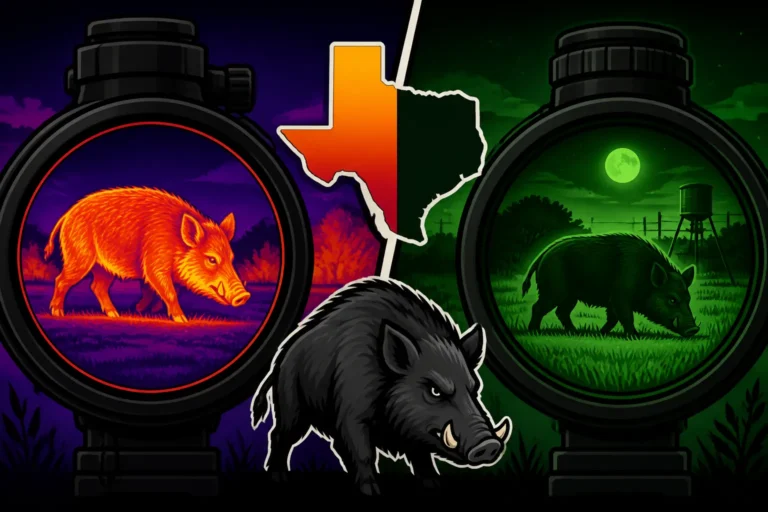
- Thermal Imaging: Thermal devices detect heat signatures, making animals stand out vividly against a cooler background, regardless of camouflage or ambient light. This is incredibly effective for spotting animals in thick brush, open fields, or even through light fog. For hog hunting, thermal is a game-changer, allowing you to scan vast areas and identify targets with ease. It's also excellent for tracking wounded game in the dark. For a deeper dive into what's available, check out Best Thermal Scopes for Hog Hunting in Texas.
- Night Vision: Night vision amplifies ambient light (starlight, moonlight) to create a visible image. It generally provides better detail and recognition than thermal at closer ranges, allowing you to identify species more accurately. However, it requires some ambient light and can be hampered by heavy overcast skies or dense cover.
The choice between thermal and night vision often comes down to specific needs. Thermal excels at detection and is less affected by cover, while night vision offers better resolution for identification in suitable conditions. Many hunters find that a combination, or at least a thermal monocular for scanning, is the most versatile approach. For a complete breakdown, it's worth reading Thermal Scope vs Night Vision for Hog Hunting. Remember, always confirm local regulations regarding night hunting for specific species, as laws for exotics typically differ from those for hogs.
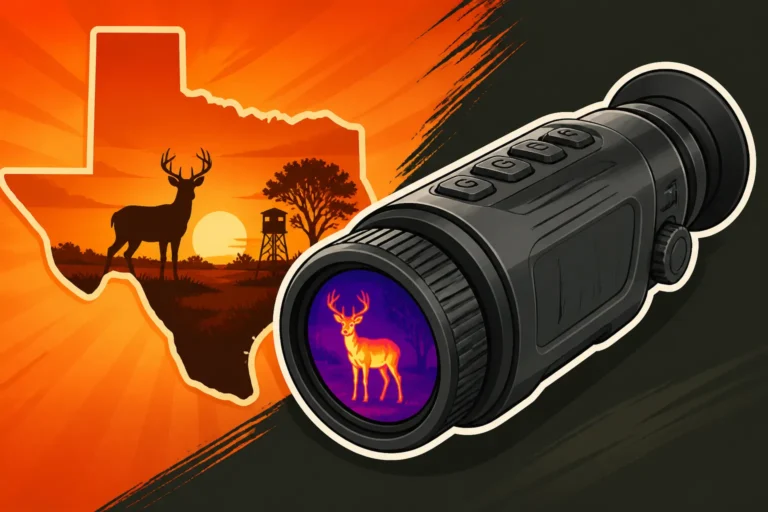
Handheld Thermals for Scouting and Recovery
Even if you don't plan to mount a thermal device on your rifle, a handheld thermal monocular is an incredibly powerful tool for any Texas hunter, especially when dealing with exotics.
Imagine this scenario: you've made a great shot on an Axis buck right at last light, but it bolts into thick cover. Instead of waiting until morning, risking spoilage or predation, a thermal monocular can help you quickly locate the downed animal by its heat signature. This can save valuable meat and provide peace of mind.
Beyond recovery, thermal monoculars are fantastic for:
- Pre-dawn Scouting: Before legal shooting light, you can scan fields and senderos to see what animals are present and where they're moving, helping you plan your approach for the morning.
- Verifying Presence: If you suspect animals are in a certain area but can't see them with binoculars, a quick scan with a thermal can confirm their presence, revealing deer, hogs, or other exotics hidden in the shadows or dense vegetation.
- Safety: They can also be used to identify potential hazards like snakes or other predators in low light, adding an extra layer of safety to your hunt.
The portability and ease of use of a thermal monocular make it an indispensable tool for extending your effective scouting and recovery time, especially in Texas's challenging environments. Companies like Pulsar, AGM, and ATN offer a range of reliable thermal monoculars. For more information on choosing one, take a look at Best Thermal Monocular for Scanning in Texas.
Selecting Optics for Specific Exotic Species
As we've discussed, Texas exotics are a diverse bunch, and tailoring your optics to the specific species you're pursuing can significantly improve your chances of success. It's not just about raw power; it's about the right tool for the job.
Optics for Axis Deer and Blackbuck
Axis deer and Blackbuck antelope are often found in similar habitats: open to semi-open country with patches of cover. The Texas Hill Country is particularly known for its thriving Axis populations, while Blackbuck favor wide-open grasslands. Both species are incredibly alert, with excellent eyesight, and can be quite skittish.
- Axis Deer: These animals are most active during the cooler parts of the day, making dawn and dusk prime hunting times. For Axis, you'll need binoculars with excellent light-gathering capabilities (10×42 or 10×50 are ideal) to pick them out of shadows or identify antlers in low light. Your rifle scope should have good low-light performance as well, and a variable magnification in the 3-9x to 4-16x range provides the versatility needed for potential quick shots in brush or more deliberate shots across an open field. Given their coloration, they can blend into tall grass or dappled light surprisingly well. Understanding How to Hunt Axis Deer Free-Range Tactics will emphasize the importance of good glass.
- Blackbuck Antelope: Blackbuck are incredibly fast and can be spotted from vast distances in their preferred open habitats. High-power binoculars (10x or 12x) and a spotting scope are invaluable for locating and evaluating these agile animals without spooking them. For your rifle, a scope with a higher top-end magnification (up to 16x or 20x) might be beneficial for those longer shots on open plains. Precise ranging is critical, as distances can be deceptive when hunting Blackbuck.
For both species, clear glass with good color rendition will help differentiate them from the surrounding landscape, especially when they are partially obscured or at a distance.
Optics for Aoudad Sheep
Hunting Aoudad in the Trans-Pecos mountains of West Texas is arguably one of the most physically demanding and optics-intensive exotic hunts. These wary sheep inhabit rugged, steep terrain, and spotting them often requires hours of meticulous glassing from high vantage points. If you're planning an Aoudad Sheep Hunting in Texas trip, your optics are your most important tools.
- Binoculars and Spotting Scopes: This is where top-tier binoculars (12×50 or even 15×56) and a high-magnification spotting scope (20-60x or 25-75x) truly shine. You'll spend an incredible amount of time behind the glass, picking apart distant mountainsides for any sign of movement. Clarity, resolution, and comfortable ergonomics are paramount to avoid eye strain during these long glassing sessions. A sturdy tripod for both your binoculars and spotting scope is absolutely non-negotiable for stable viewing and long-range observation.
- Rifle Scopes: Aoudad hunts often culminate in long-range shots across canyons or up steep slopes. Your rifle scope needs a capable variable magnification, often in the 4-16x, 5-20x, or even 5-25x range, combined with a precise reticle (MIL/MOA or a reliable BDC) and turrets that allow for accurate dialing of elevation and windage. Angle compensation in your rangefinder is also critical due to the extreme elevation changes.
The rugged nature of Aoudad hunting means your optics must be incredibly durable, capable of withstanding bumps, drops, dust, and harsh weather conditions.
Optics for Nilgai Antelope
Nilgai antelope are unique in Texas, found predominantly in the vast, dense brush country of the coastal plains, particularly around the King Ranch and surrounding areas. They are large, tough animals, notoriously difficult to spot, and incredibly resilient. If you plan to go Nilgai Hunting in South Texas, your optics choices will be dictated by their elusive nature and the challenging terrain.
- Binoculars and Spotting Scopes: While you might think "dense brush" means short ranges, Nilgai often break out into large pastures or senderos, or you might spot them from a vehicle at long distances. Powerful binoculars (10×50 or 12×50) are essential for scanning the edges of brush lines and picking out their subtle gray-brown forms. A spotting scope can be useful for confirming identification and trophy quality at extended ranges once they've been located.
- Rifle Scopes: Given their size and toughness, and the potential for longer shots across open areas, a robust rifle scope with a versatile magnification range (3-9x, 4-16x) is a solid choice. The scope needs to be exceptionally durable and waterproof to handle the coastal humidity and any sudden downpours. Good light transmission is important, as Nilgai are often active during low-light periods. Since they are incredibly tough, shot placement is paramount, requiring a clear, crisp image from your scope.
For Nilgai, the challenge is often first finding them in the vast, thick cover. Therefore, maximizing your ability to glass effectively from elevated positions or across openings becomes incredibly important, making quality binoculars and a steady hand (or tripod) key.
Maintenance and Care for Your Optics
You've invested good money and time in selecting the perfect optics for your Texas exotic hunts. Now, it's crucial to protect that investment. Proper care and maintenance aren't just about making your gear last; they're about ensuring your optics perform flawlessly when that trophy of a lifetime steps out.
Protecting Your Investment
Optics are precision instruments, and even the most rugged designs benefit from thoughtful care.
- Lens Cleaning: This is perhaps the most critical aspect of optic care. Never use your shirt, a paper towel, or harsh chemicals to clean your lenses. Dust, dirt, and oil can easily scratch the delicate coatings. Always start by using a soft brush or compressed air to remove any loose debris. Then, use a specialized lens cleaning cloth (microfiber is best) and a reputable lens cleaning solution. Apply the solution to the cloth, not directly to the lens, and wipe gently from the center outwards in a circular motion. Brands like Vortex offer excellent lens pens and cleaning kits that are perfect for field use.
- Storage: When not in use, always store your optics in a protective case or bag. Binoculars should have lens caps on both the objective and ocular lenses. Keep scopes capped when not actively hunting. Avoid storing optics in direct sunlight or extreme temperatures, which can degrade seals and coatings over time. A climate-controlled environment is ideal for long-term storage.
- Covers and Cases: Invest in neoprene covers for your rifle scopes, and padded cases for your binoculars and spotting scopes. These act as a first line of defense against bumps, scratches, and dust accumulation, especially when transporting your gear to and from the lease.
Environmental Protection
Texas weather is notoriously unpredictable and can be harsh on gear. Your optics need to be ready for anything Mother Nature throws their way.
- Waterproof and Fog-proof: Ensure all your optics are rated as fully waterproof and fog-proof. Most quality optics today are O-ring sealed and nitrogen or argon purged to prevent internal fogging. However, constantly exposing them to extreme temperature changes or submerging them unnecessarily can still test these seals. If your optics do get wet, dry them thoroughly with a soft cloth before packing them away.
- Dust and Sand: The dusty conditions of many Texas regions can be brutal on optics. Always use lens caps when not actively glassing or shooting. If dust gets on your lenses, follow the cleaning procedure outlined above – never wipe dry dust, as it will scratch the lens.
- Heat: Texas summers are no joke. Avoid leaving your optics exposed to direct sunlight in a vehicle for extended periods, as extreme heat can sometimes affect seals and internal components.
A little proactive care goes a long way in ensuring your optics remain reliable, clear, and ready for action throughout your exotic hunting adventures in Texas.
Optics for Exotic Hunting in Texas Comparison Table
| Optic Type | Primary Use | Ideal Magnification Range | Key Features for Exotics Hunting | Example Species Application |
|---|---|---|---|---|
| Binoculars | Scouting, spotting, general observation | 10×42, 12×50, 15×56 | Excellent light gathering, wide FOV, durable, ergonomic | Axis Deer, Blackbuck, Initial Aoudad/Nilgai spotting |
| Spotting Scope | Long-range identification, trophy judgment | 15-45x, 20-60x, 25-75x | High magnification, superior clarity, tripod compatible | Aoudad, distant Nilgai, assessing trophy Blackbuck |
| Rangefinder | Precise distance measurement | 800-1500+ yards reflective range | Angle compensation, scan mode, fast acquisition | All exotics for ethical shot placement, especially long shots |
| Rifle Scope | Aiming, target acquisition | 3-9x, 4-16x, 5-25x | Variable power, clear glass, durable, reliable turrets | All exotics, adaptable for various ranges/cover |
| Thermal Monocular | Night/low-light scouting, tracking | N/A (heat detection) | Heat signature detection, portable, rugged, fast scanning | Tracking wounded game, night hog hunting (combo), pre-dawn scouting |
Disclaimer
Please be aware that hunting regulations and seasons are subject to change. Always consult the most current Texas Parks and Wildlife Department (TPWD) Outdoor Annual before any hunting activity to ensure compliance with all state and local laws. This guide is for informational purposes only and should not be considered legal advice.