Best Thermal Scopes for Hog Hunting in Texas
The struggle is real when you’re out in the Texas darkness, hearing hogs rooting just beyond your sight, knowing they’re there but unable to get a clear, ethical shot. Traditional night hunting methods often fall short, leaving you frustrated and the hogs to continue their destructive path. This comprehensive guide will illuminate the world of thermal scopes, helping you understand their technology, choose the best models for your needs, and apply them effectively for successful hog hunting across the vast and varied Texas landscape.
Understanding Thermal Technology for Hog Hunting
Let's be honest, hunting feral hogs in Texas isn't just a sport; it's a necessary wildlife management effort, and often, the most effective time to do it is under the cloak of night. That's where thermal technology steps in, transforming what was once a blind endeavor into a targeted, efficient operation. But what exactly is thermal imaging, and why has it become such an indispensable tool for Texas hog hunters?
The Science Behind Thermal Imaging
At its core, thermal imaging isn't about seeing in the dark like night vision; it's about seeing heat. Every object with a temperature above absolute zero emits some form of infrared radiation, and thermal scopes are designed to detect these subtle differences. Think of it like this: your thermal scope has a specialized lens that focuses the infrared energy emitted by everything in its field of view onto a sensitive detector. This detector then creates a detailed temperature pattern, which is then translated into a visual image on your scope's display. What you see isn't light reflecting off an object, but rather the heat signature emanating from it. This means hogs, which are warm-blooded creatures, stand out like a beacon against a cooler background, whether it's the cold ground, dense brush, or even a vehicle engine after a long drive.
The resolution of the detector, often measured in pixels like 384×288 or 640×480, plays a huge role in how clear and detailed this heat signature appears. A higher resolution means more detail, making it easier to identify an animal and distinguish it from other heat sources, which is absolutely critical for ethical shot placement. Similarly, the sensitivity of the sensor, often expressed as NETD (Noise Equivalent Temperature Difference), tells you how small a temperature difference the scope can detect. A lower NETD value (e.g., <25mK or <30mK) indicates a more sensitive sensor, allowing you to pick up on even fainter heat signatures, which can be the difference between spotting a hog partially obscured by tall grass or missing it entirely.
Why Thermal is a Game-Changer for Texas Hogs
Texas is battling a severe feral hog problem, with estimates placing the population anywhere from 2.5 to 5 million animals. These intelligent, prolific breeders cause billions of dollars in agricultural damage annually, destroying crops, tearing up pastures, and even preying on livestock. Because hogs are largely nocturnal, especially in the sweltering Texas heat, hunting them during daylight hours can be incredibly challenging and often less productive. They learn quickly and adapt to pressure, seeking refuge in thick brush and moving primarily after sundown.
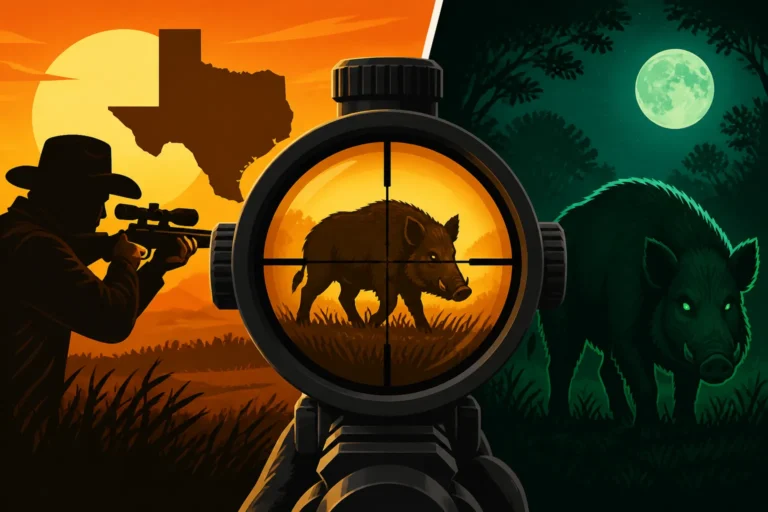
This is precisely where thermal scopes become an absolute game-changer. Imagine scanning a dense tree line or a field of tall corn at night and instantly spotting the distinct heat signatures of a sounder of hogs. You're not relying on ambient light, moonlight, or artificial illumination; you're seeing them through their own emitted heat. This capability vastly increases your effective hunting hours and your success rate. It allows you to quickly locate and engage multiple targets, which is vital when trying to make a dent in large hog populations. The ability to spot hogs in areas where they would be completely invisible to the naked eye or even traditional night vision is unparalleled. Whether you're trying to protect your property, manage a lease, or simply enjoy the thrill of the hunt, thermal technology provides a crucial advantage.
Thermal vs. Night Vision: Key Differences
It's easy to get thermal and night vision mixed up, but they operate on fundamentally different principles, and understanding this distinction is key to choosing the right tool for your specific needs, especially for hog hunting in Texas. Night vision, often referred to as image intensification, gathers the small amounts of visible light (and some infrared light) present in the environment, amplifies it thousands of times, and then presents it on a phosphor screen, typically in shades of green. It essentially makes a very dim scene look much brighter, allowing you to see in low-light conditions.
The major drawback of night vision for hog hunting is its reliance on some ambient light. On a completely overcast, moonless night in the deep Texas brush, night vision can struggle significantly. Furthermore, anything that blocks visible light – dense foliage, fog, or even heavy rain – will impede night vision's effectiveness. Hogs are masters of concealment, and they'll often hold up in areas so thick that night vision simply can't penetrate.
Thermal imaging, on the other hand, doesn't care about light. It sees heat. This means it can "see through" smoke, fog, light brush, and even complete darkness. A hog hiding behind a thin bush will still emit heat that a thermal scope can detect, making it stand out from its cooler surroundings. For hunting, especially for quick target acquisition and tracking in challenging conditions, thermal offers a distinct advantage. While night vision might give you a slightly more "natural" image with better detail recognition of visible features, thermal excels at detection and identification of living, warm-blooded creatures, which is paramount for hunting hogs at night. For many Texas hunters, having both a thermal monocular for scanning and a thermal scope mounted on their rifle is the ideal combination. To dive deeper into the legal aspects, you might want to read about whether Is Thermal Hunting Legal in Texas?.
Key Features to Look for in a Thermal Scope
Choosing a thermal scope can feel overwhelming with all the technical jargon and various models on the market. But for effective hog hunting in Texas, a few core features truly stand out. Prioritizing these will help you cut through the noise and find a scope that meets the demanding conditions of nocturnal hunting.
Sensor Resolution and Magnification
These two features are absolutely critical because they directly impact your ability to see and identify your target at varying distances. The sensor resolution, typically expressed in pixels like 384×288 or 640×480, refers to the number of individual thermal detectors in the sensor array. More pixels mean more thermal data, resulting in a sharper, more detailed image. For hog hunting, where distinguishing a hog from a stump or accurately placing a shot matters, a higher resolution is always better, though it comes at a higher price point. While 384 resolution is certainly capable, especially at closer ranges (say, under 150 yards), a 640 resolution sensor will provide significantly more clarity and detail at longer distances, making identification much easier and safer.
Magnification also plays a crucial role. Thermal scopes have both optical magnification (the base zoom, like 1.5x or 2.5x) and digital zoom (which magnifies the image digitally, often pixelating it). You want sufficient optical magnification to bring the target closer without excessive digital zoom, which can degrade image quality. Many scopes offer a variable optical zoom, which is fantastic for adapting to different hunting scenarios, from close-quarters encounters in thick brush to longer shots across open fields. However, remember that as you increase magnification, your field of view (how wide an area you can see) decreases. A good balance allows you to scan effectively at lower magnification and then zoom in for positive identification and precise targeting.
Refresh Rate and Display Quality
Imagine trying to track a running hog with a scope that lags, freezes, or produces a jerky image. Frustrating, right? That's why refresh rate is so important. Measured in Hertz (Hz), the refresh rate indicates how many times per second the display updates the image. For thermal scopes, 30 Hz is generally considered the minimum acceptable, but 50 Hz or 60 Hz is vastly superior, providing a much smoother, more fluid viewing experience. This is especially vital when tracking moving targets like hogs that can bolt through the brush with surprising speed. A higher refresh rate means less motion blur and a more responsive display, which can be the difference between a clean shot and a miss.
The display quality itself also impacts your overall experience. Modern thermal scopes typically use LCOS (Liquid Crystal on Silicon) or AMOLED (Active Matrix Organic Light Emitting Diode) displays. AMOLED displays are generally preferred for their vibrant colors (even in thermal, where colors represent temperature differences), deeper blacks, faster response times, and better performance in extreme temperatures. A high-resolution display within the scope (e.g., 1024×768 or 1280×960) complements a high-resolution sensor, ensuring that the detailed thermal data is presented as clearly as possible to your eye. When you're spending hours staring through a scope in the dark, a clear, smooth, and comfortable viewing experience reduces eye strain and helps you stay focused.
Detection, Recognition, and Identification (DRI) Ranges
When you're comparing thermal scopes, you'll often see specifications for "Detection, Recognition, and Identification" (DRI) ranges. These aren't just marketing numbers; they're standardized metrics that help you understand a scope's practical capabilities.
- Detection Range: This is the maximum distance at which the thermal scope can simply detect the presence of a heat source, usually represented by a minimum of two pixels. At this range, you know something is out there, but you can't tell what it is. For example, a scope might detect a man-sized object at 2,000 yards. This is great for initial scanning.
- Recognition Range: At this distance, the thermal image provides enough detail (typically 6-8 pixels) for you to recognize the general shape and characteristics of the heat source. You might be able to tell it's an animal, and perhaps even distinguish between a deer and a hog, but without enough detail for confident identification. A scope might recognize a hog-like shape at 600 yards.
- Identification Range: This is the most critical metric for ethical hunting. At the identification range (often 12-15 pixels), you have enough detail to positively identify the target, assess its size, and determine if it's a shootable animal. This is where you can confidently discern a hog from a cow, or even a large boar from a smaller sow within a sounder. If a scope can identify a hog at 200-300 yards, that's a practical maximum for most ethical shots.
It's important to remember that these ranges are often based on ideal conditions and a standardized target size. Real-world conditions—like humidity, wind, terrain, and the animal's orientation—can all affect these ranges. When choosing a scope, consider the typical distances you'll be hunting in Texas. For example, if you mostly hunt dense brush country where shots are under 100 yards, you might not need the absolute longest DRI ranges. But if you hunt open fields and want to scan large areas, a longer recognition and identification range will be incredibly beneficial. GoHunt, and similar platforms, often provide detailed specifications and real-world reviews that can help contextualize these numbers.
Battery Life and Power Solutions
There's nothing worse than having your thermal scope die right when the hogs come out. Reliable power is absolutely non-negotiable for night hunting. Pay close attention to the advertised battery life, but also consider real-world performance, as continuous use, extreme temperatures, and higher brightness settings can significantly reduce battery duration. Many modern thermal scopes utilize internal rechargeable batteries, which can be convenient but also mean you can't simply swap out dead batteries in the field.
Scopes with external battery pack options or standard removable batteries (like 18650s or even AA/CR123s for some older models) offer more flexibility. If your scope has an internal battery, look for models that support charging via a power bank (USB-C is becoming standard), allowing you to top up the battery on the go. Investing in a quality power bank with high capacity is a smart move.
Another consideration is battery type. Lithium-ion batteries generally offer the best performance in terms of capacity and cold-weather resilience. Some scopes feature intelligent power management systems that include "sleep mode" or "standby mode" to conserve power between scanning sessions. For long nights in the field or multi-day hunts on a Texas lease, having redundant power solutions—whether it's extra battery packs, a high-capacity power bank, or a method to charge in your vehicle—is crucial. Don't let a dead battery cut your hunt short.
Top Thermal Scope Brands and Models for Texas Hog Hunters
The thermal scope market has exploded in recent years, offering a wide range of options from budget-friendly entry points to high-performance professional-grade devices. For Texas hog hunters, reliability, image quality, and robust construction are paramount, given the often rugged and demanding hunting conditions.
High-Performance Options
When you're looking for the absolute best in thermal imaging, often with superior sensor quality, processing power, and advanced features, you'll be looking at brands like Pulsar and Trijicon. These manufacturers are at the forefront of thermal technology, delivering scopes that offer exceptional clarity, detection ranges, and reliability, albeit with a higher price tag.
Pulsar is a name synonymous with innovation in the thermal optics world. Their Thermion series, for instance, often comes in a traditional riflescope form factor, making it comfortable and familiar for many hunters. Models like the Pulsar Thermion 2 XP50 Pro or the Thermion 2 XQ50 Pro boast high-resolution 640×480 or 384×288 sensors, depending on the model, paired with incredibly sensitive NETD values (often <25mK). This combination delivers stunning image quality, allowing for clear identification of hogs at impressive distances, even in adverse conditions like fog or light rain. The Thermion's advanced image processing, smooth 50Hz refresh rate, and robust magnesium alloy body make it a favorite among serious hog hunters. Features like multiple color palettes, picture-in-picture mode, built-in video recording, and extensive ballistic profiles further enhance their functionality. If you want to know if Is the Pulsar Thermion 2 Worth It for Hog Hunting?, many seasoned hunters would emphatically say yes.
Trijicon's REAP-IR and IR-PATROL series are also top-tier choices, renowned for their rugged durability and no-nonsense performance. Trijicon has a strong reputation in the tactical and military sectors, and that robust design ethos carries over to their thermal hunting scopes. While perhaps not as feature-laden with digital bells and whistles as some competitors, Trijicon scopes excel in core thermal performance. They often feature high-quality 640×480 sensors and are built to withstand heavy recoil and harsh environments. The focus with Trijicon is on delivering a clear, reliable thermal image consistently. Their scopes are known for being incredibly user-friendly with intuitive controls, allowing you to focus on the hunt rather than fiddling with settings. For hunters who prioritize bulletproof reliability and exceptional image quality above all else, Trijicon represents a premium, long-term investment.
Mid-Range Workhorses
For many Texas hog hunters, the sweet spot lies in the mid-range category, where you can find excellent performance, robust features, and dependable quality without breaking the bank. Brands like AGM and ATN have carved out a strong niche here, offering compelling thermal scopes that deliver significant value.
AGM Global Vision has quickly become a very popular choice, especially with their Rattler series. The AGM Rattler TS35-384 and TS50-640 (or their V2 iterations) are prime examples of scopes that offer fantastic image quality for their price point. The TS35-384, for instance, provides a solid 384×288 sensor with a 50Hz refresh rate, making it more than capable for most hog hunting scenarios within 200-250 yards. The TS50-640, with its higher resolution, pushes that identification range even further. These scopes are known for their ease of use, compact size, and respectable battery life. They often include features like Wi-Fi streaming, video recording, and multiple reticle options, giving hunters plenty of versatility. Many hunters contemplating Pulsar vs AGM Thermal Scopes for Hogs find that AGM offers a compelling balance of performance and affordability.
ATN (American Technologies Network) has also made significant strides with their ThOR thermal rifle scopes. ATN is well-known for integrating a host of digital features into their optics, often referring to them as "smart HD optics." The ATN ThOR 4 series, for example, combines a thermal sensor with an impressive suite of features including a ballistic calculator, smart rangefinder, dual-stream video recording, Wi-Fi, and even a gyroscope and accelerometer for improved shooting stability. While some hunters prefer a simpler interface, others appreciate the comprehensive digital ecosystem ATN provides. Their sensors range from 384×288 to 640×480, and they often focus on long battery life. If you're a tech-savvy hunter who wants a scope that can do almost everything, an ATN ThOR could be a great fit. Their extensive feature set can be a real asset for advanced hunters, and many find that Is the ATN ThOR Worth It for Hog Hunting? because of its multi-functional capabilities.
Budget-Friendly Choices
Not every hunter needs or wants to spend thousands of dollars on a thermal scope, especially if they're just getting started or only hunt occasionally. The good news is that the market has expanded to offer some surprisingly capable budget-friendly options that can still get the job done for hog hunting in Texas. These scopes might not have the absolute highest resolution or the most advanced features, but they provide a crucial thermal advantage over traditional night hunting.
When looking at budget options, you'll typically find scopes with 256×192 or 384×288 resolution sensors and often slightly lower refresh rates (though 50Hz is becoming more common even in this segment). While these won't offer the crisp, long-range identification of their high-end counterparts, they are perfectly suitable for detecting and recognizing hogs at closer to mid-range distances—think under 150 yards, which is where many brush country shots happen anyway. Brands like InfiRay Outdoor (with models like the Finder or the Jerry C series for clip-ons, or their more dedicated scopes), Hikmicro, and sometimes entry-level offerings from AGM or Pulsar's simpler XQ series can fall into this category.
For example, a Hikmicro Gryphon LRF GQ35 or a similar scope might offer a 384×288 sensor and 50Hz refresh rate at a price point significantly lower than premium models. The key is to manage expectations. You might need to close the distance a bit more to achieve positive identification, and the image might not be as sharp or detailed, but the core benefit of seeing heat signatures in the dark is still there. These scopes often strip away some of the more advanced digital features to keep costs down, focusing on core thermal performance. They are excellent choices for hunters looking to get into thermal without a massive initial investment. It’s definitely possible to find the Best Budget Thermal Scope Under $2000 if you do your research and understand what features you prioritize.
Here's a quick comparison of some popular thermal scopes for hog hunting:
| Feature/Model | Sensor Resolution | Objective Lens | Refresh Rate | NETD (Sensitivity) | Base Magnification | Key Features | Approximate Price Range |
|---|---|---|---|---|---|---|---|
| Pulsar Thermion 2 XP50 Pro | 640×480 | 50mm | 50Hz | <25mK | 2-16x | Traditional scope design, high detail, dual battery, video/Wi-Fi, ballistic calc | $4,500 – $5,500 |
| Trijicon REAP-IR | 640×480 | 35mm | 60Hz | <50mK | 2.5x | Rugged, simple controls, excellent core performance, military-grade | $6,500 – $7,500 |
| AGM Rattler TS50-640 | 640×480 | 50mm | 50Hz | <35mK | 2.5-20x | Good value, compact, picture-in-picture, recording, Wi-Fi | $3,000 – $4,000 |
| ATN ThOR 4 4.5-18x | 384×288 | 50mm | 60Hz | <30mK | 4.5-18x | Smart features (ballistic calc, rangefinder), long battery, video/Wi-Fi | $2,000 – $3,000 |
| Hikmicro Gryphon HQ35L (Monocular) | 384×288 | 35mm | 50Hz | <35mK | 2.4-19.2x | Monocular with LRF, good for scanning (not a rifle scope, but good combo) | $2,000 – $2,500 |
| InfiRay Outdoor Bolt TL35 | 384×288 | 35mm | 50Hz | <40mK | 3-12x | Traditional scope design, good performance for price, internal recording | $2,500 – $3,000 |
Note: Prices are approximate and can vary based on retailer, sales, and specific model variations.
Practical Considerations for Hog Hunting in Texas
Texas presents a unique set of challenges and opportunities for hog hunting. From the scorching summer heat to the varied terrain and specific legal regulations, understanding these practical aspects is just as important as choosing the right gear. Your thermal scope is a powerful tool, but it's most effective when used intelligently within the Texas context.
Adapting to Texas Weather and Terrain
Texas weather is famously unpredictable and often extreme. During much of the year, particularly from late spring through early fall, temperatures can soar well into the 90s or even 100s. While thermal scopes "see" heat, these ambient temperatures can sometimes reduce the contrast between an animal and its background, especially if the ground or vegetation has retained a lot of solar heat. Humidity can also slightly degrade thermal image quality. However, the advantage is still overwhelmingly with thermal, as the hog's core body temperature will always be significantly higher than its surroundings.
The diverse Texas terrain, from the dense South Texas brush country to the rolling plains and agricultural fields, also impacts your approach. In thick brush, close-range detection and quick target acquisition are paramount. A wider field of view at lower magnification can be more beneficial for scanning. In open fields, longer detection and identification ranges become more critical, allowing you to spot hogs from a distance and plan your approach. The use of a tripod for scanning large areas can reduce fatigue and improve stability, especially if you're using a handheld thermal monocular in conjunction with your scope.
Legalities of Thermal Hunting in Texas
One of the most appealing aspects of hog hunting in Texas is the relatively liberal regulations surrounding it. Feral hogs are considered an exotic, invasive species, and there is no closed season or bag limit on them. This means you can hunt them year-round, day or night, and with almost any method you choose, provided you have landowner permission if on private land. This includes the use of thermal imaging devices.
Yes, Is Thermal Hunting Legal in Texas? – absolutely! You can hunt feral hogs with thermal scopes and other night vision devices. There are no restrictions on weapon type, caliber, or ammunition when hunting hogs, giving you a lot of freedom. However, it's crucial to always be aware of your surroundings, understand the property boundaries you're hunting on, and be mindful of any specific regulations that might apply to particular public hunting areas or WMAs, although most hog hunting with thermal occurs on private leases or ranches. Always double-check the latest Texas Parks and Wildlife Department (TPWD) Outdoor Annual for any updates, though hog regulations are typically stable. Also, be aware of any local ordinances, especially near populated areas.
Mounting and Zeroing Your Thermal Scope
Proper mounting and zeroing are fundamental to accuracy with any rifle scope, and thermal scopes are no exception. Given their often unique form factors and sometimes heavier weight compared to traditional glass, careful attention to mounting is key.
Mounting:
- Optics Rail: Most thermal scopes will attach to a standard Picatinny or Weaver rail. Ensure your rifle has one that's securely attached.
- Mount Type: Use a high-quality mount, preferably one designed for thermal optics or heavy-duty use. Quick-detach (QD) mounts can be convenient if you plan to swap between thermal and traditional glass, but ensure it returns to zero reliably.
- Eye Relief: Thermal scopes typically have less critical eye relief than traditional scopes, but you still want a comfortable and consistent head position for optimal viewing. Adjust the mount position on the rail to achieve this.
- Leveling: Use a leveling kit to ensure your scope is perfectly level with your rifle's bore. Canting your scope will lead to horizontal point of impact shifts at different ranges.
Zeroing:
- Thermal Targets: You can’t zero a thermal scope using traditional paper targets. You need a thermal-specific target, which typically consists of a material that reflects or absorbs heat differently from its background. Aluminum foil taped to cardboard, or commercially available thermal targets (often a thin sheet of specialized material that rapidly heats or cools) work well. Some hunters use hand warmers or even just aim at a patch of ground that has been recently warmed or cooled.
- Method: Most thermal scopes have a "one-shot zero" feature or a similar digital zeroing process. You take a shot, use the scope's software to move a reticle to where the bullet impacted, and save the zero. It's often recommended to fine-tune this with a few more shots at your chosen zero range (e.g., 50 or 100 yards) to confirm accuracy.
- Profile Saves: Many advanced thermal scopes allow you to save multiple zeroing profiles for different rifles, ammunition types, or even distances. This is a fantastic feature if you use the same scope on multiple firearms or switch between different hog loads.
It’s definitely worth looking into videos or guides specific to your thermal scope model for detailed mounting and zeroing instructions. Precision here directly translates to ethical and successful hunting. For more general advice on Best Gear for Feral Hog Hunting in Texas, consider all aspects of your setup.
Maximizing Your Thermal Scope's Performance
Having a top-notch thermal scope is only half the battle; knowing how to use it effectively in the field is what truly makes a difference. From scanning techniques to ethical shot placement, maximizing your scope's performance means understanding its capabilities and limitations.
Scanning Techniques and Situational Awareness
One of the biggest mistakes new thermal users make is using their rifle-mounted scope for all their scanning. While it's tempting, constantly swinging your rifle around is unsafe, tiring, and can limit your field of view. This is where a dedicated thermal monocular truly shines. A monocular allows you to continuously scan large areas, identify potential targets, and assess the situation before you raise your rifle.
When scanning, move methodically and slowly. Hogs often blend surprisingly well, even in thermal, especially if they are partially obscured or at a distance. Look for anything that doesn't quite fit the natural thermal pattern of the environment. Sometimes it's a subtle heat signature in the brush, other times it's a moving blob in an open field. Pay attention to changes in elevation, shadows (which can be cooler), and areas of dense cover where hogs love to hide.
Situational awareness extends beyond just spotting the hogs. Once detected, use your monocular (or lower magnification on your scope) to observe their movement patterns, the size of the sounder, and the surrounding terrain. This helps you plan your approach, consider wind direction, and identify potential escape routes for the hogs. For hunters who also pursue other predators, these techniques are similar to those outlined in Coyote Hunting in Texas: Night & Thermal. By coupling a good scanning monocular with a quality thermal scope, you are much more efficient and safer in the field. To learn more about scanning specific to this, check out Best Thermal Monocular for Scanning in Texas.
Pairing with a Thermal Monocular
As touched upon, the combination of a thermal rifle scope and a thermal monocular is arguably the most effective setup for serious night hunting, especially for hogs in Texas. The monocular acts as your primary scouting tool, your "eyes in the dark," while the rifle scope is for precise targeting once a hog is identified.
Here's why this pairing works so well:
- Safety: You never point a loaded rifle at something you haven't positively identified. A thermal monocular allows you to scan wide areas, positively identify targets, and confirm clear shooting lanes without ever shouldering your weapon until it's time to take a shot.
- Efficiency: Scanning with a monocular is much faster and less fatiguing than continually holding up a rifle. You can cover more ground, spend more time observing, and quickly pick up on subtle heat signatures.
- Versatility: Many monoculars are lightweight and compact, easily carried in a pocket or around your neck. They can be used for blood trailing, confirming downed animals, and general navigation in the dark.
- Cost-Effectiveness: You don't necessarily need a top-tier monocular if you have a great rifle scope. A mid-range monocular (e.g., 384 resolution) can effectively detect hogs, and then you rely on your higher-resolution rifle scope for the final identification and shot.
Think of it like this: your monocular is your wide-angle lens, and your rifle scope is your telephoto lens. They serve different but complementary purposes, drastically increasing your effectiveness and safety when hunting hogs at night.
Ethical Considerations and Shot Placement
Just because you can see a heat signature at a great distance with your thermal scope doesn't mean you should take a shot. Ethical hunting demands positive identification and the ability to make a clean, humane kill. Thermal imaging excels at detecting and identifying warm bodies, but judging exact size, sex, and precise shot placement can sometimes be challenging, especially at extreme ranges or in very thick cover.
Always strive for the highest resolution and clarity possible to ensure you're shooting at a hog and not a deer, a cow, or a landowner's dog. Use the magnification settings on your scope to achieve the best possible image for identification before squeezing the trigger. Once identified, aim for the vitals. For hogs, the brain shot (just behind the ear hole) or a shoulder shot are typically the most effective for a quick, humane kill. Their vitals are situated a bit more forward than deer, so understanding Best Shot Placement for Hogs is critical.
After the shot, use your thermal monocular or scope to confirm the animal is down. If it runs, the thermal can be invaluable for tracking. Fresh blood trails will often retain heat, and a downed animal's body will radiate heat for a significant period, making recovery much easier than trying to track in the dark without thermal. Never take a risky shot that could wound an animal or endanger others. Ethical hunting practices remain paramount, even with advanced technology.
Maintenance and Care for Your Thermal Scope
Your thermal scope is a significant investment, and like any precision optic, it requires proper care and maintenance to ensure longevity and consistent performance. Neglecting it, especially in the rugged and sometimes harsh Texas hunting environment, can lead to costly repairs or a prematurely failed unit.
Cleaning and Storage Best Practices
After a long night out hog hunting in Texas, your thermal scope is likely to encounter dust, mud, moisture, and possibly even some hog blood or hair. Regular cleaning is crucial, but it needs to be done correctly to avoid damaging the delicate optics and electronics.
Cleaning:
- Exterior Body: Use a soft, damp cloth to wipe down the exterior of the scope, removing any dirt or grime. Avoid harsh chemicals that could degrade the housing material.
- Lenses: The germanium lenses on thermal scopes are expensive and easily scratched. Always use a dedicated lens cleaning kit with a soft brush, lens cleaning solution, and a microfiber cloth. First, gently brush away any loose dust or debris. Then, apply a small amount of lens cleaner to the cloth (never directly to the lens) and gently wipe in a circular motion from the center outwards. Do not use harsh solvents, paper towels, or your shirt.
- Connectors: If your scope has exposed charging ports or data ports, ensure they are clean and dry before use or storage. Use a soft brush or compressed air to dislodge any debris.
Storage:
- Dry Environment: Always store your thermal scope in a cool, dry place. Humidity can be detrimental to electronics and optics. If you've been out in wet conditions, allow the scope to thoroughly air dry before putting it away. You might consider using desiccant packets in your storage case.
- Protective Case: Store the scope in its original padded case or a high-quality hard case to protect it from impacts and scratches. Ensure lens caps are on.
- Battery Management: If your scope uses removable batteries, consider removing them for long-term storage to prevent leakage. For scopes with internal batteries, check the manufacturer's recommendations; some suggest storing at a partial charge (e.g., 50-70%) rather than fully charged or completely drained.
Software Updates and Troubleshooting
Like many modern electronic devices, thermal scopes often receive software updates from their manufacturers. These updates can introduce new features, improve performance, fix bugs, or enhance compatibility. It's a good practice to periodically check your manufacturer's website or app (if applicable) for the latest firmware. Updating usually involves connecting the scope to a computer or using a dedicated app via Wi-Fi. Following the update instructions carefully is important to avoid bricking your device.
Basic Troubleshooting:
- No Image/Power: First, check the battery. Is it charged? Is it inserted correctly? If it's an internal battery, try plugging it into a power source.
- Poor Image Quality: Ensure the objective lens and ocular lens are clean. Adjust the focus on the objective lens and the diopter on the ocular lens. Perform a NUC (Non-Uniformity Correction) – most scopes have a button for this, which recalibrates the sensor and often clears up image artifacts.
- Buttons Not Responding: A soft reset (turning off and on) can often resolve minor electronic glitches. If issues persist, refer to your owner's manual for a hard reset procedure, but be aware this might revert settings to factory defaults.
- Wi-Fi/App Issues: Ensure your phone or tablet is compatible and the app is updated. Try reconnecting or restarting both devices.
For more complex issues, don't hesitate to contact the manufacturer's customer support. They are best equipped to diagnose and resolve problems with their specific devices. A platform like GoHunt or other forums often host discussions where users share common issues and solutions, which can also be a valuable resource.
Protecting Your Investment in the Field
The Texas hunting environment can be unforgiving. Protecting your thermal scope from potential damage while you're actively hunting is just as important as proper storage.
- Lens Protection: Always use lens caps when not actively viewing or shooting. Consider a flip-up cap for quick access and immediate protection.
- Scope Covers: A Neoprene or similar soft cover can protect the body of the scope from scratches, dust, and minor impacts, especially when moving through dense brush or transporting the rifle.
- Weather Protection: While many thermal scopes are rated as water-resistant or even waterproof, extreme downpours or submersion should be avoided. If hunting in heavy rain, consider a temporary cover or umbrella if possible, and always dry the scope thoroughly afterward.
- Recoil Management: Ensure your scope is rated for the caliber you are shooting. Heavy-recoiling rifles can damage scopes not designed to withstand the forces. Check that your mount is tight and secure before each outing.
- Avoid Drops: This might seem obvious, but be extra careful when carrying your rifle, especially when getting in and out of vehicles or blinds. A hard drop can easily damage internal components or throw off your zero. Use a quality sling that keeps your rifle secure and close to your body.
By taking these proactive steps, you'll ensure your thermal scope remains a reliable and effective tool for many successful hog hunts to come.
Cost vs. Value: Making an Informed Decision
When it comes to thermal scopes, the price range is vast, from under $1,000 to well over $7,000. Navigating this spectrum can be daunting, but understanding the relationship between cost and the value you receive will help you make an informed decision that suits your hunting style and budget.
Entry-Level vs. High-End Investment
The adage "you get what you pay for" generally holds true in the thermal optics market.
Entry-Level scopes (typically $1,000 – $2,500) usually feature lower resolution sensors (e.g., 256×192, 384×288), potentially lower NETD values (meaning less sensitivity), and fewer advanced features. They are excellent for detection at closer ranges (under 100-150 yards) and can certainly help you get started with night hunting for hogs. They offer a significant advantage over traditional methods and are perfect for hunters with smaller properties or those who primarily take closer shots. The "value" here is in accessibility – getting into thermal without a massive outlay. However, you might experience more pixelation at higher digital zoom, shorter identification ranges, and potentially less robust build quality.
Mid-Range scopes (typically $2,500 – $4,500) hit a sweet spot for many Texas hunters. Here you'll find reliable 384×288 and some 640×480 resolution sensors, often with better NETD values (<35mK), improved displays, and a good balance of useful features like video recording, Wi-Fi, and multiple reticles. Brands like AGM and ATN often excel in this category, offering a strong blend of performance and features for the price. These scopes significantly extend your effective identification range (200-300 yards) and provide a clearer image, making target assessment easier and safer. The value here is in enhanced performance and reliability for a serious hunter without reaching the absolute top tier.
High-End scopes (typically $4,500 – $7,000+) are where you get cutting-edge technology: high-resolution 640×480 sensors with extremely low NETD values (<25mK), top-tier image processing, rugged military-grade construction, and premium features like advanced ballistic calculators, laser rangefinders, and exceptional optical clarity. Brands like Pulsar and Trijicon dominate this segment. These scopes offer unparalleled identification ranges (300+ yards), superior image detail, and extreme reliability in the most challenging conditions. The value here is in maximum performance, confidence in extreme ranges, and often, a longer lifespan with less chance of needing an upgrade down the road. They are an investment for professional outfitters, dedicated hunters, or those who demand the best. When looking at long-term savings from hog damage, a high-end scope can pay for itself many times over.
Understanding Warranties and Customer Support
Beyond the sticker price, consider the long-term value, which is heavily influenced by the manufacturer's warranty and customer support. A thermal scope is an electronic device exposed to the elements, and issues can arise. A robust warranty provides peace of mind and protection for your investment.
- Warranty Length: Most reputable thermal scope manufacturers offer warranties ranging from 2 to 5 years, with some extending even longer for specific components. Pay attention to what the warranty actually covers – is it just the sensor, or the entire unit? Are there limitations on accidental damage?
- Repair vs. Replacement: Understand the manufacturer's policy on defective units. Will they repair it, or replace it with a new or refurbished unit? What is the typical turnaround time for service?
- Customer Support Reputation: Research the brand's reputation for customer service. Are they responsive? Do they have a clear process for warranty claims and repairs? Can you easily reach a human for technical assistance? Online forums and reviews can be great sources for this information.
Companies like Pulsar and AGM, for instance, generally have good reputations for standing behind their products and providing decent customer support. Before making a purchase, especially of a higher-priced unit, take the time to read through the warranty information and any available customer service reviews. A strong warranty and reliable customer support significantly add to the overall value of your thermal scope, ensuring that your investment is protected for years of effective hog hunting in Texas. Don't overlook this crucial aspect when deciding.
Disclaimer
Please remember that hunting regulations can change, and it is always your responsibility to verify the most current laws and regulations with the Texas Parks and Wildlife Department (TPWD) before heading into the field. This guide provides general information and recommendations, but it is not a substitute for official legal guidance. Hunt safely, ethically, and responsibly.