Alligator Hunting in Texas: Core vs Non-Core Counties
Alligator hunting in Texas can feel like navigating a swamp blindfolded sometimes. The regulations are intricate, varying wildly depending on where in our vast state you're planning to hunt, making it tough to even know where to begin. This comprehensive guide will untangle the complexities, explaining the crucial differences between core and non-core alligator hunting counties, and arm you with the knowledge needed for a successful and legal hunt.
Understanding Alligator Hunting in Texas
Texas is home to a robust population of American alligators, primarily concentrated in the eastern and southeastern parts of the state. These incredible reptiles are a vital part of our wetland ecosystems, and their management through regulated hunting is a testament to successful conservation efforts. However, jumping into alligator hunting without understanding the nuances can lead to frustration and potential legal issues.
Alligator Biology and Behavior
American alligators are truly fascinating, ancient predators that have roamed these lands for millions of years. In Texas, they thrive in slow-moving freshwater habitats like swamps, marshes, bayous, rivers, and even large creeks and stock tanks. They are apex predators, playing a critical role in maintaining the balance of their ecosystems by preying on fish, snakes, turtles, birds, and small mammals. Knowing their preferred habitat and diet is the first step in locating them.
As cold-blooded reptiles, their activity levels are heavily influenced by temperature. They become much more active and visible during warmer months, typically from spring through early fall, which directly impacts the best times for hunting. During cooler periods, they may retreat into dens or become largely inactive. Understanding these seasonal shifts in behavior is key to successful alligator hunting.
Alligators are also territorial, especially the larger males, and can be quite secretive. They utilize dens, often excavated into muddy banks, for shelter and hibernation. Females build large mound nests for their eggs, fiercely protecting their young for months after hatching. Their powerful bite and tail are formidable defenses, emphasizing the need for extreme caution and respect when pursuing them. Texas boasts a healthy alligator population, particularly in the coastal plain, which allows for regulated hunting to manage their numbers and prevent overpopulation, especially where they might conflict with human activities.
Historical Context of Texas Alligator Hunting
It might be hard to believe now, but American alligators were once on the brink of extinction. In the mid-20th century, unregulated hunting for their valuable hides and habitat destruction pushed their populations to dangerously low levels across much of their range, including Texas. This decline led to the species being listed under the Endangered Species Act in the late 1960s, providing much-needed federal protection.
Thanks to intensive conservation efforts, spearheaded by state agencies like the Texas Parks and Wildlife Department (TPWD), alligator populations made an incredible comeback. Protection measures, habitat restoration, and strict regulations allowed their numbers to rebound significantly. This conservation success story is a prime example of how dedicated management can bring a species back from the brink.
As populations recovered, regulated hunting was reinstated as a vital management tool. This decision wasn't taken lightly; it was based on scientific data indicating that sustainable harvest could help manage alligator numbers, prevent overpopulation in certain areas, and mitigate human-alligator conflicts, especially in rapidly developing coastal regions. This history of near-extinction and subsequent recovery heavily influenced the cautious, science-based approach seen in today's alligator hunting regulations, particularly the distinction between core and non-core counties.
Core Alligator Hunting Counties
The management of alligator hunting in Texas is highly specialized, and understanding the concept of "core" counties is absolutely fundamental. These are the areas where alligators are most abundant, and as such, their harvest is more tightly controlled to ensure long-term sustainability.
Defining Core Counties and Their Regulations
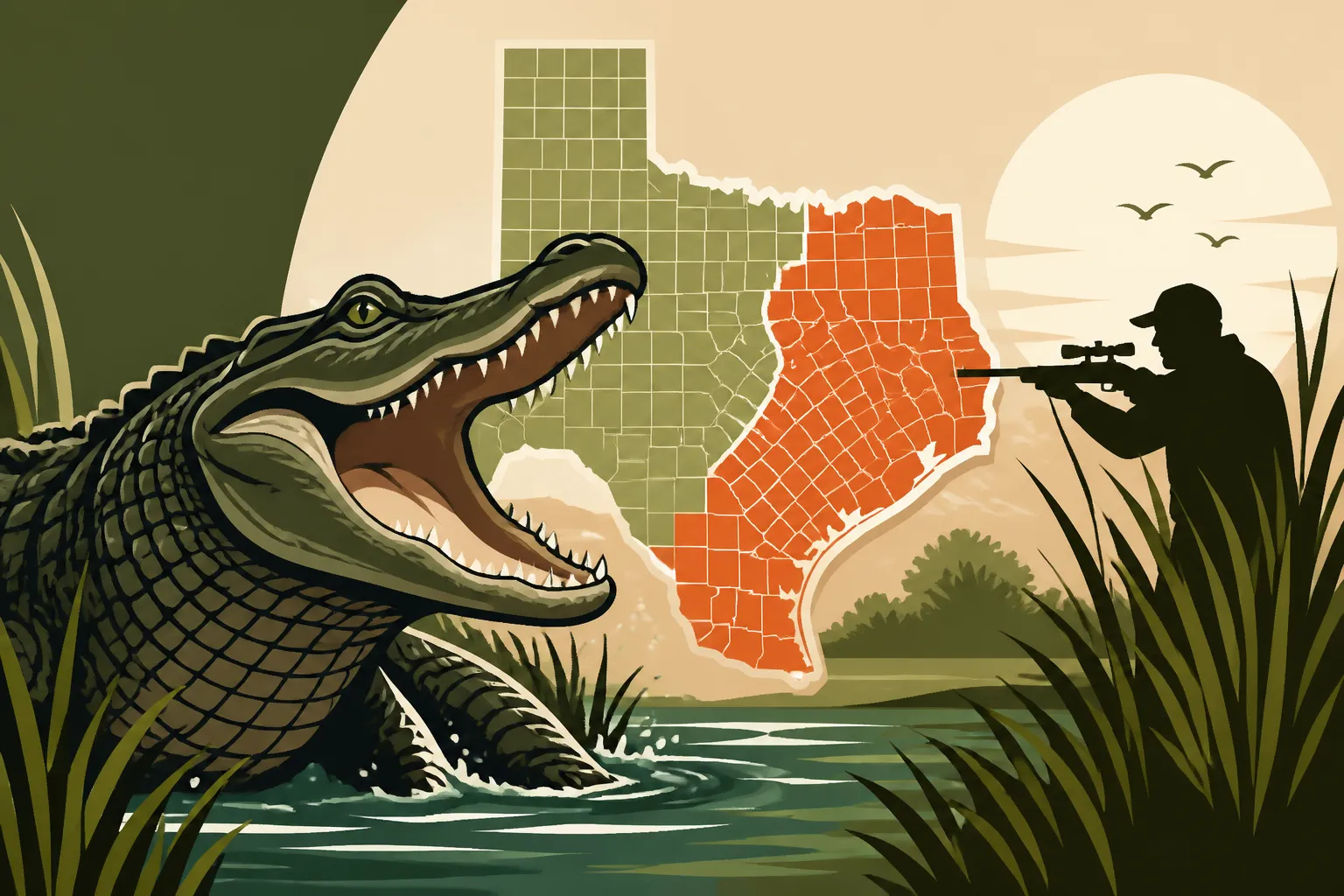
Core counties are specifically designated by TPWD as regions with dense, well-established alligator populations that can support a managed harvest. You'll find these counties primarily concentrated in Southeast Texas, extending along the Gulf Coast and inland, encompassing rich marshlands, bayous, and river systems. Classic examples include Brazoria, Chambers, Galveston, Jefferson, Orange, and Liberty counties. If you're planning to hunt in these areas, prepare for stricter rules.
In these core counties, the alligator hunting season is typically very short and specific, usually running for a mere three weeks from September 10th to September 30th. This precise timeframe is chosen to coincide with a period when alligators are active but outside their crucial breeding and nesting seasons, minimizing disruption to their life cycle. The most critical regulation in core counties is the absolute requirement for a special alligator tag issued by TPWD. You cannot legally harvest an alligator in a core county without one of these unique, individually numbered tags.
The harvest quota in core counties is rigorously managed. TPWD allocates a specific number of tags to each core county, and these tags are distributed through a couple of primary avenues. Many tags go to landowners who participate in TPWD's Managed Lands Deer Program (MLDP) or other wildlife management programs that include alligators. The remaining tags are made available to the public through a highly competitive public drawn hunt system. This strict allocation system is designed to maintain sustainable harvest levels and prevent any localized overharvesting.
Drawn Hunts and Public Land Opportunities in Core Counties
Securing an alligator tag in a core county can feel like winning the lottery due to the limited quota and high demand. For the general public, one of the most accessible and exciting avenues is through the annual Texas Drawn Hunts & Public Hunt Draw 2027 program. TPWD offers specific drawn hunts for alligators on various public lands, including several Wildlife Management Areas (WMAs) located within the core counties. These hunts provide a unique opportunity to experience alligator hunting in prime habitat.
The application process for drawn hunts is done online through the TPWD website and requires careful attention to deadlines and specific endorsements on your general hunting license. For instance, opportunities at places like the J.D. Murphree WMA near Port Arthur or the Anahuac National Wildlife Refuge (often managed in cooperation with TPWD) can offer excellent, though highly competitive, public access. It's crucial to research the specific hunt details, as methods and requirements can vary from one WMA to another.
Even if a drawn hunt doesn't pan out, some landowners in core counties who receive alligator tags through TPWD's management programs may offer guided alligator hunts. While typically more expensive than public land opportunities, these hunts often boast a higher success rate and come with the invaluable expertise of experienced guides, which can be particularly beneficial for first-time alligator hunters. It's an investment, but one that often guarantees a memorable and educational experience.
Non-Core Alligator Hunting Counties
Beyond the tightly regulated core counties, a different set of rules applies to the rest of Texas. These "non-core" counties offer distinct opportunities and challenges for alligator hunters, often with more flexible regulations but potentially more dispersed populations.
General Non-Core County Rules and Opportunities
Non-core counties are, by definition, any Texas county not explicitly designated as a core alligator hunting county. This covers a vast geographic area where alligator populations are generally less concentrated, more scattered, or limited to specific water bodies. Don't mistake "non-core" for "no alligators"; it simply means the population dynamics and management needs are different than in the dense coastal marshes.
The regulations for non-core counties are significantly more liberal, largely acknowledging that alligators in these areas are often found in smaller numbers or can sometimes become nuisance animals. The hunting season is much longer, typically spanning from April 1st to June 30th, and then again from September 1st to September 30th. This extended season provides hunters with a broader window of opportunity. The most significant difference is that in non-core counties, you do not need a special alligator tag from TPWD. A valid Texas hunting license with the standard Alligator Hunting Endorsement is sufficient.
While you don't need a special tag, there are still critical restrictions. The bag limit in non-core counties is generally set at one alligator per person per year. More importantly, there's a strict size restriction: only alligators 10 feet or longer may be harvested. This specific length limit is a crucial conservation measure, designed to protect younger, breeding-age alligators and focus the harvest on older, larger individuals that are more likely to be involved in nuisance encounters.
Private Land Opportunities and Challenges in Non-Core Counties
The vast majority of alligator hunting in non-core counties takes place on private land. If you own property with suitable alligator habitat – be it a large pond, a section of a river, or a major creek system – or if you can secure permission from a landowner, you have the opportunity to hunt alligators during the open non-core season. This often provides a solution for landowners dealing with problematic alligators that might be impacting livestock or other activities.
The primary challenge in non-core counties isn't the regulatory hurdle of acquiring a tag, but rather the practical hurdle of finding huntable populations and gaining access. Alligators in non-core areas can be quite elusive, and suitable habitat might be isolated. This often requires diligent scouting, establishing good relationships with private landowners, or finding a hunting lease that specifically includes alligator hunting as an option. You might find some great leads by exploring Hunting Leases in Texas: Complete Guide (Cost & How to Find).
It is absolutely paramount to confirm the exact county boundaries before you hunt. Texas county lines can sometimes be less than obvious, and mistakenly hunting an alligator in a core county while adhering to non-core rules can lead to serious legal consequences, including hefty fines and loss of hunting privileges. Always consult the most current Texas Parks and Wildlife Outdoor Annual, or utilize reliable mapping tools like onX Hunt or HuntStand, to verify the precise designation of your hunting location.
Here's a quick comparison of the key differences:
| Feature | Core Alligator Counties (e.g., Jefferson, Chambers, Brazoria) | Non-Core Alligator Counties (Rest of Texas) |
|---|---|---|
| Hunting Season | September 10 – September 30 | April 1 – June 30, and September 1 – September 30 (Check Annual for specifics) |
| Required Tag | YES (Special TPWD Alligator Tag) | NO (Valid hunting license with Alligator Endorsement sufficient) |
| Bag Limit | Varies by tag allocation (typically one per tag) | One alligator per person per year |
| Size Restriction | None (specific to tag) | 10 feet or longer only |
| Access | Limited, often through Drawn Hunts or Managed Landowners | Primarily Private Land; some public with appropriate permits |
| Management | Highly regulated with specific quotas and landowner programs | General regulations, focused on nuisance and larger animals |
Licenses, Tags, and Permits for Texas Alligator Hunting
Navigating the bureaucratic side of alligator hunting is just as crucial as understanding their behavior. Without the correct licenses, tags, and reporting, even a successful hunt can turn into a costly legal headache.
Required Licenses and Endorsements
Before you even think about setting foot in alligator habitat, you absolutely must have the right paperwork in order. For starters, every hunter in Texas, regardless of what they're pursuing, needs a valid Texas hunting license. This isn't just a suggestion; it's a legal requirement for almost all hunting activities. You can't just head out with a firearm or bow without one, even if you’re on private land, unless you meet very specific (and rare) exemptions that typically don't apply to alligator hunting. You can find detailed information on costs and types of licenses in the Texas Hunting License: Cost, Types & How to Buy (2026) guide.
Specifically for alligator hunting, you also need to purchase a dedicated Alligator Hunting Endorsement. This is an additional stamp or endorsement that you buy alongside your general hunting license. Think of it like an add-on that specifically grants you the privilege to hunt alligators. Non-residents will, of course, face higher license and endorsement fees, but the requirements remain consistent across the board. Always ensure your license and endorsements are current for the entire hunting season you plan to participate in.
Beyond the general license and endorsement, if you have your sights set on hunting in a core alligator county, you'll need the most critical piece of paper: an actual alligator tag. These aren't readily available for purchase over the counter. They are meticulously issued by TPWD either to landowners who are part of their alligator management programs or, for public hunters, through the highly competitive public drawn hunt system. Without one of these physical, numbered tags in your possession, you simply cannot legally harvest an alligator in a designated core county, regardless of whether you have a valid general hunting license and alligator endorsement.
Harvest Reporting and Tagging Procedures
The responsibilities of an alligator hunter don't end the moment you've successfully harvested an animal. Texas has very stringent harvest reporting and tagging requirements for alligators, crucial elements for effective wildlife management. Immediately after you've taken an alligator, the very first step is to attach the appropriate tag to the animal. If you're in a core county, this will be the specific physical tag that was issued to you. If you're in a non-core county, you'll typically use a designated portion of your hunting license that functions as your alligator tag. This tag must remain attached until the alligator is prepared for consumption or storage.
The next critical step is harvest reporting. For alligators harvested in core counties, the process is usually more hands-on. You are often required to immediately contact TPWD (either by calling a specific regional office or, in some cases, visiting an official check station) to validate your tag and formally report the harvest. This immediate validation helps TPWD accurately track the limited quota in these highly managed areas. For harvests in non-core counties, the reporting process is generally more streamlined, often requiring you to report your alligator online through the TPWD website or the My Texas Hunt Harvest mobile app, typically within 24 hours of harvest. This system is similar to how many deer harvests are reported statewide. For more details on this process, check out Texas Hunting Tags & Harvest Reporting (My Texas Hunt Harvest).
It is absolutely paramount that you follow these tagging and reporting procedures to the letter. Failure to properly tag an alligator, or to report your harvest within the specified timeframe, can result in substantial fines, penalties, and even the loss of hunting privileges. These rules are not designed to be an inconvenience; they are essential for the long-term conservation and sustainable management of Texas's alligator population, ensuring that future generations will also have the opportunity to hunt these remarkable reptiles. Always consult the most current Texas Parks and Wildlife Outdoor Annual for the specific and up-to-date reporting requirements, as regulations can sometimes be adjusted from season to season.
Essential Tactics and Gear for Alligator Hunters
Alligator hunting is a unique pursuit that demands specialized tactics and equipment, vastly different from hunting deer or hogs. It's a challenging and thrilling experience that requires preparation, precision, and respect for a powerful predator.
Preferred Hunting Methods
Alligator hunting is far from a standard pursuit; it often involves specialized techniques, especially given that many hunts occur on or near water. One of the most common and often effective methods, particularly when targeting specific areas, is the use of a baited hook. This involves rigging a heavy-duty hook with a tempting bait, like a chicken quarter, a whole fish, or even fish scraps, suspended just above the water line from a sturdy tree branch or pole. Once an alligator takes the bait and is securely hooked, the hunter then approaches the animal, often by boat, and dispatches it. Careful placement is key to avoid catching non-target wildlife.
For hunters seeking a more active and adrenaline-pumping experience, stalking and harpooning or bowhunting are popular methods. These hunts frequently occur at night from shallow-draft boats, like airboats or flat-bottomed jon boats, using powerful spotlights to scan for the distinctive reddish-orange eye shine of alligators. Once an alligator is spotted and carefully approached, a specialized harpoon with an attached retrieval line or a heavy-duty bowfishing setup with an alligator-specific arrow is used to secure the animal. The subsequent "fight" can be intense, as the alligator will thrash violently. Once subdued, the alligator is brought alongside the boat for dispatch. Bowhunting for alligators shares some foundational principles with Bowhunting in Texas: Archery Season Guide, though the equipment is highly specialized.
While firearms are generally not used as the primary means to take a free-swimming alligator, they are commonly employed for the final dispatch of a captured or secured animal. Shot placement is absolutely critical; the target is a small area on the back of the alligator's head, directly in line with its eyes, to ensure a humane and instantaneous kill. Hunters often carry a "bangstick" – a pole with a firing mechanism that discharges a rifle or shotgun shell upon contact – or a powerful handgun for this purpose. This final step requires steady nerves, precise aiming, and a deep understanding of alligator anatomy.
Recommended Equipment
Equipping yourself properly for an alligator hunt is paramount, not just for success but, more importantly, for safety. A reliable, robust boat is your most essential piece of gear. Airboats are superb for navigating shallow marshes and swamps, offering unmatched access, but a sturdy flat-bottomed boat with a dependable outboard engine can also work well in deeper rivers and bayous. For night hunting, a powerful spotlight or a thermal imaging device is indispensable for locating alligators by their distinct eye shine. Don't forget a good pair of binoculars for scouting during daylight hours.
For the actual capture, a variety of specialized tools come into play. If you're using the baited hook method, you'll need heavy-duty fishing rods and reels spooled with incredibly strong line, along with large, specialized treble or single hooks designed for alligators. For harpooning, invest in a well-made harpoon with sturdy detachable heads and plenty of strong, buoyant rope, along with floats to track a submerged alligator. Bowhunters will need specialized alligator arrows fitted with broadheads designed for penetration and retention, paired with an effective retrieval system. Essential auxiliary tools include a robust gaff, a large net for controlling the alligator near the boat, and stout gloves.
Safety gear cannot be overstated. Always, always wear a life vest, especially when operating a boat in low light conditions or when handling a powerful, thrashing alligator. Carry a comprehensive first-aid kit, a reliable communication device (a satellite phone or marine radio is advisable in remote areas where cell service is unreliable), and a GPS unit to navigate unfamiliar waters. Lastly, a sturdy, sharp hunting knife is indispensable for field dressing the harvested alligator. Remember, you are dealing with a wild, powerful predator, so never underestimate the importance of preparedness, having a hunting partner, and adhering to strict safety protocols.
Conservation and Ethical Hunting Practices
The opportunity to hunt alligators in Texas is a privilege, directly linked to the success of decades of conservation efforts. Ethical hunting practices are not just about following the rules; they are about respecting the animal, the environment, and ensuring that this unique tradition can continue for generations to come.
The Role of Alligator Management
The remarkable recovery and current healthy population of the American alligator in Texas stands as a shining example of effective wildlife management. TPWD continuously monitors alligator populations through rigorous scientific surveys, habitat assessments, and careful analysis of harvest data. This extensive data allows them to meticulously set appropriate hunting seasons, determine precise bag limits, and allocate tags where necessary, as seen in the core counties. This science-based approach ensures that hunting remains a sustainable activity, preventing overharvesting and safeguarding the species' long-term ecological health. Every hunter who legally participates and diligently reports their harvest directly contributes to this ongoing conservation success.
Alligator management extends beyond just hunting; it plays a critical role in mitigating human-alligator conflicts. As Texas's population grows and development encroaches further into traditional alligator habitats, encounters between people and alligators become more frequent. Regulated hunting, particularly the careful removal of large, potentially troublesome alligators, helps to manage these interactions. It reduces risks to human safety and domestic animals while simultaneously maintaining a healthy and balanced alligator population across its vast range.
Furthermore, a significant portion of the revenue generated from hunting licenses, endorsements, and drawn hunt fees directly contributes to vital conservation initiatives. These funds are used by TPWD for habitat preservation and restoration projects, especially in crucial wetlands and marsh areas that are essential for alligator breeding, nesting, and survival. Therefore, every legal alligator hunter contributes financially to the overall health and sustainability of Texas's rich ecosystems and the diverse array of Texas Game Animals: What You Can Hunt.
Ensuring a Sustainable Future for Alligator Hunting
Ethical hunting practices form the bedrock of ensuring that alligator hunting remains a respected and viable tradition in Texas. This commitment begins with strict adherence to all established regulations. This means meticulously following season dates, respecting bag and size limits, and fulfilling all tagging and reporting requirements. Cutting corners or intentionally disregarding these rules not only risks severe legal repercussions but also fundamentally undermines the diligent conservation efforts that make regulated hunting possible in the first place.
Humane dispatch is another absolutely critical aspect of ethical hunting. As hunters, we bear the responsibility to ensure that any harvested animal experiences the quickest, most humane death possible, minimizing suffering. This demands a high level of skill, sound judgment, and the use of appropriate, well-maintained equipment. Practicing precise shot placement and thoroughly understanding alligator anatomy are not just recommendations but ethical imperatives. Respect for the animal should permeate every stage of the hunting process, from the initial pursuit to the final processing of the meat and hide.
Finally, proactive education—both for yourself and for others—about alligators, their ecological role, and the importance of conservation is key to fostering ongoing appreciation and responsible behavior. Sharing accurate knowledge about safety around alligators, dispelling myths, and highlighting the vital role of sustainable hunting in species management will help cultivate a broader understanding and support for these practices. By doing so, we ensure that future generations of Texans will continue to have the privilege and thrill of alligator hunting, keeping this truly unique tradition alive and thriving.
Disclaimer
This guide provides general information based on current Texas Parks and Wildlife Department regulations. Hunting regulations, season dates, and specific county designations can change frequently. Always consult the official TPWD Outdoor Annual or website for the most current and specific rules and dates before planning any hunting trip.