Best Decoys for Dove Hunting in Texas
There's nothing quite like the rush of a dove hunt, but if you've spent an opening day sweating in a field, watching birds flare at 60 yards, you know the frustration of not being able to draw them in close. Doves are smarter than many give them credit for, and simply showing up to a hot field often isn't enough to consistently put birds in the bag. This comprehensive guide will walk you through everything you need to know about using decoys to transform your Texas dove hunting experience, turning those high-flying streaks into manageable, ethical shots.
Why Dove Decoys Are a Game-Changer in Texas
For many Texas dove hunters, decoys are an afterthought, or perhaps something they've only seen duck hunters use. But let me tell you, when used correctly, dove decoys are every bit as effective for migratory birds as waterfowl spreads are. They provide a visual magnet that can pull in otherwise wary birds, giving you more opportunities and a much more rewarding hunt. It’s all about creating an illusion of safety and numbers that doves naturally gravitate towards.
Overcoming Wary Birds
Doves, especially after the first few days of the season, become incredibly wise to hunter pressure. They’ve seen shotguns, heard the blasts, and learned to recognize danger. High-flying flocks will often circle fields, assessing the situation before committing to land or feed. This is where decoys truly shine. A well-placed spread mimics a group of contented doves already on the ground or perched, feeding or resting. This visual cue bypasses their inherent caution, signaling that the area is safe. Instead of just buzzing the field and moving on, they're more likely to dip down for a closer look, offering you those prime shooting lanes. It's a psychological trick on the birds, playing on their desire for companionship and safety in numbers.
Think about it: would you rather land in an empty parking lot or one where a few cars are already parked? Doves operate on a similar principle. They are social birds, and seeing others on the ground indicates a safe feeding or watering spot. This effect is even more pronounced when hunting Mourning Dove Hunting Tactics for Texas in pressured areas or later in the season when birds have become particularly skittish. Decoys give you that critical edge, allowing you to intercept birds that might otherwise give your setup a wide berth.
Extending Your Shot Opportunities
Beyond simply drawing birds closer, decoys significantly increase the duration of your shooting opportunities. Instead of just a quick fly-by, doves will often hover, circle, and even attempt to land among the decoys. This means you have more time to shoulder your shotgun, track the bird, and take a controlled shot. Those frustrating, rushed shots at birds zipping past become much rarer, replaced by more deliberate, effective shooting. This not only increases your chances of hitting the bird but also promotes more ethical hunting by allowing for cleaner kills.
Consider a scenario where doves are entering a field at high speeds. Without decoys, you might get a split second to react. With decoys, those same birds might slow down, dip their wings, and present a much more favorable target as they attempt to join their "friends." This extended engagement also means that if you miss the first shot, the bird might still be in range for a follow-up, giving you a second chance. This is particularly valuable when you're trying to fill your Texas Dove Bag Limit & Possession or introduce new hunters to the sport, as it provides a more forgiving and enjoyable experience.
Types of Dove Decoys and How They Work
Just like with duck or goose hunting, there's a whole array of dove decoys out there, each designed to achieve a slightly different effect. Understanding the different types and how to use them is crucial for building an effective spread that will truly fool those Texas doves. It's not just about throwing a few plastic birds out there; it's about creating a dynamic, lifelike scene.
Stationary Decoys (Shells, Full-Bodies)
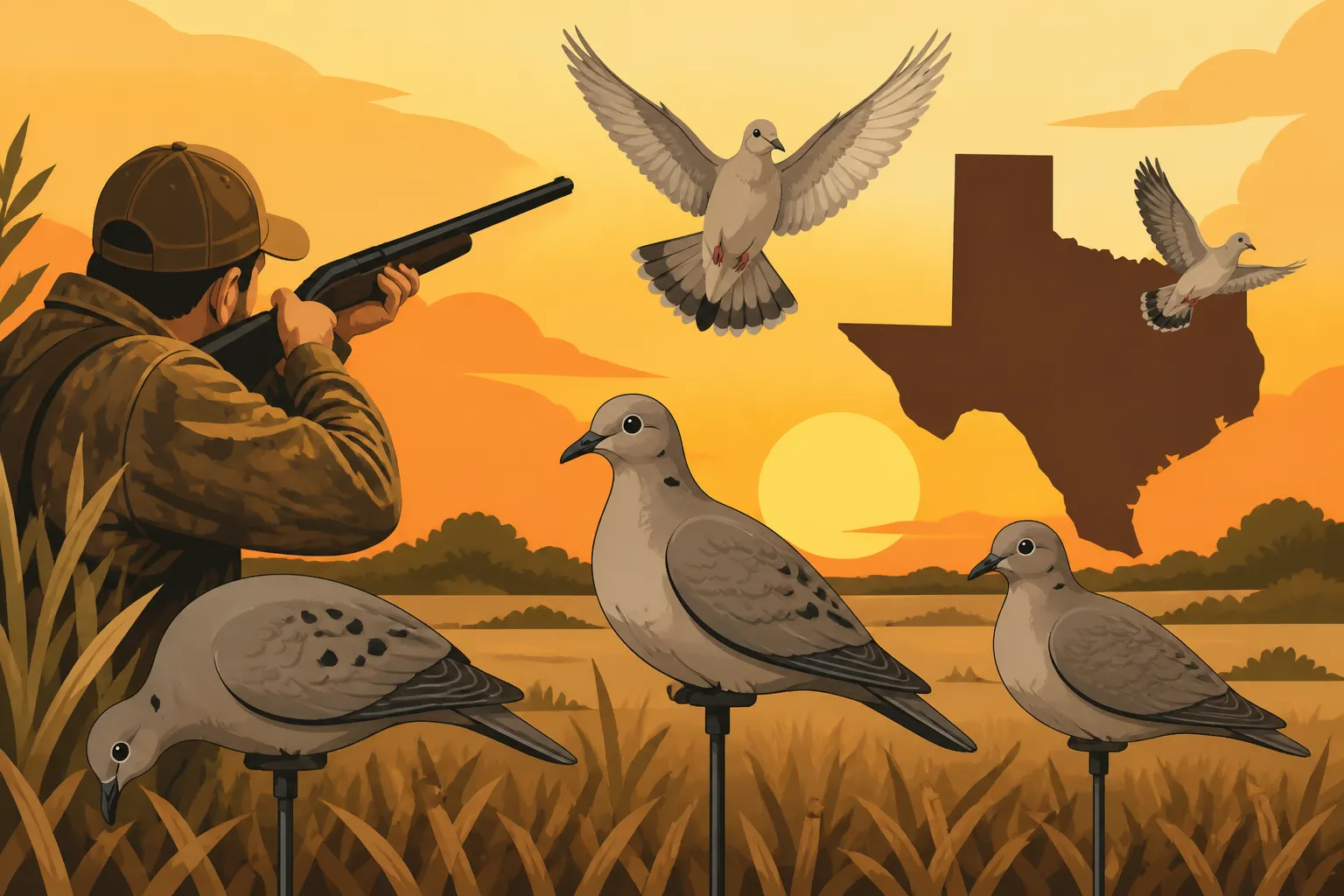
Stationary decoys are the bread and butter of any dove spread. These are typically lightweight, plastic representations of doves that are either full-bodied or half-shells. They work by mimicking birds feeding on the ground or perched on fences and branches, providing a static visual invitation for incoming doves. They're easy to transport, relatively inexpensive, and form the foundation of your decoy spread.
When using stationary decoys, realism is key. Look for decoys with good paint schemes and accurate molding. Many hunters will paint their own to reduce shine or add unique touches. You can place them on the ground using stakes, clip them to existing fence lines or tree branches, or even attach them to custom poles to get them up into the air a bit more. The goal is to make them look as natural as possible – as if real doves have just settled in. Brands like Mojo Outdoors and Higdon make reliable stationary options. Remember that doves in Texas can be a mix of White-Winged vs Mourning Dove in Texas, so having a variety can be beneficial, especially in areas where both are common.
Motion Decoys (Spinning Wings, Flagging)
This is where dove decoy spreads really come alive and become irresistible to wary birds. Motion is a huge attractor in the dove world, simulating the fluttering of wings as birds land or take off, which is a powerful signal of activity and safety. Spinning-wing decoys are by far the most popular and effective motion decoys for doves. These battery-operated devices feature spinning wings that mimic the flash of a dove in flight. They create a beacon that can be seen from great distances, pulling birds from far and wide into your setup.
Beyond spinning wings, flagging is another highly effective motion tactic. A dove flag is essentially a fabric wing on a stick that you manually wave to simulate a landing or flaring bird. It's more interactive and requires your attention, but it can be incredibly potent for those last-second pulls or for catching the eye of a high-flying flock. Many hunters swear by manual flagging, especially when doves are circling and need that extra bit of persuasion. Combining spinning wings with manual flagging offers the best of both worlds, providing constant motion and the ability to add targeted, aggressive flagging when needed. Just be aware of local regulations, as some areas might have restrictions on electronic callers or motorized decoys, although spinning wing decoys are generally legal for doves in Texas.
Kite Decoys and Balloons
While less common than spinning wings, kite decoys and large balloon decoys can also play a role in certain dove hunting scenarios, particularly for drawing attention from extremely far distances. These decoys are designed to be suspended high in the air, mimicking a dove hovering or flying at altitude. They capitalize on the fact that doves have excellent eyesight and are constantly scanning the sky for other birds.
Kite decoys, often shaped like a dove or a hawk (to scare other birds towards your spread, surprisingly), can be effective on windy days, swaying and dipping naturally. Balloon decoys, usually helium-filled and tethered, offer a similar high-visibility profile, even on calm days. They serve as a visible landmark for distant flocks, guiding them towards your general area before your ground-level spread takes over. While they might not be the primary tool for bringing birds into gun range, they are excellent for broad visibility, especially when hunting vast, open fields or when birds are working extremely high. However, keep an eye on the wind and your tether lines; a lost balloon or kite can be a pain!
Setting Up Your Dove Decoy Spread for Success
Having the right decoys is only half the battle; knowing how to deploy them effectively is what truly separates a good hunt from a great one. The setup of your dove decoy spread needs to be strategic, considering everything from bird flight patterns to wind direction and available cover. It’s an art as much as a science, and adapting to the specific field and conditions is paramount.
Location, Location, Location: Key Considerations
The absolute first step to a successful decoy spread is choosing the right spot. You can have the fanciest decoys money can buy, but if you set them up where no doves fly, they're useless. Before even thinking about decoys, scout your chosen area thoroughly. Look for signs of dove activity: feeding areas (like harvested grain fields or sunflower plots), water sources, and roosting trees. Pay attention to how the birds are entering and exiting the area. Are they flying low over a particular fence line? Are they coming in from a specific direction to water? This pre-hunt scouting is the most critical component. Many hunters use mapping tools like GoHunt to mark potential flight paths and optimal setup locations during their scouting trips.
Once you’ve identified a high-traffic zone, look for natural cover for your blind. This could be a stand of mesquite, a fencerow overgrown with weeds, or even a small depression in the field. Your hide needs to be as natural and inconspicuous as possible. Remember, doves have keen eyesight. Lastly, consider the sun's position. You ideally want the sun at your back or side, shining into the doves' eyes as they approach, making it harder for them to spot you. Positioning yourself for optimal light also helps with your shooting visibility and target acquisition.
Decoy Placement Strategies (Patterns, Heights)
Now for the fun part: arranging the decoys! The goal is to create a natural-looking landing zone that screams "safe and tasty food here!" A common and highly effective strategy is to create a "U" or "J" shape with your stationary decoys, with the open end of the shape facing into the prevailing wind. Doves, like most birds, prefer to land into the wind, as it provides lift and allows for a softer touchdown. Your blind should be at the closed end of the "U" or "J," giving you shots at birds approaching or hovering over the opening.
Varying the height of your stationary decoys adds a lot of realism. Clip some to fence wires, place others on short stakes in the stubble, and if you have taller poles, get a few up to mimic birds perching higher up. This creates a multi-dimensional look that's more convincing. For spinning-wing decoys, place them prominently in the landing zone – often slightly in front of your blind, elevated on a pole if possible. The flashing wings need to be highly visible. A good rule of thumb is to have at least one spinning wing decoy for every 10-12 stationary decoys, though this can vary. Remember, you can always adjust throughout the hunt. If birds are flaring, try moving your decoys closer or further from your blind, or adjusting their height. Check out Dove Field Setup: Where to Stand for more detailed layout ideas.
Integrating Motion for Maximum Realism
Motion is the secret sauce for dove decoys. Without it, your spread is just a collection of plastic birds, and while it might attract some, it won't be nearly as effective as a spread with dynamic movement. As mentioned, spinning wing decoys like the Mojo Dove are excellent. Place them strategically within your stationary spread, often at the edges of your intended landing zone or slightly elevated on a pole. The movement catches the eye from a distance and convinces wary birds that the area is active and safe.
Don't be afraid to experiment with the number and placement of your motion decoys. Sometimes, a single spinning wing is enough. Other times, having two or three creates an even more irresistible magnet. Consider combining them with manual flagging. When a flock is circling high, a quick flash of a dove flag can often be the final nudge they need to commit. This is especially true for White-Winged Dove Hunting Tactics for Texas, which can often be a bit more hesitant to commit than Mourning Doves. The key is to make it look effortless and natural. Avoid erratic or overly aggressive flagging that might spook birds; a gentle flutter is usually more effective. Practice your flagging technique at home so it looks like a natural bird landing or taking off.
Choosing the Right Decoys for Texas Conditions
Texas dove hunting can throw a lot at you: scorching early season heat, dusty fields, and occasionally even some unexpected rain. Your decoys need to be able to stand up to these conditions and perform reliably. Investing in quality gear upfront will save you headaches and missed opportunities later.
Material and Durability for Texas Heat
Texas heat, especially during the Texas Dove Season 2026: Zones & Dates opener in September, is no joke. Cheap plastic decoys can warp, fade, or even crack when exposed to direct sun for extended periods. When choosing decoys, look for those made from durable, UV-resistant plastics. High-quality EVA foam decoys are also excellent as they are practically indestructible, lightweight, and won't glint in the sun like hard plastic can.
Consider the paint finish as well. A matte finish is always preferable to a glossy one, as glare can immediately alert wary doves to something unnatural. Some hunters even take a can of matte spray paint to their decoys to dull any shine. Durability also extends to the stakes and clips. Flimsy plastic stakes will break in hard Texas soil, and weak clips won't hold up on a windy day. Look for metal stakes or robust plastic ones, and strong, spring-loaded clips that will keep your decoys securely in place. You're going to be setting these up and tearing them down repeatedly, so they need to withstand the abuse.
Species-Specific Decoys (Mourning vs. White-Winged)
While a generic dove decoy might work for both, using species-specific decoys can certainly enhance your success, especially if you're targeting one species predominantly. Texas is unique in that it offers fantastic hunting for both Mourning Doves and White-Winged Doves, with distinct zones for each. White-Winged vs Mourning Dove in Texas explains these differences in more detail.
Mourning Dove decoys tend to be smaller and have a more slender profile, often with a subtle pinkish hue. White-Winged Dove decoys are noticeably larger, with the prominent white wing bar being their defining feature. If you're hunting primarily in the Central or South zones, where White-Wings are abundant, having a good number of White-Wing decoys in your spread is a smart move. If you're in the North zone, Mourning Dove decoys will be your priority. Many companies offer combo packs or individual decoys of both species. Ultimately, a mixed bag of both types of decoys is a great strategy, ensuring that your spread appeals to whatever doves are flying that day.
Budget-Friendly vs. Premium Options
Just like any hunting gear, there's a wide range of price points for dove decoys. You can certainly get started with some budget-friendly options, but there are also premium decoys that offer enhanced realism and durability. For beginners, a basic starter kit of a dozen stationary decoys and one spinning-wing decoy is a great entry point. Brands like Mojo Outdoors often have these types of kits.
| Decoy Type | Pros | Cons | Best Use Case | Price Range (per dozen/unit) |
|---|---|---|---|---|
| Stationary Shells | Lightweight, compact, affordable | Less realistic, can glare | Bulk of the spread, ground feeding | $20 – $50 |
| Stationary Full-Body | More realistic, better profile | Bulkier, slightly more expensive | Ground feeding, perching on fences | $30 – $70 |
| Spinning Wing | High visibility, strong attraction | Battery-dependent, more expensive | Primary attractor, visible from distance | $50 – $150 (per unit) |
| Kite/Balloon | Very high visibility, covers large areas | Wind-dependent, requires setup, can lose | Long-range attraction, wide open fields | $20 – $80 (per unit) |
Premium options often feature more detailed paint, flocked surfaces (to reduce glare even further), and more robust motors for spinning wings. These can certainly improve your success rates, especially when hunting pressured birds. However, don't feel like you need to break the bank to get started. A well-placed, smaller spread of basic decoys will outperform a haphazardly placed, expensive spread any day. As you gain experience, you'll figure out what works best for your specific hunting style and local conditions. A good resource for finding competitive prices and comparing various models is often a hunting-specific marketplace or online retailer that caters to a broad audience, offering options from multiple brands.
Advanced Decoy Tactics and Troubleshooting
Once you've mastered the basics, there's a whole world of advanced decoy tactics you can explore to really fine-tune your dove hunting success. Doves are adaptable, and so should your decoy strategy be. Being able to read the birds and adjust your setup on the fly can make all the difference.
Combining Decoy Types and Natural Cover
The most effective decoy spreads are those that blend seamlessly with the natural environment and utilize multiple decoy types to create a comprehensive illusion. Don't rely solely on one type of decoy. Instead, think about how real doves interact with their surroundings. They feed on the ground, perch on dead snags, drink from puddles, and fly in and out. Your spread should reflect this activity.
For example, you might place a cluster of full-body decoys on the ground in a harvested wheat field, mimicking feeding birds. Then, elevate a few shell decoys on short stakes along a fencerow, as if they're resting. Crucially, position one or two spinning-wing decoys prominently in the air, perhaps on a Mojo pole, to act as a visual beacon. And don't forget the power of natural cover. Your blind should be well-hidden. If there’s a lone mesquite tree in the middle of a field, clip a few decoys to its branches – real doves love to perch there. This creates a more dynamic and believable scene that's harder for incoming doves to differentiate from a real flock. When using a tool like GoHunt to scout, make sure to mark natural perching areas in the field.
Adapting to Changing Wind and Bird Behavior
One of the biggest mistakes a hunter can make is to set up a static decoy spread and refuse to adapt. Wind direction is critical for dove landing patterns. As mentioned, doves prefer to land into the wind. If the wind shifts during the day, your landing zone will shift with it. You might need to physically move your decoys, or at least your spinning wings, to re-orient your landing strip. If birds are consistently flaring from a certain angle, that's your cue to adjust your setup or your concealment.
Observe how the doves are flying. Are they coming in high? Are they circling wide? Are they ignoring your spread and heading to a different part of the field? These are all clues. If they're flying high, you might need to raise your spinning wings or add a kite decoy to gain visibility. If they're flaring, check your camo or try moving your blind. Perhaps they're seeing something in your setup they don't like, or the sun is causing too much glare. Being flexible and willing to make changes mid-hunt will drastically improve your success. This active observation and adaptation are key elements to Dove Hunting Tactics: Field Setup & Shooting.
Common Mistakes and How to Avoid Them
Even experienced hunters can fall prey to common decoy mistakes. The first is poor concealment. You can have the best decoy spread, but if doves see you moving in your blind or spotting your unnatural outline, they're gone. Invest in good camouflage, use natural vegetation to break up your shape, and remain absolutely still when birds are approaching. Another frequent error is setting up decoys too close or too far from your blind. Too close, and birds will land behind or beside you, giving you awkward shots. Too far, and they might land just out of comfortable range. Aim for 20-30 yards from your blind as an ideal landing zone.
Over-decoying is also a trap. You don't always need hundreds of decoys. A smaller, well-placed spread is often more effective than a massive, messy one. Also, neglecting maintenance can be a problem. Keep your decoys clean, free of dust, and touch up faded paint. Replace dead batteries in spinning wings. A shiny, dusty, or non-moving decoy is a dead giveaway. Finally, forgetting to consider the sun's position can ruin a hunt. Always try to have the sun at your back, making it harder for doves to see you and providing better visibility for your shots. Proper setup, as detailed in How to Use Decoys for Dove Hunting, can prevent many of these issues.
Essential Gear to Complement Your Decoys
While decoys are a powerful tool, they are part of a larger system. To maximize their effectiveness, you need to think about the other critical pieces of gear that work in conjunction with your decoy spread to create the ultimate dove hunting setup. It's about creating a cohesive, believable environment that gives doves no reason to be suspicious.
Blinds and Camouflage for Effective Concealment
Your decoys pull birds in, but your concealment keeps them from flaring at the last second. A good blind is not just a luxury; it's a necessity. You have several options for blinds, ranging from simple chair blinds with mesh sides to more elaborate pop-up ground blinds. The key is to blend in. For Texas dove hunting, often done in open fields, a low-profile ground blind or a well-brushed-in chair blind is perfect. Make sure the blind fabric patterns match the local vegetation as closely as possible.
Beyond the blind itself, personal camouflage is vital. Wear full camo – head-to-toe. This includes a camo hat, face mask or paint, and gloves. Doves have incredible eyesight and can spot a bare face or hands very easily, especially against a bright sky. Break up your outline, stay still, and avoid sudden movements when birds are working your spread. Remember, it’s not just about hiding; it’s about disappearing into your surroundings. If you're looking for ideas on Best Lightweight Camo for September Dove Hunting, consider breathable fabrics to combat the Texas heat.
E-Callers and Sound for Added Attraction
While not always necessary, especially with a good decoy spread, electronic callers (e-callers) can be a valuable addition to some dove hunting setups. They add another layer of realism by mimicking the cooing sounds of doves, further convincing incoming birds that your spread is a lively, active feeding or resting area. The sound component can be particularly effective on slow days or when doves are being exceptionally stubborn.
Before deploying an e-caller, however, always double-check current Texas hunting regulations. While spinning-wing decoys are generally permitted for migratory birds like doves, regulations around electronic callers can vary and are often more restrictive for migratory game birds than for nuisance species like hogs or coyotes. Assuming it's legal, place your e-caller discreetly near your decoy spread, ensuring the sound projects naturally across the field. Start with low, intermittent cooing sounds rather than constant, loud broadcasts, which can sound unnatural. Just remember, sound is secondary to sight for doves; your visual decoy spread should always be the primary draw.
Transport and Storage Solutions
You’ve got your decoys, your spinning wings, your blind, and all your other gear. Now, how do you get it all to the field and keep it organized? Transport and storage often get overlooked, but they can significantly impact your hunting experience, especially if you're hiking into Where to Hunt Mourning Dove in Texas or How to Hunt Dove Without a Field. Lightweight mesh decoy bags are excellent for stationary decoys, allowing you to carry a large number easily and letting any moisture drain out. For spinning-wing decoys, consider padded carrying cases to protect their delicate motors and wings.
A good hunting backpack with external straps can help carry your blind, shotgun, and other essentials, keeping your hands free for decoys. Think about how you’ll store them at home too. Keeping them clean, dry, and organized will prolong their lifespan and ensure they're ready for the next hunt. Preventing tangles, especially with spinning wing decoys, means less setup time in the field and more time focusing on the birds. Many hunters also carry a small repair kit, just in case a decoy stake breaks or a spinning wing needs a quick fix.
Disclaimer
Please remember that hunting regulations can change frequently. Always consult the most current Texas Parks and Wildlife Department Outdoor Annual before heading afield to ensure you are in compliance with all state and federal laws regarding seasons, bag limits, licensing, and equipment.