What Is the Best Thermal Scope for Hogs Under $3000?
Hunting hogs at night in Texas can feel like trying to find a ghost in a pitch-black labyrinth. Traditional night vision might show you some green outlines, but when those elusive sounders are tucked into dense brush or tall South Texas grass, they disappear. That's where thermal scopes truly shine, turning the night into your ally. This comprehensive guide will walk you through finding the best thermal scope for hogs under $3000, ensuring you have the edge on these destructive critters.
Why Thermal is a Game-Changer for Texas Hog Hunting
For many Texas hunters, feral hogs are more than just game; they're an agricultural menace that wreaks havoc on crops, fences, and native wildlife habitats. Their nocturnal habits, combined with their incredible adaptability, make them notoriously difficult to control with traditional daytime hunting methods. This is precisely where thermal technology steps in to level the playing field.
The Frustration of Traditional Night Hunting
Think about trying to spot a hog under a sliver of moonlight or even with a powerful spotlight. It's often a struggle. The light can spook them, and even if you do catch a glimpse, identifying the target clearly, especially amidst the thick cover of a mesquite flat or an East Texas pine forest, is incredibly challenging. Many of us have spent countless hours in a blind, squinting into the darkness, hearing hogs just out of sight, feeling utterly defeated.
Traditional night vision, while an improvement, still relies on some ambient light or an IR illuminator, which can also be detected by savvy hogs. Plus, night vision struggles to differentiate between a hog and a deer by body heat alone, or to see through fog, smoke, or even heavy brush. The frustration builds when you know they're there, but you just can't get a positive ID or a clear shot. It's a game of hide-and-seek where the hogs usually win.
The Undeniable Advantage of Thermal Imaging
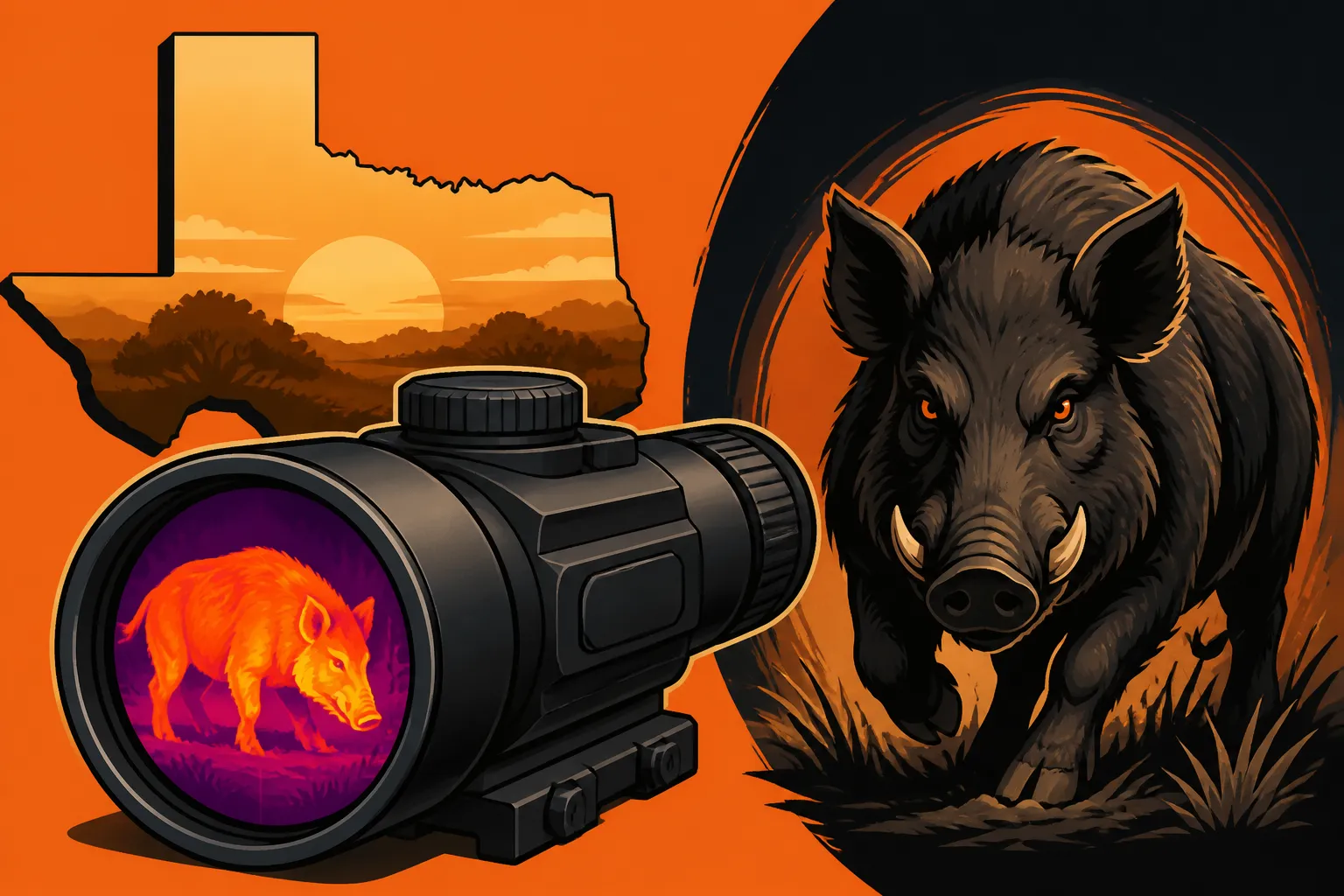
Thermal imaging doesn't rely on light; it detects heat signatures. This fundamental difference is what makes it so revolutionary for night hunting. Imagine looking through your scope and seeing a bright, glowing outline of a hog, even if it's completely hidden by tall weeds or a dense tree line. That's the power of thermal. It cuts through darkness, light fog, and even light cover that would render traditional night vision useless.
This technology offers several critical advantages. First, you can spot hogs much further away, giving you ample time to plan your approach or set up for a shot. Second, it significantly improves target identification. You can quickly discern the size and number of hogs, ensuring you're targeting the right animals. Third, and perhaps most importantly, it's a huge safety booster. You can clearly see if there are other animals or objects in your firing line that might be obscured by darkness. For a deeper dive into the benefits, you might want to read more on How to Hunt Hogs at Night With Thermal. The ability to see heat means you're no longer guessing; you're seeing.
Key Features to Look for in a Thermal Scope Under $3000
When you're looking to invest in a thermal scope, especially with a budget in mind, it’s easy to get overwhelmed by all the technical jargon. But don't worry, we'll break down the most critical features that directly impact your hog hunting success in Texas. Getting the right combination of these specs will ensure you get the most bang for your buck without crossing that $3000 threshold.
Resolution and Sensor Size
These two specifications are the heart of your thermal scope's performance. The resolution (e.g., 384×288, 640×480) refers to the number of pixels in the thermal sensor. A higher resolution means more detail and a clearer image. For hog hunting, especially if you need to make ethical shots at varying distances, higher resolution is always better. While 640×480 resolution sensors are fantastic, they often push past the $3000 mark. Within our budget, a 384×288 sensor is generally the sweet spot, offering good detection and identification capabilities without breaking the bank. Some newer 384 models even offer enhanced pixel pitch (the size of each individual pixel), which can improve perceived clarity.
Sensor size (or pixel pitch), measured in micrometers (µm), also plays a role. Smaller pixel pitch (e.g., 12µm vs. 17µm) allows more pixels to be packed onto a smaller sensor, which can lead to a sharper image and better optical magnification while keeping the unit compact. However, it can also make the sensor less sensitive in some conditions. For hog hunting, you want a good balance that gives you enough detail to distinguish a hog from a deer, especially at distances where shot placement is critical.
Refresh Rate and Magnification
The refresh rate (e.g., 30Hz or 60Hz) dictates how smoothly the image updates as you pan the scope or track a moving target. Imagine watching a video; a 60Hz refresh rate is like a smooth, continuous video, while a 30Hz rate might appear a bit choppier, especially with fast-moving animals. For hog hunting, where hogs are rarely standing still, a 60Hz refresh rate is highly desirable. It provides a much more fluid viewing experience, making it easier to track and lead your target accurately, reducing the chances of a missed shot due to a laggy display.
Magnification in thermal scopes comes in two forms: optical (base) and digital zoom. Optical magnification is the true magnification provided by the lens and sensor, offering the clearest image. Digital zoom, on the other hand, essentially magnifies the pixels, which can lead to a "pixelated" or "grainy" image as you zoom in further. It's crucial to focus on a scope with a reasonable optical base magnification (typically 1.5x to 3x within this budget) that suits your hunting distances. While digital zoom can be helpful for quick identification at longer ranges, relying too heavily on it will degrade image quality. You want enough base magnification to identify your target and then use digital zoom sparingly to confirm details before taking a shot.
Battery Life and Durability
There’s nothing worse than having your gear die on you in the middle of a hunt. Battery life is a critical, yet often overlooked, feature for thermal scopes. Hog hunts can stretch for hours, and you don't want to be fumbling with battery changes in the dark. Look for scopes with integrated rechargeable battery systems that offer 4-6 hours or more of continuous use. Many scopes also allow for external power banks via a USB-C connection, which can be a lifesaver on an extended night out. Brands like AGM and Pulsar often excel in this area, offering robust battery solutions.
Durability is equally important, especially when hunting in the rugged Texas environment. Your scope will be exposed to dust, heat, humidity, rain, and the inevitable bumps and scrapes that come with navigating brush country or dense forests. Look for scopes with an IP rating (e.g., IP67 for dust and water resistance) and a shock-resistant design capable of withstanding the recoil of your rifle. A scope made from aircraft-grade aluminum or high-impact polymer is a good indicator of robust construction.
User Interface and Features Recording, Wi-Fi
An intuitive user interface can make or break your hunting experience. In the dark, you don't want to be fumbling through complex menus to change settings or switch reticles. Look for scopes with easy-to-use buttons or a simple rotary encoder for quick adjustments. Programmable hotkeys can also be a huge advantage.
Beyond the basics, many modern thermal scopes offer advanced features like video recording and Wi-Fi connectivity. Video recording lets you capture your successful hunts to review later or share with friends and family. This can be invaluable for analyzing shot placement and improving your skills. Wi-Fi connectivity allows you to stream the live image from your scope to a smartphone or tablet, which can be great for sharing the view with a hunting buddy or even for recording without direct interaction with the scope itself. Some apps, like GoHunt, can even integrate with certain thermal units for data logging or sharing, though specific integrations vary. These features, while not essential for taking a shot, significantly enhance the overall hunting experience and provide valuable tools for improvement.
Top Contenders: Best Thermal Scopes Under $3000 for Texas Hogs
Navigating the market for thermal scopes can be daunting, but several excellent options consistently fall within the sub-$3000 price point while still delivering reliable performance for Texas hog hunting. We'll highlight a few of the most popular and highly-regarded choices.
AGM Rattler V2 35-384
The AGM Rattler V2 35-384 has quickly become a favorite among hog hunters, and for good reason. It features a 384×288 thermal sensor with a 12µm pixel pitch, offering a clear image for detection and identification. What truly sets it apart, especially in this price range, is its 60Hz refresh rate. This ensures a remarkably smooth image, which is incredibly helpful when tracking running hogs through dense cover. The 35mm objective lens provides a good balance of field of view and magnification.
In terms of practicality, the Rattler V2 boasts excellent battery life, often exceeding 4.5 hours on its internal rechargeable battery, and it's compatible with external USB-C power banks for extended hunts. It's built rugged, with an IP67 rating, meaning it can handle the dusty, humid, and sometimes wet conditions of a Texas night. The user interface is relatively straightforward, allowing for quick adjustments. You'll find features like picture-in-picture mode, multiple reticle options, and video recording capabilities. For hunters looking for a high-performance scope that won't break the bank, the AGM Rattler V2 35-384 is a strong contender, offering a lot of the features you’d see in more expensive units. Many hunters consider this a strong option for Best Gear for Feral Hog Hunting in Texas due to its balance of price and performance.
Pulsar Talion XQ38 / XQ35
Pulsar is a name synonymous with quality in the thermal optics world, and their Talion XQ series, particularly the XQ38 or XQ35 models, often sneak in just under or around the $3000 mark. These scopes feature a 384×288 resolution sensor with a 17µm pixel pitch, delivering very respectable image quality. While some models might have a 50Hz refresh rate (depending on the exact iteration), they still provide a smooth viewing experience.
What stands out with the Talion series is its ergonomic design, often featuring a unique focus mechanism and a quick-release battery pack system that makes swapping batteries in the field incredibly fast and easy. The XQ models generally have long battery life, often around 5-6 hours, and are built to Pulsar's high standards of durability, ready for the rigors of any Texas hunting excursion. They also come packed with features like multiple color palettes, customizable reticles, and built-in video and still image recording. The Talion's compact size and user-friendly controls, often praised for their intuitive layout, make it an attractive option for those who appreciate premium build quality and reliable performance. When comparing Pulsar vs AGM Thermal Scopes for Hogs, the Talion XQ series often provides a slightly more refined user experience and ruggedness.
ATN ThOR LT 320 3-6x
For hunters on the tighter end of the "under $3000" budget, the ATN ThOR LT 320 series offers an accessible entry point into quality thermal imaging. The 3-6x model, in particular, provides a solid magnification range for most hog hunting scenarios. These scopes typically feature a 320×240 resolution sensor with a 12µm pixel pitch, which, while lower than the 384 options, is still perfectly capable of detecting and identifying hogs at common hunting ranges. ATN has focused on making these units lightweight and easy to use, resembling traditional rifle scopes.
The ThOR LT 320 often boasts an impressive battery life, sometimes reaching 10 hours or more on a single charge, which is a significant advantage for those long nights out. While its refresh rate might be 30Hz, for stationary or slower-moving targets, it still performs admirably. ATN scopes often come with a simplified user interface, making them a great choice for beginners or those who prefer a no-frills approach to thermal hunting. While it might not have all the bells and whistles of higher-end units, the ThOR LT 320 offers fantastic value, giving you reliable thermal detection and imaging without breaking your budget. It’s a workhorse for getting the job done efficiently.
Here's a quick comparison of these top contenders:
| Feature | AGM Rattler V2 35-384 | Pulsar Talion XQ38/XQ35 | ATN ThOR LT 320 3-6x |
|---|---|---|---|
| Sensor Resolution | 384×288 | 384×288 | 320×240 |
| Pixel Pitch | 12µm | 17µm | 12µm |
| Refresh Rate | 60Hz | 50Hz (typical) | 30Hz |
| Objective Lens | 35mm | 38mm / 35mm | 35mm |
| Base Magnification | 2.5x | 2.5x / 2x | 3x |
| Battery Life | ~4.5+ hours | ~5-6 hours | ~10+ hours |
| Water/Dust Rating | IP67 | IPX7 | IP-rated (check model) |
| Video Recording | Yes | Yes | Yes |
| Wi-Fi | Yes | Yes | No (stream via USB) |
| Price (approx.) | $2,200 – $2,700 | $2,500 – $3,000 | $1,500 – $2,000 |
Prices are approximate and subject to change based on retailer and promotions.
Maximizing Your Thermal Scope's Potential in Texas
Buying a thermal scope is a significant investment, but simply owning one isn't enough. To truly dominate the night and make the most of your new gear, especially when pursuing hogs in the diverse Texas landscape, you need to understand how to use it effectively.
Pairing with a Thermal Monocular
One of the smartest strategies for maximizing your thermal scope's potential is to pair it with a dedicated thermal monocular. A scope mounted on your rifle is for aiming and shooting, but constantly scanning large areas with it can be cumbersome, tiring, and drain your battery quickly. This is where a thermal monocular becomes your best friend.
Imagine you're sitting in a ground blind overlooking a hog trail or a freshly rooted field. Instead of lifting your heavy rifle every few minutes, you can comfortably scan the entire area with a lightweight thermal monocular. Once you detect a heat signature, you can then switch to your rifle-mounted scope for positive identification and the shot. This two-device approach offers several key benefits: it conserves your rifle scope's battery, reduces fatigue, provides a wider field of view for scanning, and allows for quicker target acquisition. Many seasoned hog hunters in Texas swear by this method for increased efficiency and comfort. If you're looking for recommendations, check out Best Thermal Monocular for Scanning in Texas.
Practice and Understanding Thermal Signatures
Just like with any new piece of hunting equipment, there's a learning curve with thermal optics. Hogs, deer, coyotes, and even rocks heated by the sun will all appear as heat signatures, but their patterns and movements are distinct. It's crucial to spend time practicing with your thermal scope during both day and night conditions, even when you're not hunting.
Take it out in your backyard, on your lease, or at a friend's property. Observe how different animals appear. Notice the difference between a hog's heat signature (often rounder, blockier) and a deer's (taller, more defined legs). Pay attention to how environmental factors like trees, bushes, water, and even dirt roads appear. Wet ground, for instance, can sometimes appear cooler. Understanding these nuances will drastically improve your ability to quickly identify targets and make ethical decisions. You can even use mapping tools like GoHunt to scout areas during the day, noting potential hog hideouts or travel corridors, and then visualize how those areas might look at night through your thermal. This practice will build your confidence and make you a more effective night hunter.
Legalities and Regulations
Before you head out with your new thermal scope, it's absolutely paramount to understand the current hunting regulations in Texas. The good news is that thermal imaging devices are legal for hunting feral hogs in Texas. In fact, Texas has some of the most permissive regulations when it comes to hog hunting, largely due to their status as an invasive species.
However, always double-check the latest Texas Hunting Regulations Changes for 2026 in the Texas Outdoor Annual to ensure you're compliant with all laws. While thermal is generally fine for hogs, the regulations for other game animals can be much stricter regarding night hunting or the use of artificial lights/thermal. For example, you generally cannot use artificial light or thermal for hunting deer in Texas. Staying informed about Is Thermal Hunting Legal in Texas? is not just about avoiding fines; it's about being a responsible and ethical hunter. Make sure you understand county-specific rules as well, as some local ordinances might exist, though statewide regulations on thermal for hogs are quite clear.
Disclaimer
Please note that hunting regulations, product specifications, and pricing are subject to change. Always consult the most current Texas Parks and Wildlife Department regulations before hunting. The information provided in this guide is for informational purposes only and does not constitute legal advice. It is the responsibility of the individual hunter to ensure compliance with all applicable local, state, and federal laws.