How to Hunt Javelina on a Texas Lease
Many hunters heading to a Texas lease for the first time mistake the javelina for a small feral hog, leading to legal headaches or missed opportunities. These "skunk pigs" are unique desert dwellers with specific behaviors that require a different approach than your average sow. This guide solves the mystery of the collared peccary, covering everything from habitat identification to effective stalking tactics.
Understanding Javelina Behavior and Habitat on the Lease
To hunt javelina successfully, you first have to realize that they are not actually pigs. While they look like miniature hogs, they belong to the peccary family. On a Texas lease, especially in the South Texas Brush Country or the Trans-Pecos, they fill a very specific niche. They are far more predictable than feral hogs but also possess a keen sense of smell and hearing that can bust a lazy hunter in seconds. Understanding their biological quirks is the first step toward a successful harvest.
Not Your Average Pig Identification
The most common mistake on a lease is misidentifying a javelina as a hog. Javelina are much smaller, usually weighing between 35 and 55 pounds. They have a distinct "collar" of light-colored hair around their neck, hence the name collared peccary. Their tails are virtually non-existent, and their ears are smaller and more rounded than those of a feral hog.
Perhaps the most important distinction is their teeth. While hogs have tusks that curve outward and upward, javelina have short, straight tusks that point downward. They also possess a scent gland on their lower back that produces a pungent, skunk-like odor. If you are wondering about the nuances of these species, you should check out the Javelina vs Feral Hog: What's the Difference? guide to avoid any legal mishaps on your lease.
Preferred Terrains in South and West Texas
On a typical lease in Webb or Dimmit County, you will find javelina in the thickest "monte" available. They love prickly pear cactus, which provides both nutrition and hydration. If your lease has rolling hills with dense mesquite, acacia, and guajillo, you are in javelina country. They aren't as nomadic as hogs; they tend to stay within a well-defined home range of a few hundred acres.
In the West Texas regions, they frequent rocky arroyos and canyons. They use the natural topography to shield themselves from the wind and sun. Unlike deer, which might bed down in somewhat open tall grass, javelina prefer to tunnel into the heart of a brush thicket. Finding their "bedroom" is usually a matter of looking for cleared-out dirt patches under the lowest hanging branches of a mesquite tree.
Social Structures and Scent Marking
Javelina are incredibly social animals, traveling in groups known as squadrons. These groups can range from half a dozen to over twenty individuals. This social nature is a double-edged sword for the hunter. While it makes them easier to spot because there are more eyes and ears to detect, it also means that if you spook one, you spook the whole squadron.
They use their scent gland to mark rocks, trees, and even each other to maintain group cohesion. On a quiet morning, you can often smell a javelina before you see it. This scent is heavy, musky, and unmistakable. If you are walking a sendero and hit a wall of skunk-like odor, stop immediately. They are likely just inside the brush line. Understanding this social behavior is key when you How to Hunt Javelina in South Texas because it dictates how you approach a suspected bedding area.
Scouting and Locating Javelina
Scouting for javelina is often done concurrently with deer scouting, but you have to look for different signs. Because they are low to the ground, their sign is often hidden under the canopy. You won't see rub trees like you do with bucks, but you will find plenty of evidence if you know where to look. On a managed lease, javelina often become "pests" at the feeder, but finding them away from the corn is where the real challenge lies.
Reading Sign Tracks Wallows and Scat
Javelina tracks are much pointier than hog tracks. They look like two sharp raindrops side by side. Because they are lighter than hogs, their tracks don't sink as deep into the South Texas sand unless it’s wet. Look for these tracks along the edges of watering holes or in the soft dirt of a sendero. If you see tracks that seem to wander aimlessly in a small area, you’ve found a feeding site.
Wallows are another great indicator. Javelina will find a soft spot of dirt, often in the shade, and roll around to cool off and coat themselves in dust. These wallows will often have that distinct musky smell. Their scat is also unique; it’s usually blunt-ended and contains a lot of undigested cactus fiber or seeds. If the scat is moist, the squadron is likely within a few hundred yards.
Using Trail Cameras and Water Sources
Trail cameras are your best friend for determining the size of the squadron and their timing. While you might be focused on How to Pattern Bucks With Trail Cameras, keep an eye on the timestamps for the "red pigs." Javelina are primarily diurnal, meaning they are active during the day, but in the blistering Texas heat, they often shift their activity to the very early morning and late evening.
Water is the ultimate magnet. In the arid regions of Texas, a stock tank or a leaking trough is a gold mine. Javelina need to drink regularly, especially if they aren't eating much prickly pear. Set your cameras near water gaps or low spots in fences. They don't jump fences like deer; they find a hole and push through it. Look for hair caught on the bottom strand of barbed wire to find their preferred entry points into a pasture.
The Role of Feeders and Supplemental Corn
Let’s be honest: most javelina on Texas leases are killed near a corn feeder. They love easy calories. However, they can be intimidated by large groups of hogs or dominant bucks. They will often hang back in the brush until the "big players" have finished. If you are sitting in a blind, don't leave the second the sun comes up. Javelina often show up at the feeder between 9:00 AM and 11:00 AM when the woods have calmed down.
If you want to hunt them away from the blind, try "corning" a road. Pouring a line of corn down a long, straight sendero is a classic South Texas tactic. This allows you to glass from a distance and wait for the squadron to emerge. When they do, they usually stay for a while, giving you plenty of time to plan a stalk. Just make sure you are following all regulations, and if you have questions, read up on Is It Legal to Hunt Over Corn in Texas? to stay within the law.
| Feature | Javelina (Collared Peccary) | Feral Hog (Wild Pig) |
|---|---|---|
| Weight | 35 – 60 lbs | 50 – 400+ lbs |
| Tail | Vestigial (nearly invisible) | Long, often hairy |
| Ears | Small and rounded | Large and often pointed |
| Tusks | Short, straight, vertical | Long, curved, outward |
| Scent | Strong, skunk-like musk | Earthy, muddy, or "gamey" |
| Group Name | Squadron | Sounder |
| Activity | Primarily Day (Diurnal) | Primarily Night (Nocturnal) |
Effective Hunting Tactics for Collared Peccary
Once you’ve located a group of javelina on your lease, the real fun begins. Because they have relatively poor eyesight, they are one of the best animals for a beginner to practice stalking. However, their nose is top-tier. If the wind shifts, the hunt is over. Whether you prefer the patience of a blind or the adrenaline of a stalk, these tactics will help you close the distance.
The Classic Spot and Stalk
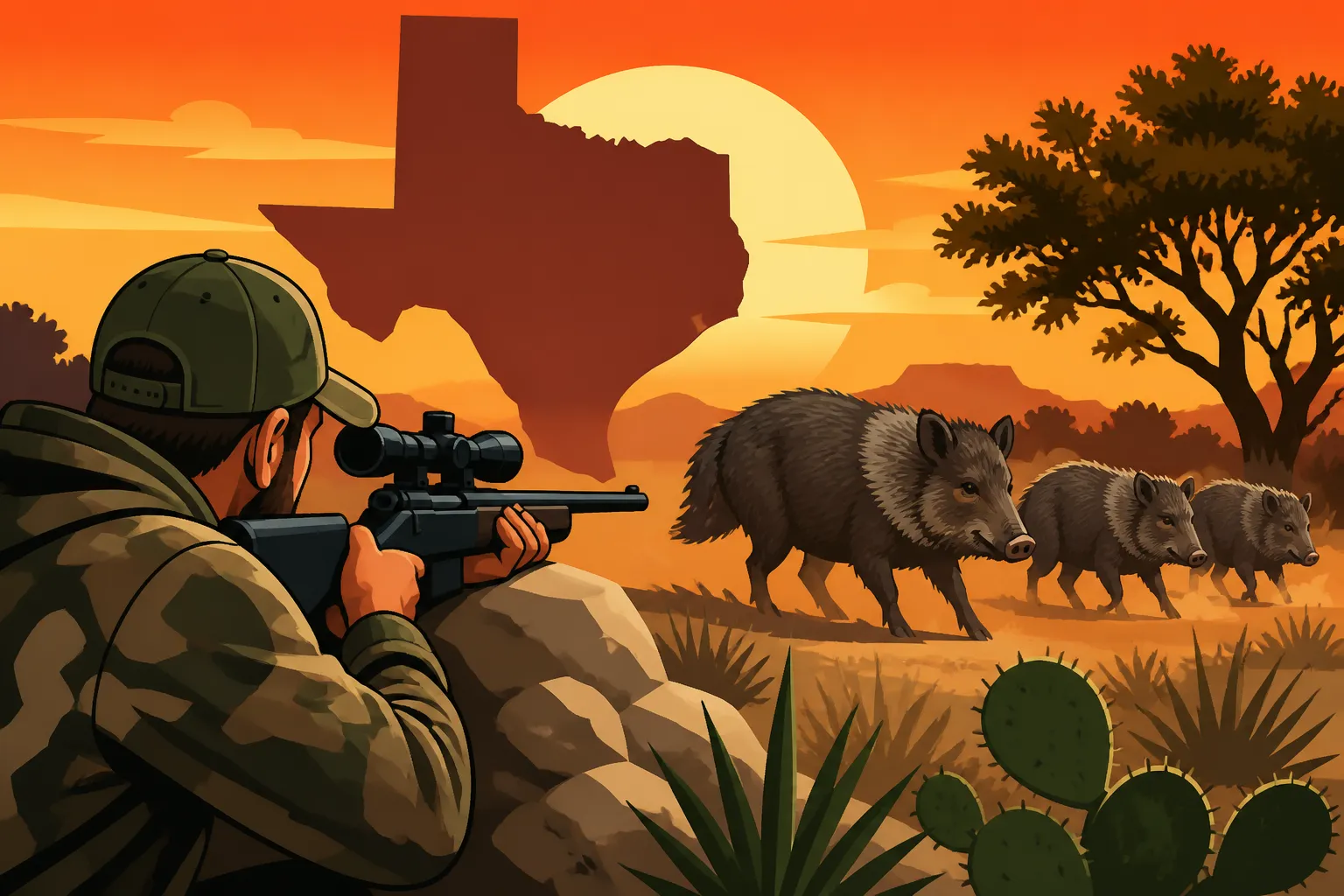
Spot-and-stalk is arguably the most rewarding way to hunt javelina. Use your optics to glass senderos or open cactus flats from a high point or the bed of a truck. Once a squadron is spotted, check the wind. You want the wind blowing directly from them to you. Because javelina are low to the ground, you can often use the brush as a screen to get within 20 or 30 yards.
Slow, deliberate movements are necessary. Even though their eyesight isn't great, they are very sensitive to movement and sound. If you hear them "woofing" or clicking their teeth, stop. That is their warning signal. Wait for them to go back to feeding before you take another step. This is a great time to utilize the Best Binoculars for South Texas Brush to ensure you are looking at a legal animal and not a young hog.
Ambush Hunting from Blinds
If you prefer a more relaxed approach, hunting from a box blind or a tripod over a feeder is very effective. The key here is patience. Javelina are often the last to show up and the first to leave if they sense something is off. Avoid making noise in the blind, such as clicking your safety or moving your chair. They are very attuned to metallic sounds.
When hunting from a blind, pay attention to the hierarchy. Usually, an older female leads the group. If you harvest her, the rest of the squadron may hang around in confusion for a few minutes, potentially offering a second shot if you have multiple tags. Always check the Texas Javelina Season by Zone before pulling the trigger, as regulations can vary significantly between the North and South zones.
Calling and Scent Management
Believe it or not, javelina can be called. They are very protective of their young. A predator call that mimics a distressed piglet or a rabbit can bring a squadron charging in, hair bristled and teeth clicking. This is a high-adrenaline tactic and should be done with a backup partner, as they can be aggressive when they think a group member is in danger.
Scent management is non-negotiable. Because they have a scent gland themselves, they are hyper-aware of foreign odors. Avoid wearing heavy colognes or using "cover scents" that don't belong in the desert. The best scent control is simply staying downwind. If you are hunting at night—though usually unnecessary for javelina—ensure you know the rules by checking How to Hunt Hogs at Night in Texas: Is It Legal? (Yes) as the rules for non-game versus game animals can be tricky.
Gear Shot Placement and Field Care
Don't let their size fool you; javelina are tough. They have thick hide and dense bone structures for their size. Using the right gear and knowing where to aim is the difference between a quick recovery and a long, frustrating track through thorny brush. Furthermore, how you handle the animal after the shot determines whether the meat is delicious or destined for the coyote pile.
Best Weapons and Optics for the Brush
For rifle hunters, almost any deer-caliber rifle is more than enough. The .223 Remington, .243 Winchester, or even a 30-30 are perfect choices. You want a bullet that expands quickly but holds together. Because shots are often close (under 100 yards), a high-magnification scope isn't necessary. A simple 3-9×40 or even a red dot sight works wonders in the thick "tight" brush of South Texas.
Archery hunters find javelina to be the perfect challenge. They provide a small target and are often moving. Small-diameter arrows with sharp fixed-blade broadheads are recommended. Mechanicals work, but given the javelina's propensity for being in thick brush, a fixed blade reduces the chance of a deflection. Check your Texas Javelina Season Dates 2026 to make sure your gear matches the current legal season for your specific county.
Anatomical Considerations for a Clean Kill
The vitals on a javelina are located further forward than on a deer. If you aim behind the shoulder as you would on a buck, you might hit the guts or the rear of the lungs. The best shot is "tight to the shoulder." Aim for the lower third of the body, directly above the front leg. This will take out the heart and both lungs.
Avoid headshots unless you are an expert marksman, as their brains are small and their thick skulls can cause deflections at odd angles. If you are struggling with where to aim, the principles in Best Shot Placement for Hogs are very similar, though you must scale down your expectations for the size of the "kill zone." A well-placed shot will usually drop them within 40 yards.
Dealing with the Scent Gland and Texas Heat
Field dressing a javelina requires a steady hand. The most important thing is the scent gland on the back. Contrary to popular belief, you don't need to cut it out first. In fact, cutting into it will release the musk and ruin the meat. The best method is to skin the animal carefully, starting from the legs and working toward the back. When you reach the gland, skin around it, leaving it attached to the hide.
Once the hide is off, the meat is actually quite lean and mild—often described as a cross between pork and veal. However, because javelina are often hunted in warm weather, you must get the carcass on ice immediately. Use the tips in How to Cool a Deer Fast in Texas Heat to ensure your javelina meat doesn't spoil. Once cooled, the hind quarters and backstraps make excellent chorizo or slow-roasted carnitas.
Disclaimer
The information provided in this guide is for educational and informational purposes only. Hunting regulations in Texas are subject to change annually by the Texas Parks and Wildlife Department (TPWD). Always consult the current Texas Outdoor Annual for specific season dates, bag limits, and county-specific restrictions before heading into the field. Ensure you have a valid Texas hunting license and any required endorsements before attempting to harvest a javelina.