Best Shot Placement for Hogs
Hunting feral hogs in Texas can be an incredibly rewarding experience, offering both a challenge and a chance to help manage a pervasive nuisance species. However, these tough, resilient animals aren't always easy to put down cleanly. One of the biggest frustrations hunters face is making what they think is a good shot, only for the hog to disappear into the brush, leaving behind a sparse blood trail and a whole lot of questions. This guide is dedicated to helping you understand the absolute best shot placement for hogs, ensuring you make ethical, effective kills, and minimize the risk of losing your animal.
Understanding Hog Anatomy for Shot Placement
Unlike deer, whose vitals are often depicted in neat, easily digestible diagrams, a hog's anatomy can be a bit tricky, especially with their thick hides, dense muscle, and often substantial fat layers. Knowing exactly where to aim is paramount, and it often differs from what you might instinctively consider for other game.
The Vitals: Heart and Lungs
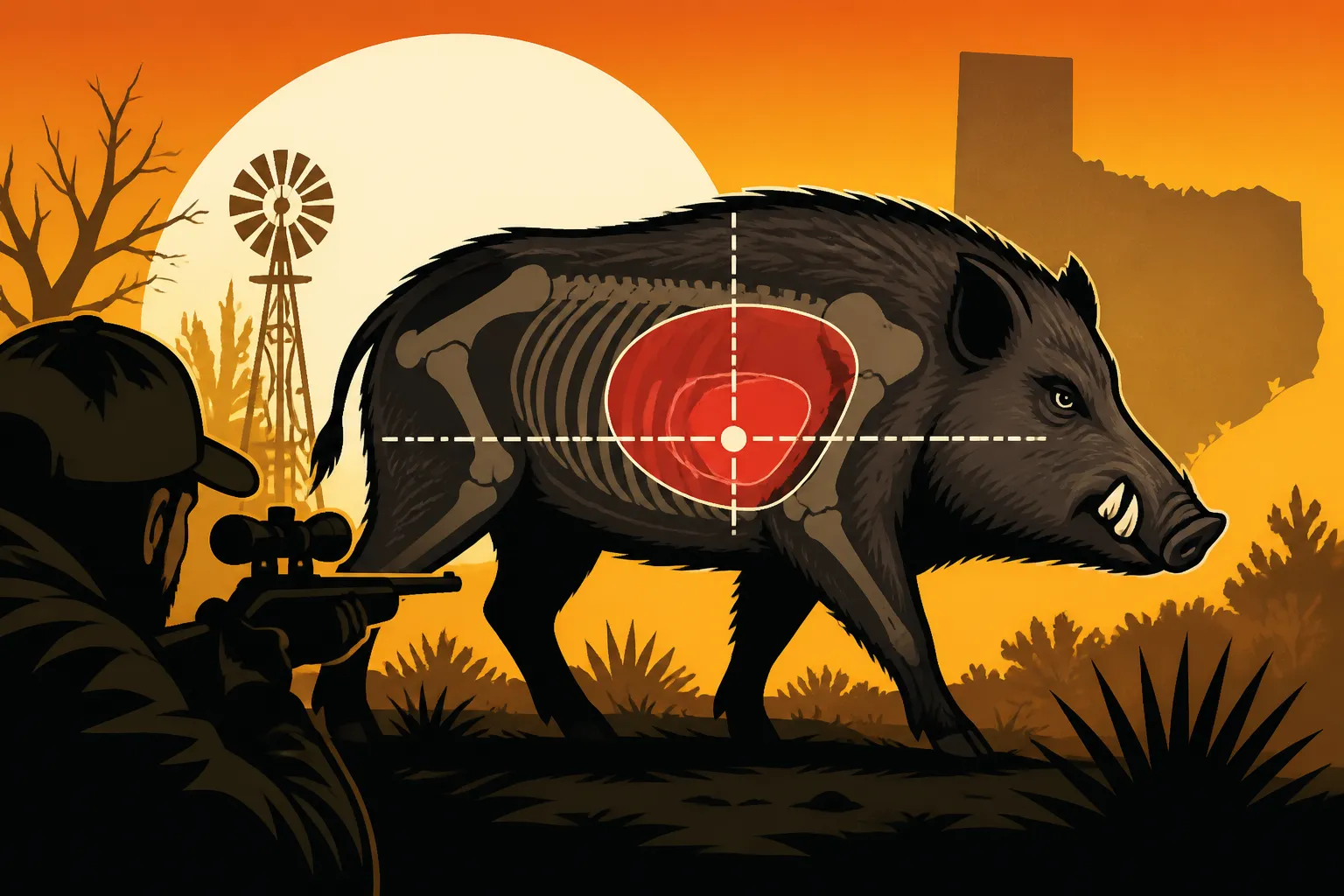
When you're aiming for a quick, humane kill, the heart and lungs are your primary target. These organs are crucial for life, and their disruption leads to rapid incapacitation. For a hog, the heart sits low in the chest, just above the sternum, tucked behind the shoulder. The lungs surround the heart, extending further back into the rib cage.
On a broadside hog, envision a spot about one-third of the way up from the bottom of the chest, directly behind the foreleg. This is your sweet spot for a heart-lung shot. If you hit this area, you'll likely clip the top of the heart and blow through both lungs. The result is typically a short tracking job, if any, and a quickly expired animal. What often surprises new hog hunters is how far forward the vitals are compared to deer. If you aim where you'd typically aim for a whitetail deer, you might end up hitting further back, through the liver or gut, leading to a much more difficult and less ethical recovery. Remember, for hogs, think low and forward. A good visual cue is to aim directly in line with the hog's elbow when it's standing broadside.
Consider a hog moving through thick mesquite. You get a fleeting broadside shot. Instead of panicking and aiming generally at the shoulder, take a split second to visualize that low, forward target. Imagine a vertical line running up from the front leg, and a horizontal line running from the bottom of the chest. Where they intersect, that's your bullseye. Even with a tough hide, a well-placed bullet or broadhead in this zone will do its job.
The Central Nervous System: Brain and Spine
For an instantaneous drop, nothing beats a shot to the central nervous system (CNS), specifically the brain or the upper spine. These shots sever the connection between the brain and the rest of the body, causing the animal to drop in its tracks, often without even a twitch.
The brain shot is incredibly effective when executed perfectly, but it comes with a significant risk. A hog's brain is surprisingly small, roughly the size of a golf ball or a small orange, and it's protected by a thick, sloped skull. To make a clean brain shot, you need a precise angle. On a broadside hog, aim at the base of the ear, or slightly behind and below the eye, where the jawline meets the skull. For a hog facing you head-on, aim dead center between the eyes, or slightly above, where the brain sits. The margin for error here is razor-thin. A miss by even an inch can result in a jaw shot, a snout shot, or merely a glancing blow off the thick skull, leading to a horribly wounded animal that will certainly suffer and likely escape. Unless you are extremely confident in your marksmanship, your weapon's accuracy, and the hog is perfectly still at a very close range, the brain shot is often best avoided.
A spine shot, particularly aiming for the cervical spine (neck) or thoracic spine (mid-back), can also drop a hog instantly. For a neck shot, aim at the base of the skull, where the neck meets the body, or about one-third of the way up the neck, aiming for the center. This can paralyze the hog. Similarly, a shot through the top of the shoulders can hit the spine, dropping the animal. However, like the brain shot, the spine is a relatively small target, especially when dealing with a moving hog or one partially obscured by brush. A slight miss might only wound the animal, potentially breaking a leg or paralyzing it temporarily without a lethal blow to the vitals, leading to a recovery challenge. While effective when precise, these CNS shots demand an elevated level of precision and should be attempted only by experienced hunters under ideal conditions.
Ideal Shot Angles and Zones for Different Scenarios
Understanding hog anatomy is one thing, but translating that into practical aim points when a hog isn't standing perfectly still or broadside is another challenge entirely. Different angles demand different points of aim to achieve that vital hit.
Broadside Shot: The Classic Kill Zone
The broadside shot is, without a doubt, the most ethical and easiest shot to make on a hog, particularly when aiming for the heart and lungs. When a hog is standing perfectly sideways to you, its entire side is exposed, offering the clearest path to its vital organs.
For this shot, your aiming point should be roughly one-third of the way up from the bottom of the chest, directly in line with the back of the front leg. Think of it as punching through the elbow. If you're looking for a visual, picture a line running straight up from the hog's elbow. Follow that line up about a third of the way, and that's your sweet spot. This placement ensures your bullet or broadhead passes through both lungs and often catches the top of the heart, resulting in massive hemorrhage and rapid organ failure. A good example is watching a hog casually rooting around a feeder. It pauses, broadside, giving you that perfect opportunity. Take your time, focus on that spot, and squeeze the trigger. The pig will often kick or run a short distance before succumbing. This is also the ideal shot for bowhunting in Texas: Archery Season Guide, where broadhead placement is even more critical due to limited kinetic energy compared to a rifle.
Quartering-Away Shot: Exposing the Vitals
The quartering-away shot occurs when the hog is angled away from you, with its rear end slightly closer to you than its front. This angle can actually present an excellent opportunity for a double-lung or heart shot, as it often exposes more of the vitals and allows for deeper penetration through the softer rib cage rather than the thick shoulder plate.
For a quartering-away hog, you'll want to aim slightly further back than a broadside shot, directing your projectile to exit through the opposite shoulder. Imagine the bullet or arrow traveling diagonally through the animal. Your aiming point should be in the last third of the rib cage on the side closest to you, but visualizing the exit point on the opposite shoulder will help you guide your aim. This path will ensure the projectile travels through the paunch, then through the liver, and finally into the lungs and heart before exiting the far side. This angling shot maximizes internal damage.
Consider a hog slowly walking away from your stand or blind, perhaps heading towards a water source. It presents a slight quarter-away angle. Instead of waiting for a perfect broadside that might never come, you can take this ethical shot. Focus on driving your projectile through the hog, aiming for the far-side shoulder. This shot is particularly effective for larger boars with thick shields, as it bypasses the densest part of their shoulder.
Quartering-To Shot: A Risky Proposition
A quartering-to shot is when the hog is angled towards you, with its front end closer. This is generally considered a low-percentage shot for vital organs and should be approached with extreme caution, often avoided if other options exist. The primary challenge is that the hog's heavy shoulder bone and thick chest shield protect its vitals, making a clean path difficult.
If you must take a quartering-to shot, the best strategy is to aim for the point of the shoulder, trying to break it and then drive the bullet into the chest cavity. This is an attempt to penetrate the shoulder and then angle towards the vitals. Another option is a direct chest shot, aiming for the center of the chest where the neck meets the body, attempting to hit the sternum and enter the chest cavity between the shoulders. However, the amount of bone you'll encounter means you need a powerful caliber and a tough bullet to ensure adequate penetration. The risk of hitting only the shoulder, or glancing off the sternum, leading to a superficial wound, is high.
Picture a hog emerging from the brush, walking directly toward your position, giving you a quartering-to angle. While it might be tempting to shoot, evaluate if waiting a few more seconds for it to turn broadside or quarter-away is a better option. If it's your only ethical shot, aim precisely for the shoulder point or the crease of the chest. This is definitely a scenario where the "Best Shot Placement for Whitetail Deer" advice regarding quartering-to shots would also largely apply, emphasizing extreme precision or waiting for a better angle.
Head Shot: High Reward, High Risk
The head shot on a hog is a polarizing topic among hunters. When done correctly, it's lights out – an instant, humane kill. When done incorrectly, it can lead to one of the most terrible wounds imaginable, leaving the hog to suffer.
The target for a brain shot is incredibly small. On a broadside hog, aim directly at the base of the ear canal. This spot provides the clearest path to the brain, bypassing much of the skull. If the hog is facing you head-on, aim dead center between the eyes, or slightly above, where the brain is situated deeper in the skull. The key is understanding that the brain isn't necessarily directly between the eyes, but rather further back.
The high risk associated with this shot cannot be overstated. A small miscalculation, a slight flinch, or an unexpected movement by the hog can result in a gruesome non-lethal wound to the jaw, snout, or face. These injuries prevent the hog from feeding and drinking, condemning it to a slow, painful death. Therefore, the brain shot should only be considered under very specific circumstances: a perfectly stationary hog, very close range (usually under 50 yards), and with absolute confidence in your shooting ability and equipment. For many hunters, especially those new to How to Hunt Feral Hogs in Texas (Step by Step), focusing on the heart-lung area is a far safer and more ethical primary strategy.
Factors Influencing Your Shot Decision
Choosing the best shot placement isn't just about knowing anatomy; it's also about understanding how external factors can impact your decision in the field. Every hunting scenario is dynamic, and adapting your strategy is key to ethical hunting.
Weapon Type and Ammunition
The type of weapon you're using and the ammunition loaded in it significantly dictate your shot placement options. A high-powered rifle offers much more flexibility than a bow or a smaller caliber firearm.
With a powerful rifle, like a .308 Winchester or a 6.5 Creedmoor, paired with well-constructed bullets designed for deep penetration, you have more leeway with shot angles. These calibers can often punch through the shoulder plate of a large boar and still reach the vitals effectively. This allows for slightly less precise aiming on broadside or quartering-away shots, though precision should always be the goal. However, if you're using a smaller caliber, like a .223 Remington, or a lighter, frangible bullet, you absolutely must stick to the softest spots – the pure heart-lung area on a broadside or quartering-away shot – and avoid bone whenever possible. The same goes for hunting hogs at night. If you're using a thermal scope for hog hunting, ensure you still aim for those vital zones, as the thermal image provides a heat signature, but doesn't change the hog's internal anatomy. Best Thermal Scopes for Hog Hunting in Texas can help you see them, but it's your shot placement that finishes the job.
Bowhunters face the most stringent requirements for shot placement. Broadheads rely on cutting rather than hydrostatic shock, meaning a clean pass-through of vital organs is essential. For archers, the broadside heart-lung shot or the quartering-away shot, aiming for the opposite shoulder, are virtually the only ethical shots. Avoid quartering-to and head shots with a bow entirely, as the chances of a clean kill are astronomically low. Bowhunting Hogs in Texas: Tips often emphasize this critical precision.
Hog Size and Behavior
Hogs, especially mature boars, can vary wildly in size and toughness. A 50-pound sow is a very different animal from a 300-pound boar with a thick "shield" of scar tissue and cartilage protecting its shoulders.
For smaller hogs and younger animals, the vitals are proportionally smaller, but their hides and bone structures are less formidable. This means your margin for error might feel slightly larger, but precision remains paramount. For truly large boars, that thick shoulder shield can be incredibly dense. If you hit it directly with anything less than a heavy, bonded rifle bullet, you risk stopping your projectile before it reaches the vitals. This reinforces the importance of the low, forward heart-lung shot on a broadside animal, or the quartering-away shot that bypasses the shield entirely. Remember that these animals can weigh hundreds of pounds, making Field Dressing & Processing Game in Texas Heat a serious task, so dropping them quickly is always preferred.
Hogs are also constantly on the move, rooting, walking, and sometimes running. A shot on a stationary hog is always preferred. If a hog is moving, you must factor in its speed and direction, leading your shot if necessary, or waiting for it to pause. A running hog is an extremely difficult target for an ethical shot, and most experienced hunters will advise against it unless it's a very short-range follow-up. Their unpredictable behavior means you might only get a small window of opportunity, so understanding the vital zones for all angles is crucial.
Distance and Conditions
The distance to your target and the prevailing environmental conditions play a massive role in your ability to make an accurate shot.
At close ranges, say under 100 yards with a rifle or 30 yards with a bow, you have a much greater ability to place your shot precisely. As the distance increases, so does the potential for error due to wind drift, bullet drop, and shooter wobble. What might be an ethical shot at 50 yards might be a risky gamble at 200 yards. Always know your effective range for your weapon and your own skill level.
Environmental conditions also factor in. Strong winds can push arrows and lighter bullets off course. Low light conditions, whether dawn, dusk, or How to Hunt Hogs at Night With Thermal, can obscure your target and make precise aiming difficult. Rain or fog can reduce visibility. Always ensure you have a clear line of sight, stable shooting rest, and adequate light to confidently identify your target and place your shot. If conditions are unfavorable, it's always better to wait for a better opportunity than to risk wounding an animal.
No matter the circumstances, remember that ethical shot placement is about taking responsibility for the animal's life. If you have any doubt about making a clean, humane kill, do not take the shot.
Here's a quick summary of vital shot placement for hogs:
| Shot Angle | Primary Target Zone | Aiming Point | Pros | Cons |
|---|---|---|---|---|
| Broadside | Heart/Lungs | 1/3 up from chest bottom, behind front leg (elbow) | High success rate, large target area, clean kill. | Hog may run a short distance. |
| Quartering-Away | Heart/Lungs (via opposite side) | Last 1/3 of ribs on near side, aiming for far shoulder | Bypasses thick shoulder shield, maximizes internal damage. | Requires visualizing exit point, slightly smaller effective area. |
| Quartering-To | Shoulder/Central Chest | Point of shoulder or center of chest/neck junction | Can be effective if no other shot available. | High risk of hitting heavy bone, minimal vital exposure, high wound risk. |
| Head (Brain) | Brain | Base of ear (broadside) or between eyes (frontal) | Instant drop, no tracking. | Extremely small target, high risk of wounding jaw/face, requires perfect conditions. |
| Spine (Neck) | Cervical/Thoracic Spine | Base of skull/neck (cervical), top of shoulders (thoracic) | Instant drop. | Small target, high risk of non-lethal paralysis. |
Ultimately, ethical hunting boils down to making the cleanest, quickest kill possible. For feral hogs, this means prioritizing the heart-lung shot from a broadside or quartering-away angle. These are your bread and butter, your go-to shots that offer the highest probability of success and the least amount of suffering for the animal. Practice your shooting, understand the anatomy, and always err on the side of caution. Happy hunting!
Disclaimer
This article is intended for informational purposes only and does not constitute professional advice. Hunting regulations and best practices can change, and it is the hunter’s responsibility to verify all current laws and safety guidelines with the Texas Parks and Wildlife Department or other relevant authorities before engaging in any hunting activities. Always prioritize safety and ethical hunting practices.