How to Hunt Aoudad Sheep on a Texas Lease
Hunting aoudad is often underestimated until you are staring up a 60-degree incline in the Trans-Pecos, realizing your "exotic" hunt is actually a grueling mountaineering expedition. Many hunters struggle with the sheer resilience and sharp eyesight of these sheep, often coming home empty-handed. This guide solves that by detailing the specific tactics, gear, and behavioral knowledge required to successfully hunt aoudad on a Texas lease.
Understanding Aoudad Behavior on Texas Leases
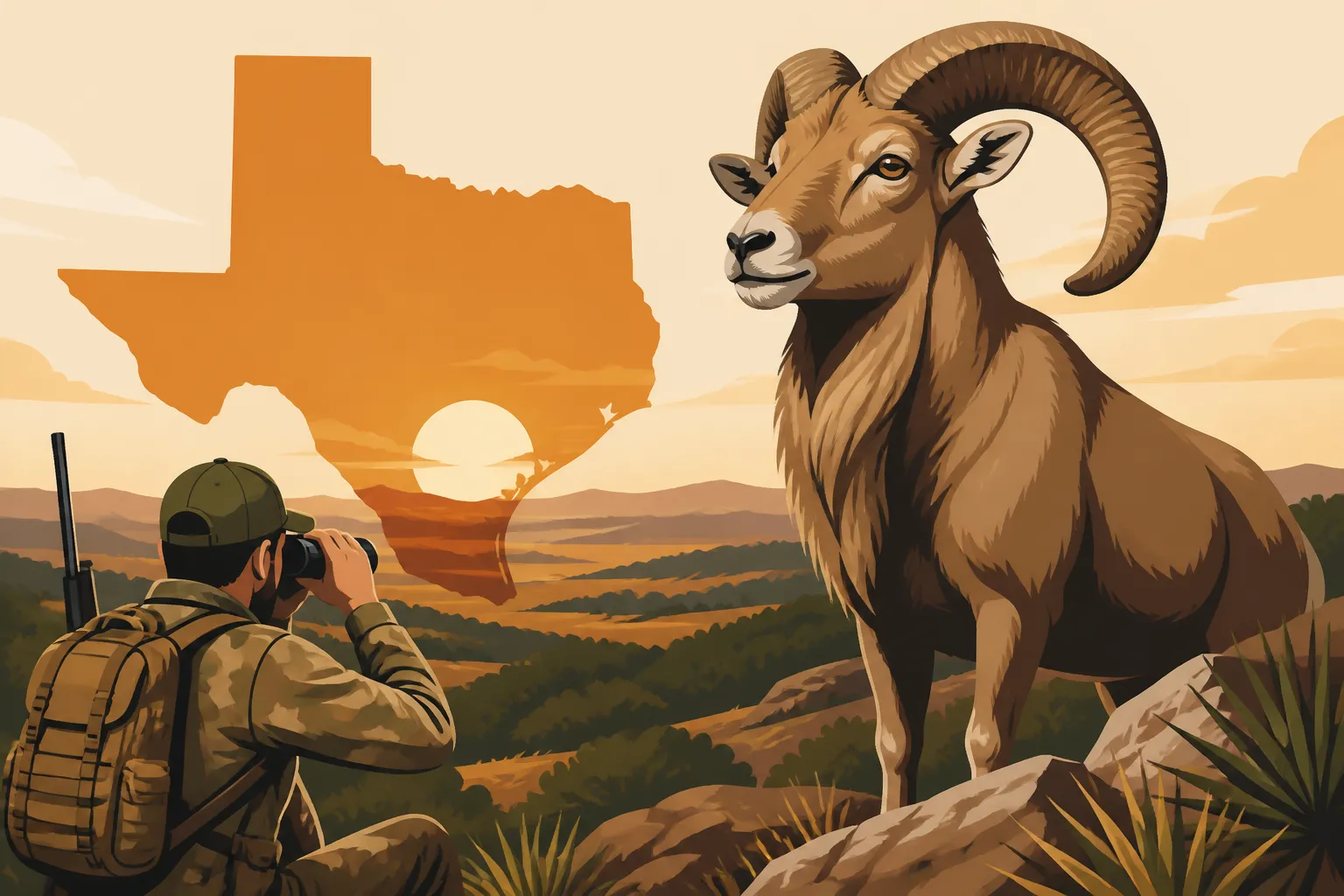
To hunt an aoudad, you first have to realize that you are dealing with one of the most wary animals in the state. Originally from the Atlas Mountains of North Africa, Barbary sheep—commonly called aoudad in Texas—have adapted perfectly to the rugged rimrock and desert canyons of the Lone Star State. Whether you are on a high-fenced ranch in the Hill Country or a massive low-fence spread in West Texas, their instincts remain the same: they want to be high up where they can see everything.
Habitat and Movement Patterns
Aoudad are masters of using the terrain to their advantage. They don't just hang out on the flats; they live in the "vertical" world. On a typical Texas lease, you will find them on the steepest slopes, often bedded down in the shadows of overhangs or tucked into the leeward side of a ridge to escape the wind. They have an uncanny ability to blend into the brownish-red rocks and cedar breaks, making them nearly invisible to the untrained eye.
Their movement is dictated largely by water and temperature. While they can go long periods without a drink, they will hit water holes or troughs in the early morning or late evening. If you are using How to Hunt Aoudad in Texas (Step by Step) as your blueprint, you know that timing is everything. During the heat of the day, they become stationary. They aren't just sleeping; they are glassing the valley floors for movement. If you move while they are bedded, they will spot you from a mile away.
Social Dynamics and Herd Mentality
Aoudad are highly social animals, and this works both for and against the hunter. They usually travel in groups, which means more eyes and ears for you to contend with. A typical herd consists of several ewes, lambs, and a few sub-adult rams, with the big, trophy-class "old men" often hanging on the periphery or forming small bachelor groups. However, during the rut—which typically peaks in September and October—the big rams will be right in the middle of the action.
The biggest challenge in a herd setting is the "sentinel" effect. Usually, there is at least one old ewe that never seems to put her head down. While the rest of the herd is feeding, she is staring. This is why Best Hunting Method for Aoudad Sheep in Texas almost always involves extreme patience. If you spook one, you spook them all, and once an aoudad starts running, they don't stop until they’ve put three canyons between you and them.
Tactical Approaches for a Successful Harvest
Success on an aoudad hunt isn't about how fast you can hike; it’s about how well you can sit still. You are playing a game of "who sees whom first," and the sheep have the home-field advantage. On most Texas leases, the topography allows for long-range glassing, which is your most potent weapon.
Glassing and Spotting Techniques
You cannot find aoudad by walking through the brush. You find them by sitting on a high point and dissecting the landscape with high-quality optics. Experts often suggest a "grid" method of glassing. Start at the bottom of a ridge and move your eyes horizontally, then move up a few yards and repeat. Look for things that don't belong: the flick of a tail, the horizontal line of a back, or the sun glinting off a curved horn.
Many hunters make the mistake of looking for the whole animal. Instead, look for a patch of hair that is a slightly different shade of tan than the surrounding limestone. Because of their camouflage, Spot-and-Stalk Aoudad in West Texas requires you to spend 90% of your time behind the glass and only 10% on your feet. If you rush the glassing process, you will likely bump a herd you never even saw, and the hunt will be over before it starts.
The Art of the Stalk
Once you’ve located a trophy ram, the real work begins. You must plan a route that keeps you completely out of sight. This often means "side-hilling"—traversing the side of a mountain while staying just below the ridgeline. Use the wind religiously. Aoudad have a decent sense of smell, but it is their eyes that will bust you. If you have to cross an open area, do it slowly and only when the herd is distracted or feeding.
The final few hundred yards are the most critical. This is where you might need to crawl through cactus and lechuguilla to reach a shooting position. This is a classic Spot-and-Stalk Hunting in Texas (Exotics & Mule Deer) scenario where every pebble you kick could sound like a landslide in the quiet desert air. Always try to approach from above if possible. Aoudad naturally look for danger from the valley floor, and they are less likely to expect a predator coming down from the rimrock.
| Gear Item | Purpose | Key Feature |
|---|---|---|
| 10×42 Binoculars | Locating herds on distant ridges | High light transmission for dawn/dusk |
| Stiff-Sole Boots | Navigating rimrock and scree | Ankle support to prevent rolls on rocks |
| Flat-Shooting Rifle | Long-range ethical shots | .300 Win Mag or 7mm Rem Mag are ideal |
| Hydration Bladder | Survival in Texas heat | 3-Liter capacity for all-day stalks |
| Rangefinder | Compensating for steep angles | Angle-correction technology is a must |
Gear Essentials for Rugged Terrain
You can get away with mediocre gear when sitting in a box blind over a corn feeder, but aoudad hunting will expose every weakness in your kit. If your boots aren't broken in or your scope can't handle a bump against a rock, you’re going to have a bad time. Investing in Best Gear for Aoudad Hunting in Texas is as much about safety as it is about success.
Optics and Long-Range Accuracy
Because shots on aoudad often range from 200 to over 400 yards, and frequently at steep uphill or downhill angles, your optics must be top-tier. A rangefinder with angle compensation is non-negotiable. If you range a ram at 350 yards but you’re shooting at a 30-degree downward angle, your "true" ballistic distance is much shorter. If you don't account for this, you will shoot right over his back.
Your rifle should be a "flat-shooter." Aoudad are incredibly tough animals; they have thick hides, heavy bone structures, and a legendary will to live. Calibers like the .300 Winchester Magnum, 6.5 PRC, or .280 Ackley Improved are favorites among Texas sheep hunters. You want a bullet that retains weight and expands reliably at distance. Remember, a wounded aoudad will head straight for the nastiest, most inaccessible cliff it can find, making recovery a nightmare.
Footwear and Clothing for the Texas Heat
The terrain on an aoudad lease is designed to destroy clothing and skin. Everything in the Trans-Pecos or the Hill Country pricks, stings, or bites. You need "mountain-style" boots with a stiff shank. Soft-soled hiking shoes will lead to foot fatigue and bruised arches when you’re side-hilling on sharp rocks all day. Look for brands that offer high ankle support and a durable rubber rand to protect the leather from jagged limestone.
Clothing should be breathable but tough. Lightweight synthetic pants are better than jeans because they wick sweat and dry quickly, but make sure they can withstand thorns. Even if the morning is cool, the Texas sun will cook you by noon, so layering is key. Don't forget a pair of lightweight leather gloves; you will be using your hands to scramble over rocks, and aoudad country is full of "wait-a-minute" vines and cacti that will shred your palms.
Logistics and Rules for Your Texas Lease
Before you pull the trigger, you need to make sure your paperwork is in order. Even though aoudad are considered an exotic species in Texas, there are still specific rules you must follow. Every hunter should check Is There a Season for Aoudad in Texas? to understand that while there is no state-mandated closed season, your individual lease or ranch may have its own "management windows."
Licensing and Permits
In Texas, you generally need a valid hunting license to hunt exotics. If you are a resident, your standard "Super Combo" or hunting license covers it. If you are coming from out of state, you will need to look into the Texas Hunting License: Cost, Types & How to Buy (2026) to ensure you have the correct non-resident five-day or general license. Always keep your license on your person; game wardens are active even in the remote corners of sheep country.
It is also worth noting that while aoudad are plentiful, trophy quality varies wildly by region. If you are looking for a 30-inch ram, you need to be on a lease that practices strict management. Check out Aoudad Sheep Hunting in Texas: Cost & Where to get an idea of what different regions offer. Some leases are "meat hunts" where you can take ewes for a lower fee, while others are strictly high-dollar trophy destinations.
Handling the Harvest
Once the ram is down, the real work—and the race against the clock—begins. Texas heat is the enemy of good meat. You need to be prepared for Field Dressing & Processing Game in Texas Heat immediately. Aoudad are large animals, and their thick coats hold heat like a blanket. Getting the hide off and the meat cooled down is your top priority.
Many people claim aoudad isn't good to eat, but that usually comes from hunters who didn't handle the carcass properly. While an old ram can be tough and "musky," a younger ram or a ewe provides excellent lean meat that is great for summer sausage, jerky, or slow-cooked stews. If you are on a remote lease, bring plenty of ice and large coolers, or have a plan to get the animal to a processor quickly. If you are looking for a challenge that rivals any mountain hunt in North America without leaving the state, Aoudad Sheep Hunting in Texas is the ultimate test.
How to Hunt Aoudad Sheep on a Texas Lease Disclaimer
This guide is for informational purposes only. Hunting regulations in Texas can change annually, and individual lease rules vary significantly. Always consult the current Texas Parks and Wildlife Outdoor Annual and verify all property boundaries and local ordinances before hunting. Safety should be your primary concern when navigating rugged terrain.