Texas Dove Season 2026: Zones & Dates
Every Texas hunter knows the feeling of standing in a dusty sunflower field in 100-degree heat, sweat stinging their eyes, wondering if they are actually in the right zone or if the season even opened today. The complexity of the split seasons and zone boundaries can turn a simple morning hunt into a legal headache. This guide breaks down every date, zone, and regulation for the season to keep you legal and focused on the birds.
Understanding the Texas Dove Zones
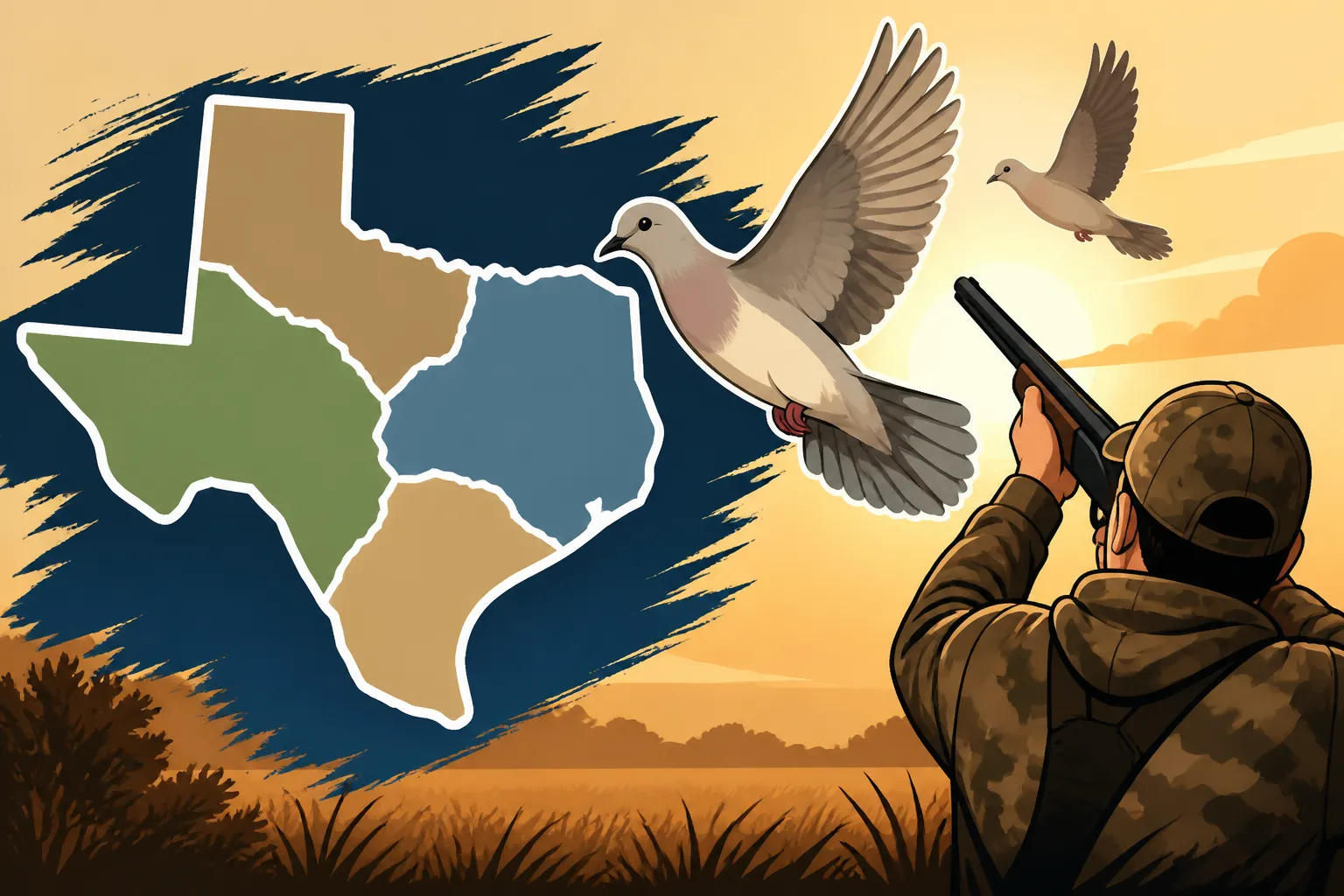
The Texas Parks and Wildlife Department (TPWD) divides our massive state into three primary zones: North, Central, and South. This isn't just about geography; it is about biology. Doves migrate at different times depending on the weather patterns and food availability across the various ecoregions of the state. If you are hunting near a boundary line, like someone living in San Antonio who might drive twenty minutes and end up in a different zone, you absolutely must know where those lines fall.
The North Zone Boundaries
The North Zone encompasses the Panhandle and much of North Texas, including cities like Amarillo, Lubbock, and the Dallas-Fort Worth metroplex. The southern boundary of this zone generally follows a line starting from the Rio Grande in Del Rio, moving east along Highway 90 to San Antonio, then up Interstate 35 to Fort Worth, and finally east along Interstate 30 to the Arkansas border. If you are hunting anywhere north of this line, you are governed by North Zone dates.
In the North Zone, the birds often arrive early and leave early. A cold front in late September can push the majority of the mourning dove population further south, which is why the early season is so critical for hunters in this region. You want to be out there for the first split to catch those local birds before the first major "blue norther" sends them packing toward the Hill Country.
Hunters in this region often focus on harvested grain fields. Whether it is wheat stubble in the Panhandle or sunflower patches near Decatur, the strategy remains the same: find the food and the water. Because the North Zone is often drier, scouting for small stock tanks or "dirt tanks" can be the most effective way to limit out quickly during the evening flight.
The Central Zone Specifics
The Central Zone is the heart of Texas dove hunting, covering the Hill Country, the Edwards Plateau, and much of Central Texas including Austin and Waco. Its northern boundary is the southern line of the North Zone, while its southern boundary follows a line from Del Rio east along Highway 90 to San Antonio, then east along Interstate 10 to the Louisiana border. This zone sees some of the highest hunter participation in the state because of the sheer density of birds and people.
If you are hunting in this zone, you are likely dealing with a mix of mourning doves and an ever-increasing population of white-winged doves. The central part of the state provides a perfect corridor for migration. You might find yourself in a cedar-choked draw one afternoon and a massive commercial sunflower field the next. The diversity of the landscape means you have to be more mobile in your scouting.
Because of the Texas Dove Zones Map (North, Central, South), hunters in the Central Zone need to be particularly careful around the San Antonio corridor. It is very easy to cross from the Central Zone into the South Zone just by driving a few miles south of Highway 90. Always check your GPS and confirm which side of the highway you are standing on, as the opening dates frequently differ by weeks.
The South Zone and Coastal Plains
The South Zone is the legendary home of South Texas brush country and the fertile Rio Grande Valley. It encompasses everything south of the Central Zone boundary (Highway 90 and I-10). This zone is unique because it often has a later opening date but stays productive much longer into the winter. The weather here stays warmer, allowing birds to linger in the sorghum and citrus groves long after the northern parts of the state have frozen over.
Hunting the South Zone often involves the Special South Zone White-winged Dove Days, which allow for early hunting opportunities specifically targeting the massive white-wing colonies. These days are usually set for the first two weekends in September, providing a "teaser" for the general season which typically opens later in the month. It is a tradition for many families to head down to Uvalde or Hondo specifically for these special days.
The South Zone is also where you will see the heaviest migration of birds from the north. By the time the second split rolls around in December, the South Zone can be absolutely loaded with mourning doves that have fled the snow and ice of the northern plains. If you can handle the thorns and the heat, the South Zone offers arguably the best dove hunting in North America.
Key Dates for the 2026 Season
The season follows the traditional split-season format that Texas has utilized for years to maximize hunter opportunity during both the early season and the winter migration. Knowing When Does Dove Season Open in Texas 2026? is the first step in planning your vacation time or lease invites. The dates are designed to protect the breeding populations while allowing a sustainable harvest.
The September Opening Split
For the North and Central Zones, the 2026 season is slated to open on Tuesday, September 1st. This is the "Holy Grail" of Texas hunting dates. Even though it’s a weekday, thousands of hunters will be taking off work to sit on a bucket and wait for that first legal shooting light. The first split in these zones typically runs through late October, providing nearly two months of consistent action.
The South Zone general season usually opens a bit later, often around September 14th or the nearest Friday. However, the Special White-winged Dove Days fill that gap. For 2026, those special days are expected to be September 4, 5, 6, 11, 12, and 13. Remember that during these special days, shooting hours are restricted to noon until sunset, and the bag limit has specific species requirements that differ from the general season.
The opening split is all about the social experience. It is the time of year when the heat is at its peak, and the camaraderie in the field is just as important as the number of birds in the bag. You will want to ensure you have the Best Early-Season Camo for Texas Heat because traditional heavy hunting clothes will lead to heat exhaustion before the morning flight is even over.
The Winter Split and Late Season
The second part of the season, known as the winter split, is a hidden gem for serious hunters. In the North and Central Zones, this usually opens around mid-December and runs through the first week of January. While the weather can be unpredictable—ranging from 70 degrees to a literal ice storm—the hunting can be phenomenal. The birds are often grouped into massive flocks, and they are moving to stay warm and fed.
In the South Zone, the winter split is even more productive. Because it remains the warmest part of the state, it acts as a massive reservoir for all the doves that have moved south. The winter dates in the South Zone often extend through late January, making it the perfect way to spend the weeks following the close of the general deer season.
Late-season hunting requires a shift in tactics. The birds are much more "skittish" because they have been shot at for months. They will flare at the slightest movement, and they often fly higher and faster. You might find that your standard improved cylinder choke isn't cutting it anymore, and a switch to a modified choke is necessary to reach those high-flying winter birds.
Summary of 2026 Texas Dove Dates
| Zone | Opening Split Start | Opening Split End | Winter Split Start | Winter Split End |
|---|---|---|---|---|
| North Zone | Sept 1, 2026 | Oct 25, 2026 | Dec 18, 2026 | Jan 3, 2027 |
| Central Zone | Sept 1, 2026 | Oct 25, 2026 | Dec 18, 2026 | Jan 14, 2027 |
| South Zone | Sept 14, 2026 | Oct 29, 2026 | Dec 18, 2026 | Jan 21, 2027 |
| Special South | Sept 4-6, 11-13 | (Noon to Sunset) | N/A | N/A |
Note: Always verify exact dates in the Texas Outdoor Annual, as TPWD can make minor adjustments based on calendar shifts.
Licensing and Essential Requirements
Before you ever step foot in the field, you have to navigate the bureaucracy of the Texas hunting license system. It isn't just about paying the fee; it is about ensuring you have the specific endorsements required for migratory birds. Failing to have a five-dollar endorsement can result in a ticket that costs hundreds, which is a fast way to ruin a good weekend.
The Super Combo and Endorsements
For the majority of Texas residents, the "Super Combo" license is the most cost-effective way to hunt. It includes your general hunting and fishing licenses along with all state-required endorsements, such as the Upland Game Bird and Migratory Game Bird endorsements. If you aren't a resident or prefer to buy things a la carte, you must ensure you specifically ask for the Migratory Game Bird Endorsement.
Understanding Texas Hunting License: Cost, Types & How to Buy (2026) is vital for those inviting out-of-state friends. Non-residents have several options, including a 5-day special migratory bird license that is significantly cheaper than a full season non-resident license. However, even with a temporary license, the state endorsements are still required.
Keep in mind that your license must be on your person at all times while hunting. While Texas now allows for digital copies of licenses via the TPWD app, it is always a good idea to have a paper backup in your hunting vest. If your phone dies in the heat, and a Game Warden walks up, you need to be able to prove you are legal.
The HIP Certification Requirement
When you buy your license, the clerk (or the online system) will ask you a series of questions about how many migratory birds you harvested the previous year. This is the Harvest Information Program (HIP) certification. Many hunters blow through these questions as a formality, but the data is actually used by federal and state biologists to set the following year's limits and dates.
HIP certification is a federal requirement for anyone hunting migratory birds, including dove, ducks, and geese. If your license does not say "HIP Certified" on it, you are technically hunting illegally. Usually, this is handled automatically during the purchase process, but you should always double-check the printout before you leave the store.
If you find that your license is missing the HIP certification, you can often go back to any license retailer and have it added. It doesn't cost anything, but the oversight is one of the most common reasons hunters get cited during the September opener. A quick check of your paperwork in August can save you a lot of trouble in September.
Bag Limits and Species Identification
Knowing what you are shooting at is just as important as knowing when to shoot. Texas is home to several species of dove, and the rules vary wildly between them. In the heat of a fast-paced flight, it can be difficult to tell a mourning dove from a white-winged dove, let alone a protected species like a white-tipped dove if you are in the deep south.
Mourning Dove vs. White-winged Dove
The daily bag limit for the 2026 season is 15 birds in the aggregate. This means you can have a total of 15 doves, which can be any combination of mourning, white-winged, and white-tipped doves (though no more than two white-tipped). Mourning doves are the classic, sleek birds with pointed tails and spotted wings. They are incredibly fast and erratic in flight.
White-winged doves are slightly larger and have a more square tail. The dead giveaway is the bright white bar on the wing, which is visible even when the bird is at a distance. In recent years, white-wings have expanded their range significantly, moving from the Valley all the way up into the Texas Panhandle and North Texas urban areas.
You need to be aware of the Texas Dove Bag Limit & Possession rules, which state that your possession limit is three times the daily bag limit. This means you can have 45 birds in your freezer at any given time. Remember, if you are transporting birds, you must leave one fully feathered wing attached to the carcass so that a warden can identify the species.
Eurasian Collared Doves: The Bonus Bird
The Eurasian Collared Dove is an invasive species that has taken over much of the Texas landscape. Because they are not native, they are not considered a game bird and have no closed season and no bag limit. You can shoot as many as you want, and they do not count toward your 15-bird aggregate limit.
These birds are easy to identify: they are much larger than mourning doves, have a pale gray color, and feature a distinct black "collar" on the back of their neck. Their flight pattern is much slower and more deliberate. They are often found around grain elevators and suburban areas, but they frequently fly through the same fields as mourning doves.
Many hunters view Eurasians as a "bonus" that helps fill the cooler. They are excellent eating and provide a bit of extra sport when the mourning dove flight slows down mid-morning. Just be absolutely certain of your identification before pulling the trigger on a bird that doesn't count toward your limit.
Possession and Transportation Rules
One of the most frequent mistakes hunters make is during the drive home. If you are hunting with a group, do not throw everyone's birds into one big pile in a single cooler. Legally, each hunter must keep their birds separate until they reach their final destination (their home). Each hunter's birds should be in a bag labeled with their name, address, and the date the birds were killed.
If you are giving birds to someone else, you must provide them with a wildlife resource document. This is a simple piece of paper that includes your information, the recipient's information, and the number of birds being transferred. Without this, the person receiving the birds is technically in possession of an illegal harvest.
Also, be mindful of the "field dressing" rules. While many people want to breast out their birds in the field to save space, remember the "one wing attached" rule mentioned earlier. It is usually easier to just gut the birds and leave them whole until you get back to camp or home where you can process them properly and legally.
Tactics for Texas Dove Success
Once you have your license and you know your dates, the real challenge begins: actually hitting the birds. Dove hunting is often called "the most expensive way to get four ounces of meat" because of the amount of lead thrown at these feathered rockets. Success requires a combination of scouting, setup, and shooting discipline.
Finding the Right Field
In Texas, "sunflowers are king." If you can find a field of black-oil sunflowers that has been shredded or mowed, you are in the money. Doves love small, oily seeds that they can pick up off of bare ground. They do not like thick grass or tall weeds where they can't see predators. This is why a freshly disked field or a mowed grain field is so attractive to them.
Beyond food, doves need water and grit. They often fly to water twice a day—once mid-morning and once right before sunset. A pond with a clean, muddy bank is much better than one with tall grass all the way to the water's edge. Doves like to land a few feet away from the water, walk up to take a drink, and then fly back to a "loafing" tree to digest.
If you are struggling to find a private lease, look into Public Hunting in Texas: WMAs & Annual Public Hunting Permit. TPWD leases thousands of acres of private farmland every year specifically for public dove hunting. These fields are often planted with sunflowers or grain and can offer world-class hunting for the price of a forty-eight-dollar annual permit.
Decoy Setups and Strategies
The use of decoys has revolutionized dove hunting in the last twenty years. The most effective tool in your bag is the spinning-wing decoy (often called a Mojo). Doves are social creatures, and the flash of the wings mimicking a bird landing is an irresistible signal to others that the area is safe and full of food.
When setting up, place your spinning-wing decoy on a tall pole in a clear area of the field. Complement this with several static decoys placed on a nearby fence line or on the ground around the spinner. The goal is to create a "landing zone" right in front of your blind or bucket. You aren't necessarily trying to get them to land, but you want to slow them down and bring them within thirty yards.
Learning How to Use Decoys for Dove Hunting is about more than just sticking them in the dirt. You need to consider the wind. Doves, like all birds, prefer to land and take off into the wind. Position your decoys so that the birds are flying toward you or crossing in front of you as they approach the spread.
Shooting Techniques and Gear
The average hunter misses far more doves than they hit. The biggest reason is the "lead." Doves can fly at speeds up to 55 miles per hour, and they are constantly changing direction. Most people shoot where the bird is, not where it is going to be. A good rule of thumb is to "double the lead" you think you need.
For your shotgun, a 12-gauge or 20-gauge is standard. Use a light load, typically #7.5 or #8 shot. You don't need heavy magnums for dove; you need a dense pattern. An improved cylinder choke is usually best for the early season when birds are close, while a modified choke is better for the late season or for windy days when birds are staying higher.
Make sure you have the right Best Gear for Dove Hunting in Texas before heading out. A comfortable swivel bucket with a built-in cooler is a lifesaver. You also need good eye protection and earplugs. Dove fields can be loud, with dozens of hunters shooting simultaneously, and protecting your hearing is a long-term investment you won't regret.
Dealing with the Texas Heat
September in Texas is not really autumn; it is just "Summer Part Two." Temperatures frequently exceed 100 degrees, and the humidity in East Texas or the Coastal Plains can be suffocating. If you aren't prepared, the heat can be dangerous for both you and your four-legged hunting partner.
Hunter Safety and Hydration
Heatstroke is a real threat during the dove opener. Many hunters spend the morning drinking coffee and the afternoon drinking beer, both of which contribute to dehydration. You need to be drinking water and electrolyte-heavy drinks starting the day before your hunt. If you start feeling dizzy, stop sweating, or get a headache, you need to get to the shade and air conditioning immediately.
Wearing the right clothing is essential. Look for "tech" fabrics that are moisture-wicking and have vented backs. A wide-brimmed hat is better than a baseball cap for keeping the sun off your neck and ears. Also, don't forget the sunscreen. Sitting in an open field for four hours under the Texas sun will result in a nasty burn if you aren't careful.
Managing your physical exertion is also key. Don't run across a plowed field to retrieve a bird every time you drop one. Mark the spot, wait for a break in the action, and walk calmly. The combination of heavy boots, soft dirt, and high heat is a recipe for a heart attack or heat exhaustion for those who aren't in peak physical condition.
Keeping Your Dog Safe
If you hunt with a dog, you are 100% responsible for their safety. Dogs do not have the ability to sweat like humans do; they cool themselves through panting. A black lab sitting in a sunflower field in 105-degree heat can reach a dangerous core temperature in minutes. You must provide them with shade and more water than you think they need.
Bring a specialized dog vest that can be soaked in water to help them stay cool. Also, bring a portable shade tent if there are no trees nearby. Watch your dog's tongue; if it is hanging out excessively far and looks "spatula-like," your dog is in the danger zone. Force them to rest and cool them down with water on their belly and paws.
Finally, be aware of the Field Dressing & Processing Game in Texas Heat requirements. Not only for the birds but for the overall hygiene of the hunt. In extreme heat, birds can begin to spoil in as little as an hour. Keep a cooler in the field with you, filled with ice, and put your birds in a gallon-sized Ziploc bag before placing them on the ice. This keeps them cool without getting them waterlogged and mushy.
Looking Forward: Preparation and Scouting
The most successful dove hunters are the ones who put in the work before September 1st. You can't just show up to a field and expect the birds to be there. Doves are nomadic; they will be in a field one day and gone the next if the food source is depleted or if a local predator moves in.
Pre-Season Scouting Techniques
Starting about two weeks before the season, start driving the backroads in the areas you plan to hunt. Look at the power lines. Doves love to sit on wires near their food and water sources. If you see a line covered in birds at 8:00 AM or 6:00 PM, you've found a flight path.
Pay attention to what is being farmed. Is the corn being cut? Is the sorghum turning red? Doves follow the harvest. If a farmer cuts a field of wheat or milo three days before the opener, every dove in the county will be there. Building a relationship with local farmers can be the best way to secure a "hot" spot for the opening weekend.
Use technology to your advantage. Satellite maps can help you identify hidden stock tanks or small patches of sunflowers that aren't visible from the road. Doves often use "landmarks" to navigate, such as a lone mott of oak trees in the middle of a field. These are the places you want to set up your blind.
Gear Check and Ammo Preparation
2026 has seen some stabilization in ammo prices, but it is still a good idea to buy your shells early. Do not wait until August 31st to go to the local big-box store, or you will find nothing but high-dollar turkey loads left on the shelf. Stock up on #7.5 or #8 lead shot (or non-toxic shot if you are hunting on certain public lands or near water).
Clean your shotgun. This sounds simple, but a summer of sitting in the safe can lead to gummed-up oil and dust. A semi-auto that hasn't been cleaned in a year is almost guaranteed to jam on the third bird of the morning. Take it apart, scrub the gas system or the inertia spring, and give it a light coat of high-quality oil.
Check your hunting vest and your stool. Make sure your "game bag" doesn't have holes in it from last year, and ensure your folding chair is still sturdy. There is nothing worse than having your seat collapse under you while you are trying to mount your gun on a fast-crossing bird.
Finding a Place to Hunt
If you don't already have a lease, you need to start looking in the spring. Texas is 95% private land, and the competition for good dove leases is fierce. You can look for "season leases" which allow you to hunt the same property all year, or "day leases" which are common around towns like Hondo, Uvalde, and Abilene.
Day hunts usually range from $100 to $150 per person per day. While this might seem steep, it usually includes a prepared field and a better chance at a limit. If you prefer the DIY approach, the Public Hunting in Texas: WMAs & Annual Public Hunting Permit is your best bet. Just be prepared for crowds on the opening weekend.
No matter where you hunt, remember that you are a guest. Respect the land, pick up your spent shotgun shells, and never leave trash in the field. Texas hunting relies on the goodwill of landowners, and one bad group of hunters can close a field to the public forever.
Texas Dove Season Disclaimer
The information provided in this guide is based on current TPWD projections and historical data. Hunting regulations, including exact dates and bag limits, are subject to change by the Texas Parks and Wildlife Commission. Always consult the official Texas Outdoor Annual and local proclamations before heading into the field to ensure compliance with all state and federal laws. Possession of a valid hunting license and all required endorsements is the sole responsibility of the hunter. This guide is for informational purposes and does not constitute legal advice.