Coyote Hunting in Texas: Night & Thermal
The presence of coyotes can be a real headache for landowners, ranchers, and even fellow hunters across Texas. These incredibly adaptable predators have a knack for impacting local deer populations, feasting on turkey poults and quail, and can even pose a threat to livestock. If you’re looking to make a significant dent in their numbers, or simply enjoy the unique challenge of hunting them, learning the ins and outs of night hunting, especially with thermal or night vision, is a game-changer. This comprehensive guide will walk you through everything you need to know to successfully hunt coyotes after dark in the Lone Star State.
The Undeniable Need for Coyote Control in Texas
Let's face it, while coyotes are a natural part of the Texas landscape, their unchecked populations can create serious imbalances. Many hunters and landowners feel the direct impact on their deer herds and game bird populations, while ranchers face very real economic losses.
Why Coyotes Pose a Challenge to Wildlife and Ranchers
Coyotes are opportunistic and incredibly efficient hunters. Their diet is varied, but they certainly aren't picky when it comes to easy meals. During fawning season, it's not uncommon for fawns to become easy targets, and turkey poults and quail chicks are particularly vulnerable to their predation. This direct pressure on juvenile game animals can lead to noticeable declines in numbers, frustrating those who work hard to manage their properties for wildlife. Beyond game animals, ranchers know all too well the heartbreak and financial strain of losing calves, lambs, and goat kids to coyotes. These intelligent canids have learned to exploit weaknesses in fencing and husbandry, making them a persistent threat to agricultural operations. Their rapid breeding cycles and uncanny ability to adapt to almost any environment, from the sprawling South Texas brush country to the fringes of urban areas, means their numbers can bounce back quickly even after successful hunting efforts.
The Legal Framework for Hunting Coyotes in Texas
One of the great things about coyote hunting in Texas, from a regulatory standpoint, is its simplicity. Unlike deer, turkey, or migratory birds, coyotes are classified as non-game animals, often referred to as varmints or predators. This means there's no closed season on coyotes anywhere in the state, and there are no bag limits. You can hunt them year-round, day or night. This lack of restriction is a huge advantage for those looking to implement consistent predator control programs.
However, a crucial point to remember is that while you can hunt coyotes at night, this regulation applies primarily to private land. Always, and I mean always, secure explicit permission from the landowner before stepping foot on their property, especially when hunting at night. If you're considering hunting on public land, like a Wildlife Management Area (WMA) or National Forest, the rules can be vastly different and much stricter. Many public lands prohibit night hunting, or have specific restrictions on calibers, types of firearms, or even the use of artificial lights. It's imperative to consult the Outdoor Annual published by the Texas Parks and Wildlife Department (TPWD) for the most up-to-date information, as regulations can change. Keeping an eye on publications like Texas Hunting Regulations Changes for 2026 is always a good idea to ensure you're compliant.
Deciphering Night Vision and Thermal Optics for Coyote Hunting
The world of night hunting has been revolutionized by advancements in optics. Gone are the days of struggling with spotlights and hoping for the best. Today, hunters have incredible tools at their disposal: thermal scopes and night vision devices. Understanding the strengths and weaknesses of each is key to making an informed decision for your coyote hunting setup.
Thermal Scopes: Detection Kings of the Dark
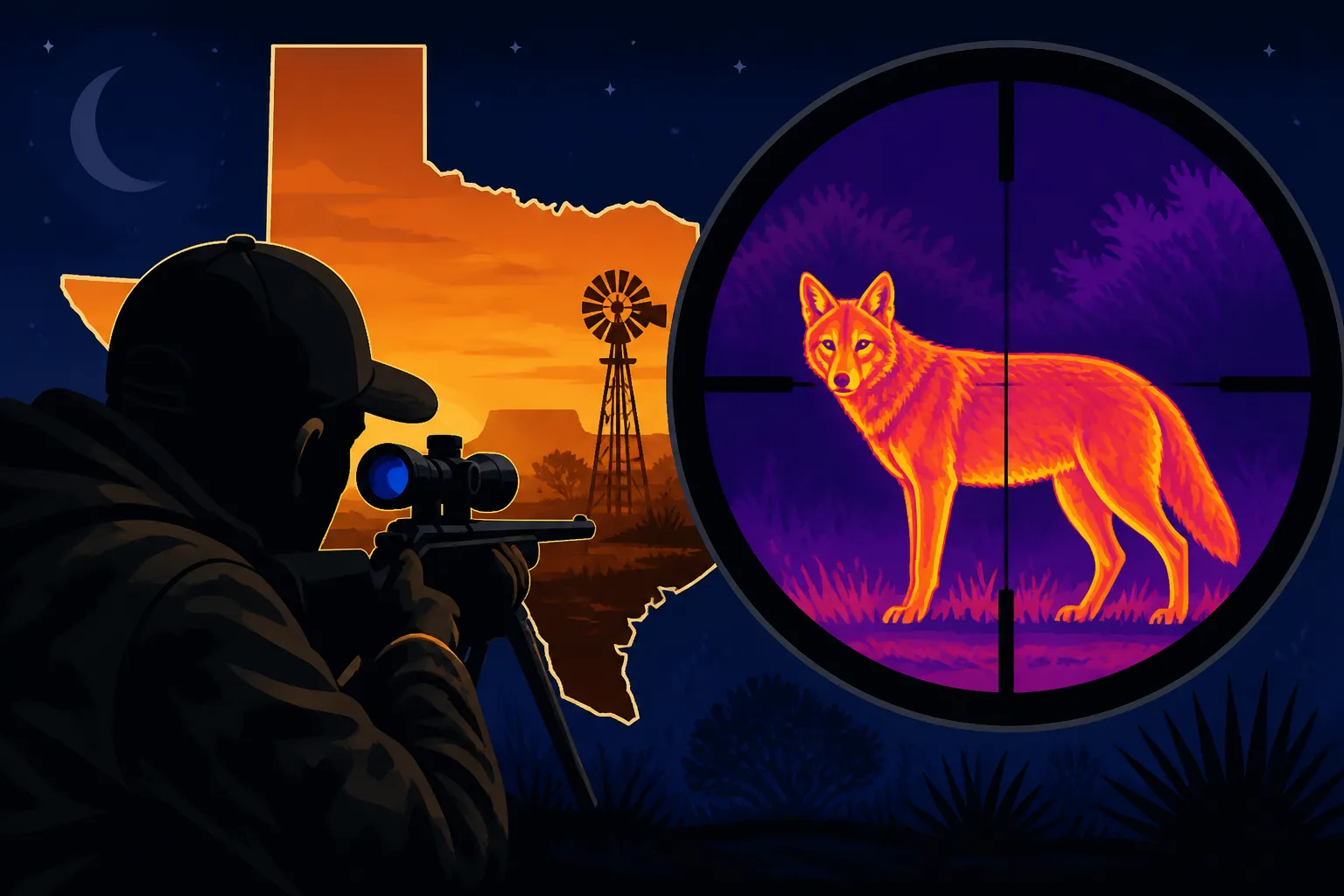
Thermal optics are, quite simply, incredible for finding warm bodies in the dark. They don't rely on ambient light; instead, they detect heat signatures. This means a coyote hiding in thick brush, behind a tree, or even on a cloudy, moonless night will glow brightly on your screen. This capability makes them unparalleled for detection. You can scan vast areas quickly and pick up an animal's heat signature long before you might see it with traditional night vision or a spotlight.
The biggest pros of thermal scopes, like those from popular brands such as Pulsar, AGM, or ATN, include their superior detection range, their ability to work in absolute zero light conditions (total darkness), and their impressive penetration through light fog, smoke, or even dust. If you've ever tried to spot an animal in dense cover at night, you know the frustration; thermal cuts through that by highlighting the heat.
However, thermal isn't without its cons. The image quality, while excellent for showing heat, often lacks the fine detail needed for precise identification. You can tell it's an animal, and with practice, you can often distinguish a coyote from a deer, but discerning subtle antler features or other specifics can be challenging. Secondly, thermal scopes can be a significant investment, often coming with a higher price tag than many night vision alternatives. For a deeper dive into these devices, you might find articles like Pulsar vs AGM Thermal Scopes for Hogs helpful, as the technology often crosses over between game species. For those on a tighter budget, there are still solid options, and exploring resources like Best Budget Thermal Scope Under $2000 can guide you.
Night Vision Devices: Bringing Detail to Dimness
Night vision devices, on the other hand, operate by amplifying existing ambient light—think starlight, moonlight, or even distant city glow. They take whatever faint light is available and multiply it many thousands of times to create a usable image. This means they excel at providing greater detail and clearer identification than most thermal units, especially at closer ranges. If you need to make out the fine details of an animal, or clearly identify terrain features, night vision often shines here. Many modern night vision scopes also integrate infrared (IR) illuminators, which act as an invisible flashlight to further boost their performance in very low light.
The advantages of night vision include generally better detail for identification, and often a more natural, grayscale image that some hunters find easier to interpret. They can also be more affordable than high-end thermal units, making them a good entry point for night hunting.
But night vision has its own set of limitations. It absolutely requires some ambient light to function; in total pitch-black conditions, without an IR illuminator, it's essentially useless. Thick brush, heavy fog, or even heavy cloud cover can significantly degrade performance. Additionally, night vision can suffer from "blooming" or "washout" when exposed to bright lights, like vehicle headlights or a strong flashlight, which can temporarily blind the optic. You can learn more about the direct comparison in Thermal Scope vs Night Vision for Hog Hunting, which has much crossover for coyote hunting.
Choosing the Right Optic for Your Budget and Style
Deciding between thermal and night vision often comes down to your primary goals, budget, and personal preference. Many experienced night hunters advocate for a hybrid approach: using a thermal monocular for broad-area scanning and quick detection, then switching to a weapon-mounted night vision scope or a dedicated thermal scope for the actual shot. The thermal monocular, like the Best Thermal Monocular for Scanning in Texas, allows you to spot coyotes far away, even those partially obscured by vegetation, then once detected, you can use your weapon-mounted optic to confirm identity and take the shot.
| Feature | Thermal Scope | Night Vision Device |
|---|---|---|
| Detection | Excellent (detects heat signatures) | Good (amplifies ambient light) |
| Identification | Good (can be challenging for fine details) | Very Good (clearer, more natural image) |
| Light Required | None (works in total darkness) | Some ambient light required (needs IR in dark) |
| Weather Impact | Minimal (cuts through fog, smoke) | Significant (degraded by fog, heavy cloud) |
| Cost | Generally Higher | Can be Lower (depending on generation/features) |
| Common Use | Scouting, detecting animals in dense cover | Positive ID, clearer shot placement |
Ultimately, if your priority is finding animals at range in any condition, thermal is king. If precise identification and a more natural image are more important, and you're typically hunting in areas with some ambient light, night vision might be your preference. Consider your typical hunting environment—open fields versus dense timber—and how much ambient light is usually present.
Essential Gear and Tactics for Night-Time Stands
Once you've wrapped your head around the optics, it's time to gather the rest of your arsenal and understand the specific strategies that make night coyote hunting successful. This isn't just about spotting them; it's about getting them into a position for a clean shot.
Firearms, Ammunition, and Stabilization
For coyote hunting, especially at night, accuracy is paramount. You want a flat-shooting, relatively low-recoil caliber that delivers sufficient energy for a humane kill without excessive over-penetration or destruction of fur if you're saving pelts. Popular choices among Texas coyote hunters include the trusty .223 Remington/5.56 NATO, the incredibly fast .22-250 Remington, the versatile .243 Winchester, and newer options like the 6.5 Grendel. These calibers offer a good balance of speed, accuracy, and knockdown power for coyotes.
One piece of gear that has become almost indispensable for serious night hunters is a suppressor. The benefits are numerous: it significantly reduces the muzzle blast, protecting your hearing and that of your hunting partners. More importantly, it lessens the "report" of the shot, which can make follow-up shots easier on a group of coyotes and causes less disturbance to other wildlife (or neighbors). Companies like Yankee Hill Machine (YHM) and SilencerCo make excellent suppressors suitable for these calibers.
Given the inherent challenges of shooting in the dark, stability is crucial. Free-handing a shot with a heavy rifle and optics can lead to missed opportunities. Invest in quality shooting sticks or a sturdy tripod. Bipods are also an option, but tripods offer more versatility for varying terrain and standing shots. These aids provide a rock-solid platform, allowing you to focus on target acquisition and precise shot placement. You might also find general rifle scope advice in Best Rifle Scope for Texas Deer Hunting useful, as the principles of clear glass and robust construction apply across hunting disciplines.
Mastering the Art of Calling Coyotes After Dark
Coyote hunting is often synonymous with calling, and at night, electronic callers (e-callers) truly reign supreme. The ability to project realistic, high-volume sounds with a remote control is a huge advantage. Brands like Foxpro, Primos, and Lucky Duck dominate the e-caller market, offering a vast library of sounds.
Effective sounds typically mimic distress. Rabbit distress calls (like cottontail or jackrabbit) are perennial favorites, as are fawn distress calls, especially during late spring and summer when fawns are prevalent. Pup distress calls can also be incredibly effective, particularly during denning season, as they tap into the protective instincts of adult coyotes. Don't be afraid to experiment with howls and barks, too; sometimes an interrogation howl can provoke a territorial response.
The key to calling is not just what sound you play, but how you play it. Start with lower volume and gradually increase it. Set your e-caller 30-50 yards away from your position, preferably upwind, to draw the coyote's attention away from you. This also means if a coyote circles downwind to get a scent, it's more likely to scent the caller first, giving you a precious few extra seconds. Vary your calling sequences, mixing distress with howls, and integrate periods of silence. Often, coyotes will approach silently, so patience is a virtue. For an even deeper dive into calling strategies, check out Predator Calling for Coyotes in Texas.
Stealth, Wind, and Stand Location Selection
Success in night coyote hunting relies heavily on minimizing your presence. Coyotes have an incredible sense of smell and hearing, and they are incredibly wary. Your approach to the stand must be as quiet and scent-free as possible. This means walking softly, avoiding rustling brush, and paying attention to wind direction from the moment you step out of your vehicle.
Wind direction is, arguably, the single most critical factor in stand selection. Coyotes will almost always try to circle downwind of a call to get a whiff of whatever is making the noise. This is their primary defense mechanism. Position yourself so that the wind is blowing from your position towards the area you expect the coyote to come from, but also consider where they might try to circle to. Often, you want to be able to see that downwind approach.
When choosing a stand location, look for areas that offer a good field of view, ideally with a clear backdrop to help identify animals against the night sky, especially if you're using optics that might struggle with busy backgrounds. Elevated positions can provide an advantage, allowing you to see over brush. Natural pinch points, clearings between dense cover, or along fence lines are often productive. Utilize mapping applications like onX Hunt or HuntStand, as discussed in Best Hunting Apps for Texas onX, HuntStand & More, to pre-scout locations during the day, identify potential entry/exit routes for coyotes, and plan your approach based on anticipated wind direction. Getting into your stand undetected, with the wind in your favor, sets the stage for success.
Planning Your Texas Coyote Hunt: Locations and Considerations
Knowing the gear and tactics is one thing, but finding a place to hunt is often the biggest hurdle. Texas offers a mix of opportunities, from vast private ranches to limited public access, each with its own set of rules and considerations.
Hunting on Private Land and Leases
By far, the most common and often most productive avenue for coyote hunting in Texas is on private land. The sheer amount of private acreage in the state means that countless landowners are dealing with coyote populations and are often keen to have ethical hunters help with control. This can range from a single rancher giving you permission to hunt a few hundred acres, to joining a larger hunting lease.
Building relationships with landowners is key. Start by knocking on doors, introducing yourself, and explaining your intentions. Offer to share any game cameras footage you get, or even assist with other chores on the property. A good reputation can open many doors. For those seeking more consistent access, especially for deer season, many hunting leases allow predator hunting as part of the agreement. Resources like Best Hunting Lease Websites for Texas can be a great place to start your search for these opportunities. A dedicated article on How to Hunt Coyote on a Texas Lease could provide even more specific insights into this arrangement. The benefits of private land are numerous: fewer regulations, less competition from other hunters, and the ability to establish consistent stand locations and calling routes.
Navigating Public Hunting Opportunities
While Texas has an abundance of private land, there are also public hunting opportunities, though they often come with more restrictions. The Texas Parks and Wildlife Department (TPWD) manages a number of Wildlife Management Areas (WMAs) and offers drawn hunts, while some National Forests (like the Sam Houston National Forest or Davy Crockett National Forest) permit hunting.
If you plan to hunt on public land, you'll almost certainly need to purchase an Annual Public Hunting (APH) Permit, often in conjunction with your general hunting license. This permit grants access to thousands of acres across the state. However, it is absolutely critical to check the specific regulations for each WMA or public hunting unit you intend to visit. Many WMAs have very strict rules regarding hunting hours, prohibiting any hunting after dark, or limiting it to specific times. Caliber restrictions, firearm types, and the use of artificial lights are all common points of regulation. While coyote hunting might be permitted, the method (day vs. night) can be heavily restricted. Always refer to the specific WMA's regulations in the Outdoor Annual or on the TPWD website. Expect more hunting pressure on public lands, and be prepared for less productive hunting than on private, unpressured acreage. For a general overview, Public Hunting in Texas: WMAs & Annual Public Hunting Permit is a great starting point.
Maximizing Success: Time of Year and Weather
Coyotes can be hunted year-round in Texas, but certain times offer better opportunities. The winter months, generally from December through March, are often considered prime time. This coincides with their breeding season, making them more active and responsive to calls, especially howls. Additionally, if you're interested in keeping pelts, winter furs are typically thicker and more desirable.
When it comes to weather, clear, calm nights are ideal. Strong winds can carry your scent further, make it harder for coyotes to hear your calls, and make it difficult for you to hear their approach. Heavy rain also tends to keep coyotes bedded down. Overcast nights with a light breeze can be excellent, as the lack of moonlight can make them feel more secure, and the breeze helps carry your call. For night vision users, a full moon provides ample ambient light, but for thermal users, moon phase doesn't matter as much.
Safety, Ethics, and Post-Hunt Practices
Hunting at night brings an added layer of responsibility and safety considerations. It’s a different world when the sun goes down, and adherence to strict safety protocols is non-negotiable. Furthermore, ethical practices ensure we respect the animals we hunt and the land we hunt on.
Ensuring Safety During Night Operations
The most critical safety rule in any hunting scenario, but especially at night, is positive target identification. Never, under any circumstances, shoot at a sound, a flicker of movement, or a vague shape. You must clearly identify your target as a coyote before taking a shot. Mistakes can be tragic, potentially resulting in shooting a domestic animal, or worse, another person. Thermal optics, while excellent for detection, can sometimes lack the detail for absolute identification; this is where a hybrid approach (thermal for scanning, night vision for ID) or using a red/green hunting light for final confirmation (if legal and appropriate for your situation) becomes vital.
Beyond target ID, always be aware of your surroundings, your shooting lanes, and, most importantly, your backstop. What is behind your target? The dark can obscure fences, rocks, and changes in elevation, so always assume there's something you can't see.
Hunting with a partner, especially at night, adds an extra layer of safety. Two sets of eyes are always better than one, and having someone to assist with gear, spotting, and tracking is invaluable. Establish clear communication signals and ensure everyone understands the hunt plan before darkness falls.
Ethical Considerations and Respect for the Resource
Ethical hunting practices extend to predator control. While coyotes are often targeted for population management, it's still our duty as hunters to ensure clean, humane kills. This means using appropriate calibers, taking responsible shots within your effective range, and diligently tracking any wounded animals. A quick, humane kill honors the animal and reflects positively on the hunting community.
Don't overhunt a single area. Coyotes are smart, and they will become call-shy or avoid areas with too much pressure. Rotate your hunting spots to keep the animals guessing and to maintain a healthy predator-prey balance on the property. Always respect the land you're hunting on—pack out all your trash, avoid disturbing other wildlife unnecessarily, and be a good steward of the resource. If you're on a lease, adhere to all lease rules and maintain good relationships with your fellow hunters.
Dealing with Harvested Coyotes
After a successful hunt, you'll need a plan for the harvested coyote. If you're hunting during the colder winter months and are interested in the pelt, proper field care is essential to preserve its quality. This means skinning the animal promptly and cooling the hide. Fur buyers will have specific requirements for how the hide should be handled and prepared, so research this beforehand if selling pelts is your goal.
If pelt preservation isn't a concern, you'll need to dispose of the carcass respectfully. On private land, this often means burying it or placing it in an area where it won't be an issue for livestock or attract unwanted scavengers near human activity. The primary goal of coyote hunting is often predator control and managing their impact on other game species, as discussed in detail in guides like Predator Calling for Coyotes in Texas. By participating in responsible predator management, you contribute to the overall health and balance of Texas's diverse ecosystems.
Disclaimer
Please remember that hunting regulations can change. Always consult the current Texas Parks and Wildlife Department Outdoor Annual or their website for the most up-to-date and complete regulations before engaging in any hunting activities. This guide is for informational purposes only and does not supersede official state regulations.