Mule Deer vs White-Tailed Deer in Texas
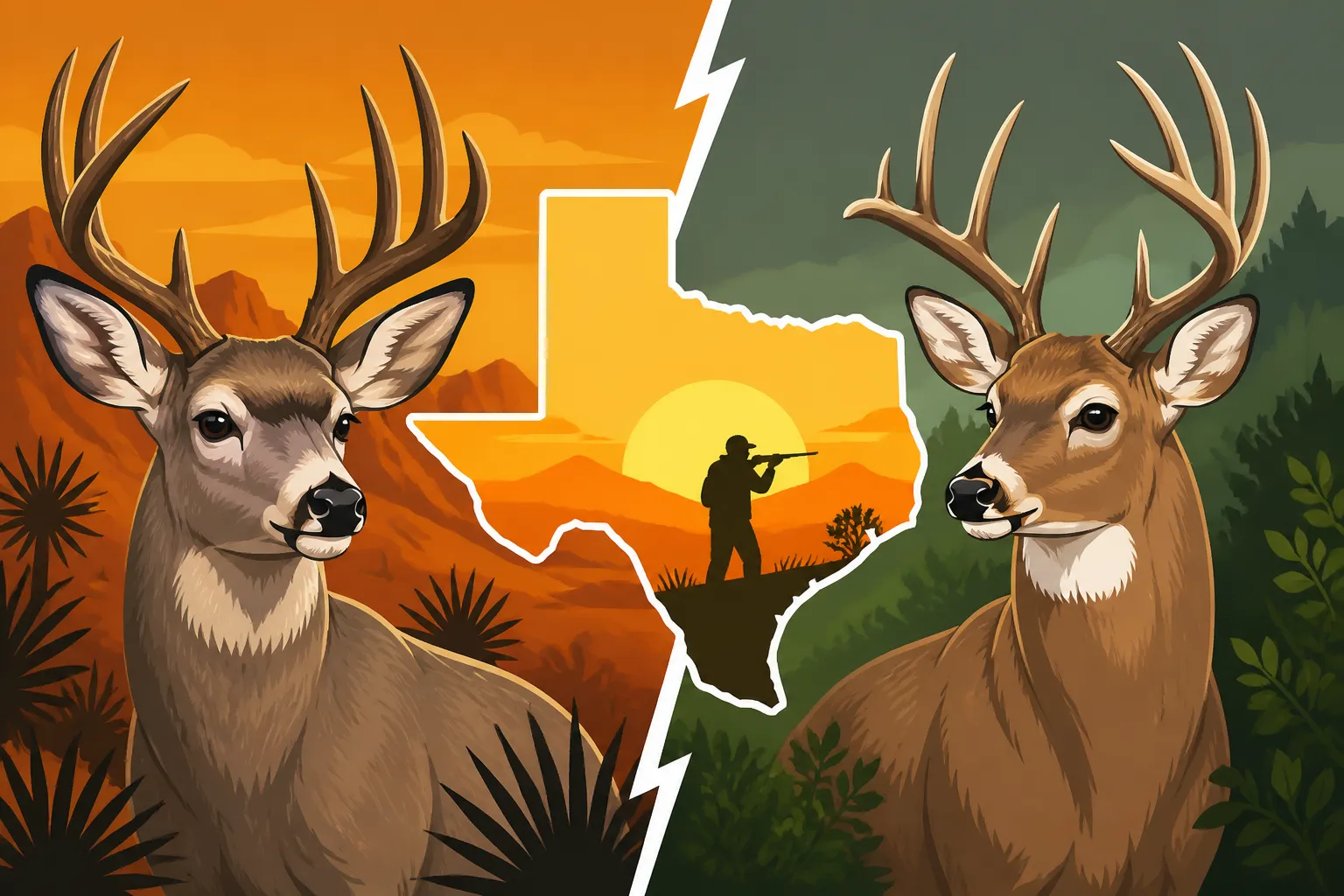
It's incredibly common to find yourself squinting through binoculars, wondering if that distant deer is a mule deer or a white-tailed deer, especially here in Texas where both species roam. The subtle differences can be a real head-scratcher, leading to confusion about hunting strategies and even regulations. This comprehensive guide will clear up that confusion, detailing the distinct characteristics, preferred habitats, behaviors, and hunting considerations for both mule deer and white-tailed deer across our great state.
Physical Distinctions Between Mule Deer and White-Tailed Deer
When you're out in the field, identifying deer correctly is the first step, and it really comes down to noticing those key physical markers. It’s not just about size, though that’s often a factor; it’s about a combination of features that, once you know what to look for, become quite obvious.
Ear Size and Shape
The most iconic difference, and the one that gives the mule deer its name, is certainly their ears. Mule deer possess remarkably large, mule-like ears that are typically several inches longer than a white-tailed deer's ears. These prominent ears are not just long, but also wider and more rounded at the tips. They can swivel almost independently, giving the deer an incredible ability to pick up sounds from various directions, which is a major adaptation for their more open, expansive habitats. White-tailed deer, on the other hand, have ears that are proportionate to their head size, shorter, and somewhat narrower. If you see ears that look like they belong on a donkey, you’re almost certainly looking at a mule deer.
Tail Characteristics
The tail is another dead giveaway, and it's where the "white-tailed" deer gets its name. A white-tailed deer's tail is broad at the base, covered in brown fur on top, but it's the pure white underside that makes it famous. When alarmed, a whitetail will raise this tail straight up, flagging it like a beacon as it bounds away. This "flag" is one of the most recognizable sights in the Texas woods. Mule deer tails, however, are quite different. They are typically narrower, round, and rope-like, usually a creamy white color with a distinctive black tip. They don't "flag" their tails like whitetails; instead, they might hold it down or slightly out as they move. Some mule deer in certain regions can have a smaller, entirely black-tipped tail, but the overall shape and lack of a large, white underside are the key identifiers.
Antler Configuration
For the bucks, the antlers provide a clear distinction, though sometimes young bucks or non-typical racks can make it tricky. White-tailed deer antlers typically grow forward from a single main beam, with individual tines (points) growing upwards off that beam. Think of it like a hand, with the palm being the main beam and fingers as the tines. Most often, the tines do not fork again. Mule deer antlers, by contrast, are usually bifurcated, meaning they fork. The main beam forks into two points, and then each of those points forks again. This creates a more branched, often symmetrical look. This double-forking characteristic is a primary way to tell mule deer apart from whitetail bucks, even at a distance. Of course, there are always exceptions with broken antlers or unique genetic expressions, but the general pattern holds true.
Body Size and Coloration
While less reliable than ears or tails due to individual variation and age, general body size and coloration can also offer clues. Mule deer tend to be larger and heavier-bodied than white-tailed deer, with a more robust build. An adult mule deer buck can weigh significantly more than an average whitetail. Their coat color is often a grayish-brown, sometimes with a more pronounced white rump patch that extends up past the tail. White-tailed deer, especially in Texas, often have a more reddish-brown coat during warmer months, transitioning to a grayer or more muted brown in winter. They generally appear more slender and athletic compared to the stockier mule deer. While both can vary in size and color based on diet and region, these are useful general observations.
Habitat and Range in Texas
Texas is a massive state, and its diverse landscapes are home to both of these incredible deer species. However, they've largely carved out their own territories, adapting to very specific ecological niches. Understanding where each species thrives is crucial for hunters and wildlife enthusiasts alike.
White-Tailed Deer Territory
White-tailed deer are, without a doubt, the most common big game animal in Texas, found in almost every corner of the state where suitable habitat exists. They are incredibly adaptable, thriving in the dense brush of South Texas, the rolling hills and cedar breaks of the Texas Hill Country, the pineywoods of East Texas, and the scattered cover of the Trans-Pecos mountains. From the smallest backyard to vast ranches, whitetails have made themselves at home. Their preference is for areas with plenty of dense cover—think thickets, brushy draws, and wooded areas—which provides them with both security from predators and a diverse food source. Regions like the South Texas Brush Country are particularly renowned for producing exceptional trophy whitetails due to the rich habitat and management practices.
Mule Deer Territory
Mule deer, on the other hand, are much more restricted in their Texas range. You'll primarily find them in the western parts of the state, particularly in the rugged and arid Trans-Pecos region, which includes counties like Culberson, Hudspeth, Presidio, Jeff Davis, and Brewster. They also extend into the Panhandle, inhabiting the broken country of the western High Plains and the breaks along the Canadian River. These are landscapes characterized by mountains, canyons, vast open spaces, and sparse desert vegetation. Unlike whitetails, mule deer prefer these more open, mountainous, and often rocky terrains, where their keen eyesight and unique bounding gait allow them to traverse difficult ground and escape predators in wide-open country. You won't typically find mule deer in the eastern or central parts of Texas; their domain is decidedly western.
Overlap and Transition Zones
While their core ranges are distinct, there are indeed transition zones where you might encounter both white-tailed and mule deer. These areas usually occur where the eastern edge of mule deer habitat meets the western edge of white-tailed deer habitat, such as in parts of the eastern Trans-Pecos or the western fringes of the Edwards Plateau. In these overlap zones, which can sometimes be just a few counties wide, you might see both species utilizing similar resources, albeit often with slight preferences for different elevations or types of cover within the same general area. For hunters, being in one of these transition zones means you need to be extra vigilant in your identification, as the regulations for each species, especially regarding antler restrictions, can be quite different. When scouting, using advanced mapping tools, like those offered by GoHunt, can sometimes help identify these subtle habitat shifts.
Behavioral Differences
Beyond their looks and where they live, the way mule deer and white-tailed deer carry themselves and interact with their environment is strikingly different. These behavioral patterns are largely driven by their respective habitats and provide fascinating insights for anyone observing or hunting them.
Movement Patterns and Gait
Perhaps the most distinctive behavioral difference is their mode of travel when alarmed. A white-tailed deer, when spooked, typically runs in a fluid, horizontal motion, often holding its famous white tail high like a flag. Their running style is quick and evasive, relying on bursts of speed and tight turns through thick cover. Mule deer, however, are famous for their "stotting" or "pronking" gait, often referred to as a "muley hop." When startled, a mule deer will bound away, lifting all four feet off the ground simultaneously in a stiff-legged, bounding leap. This unique gait is incredibly efficient for covering broken, rocky, and uneven terrain quickly, allowing them to survey their surroundings over low-lying brush as they escape. It's a truly unmistakable sight and a sure sign you're looking at a mule deer.
Dietary Habits
Both species are primarily browsers, meaning they eat a wide variety of leaves, twigs, forbs, and cacti rather than grass. However, their specific dietary preferences are influenced by what's available in their respective habitats. White-tailed deer are incredibly diverse eaters, consuming anything from acorns and greenbriar to agricultural crops. They thrive in areas with diverse forage and access to water, allowing them to pick and choose from a rich buffet of plants. Mule deer, living in more arid and sparse environments, have adapted to consume more drought-resistant plants, including various desert shrubs, cacti, and yucca. They are also known to browse on mountain mahogany, serviceberry, and bitterbrush. Their diet is a testament to their ability to survive in environments that would be challenging for whitetails, and their feeding patterns often involve covering larger areas to find sufficient sustenance.
Social Dynamics
White-tailed deer typically live in smaller family groups, often a doe with her fawns, sometimes accompanied by yearlings. Bucks generally remain solitary or form small bachelor groups outside of the rut. They are often perceived as more secretive and wary, relying heavily on cover for concealment. Mule deer, especially outside of the rut, tend to be more gregarious, often forming larger herds. It's not uncommon to see groups of several does with their fawns, or even bachelor groups of bucks ranging together in more open country. This social structure might be an adaptation to their more open habitats, where there's less cover, and having more eyes and ears can be a defensive advantage.
Rutting Behavior
The rut, or breeding season, is a crucial period for both species, but the timing can differ. The peak of the white-tailed deer rut in Texas typically occurs from early November through mid-December, though it can vary significantly by region. For instance, the rut in South Texas might be later than in the Hill Country. During this time, bucks become highly active, chasing does, rubbing trees, and scraping the ground. Understanding When Is the Best Time to Rattle in Texas? or How to Grunt and Rattle Whitetail in the Hill Country can be key to capitalizing on this period. Mule deer also have a distinct rut, which generally occurs later than whitetails, often peaking in late November and extending through December or even into January, especially in the Trans-Pecos. During their rut, mule deer bucks will actively search for does, engaging in impressive sparring matches. These differing rut timings are important for hunters to note, as they dictate the optimal hunting periods.
Hunting Considerations in Texas
Hunting mule deer and white-tailed deer in Texas presents unique challenges and requires different approaches. Understanding these nuances is crucial for a successful and ethical hunt.
Hunting Tactics for Whitetail
White-tailed deer hunting in Texas is incredibly diverse, mirroring their widespread distribution. In dense brush country, like in South Texas, hunters often rely on elevated blinds—either Box Blind vs Tripod vs Ground Blind in Texas—over feeders or food plots. This strategy capitalizes on the whitetail's habit of using specific trails and visiting consistent food sources. Early morning and late evening are prime times, as whitetails are most active during these low-light periods. Still-hunting or stand hunting are common methods. For those interested in deeper dive, our guide on White-Tailed Deer Hunting in Texas: Complete Guide offers extensive advice. Hunters here also need to pay close attention to the Texas Antler Restrictions: 13-Inch Rule & Counties, which can vary significantly by county. Before heading out, consulting resources from GoHunt that detail county-specific regulations can prevent headaches in the field.
Hunting Tactics for Mule Deer
Hunting mule deer in the rugged landscapes of West Texas requires a completely different approach. Spot-and-stalk is the predominant method, given their preference for open, mountainous terrain. Hunters will spend hours, often days, glassing vast canyons and hillsides with high-quality binoculars and spotting scopes, searching for deer. Once a buck is spotted, a careful stalk can begin, often covering significant distances over challenging ground. This physically demanding style of hunting requires patience, good optics, and excellent physical conditioning. You can learn more about Mule Deer Hunting in Texas: Panhandle & Trans-Pecos in our dedicated article. Unlike whitetails, mule deer don't typically respond to feeders, and baiting is less common due to their habitat and movement patterns. Texas also has specific Texas Mule Deer Antler Restrictions (20-Inch Rule) that apply to the Trans-Pecos, so it's critical to be familiar with those guidelines.
Regulatory Differences
Texas Parks and Wildlife Department (TPWD) manages hunting regulations for both species, and it's essential to understand that rules are not interchangeable.
- Seasons: While some general deer seasons might overlap, specific dates for archery, general, and special late seasons can differ between white-tailed and mule deer. Always check the current Texas Outdoor Annual for precise dates for your specific county and deer species. For example, the Texas Deer Season 2026-2027: Dates by Zone provides a detailed breakdown for whitetails.
- Antler Restrictions: As mentioned, white-tailed deer are subject to the 13-inch rule in many counties, designed to protect younger bucks. Mule deer in the Trans-Pecos have a different antler restriction, generally involving a minimum outside spread of 20 inches, or at least one unbranched antler, to qualify as legal. These rules are in place to help manage herd health and age structure for each species. Using mapping tools and regulatory databases, such as those integrated with GoHunt, can provide instant access to these critical details.
- Bag Limits: Bag limits also vary. For white-tailed deer, the general statewide limit is four deer, no more than two bucks, but county-specific regulations can alter this. Mule deer typically have a much more conservative bag limit, often just one buck per hunter, reflecting their lower populations and the difficulty of hunting them.
Staying informed about these regulations is not just about compliance; it's about responsible hunting and contributing to the conservation of these magnificent animals.
Here’s a quick comparison of the two incredible species:
| Feature | White-Tailed Deer (Odocoileus virginianus) | Mule Deer (Odocoileus hemionus) |
|---|---|---|
| Ears | Proportionate to head, narrower, pointed. | Large, mule-like, rounded, longer than head. |
| Tail | Broad, brownish on top, bright white underneath; "flags" when alarmed. | Rope-like, creamy white with a distinct black tip; held down or slightly out. |
| Antlers | Main beam with tines growing upwards (typically no forking off tines). | Bifurcated (forking), main beam forks into two, which may fork again. |
| Body Size | Generally smaller, more slender, agile build. | Larger, stockier, more robust build. |
| Coloration | Reddish-brown in summer, grayish-brown in winter. | Grayish-brown overall, often with white rump patch. |
| Movement | Runs in a fluid, horizontal motion; uses speed and quick turns. | "Stotting" or "Muley hop" – all four feet off the ground in a bound. |
| Primary Habitat | Widespread across Texas; dense brush, woodlands, river bottoms, agricultural areas. | Western Texas (Trans-Pecos, Panhandle); open, mountainous, arid, rocky terrain. |
| Rut Peak | Varies by region, typically early November to mid-December. | Later than whitetails, typically late November to January. |
| Hunting Style | Stand hunting, still-hunting over feeders/food plots; relies on cover. | Spot-and-stalk; relies on glassing vast open areas. |
| Antler Regs | Often 13-inch rule in many counties. | Often 20-inch outside spread or at least one unbranched antler in Trans-Pecos. |
Disclaimer
Hunting regulations and seasons can change. Always consult the most current Texas Parks and Wildlife Department Outdoor Annual or website for the official and up-to-date information before planning any hunt. This article provides general information and should not be considered a substitute for official legal guidance.