How to Hunt Nilgai on a Texas Lease
Hunting Nilgai is often described as a cross between hunting an elk and a ghost. Many hunters arrive at their South Texas lease expecting a casual safari, only to be humbled by the incredible senses and "tank-like" toughness of the Blue Bull. This guide solves the mystery of these elusive antelope, offering a tactical blueprint to successfully harvest Nilgai on private land.
Understanding Nilgai Behavior on a Private Lease
To hunt Nilgai successfully, you have to realize you aren't hunting a deer. These animals were brought over from India, and they haven't lost an ounce of their survival instinct. On a private lease, they often have more room to roam, which makes patterning them a unique challenge compared to smaller game. Understanding their biology and social structure is the first step toward putting one in your cooler.
The Ghostly Nature of the Blue Bull
Nilgai are incredibly skittish. Unlike whitetail that might blow or stomp when they sense danger, a Nilgai often detects you from hundreds of yards away and simply vanishes. They have a horizontal field of vision that is almost unparalleled in the Texas brush. If you are hunting on a South Texas Hunting Lease Cost & Options basis, you’ll quickly notice that Nilgai don't stick to the same trails as deer. They prefer open motts of live oaks where they can see in every direction.
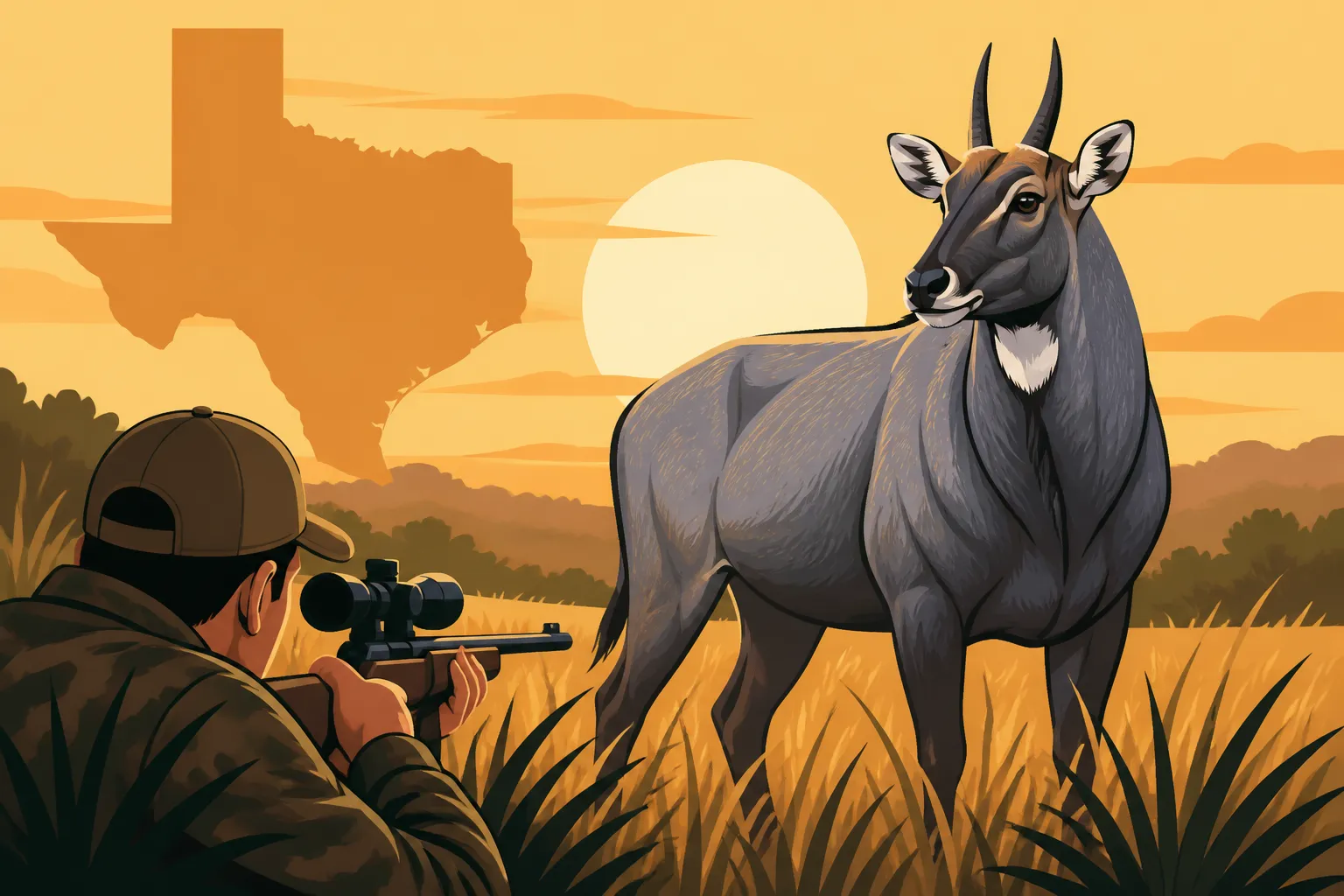
When a bull feels pressured, he won't just run to the next thicket; he might run two miles. This is why How to Hunt Nilgai in Texas (Step by Step) starts with extreme stealth. They have a "sixth sense" for movement. If you are used to glassing for the flick of an ear or a tail, you’ll need to adjust. A Nilgai bull is a massive, dark blue-grey shape that somehow blends perfectly into the shimmering heat waves of the coastal prairie.
Habitat and Home Range in South Texas
Nilgai thrive in the coastal prairies and the dense mesquite brush of the Rio Grande Valley. On a lease, they tend to congregate near coastal bermuda fields or areas with high-quality protein. However, they are highly mobile. A bull's home range can be significantly larger than a whitetail's, often covering several thousand acres. They aren't particularly territorial in the way other species are, which means you can find a "bachelor pad" of bulls one day and an empty pasture the next.
Water is a major factor in their movement. While they can go long periods without a drink, they love the mud. If your lease has "tanks" or low spots that hold water, you'll likely find their tracks. They have a distinct "cloven" hoof that is much larger and rounder than a deer's. If you are looking for Gulf Coast Hunting in Texas: Waterfowl & Nilgai opportunities, keep an eye out for these massive tracks near the water's edge, as they often share the same marshy habitat.
Daily Patterns and Feeding Habits
Nilgai are primarily grazers, but they are also opportunistic browsers. On a South Texas lease, they spend a lot of time on the edges of brush lines during the early morning and late evening. During the heat of the day, they retreat into the thickest "chaparral" they can find. Interestingly, they are very fond of the fruit from prickly pear cacti and the beans from mesquite trees.
One of the most important things to look for is their "latrines." Nilgai are creatures of habit when it comes to where they relieve themselves. They create large dung piles, often in the middle of a road or a clearing. If you find a fresh pile, you are in their living room. This is a primary sign to look for when deciding How to Hunt Nilgai on the Texas Coast specifically on private acreage. Monitoring these latrines with trail cameras can give you a clear window into their schedule.
Strategic Hunting Methods for Nilgai
The method you choose will largely depend on the terrain of your lease and your physical ability. Nilgai hunting is notoriously demanding. Because they don't respond to feeders the way deer do, you can't just sit in a box blind and wait for a "Blue Bull" to walk into a pile of corn. You have to go to them.
Spot-and-Stalk: The Ultimate Challenge
This is widely considered the most effective and rewarding way to hunt Nilgai. It involves driving or walking until you spot a group, then using the wind and cover to get within shooting range. Because Nilgai see so well, your stalk needs to be meticulous. You should always keep the wind in your face and the sun at your back whenever possible.
The terrain in South Texas is unforgiving. You'll be crawling through thorns, sandburrs, and prickly pear. A good pair of snake boots is non-negotiable here. You can find several highly-rated pairs on Amazon that offer both protection and comfort for long miles. When you are on a stalk, remember that Nilgai are tall. They will often see over the top of low brush that you think is providing you cover. Constant glassing is required to ensure you haven't been "busted" by a cow in the group you didn't see.
Safari Style vs. Safari Stands
Many South Texas leases utilize high-seat vehicles, often called "top-drives." This "safari style" hunting allows you to see over the tall mesquite and brush. It is an efficient way to cover large amounts of ground on massive leases. Once a bull is spotted from the high seat, the hunter usually dismounts and begins a stalk on foot.
Alternatively, if you know a particular "gap" or fence crossing the Nilgai are using, you can set up a temporary ground blind or use a "safari stand." These are elevated platforms that aren't as permanent as a box blind. If you are researching Best Gear for Nilgai on a Texas Lease, you might consider a portable tripod or a heavy-duty stool from Amazon to keep you comfortable while waiting in a natural blind. The key is to stay downwind. If a Nilgai catches your scent, the hunt is over before it starts.
Identifying Latrines and Fence Crossings
As mentioned earlier, latrines are gold mines for information. If your lease has internal fences, Nilgai will often have specific spots where they prefer to cross. Unlike deer that might jump a fence, a 600-pound Nilgai bull prefers to go through or under it. Look for hair on the wire and large indentations in the dirt.
Setting up near a fence crossing that leads from a bedding area to a feeding area is a high-percentage play. Since Nilgai are so heavy, they create very visible trails through the grass. If you find a trail that looks like a small bulldozer went through, you’ve found a Nilgai highway. This is a great time to implement How to Hunt Nilgai on a Texas Lease tactics by sitting patiently near these pinch points during the first and last hours of light.
| Feature | Nilgai Antelope | White-Tailed Deer |
|---|---|---|
| Weight | 300 – 800 lbs | 100 – 250 lbs |
| Senses | Legendary Eyesight | Strong Smell/Hearing |
| Reaction | Immediate Flight (Miles) | Blow/Short Run |
| Feeder Use | Very Rare | High |
| Vitals | Forward & Low | Center Behind Shoulder |
| Skin | 1-inch thick "Armor" | Thin |
Gear, Calibers, and Shot Placement
If you bring a standard deer rifle to a Nilgai hunt, you are likely setting yourself up for heartbreak. These animals are built differently. Their hide is incredibly thick—up to an inch on the neck and shoulders—and their bones are dense. You need a setup that can punch through that armor and reach the vitals.
The "Nilgai Grade" Weaponry
The consensus among South Texas guides and veterans is that .300 Winchester Magnum is the absolute minimum for a clean kill. Many prefer larger calibers like the .338 Lapua or .375 H&H. The goal isn't just to hit the animal; it's to break it down. Nilgai are famous for taking a well-placed shot and running into the thickest brush imaginable, where recovery becomes a nightmare.
When choosing ammunition, look for heavy-for-caliber, bonded bullets that retain their weight. You want something that will expand but won't fragment on the shoulder bone. This is a situation where Are Nilgai Hard to Hunt? becomes a very real question if you are under-gunned. If you are shopping for accessories, Amazon has a wide variety of recoil pads and shooting sticks that can help you manage these larger calibers and ensure a steady shot.
Shot Placement: Aiming for the Vital Triangle
A Nilgai's vitals are positioned further forward and lower than a whitetail's. If you aim for the "traditional" spot behind the shoulder, you might hit the lungs, but the bull will still run for miles. The preferred shot for many is the "neck-shoulder junction." A shot placed where the neck meets the body will often drop them in their tracks by disrupting the spinal cord or shattering the heavy shoulder assembly.
If you are taking a broadside shot, aim lower than you think. You want to be in the bottom third of the body, directly above the front leg. Because they are so tough, many hunters also use the same logic as Best Shot Placement for Hogs—aim to break the skeletal structure. If a Nilgai can't run, you can recover it. If it can run, even with a punctured lung, you may never find it in the South Texas scrub.
Essential Accessories and Optics
Quality glass is your best friend. You will spend hours looking at "blue" bushes that turn out to be nothing, and "grey" shadows that turn out to be a trophy bull. A pair of 10×42 binoculars is the standard. You can find high-quality optics from brands like Vortex or Bushnell on Amazon that provide the clarity needed to distinguish a bull's horns from the surrounding mesquite branches.
A rangefinder is also vital. The coastal prairie is notoriously flat, which makes judging distance very difficult. A bull that looks like he's at 200 yards might actually be at 350. Because the kill zone on a Nilgai is relatively small compared to their overall body size, knowing your exact yardage is the difference between a clean harvest and a wounded animal.
Recovery and Field Care in the Coastal Heat
Once the trigger is pulled, the real work begins. Nilgai are massive, and the South Texas sun is relentless. If you don't have a plan for recovery and cooling, you risk losing hundreds of pounds of the best meat in the state.
Tracking and the "No Blood Trail" Problem
Nilgai have a thick layer of fat and hide that often "plugs" the entry and exit holes. This means that even with a fatal shot, you may find very little blood on the ground. This is why Field Dressing & Processing Game in Texas Heat is such a critical skill to learn. If the bull doesn't go down in sight, wait at least 30 minutes before starting your search.
When you start tracking, look for broken branches and deep hoof gouges. Because of their weight, they leave a significant physical trail even without blood. If you are hunting on a lease, having a high-clearance vehicle with a winch is almost a necessity for loading these animals. Attempting to manhandle a 600-pound bull into the back of a truck by yourself is a recipe for a back injury.
Processing and Transporting the Meat
Nilgai meat is widely considered the Best Wild Game Meat in Texas (Ranked). It is extremely lean, has a fine grain, and lacks the "gamey" flavor often associated with venison. However, because the animal is so large, the internal heat can sour the meat quickly. You must get the hide off and the carcass quartered as fast as possible.
Bring plenty of large coolers and several hundred pounds of ice. You will need to know How to Cool a Deer Fast in Texas Heat and then multiply that effort by four. Many hunters choose to skin the animal immediately in the field to allow the meat to breathe. Once quartered, the meat should be kept on ice but not allowed to sit in water. A high-end rotomolded cooler, which you can find on Amazon, is an excellent investment for keeping Nilgai meat at the proper temperature during the long drive home from the lease.
Disclaimer
The information provided in this guide is for educational and informational purposes only. Hunting regulations, including license requirements and bag limits, are subject to change by the Texas Parks and Wildlife Department. Always consult the official Texas Outdoor Annual before planning your hunt. Ensure you have the landowner's permission and all necessary permits for hunting on a private lease. Hunting large game involves inherent risks; always prioritize safety and ethical hunting practices.