How to Hunt Blackbuck Antelope in Texas
Hunting blackbuck antelope in Texas can be a truly exhilarating experience, but it’s far from a walk in the park. These agile, keen-sighted exotics present a unique challenge, often leaving hunters frustrated by their uncanny ability to vanish into seemingly sparse cover or bolt at the slightest hint of danger. This comprehensive guide is designed to equip you with the knowledge and tactics necessary to successfully pursue blackbuck in the diverse Texas landscape, from understanding their behavior to selecting the right gear and executing a successful hunt.
Understanding Blackbuck Antelope Behavior and Habitat in Texas
Before you even think about loading your rifle, truly understanding the blackbuck you're pursuing is paramount. These aren't your typical whitetail; they have a distinct set of instincts and preferences shaped by their native environment and their adaptation to the Texas plains and brush country.
Native Origins and Texas Adaptation
Blackbuck antelope, or Antilope cervicapra, originally hail from the grasslands and open forests of India and Nepal. They were first introduced to Texas in the early 20th century, largely on private ranches, and have since thrived in the state's similar semi-arid conditions, particularly across the Edwards Plateau and parts of South Texas. Their survival here is a testament to their adaptability, but they retain many of the behaviors that made them successful in their homeland. You'll find them grazing on grasses, forbs, and even browsing on some woody vegetation, making them quite flexible in their diet. They're built for speed and endurance, capable of bursts up to 50 miles per hour, which is often what makes them so challenging to hunt once they spot you.
Social Structure and Daily Routines
Blackbuck live in dynamic social groups. You'll typically encounter three types of herds: bachelor groups of males, herds of females and young, and territorial males. The mature, trophy-worthy bucks are often solitary or hold small territories, especially during the breeding season. Their daily routine is largely dictated by food availability and security. They are primarily diurnal, meaning they are most active during the day, particularly in the cooler parts of the morning and late afternoon, much like our native deer. Midday often finds them bedded down in shaded areas or against taller vegetation, chewing their cud and staying vigilant. Understanding these patterns is critical; if you're out glassing at noon on a sweltering August day, chances are you'll be looking at bedded animals, not actively grazing ones.
Preferred Habitat in Texas
In Texas, blackbuck gravitate towards open to semi-open grasslands interspersed with scattered mesquite, oak motts, or cedar brakes that offer both grazing opportunities and crucial cover. They love rolling hills that provide good vantage points to spot predators (or hunters!). You'll often find them on larger ranches with expansive pastures, particularly in regions like the Hill Country, where the landscape offers a mosaic of open fields and denser cover. Unlike whitetail that might stick to thick creek bottoms, blackbuck prefer to use elevated positions to survey their surroundings. Look for areas where fields meet scattered brush, offering easy access to food and a quick escape route into thicker cover. When considering Blackbuck Antelope Hunting in Texas: Cost & Where, you'll notice many reputable outfits are located in these prime blackbuck habitats.
Essential Gear and Setup for Blackbuck Hunting
Hunting blackbuck successfully demands specific gear choices that cater to their keen senses and the open Texas terrain. Skimping on quality here can mean the difference between a successful stalk and watching a magnificent animal disappear over the horizon.
Rifle and Ammunition Choices
For blackbuck, accuracy and flat trajectory are key. These animals are not large, typically weighing between 70-100 pounds, so heavy magnum cartridges aren't necessary and can cause excessive meat damage. What you need is a rifle that you can shoot accurately out to 200-300 yards, as shots can often be long in their open habitat.
A .243 Winchester, .25-06 Remington, 6.5 Creedmoor, or a .270 Winchester are all excellent choices. These calibers offer a good balance of velocity, manageable recoil, and sufficient energy for a clean, ethical kill. When it comes to ammunition, focus on well-constructed, controlled-expansion bullets. Brands like Hornady ELD-X, Barnes TSX, or Nosler AccuBond are fantastic options that retain weight and deliver deep penetration, ensuring a humane harvest. Avoid varmint-specific bullets that might fragment too quickly. Remember, shot placement is paramount, so practice regularly with your chosen rifle and ammunition. To gain a deeper insight into rifle selection, you might find our guide on the Best Rifle Scope for Texas Deer Hunting helpful, as many principles translate directly to blackbuck.
Optics for Spotting and Stalking
Blackbuck have exceptional eyesight, often likened to that of a pronghorn. This means your optics need to be top-notch. High-quality binoculars are your most important tool for glassing vast open areas to locate animals without alerting them. I’d recommend a pair of 10×42 or even 12×50 binoculars. Brands like Vortex, Leupold, and Zeiss offer excellent clarity, light transmission, and durability, which are crucial when you're spending hours scanning the horizon in the Texas sun.
A good spotting scope can also be invaluable, especially if you plan on extended long-range glassing or need to confirm horn length and characteristics from a distance to ensure it's a trophy-class animal. Finally, a reliable rangefinder is non-negotiable. Knowing the exact distance to your target is critical for making an accurate shot, especially as blackbuck often blend seamlessly into the background. For more detailed advice on glassing gear, check out our piece on the Best Binoculars for South Texas Brush, which applies perfectly to blackbuck country.
Appropriate Clothing and Footwear
Texas weather is notoriously unpredictable, often swinging from cool mornings to scorching afternoons. Layering is always a good strategy. For blackbuck, camouflage isn't just about blending in with the background; it's about breaking up your silhouette in their open environment. Lighter-colored, open-country patterns or even solid earth tones like khaki or tan work well.
Given the heat, lightweight, breathable fabrics are essential. Think moisture-wicking shirts and pants to keep you comfortable during long stalks. Sun protection is also key: a wide-brimmed hat, sunglasses, and sunscreen are absolute necessities. As for footwear, comfortable, broken-in hunting boots are a must for covering ground silently. Snake boots are a wise investment, especially in the spring and summer, to protect against rattlesnakes that are prevalent in many blackbuck habitats. For general advice on staying comfortable in the field, our guide on Best Early-Season Camo for Texas Heat provides excellent insights.
| Gear Category | Recommended Item | Key Features |
|---|---|---|
| Rifle Caliber | .243 Win, .25-06 Rem, 6.5 Creedmoor, .270 Win | Flat trajectory, ethical kill power, manageable recoil |
| Ammunition | Controlled-expansion bullets (Hornady, Barnes, Nosler) | Deep penetration, minimal meat damage |
| Binoculars | 10×42 or 12×50 | High clarity, good light transmission, wide field of view |
| Spotting Scope | 15-45×60 or 20-60×80 | Detailed long-range viewing, trophy assessment |
| Rangefinder | Laser rangefinder with angle compensation | Precise distance measurement for accurate shots |
| Clothing | Lightweight, breathable, layered camo/earth tones | Moisture-wicking, sun protection, blends with open terrain |
| Footwear | Comfortable, broken-in hunting boots (snake boots recommended) | Silent movement, ankle support, protection from hazards |
Proven Tactics for Blackbuck Antelope Hunting
Blackbuck are not just fast; they are incredibly alert, with excellent eyesight that makes them one of the most challenging exotics to approach. This means your hunting tactics need to be precise and patient.
Spot-and-Stalk Methodology
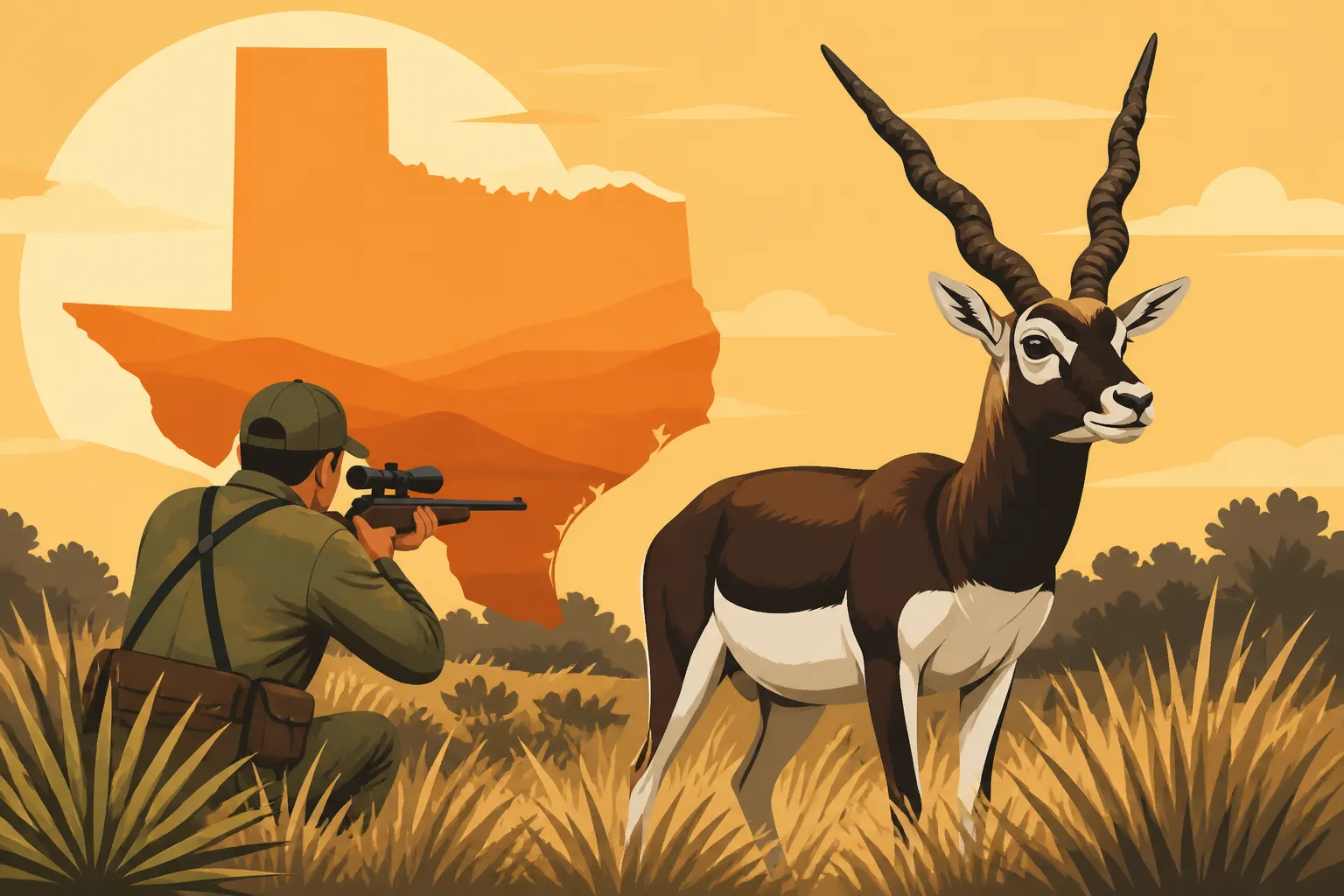
This is arguably the most exciting and effective way to hunt blackbuck. It involves patiently glassing large areas from an elevated position, locating a desirable animal, and then meticulously planning and executing a stalk to get within shooting range.
The Art of Glassing: Start your day early, getting to a high point on your lease or ranch before sunrise. Use your binoculars and spotting scope to systematically scan every inch of the landscape. Look for movement, distinct horn shapes, or the tell-tale black and white patterns that stand out against the dry grass. Blackbuck often move at first light, so this is your prime time to catch them feeding. Once you spot a buck you want to pursue, watch him for a while to understand his general direction of travel and feeding patterns.
Executing the Stalk: This is where blackbuck hunting gets tough. Their keen eyesight means you need to use every piece of available cover, no matter how small. Wind direction is critical; always try to keep the wind in your face or quartering. Move slowly, deliberately, and be prepared to crawl on your hands and knees for significant distances. Pay attention to the terrain – dry leaves, crunchy grass, or loose rocks can betray your presence. Often, the final approach will involve a low crawl, using folds in the land or sparse brush to stay hidden. This challenging method is detailed further in our guide on Spot-and-Stalk Hunting in Texas (Exotics & Mule Deer). Patience, stealth, and a keen understanding of wind and terrain are your best friends here.
Stand Hunting from Blinds
While spot-and-stalk offers the thrill, hunting from a blind can be a highly effective method, especially if the blackbuck on your property are patterned to feeders or water sources. This approach minimizes human scent and movement, allowing the antelope to feel more secure.
Setting Up Your Blind: For blackbuck, a well-placed box blind or even a pop-up ground blind can work wonders. Ensure your blind offers a good vantage point over an open area where blackbuck are known to frequent. Ideally, this would be near a feeder, a natural water source like a stock tank, or a primary travel corridor between bedding and feeding areas. Blackbuck are cautious, so place your blind several weeks before your hunt to allow them to acclimate to its presence. Make sure the sun will not be in your eyes during peak hunting times and that the wind is generally favorable to carry your scent away from where you expect animals to approach. Consider a blind that offers good concealment and is comfortable enough for long waits, as blackbuck can be sporadic in their appearances. For advice on blind setup, our article on Box Blind vs Tripod vs Ground Blind in Texas provides excellent comparative insights.
Waiting Game: Once in your blind, stay absolutely still and quiet. Minimize movement inside. Use your binoculars for scanning, but move slowly. Blackbuck will often approach cautiously, circling an area before committing. They may also appear suddenly, seemingly out of nowhere, so constant vigilance is required. Early mornings and late afternoons are generally the most productive times.
Post-Harvest Care
Once you've successfully harvested a blackbuck, quick and proper field dressing is essential, especially in the often-warm Texas climate. Blackbuck meat is lean and delicious, often described as a milder venison, but it can spoil quickly if not handled correctly.
Immediately after the shot, locate the animal and ensure it is deceased. Then, begin the field dressing process to remove the entrails and allow the carcass to cool down as rapidly as possible. This involves gutting the animal, and if conditions are particularly hot, you might consider skinning it in the field to aid in cooling. Transport the carcass to a cooler or processor as quickly as possible. Having a good cooler packed with ice is non-negotiable for preserving the meat quality. For detailed, step-by-step instructions on proper game care, refer to our comprehensive guide on Field Dressing & Processing Game in Texas Heat.
Legality and Considerations for Texas Blackbuck Hunts
Navigating the rules and understanding the best practices will ensure your blackbuck hunt is not only successful but also legal and ethical.
Licensing and Permits
Blackbuck antelope are considered an exotic species in Texas, meaning they are privately owned livestock. This has some significant implications for hunting regulations. Generally, you do need a valid Texas hunting license to hunt blackbuck, even on private land. This is because exotic animals often share habitat with native game species, and the state requires all hunters to be licensed for general hunting oversight and conservation efforts.
However, the specific seasons and bag limits that apply to native game animals like whitetail deer typically do not apply to exotics. On most private ranches, blackbuck can be hunted year-round. It's always best practice to confirm the specific requirements with your outfitter or the Texas Parks and Wildlife Department (TPWD). A quick look at Texas Hunting License: Cost, Types & How to Buy (2026) will cover the basics, and the question of Do Exotics Require a Hunting License in Texas? is also addressed in detail there.
Best Time to Hunt Blackbuck
While blackbuck can be hunted year-round, certain times offer advantages. The cooler months from September through March are often preferred. The cooler temperatures make tracking easier, reduce concerns about meat spoilage, and are generally more comfortable for the hunter. During the breeding season, which often peaks from September to November, mature bucks are more active and visible as they chase does and defend their territories. This increased activity can make them slightly less cautious and more susceptible to patterning.
However, hunting during the hot summer months, from April to August, is also possible. You'll need to be extra vigilant about hydration, snake activity, and rapid game recovery and cooling. Early morning and late evening hunts become even more critical during these warmer periods.
Ethical Hunting Practices
Hunting blackbuck ethically means respecting the animal and ensuring a humane harvest. This includes:
- Shot Placement: Always strive for a clean, ethical shot that results in a quick kill. The vitals are located behind the shoulder, similar to a deer.
- Knowing Your Limits: Only take shots you are confident you can make. If the animal is too far, obscured, or moving erratically, wait for a better opportunity. Long-range shooting requires extensive practice.
- Game Recovery: Make every effort to recover any animal you shoot. Blackbuck are tough, and even a well-placed shot might see them run a short distance. Follow blood trails diligently. If you lose the trail, mark the last known location and expand your search pattern systematically.
- Respecting the Resource: Whether on a day hunt or a longer lease, adhere to the rules set by the ranch owner or outfitter. Practice Leave No Trace principles, and always be a responsible hunter. Texas is renowned for its exotic hunting opportunities, and ensuring these populations thrive through ethical practices benefits everyone. If you’re considering an exotic hunt, many Best Exotic Hunting Ranches in Texas emphasize ethical hunting.
Remember, the goal is not just to take an animal, but to do so with respect, skill, and an appreciation for the wild places and creatures we are privileged to pursue.
Disclaimer
Please note that hunting regulations, seasons, and requirements can change. Always consult the most current Texas Parks and Wildlife Department Outdoor Annual or website for the official and up-to-date information before planning any hunting trip. This guide is for informational purposes only and should not be considered a substitute for official regulations.