Best Budget Hunting Optics for Beginners
Stepping into the world of Texas hunting, especially as a beginner, can feel like you've walked into a foreign language class where everyone's speaking fluent "optics." You hear terms like objective lens, eye relief, reticle, and magnification, and frankly, it's enough to make your head spin – and then you see the price tags! It's frustrating to want to get out there but feel held back by the sheer cost and complexity of the gear. This guide is here to cut through the confusion and show you how to choose the best budget-friendly hunting optics so you can hit the Texas woods with confidence, without emptying your wallet.
Why Quality Optics Matter Even on a Budget
It’s easy to think, "I'm just starting, I'll grab the cheapest thing I can find." And while saving money is absolutely the goal when you're looking for budget optics, there’s a critical difference between cheap and budget-friendly. Cheap optics often compromise on the very things that make them useful, leading to frustration, missed opportunities, and eventually, the need to buy again sooner than you'd like. Investing wisely, even at a lower price point, ensures your gear actually helps you in the field.
Clarity and Light Gathering
Imagine you're hunting mule deer in the Trans-Pecos region. The sun is just starting to dip below the horizon, painting the sky in fiery oranges and purples, but also making the shadows long and deep. This is prime time for deer movement. With poor quality optics, those shadows become an impenetrable wall. You might spot movement, but discerning if it's a branch swaying or a buck's antler becomes impossible. Good light-gathering capabilities, even in budget binoculars or rifle scopes, mean the lenses can collect and transmit more available light to your eye. This translates directly to being able to see more clearly in those critical low-light conditions at dawn and dusk, or when scanning dense brush for a whitetail. This clarity isn't just about brightness; it's about the crispness of the image, allowing you to identify game animals, judge their size, and make ethical shot decisions.
Durability and Reliability
Texas hunting isn't for the faint of heart, or for flimsy gear. From the thorny brush of South Texas to the rocky terrain of the Hill Country, your equipment is going to take a beating. Cheap optics often skimp on construction materials and sealing, meaning they might fog up internally with temperature changes, let dust or moisture in after a light rain, or simply break if they take a minor tumble. A budget-friendly option, however, should still offer basic waterproofing, fog-proofing, and a robust housing. Look for features like O-ring seals and nitrogen purging, which prevent internal fogging and protect against moisture. A well-built, even inexpensive, optic will endure the bumps and scrapes of a typical hunting season, ensuring it's ready when you are. You don't want your scope failing right when that trophy buck steps out, simply because it couldn't handle a little humidity.
Essential Optics for the Beginner Texas Hunter
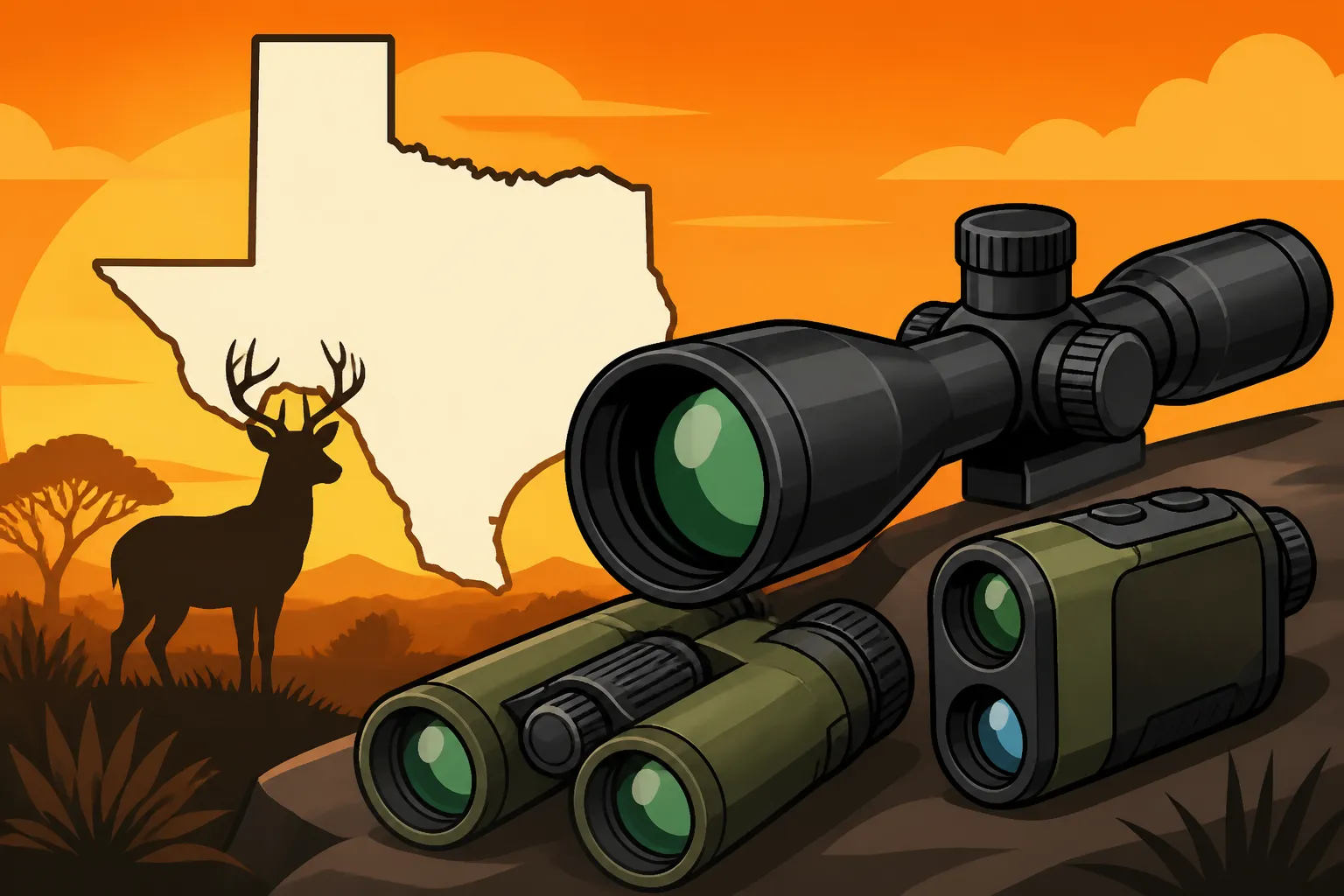
When you’re just starting, it’s easy to get overwhelmed by the sheer volume of optics available. Do you need a spotting scope? Night vision? Thermal? For a beginner, the focus should be on the core three: binoculars, a rifle scope (if you're hunting with a rifle), and a rangefinder. These are your foundational tools for scouting, targeting, and ethical shot placement.
Binoculars: Your First Line of Sight
Think of binoculars as your primary scouting tool, your eyes that can reach further than your own. Before you even think about raising a rifle, you'll be using your binoculars to locate game, assess the terrain, and identify potential shot opportunities. For a Texas beginner, something in the 8×42 or 10×42 range is often ideal. The '8x' or '10x' refers to the magnification – how many times closer an object appears. The '42' is the objective lens diameter in millimeters, which dictates how much light the binoculars gather.
An 8x magnification offers a wider field of view and is easier to hold steady, which is excellent for scanning large areas or tracking moving game. A 10x provides a bit more reach for longer distances, which can be beneficial in open country like the Panhandle. When you're using a tool like GoHunt to scout your lease before the season, identifying key bottlenecks and potential bedding areas, good binoculars will be indispensable to confirm what you see on the map. You’ll be able to spot that lone whitetail moving through the brush or a distant group of axis deer without spooking them. For more specific recommendations, consider exploring guides on Best Binoculars Under $500 for Texas Hunting.
Rifle Scopes: Precision for the Shot
If you plan to hunt with a rifle, a quality scope is non-negotiable. It's the critical link between you and an ethical, clean harvest. For most general hunting in Texas, a variable power scope, such as a 3-9×40 or 4-12×40, hits the sweet spot for budget and versatility. The '3-9x' or '4-12x' indicates the range of magnification, allowing you to dial down for closer, quicker shots in dense cover or zoom in for precise placement at longer distances. The '40' again refers to the objective lens size.
You want a scope that offers clear glass, repeatable adjustments, and a simple, reliable reticle. A duplex reticle is classic and effective for most hunting scenarios. Don't get caught up in overly complex reticles or massive magnification numbers for your first scope; often, simplicity and reliability are far more valuable for a beginner. The goal is to provide a clear, bright aiming point that you can trust under pressure. This is especially true for hunters targeting whitetail deer in the thick South Texas brush or hogs that can appear and disappear quickly. For detailed advice, check out Best Rifle Scope for Texas Deer Hunting.
Rangefinders: Closing the Distance
One of the biggest mistakes a new hunter can make is guessing yardage. Even experienced hunters can misjudge distances, especially in unfamiliar terrain or under stress. This is where a rangefinder becomes an invaluable, arguably essential, piece of equipment. It provides an instant, accurate digital readout of the distance to your target, eliminating guesswork and dramatically improving your chances of making an ethical shot.
For bowhunting in Texas, knowing precise distances is absolutely critical due to the arch of an arrow's trajectory. Even with a rifle, knowing the exact range helps you apply the correct holdover or adjust your turrets, particularly as distances increase. A basic laser rangefinder that gives you line-of-sight distance is perfect for beginners. Some models offer angle compensation, which is handy if you're hunting in hilly terrain like the Edwards Plateau, providing the "shoot-to" distance rather than just the straight-line distance. Look for a model that's easy to use with one hand and has a clear display. It doesn’t need to range out to 1,000 yards; 400-600 yards is more than sufficient for most typical hunting situations for a beginner in Texas. You can learn more about specific models in our guide on Best Rangefinder for Texas Hunting.
Key Features to Prioritize in Budget Optics
When you're trying to get the most bang for your buck, it's not about finding the cheapest item, but rather the item that offers the best balance of essential features without unnecessary frills. Focusing on these core elements will help you choose budget optics that perform reliably in the field.
Magnification and Objective Lens Size
As we touched on, these two numbers are probably the most talked-about specifications for any optic. For beginners, the temptation is often to go for the highest magnification possible, assuming "more is better." However, excessive magnification can be detrimental, especially in a rifle scope. Higher magnification often means a narrower field of view, making it harder to find and track game, and it also exaggerates natural hand shake, making the image appear unsteady. For binoculars, 8x or 10x is plenty. For a rifle scope, a maximum magnification of 9x to 12x is perfectly adequate for most Texas deer and hog hunting scenarios.
The objective lens size (the front lens) directly impacts how much light enters the optic. A larger objective lens can gather more light, leading to a brighter image, but it also makes the optic heavier, bulkier, and often more expensive. For budget optics, a 40mm or 42mm objective lens for binoculars and a 40mm or 44mm for a rifle scope is a great compromise. This provides ample light gathering for early morning and late evening without making the optic cumbersome or driving up the cost unnecessarily. A 50mm objective might be slightly brighter, but it adds significant bulk and cost that a beginner often doesn't need, especially considering that many hunting opportunities arise during legal shooting hours where a 40mm/42mm objective performs admirably.
Lens Coatings and Prism Types
This is where budget optics can really differentiate themselves from truly cheap ones. Lens coatings are thin layers applied to the glass surfaces to reduce glare, prevent reflections, and increase light transmission. Even budget-friendly optics should boast "fully multi-coated" lenses, meaning all air-to-glass surfaces have multiple layers of anti-reflective coatings. This makes a noticeable difference in image brightness, clarity, and contrast compared to uncoated or single-coated lenses. Without these coatings, a significant amount of light is lost through reflection, making for a dim, washed-out image.
For binoculars, prism type is also important. Most budget binoculars use either Porro prisms or Roof prisms. Porro prism binoculars tend to be wider and bulkier but can offer a slightly better 3D image perception and are often more cost-effective to manufacture with good optical quality. Roof prism binoculars are typically more streamlined and compact, making them easier to handle, but achieving comparable optical quality at a budget price can be more challenging. Look for models that specifically mention quality glass and fully multi-coated lenses, regardless of the prism type. Brands like Vortex, Bushnell, and Leupold often offer excellent value in their entry-level lines by focusing on these core optical qualities.
Eye Relief and Field of View
These are critical, yet often overlooked, factors that significantly impact user comfort and practicality in the field. Eye relief is the distance your eye can be from the eyepiece and still see the full, unvignetted image. For rifle scopes, generous eye relief (typically 3.5 inches or more) is crucial to prevent the scope from hitting your brow under recoil, a common and unpleasant experience for new shooters. Adequate eye relief also makes it easier to quickly get on target without having to perfectly position your eye every time. For binoculars, good eye relief (15mm or more) is particularly important for hunters who wear eyeglasses.
Field of view (FOV) refers to the width of the area you can see through the optic at a certain distance (usually 100 yards or 1,000 yards). A wider field of view makes it much easier to scan for game, especially in dense environments like the East Texas Pineywoods, and to pick up moving animals. While higher magnification narrows your FOV, you want a balance. For example, an 8x binocular will naturally have a wider FOV than a 10x binocular, making it generally easier to locate game. When you're trying to locate a deer that just blew out of a thicket, a wide FOV is your best friend.
Navigating Budget-Friendly Optics Categories: What to Look For
Understanding the technical jargon is one thing, but knowing how that translates to actual products on the shelf is another. While I won't name specific models that might change frequently, I can guide you on what to look for within each category to ensure you're getting solid value for your money.
Binocular Recommendations for the Savvy Hunter
For those just starting, the sweet spot for binoculars typically lies in the $100-$300 range. At this price point, you can find models that offer fully multi-coated lenses, decent light gathering, and respectable durability. When considering magnification, if you're primarily hunting in dense brush or timber, an 8×42 will serve you well, offering a wider field of view and making it easier to track game. If you hunt more open areas, like the South Texas brush country or the Panhandle plains, a 10×42 can give you that extra reach to identify distant animals.
Look for brands known for their entry-level quality, often offering clear glass and decent construction. Focus on ergonomic design for comfortable handling during long periods of glassing. Some models even come with a basic chest harness, which is a fantastic way to keep your binoculars secure and accessible without letting them swing around and bang against your chest. A good pair of budget binoculars can greatly assist in tasks like How to Scout for Deer Before Season in Texas on a new lease.
Rifle Scope Considerations for Deer and Hogs
When it comes to rifle scopes, the budget category generally falls between $150-$400. In this range, you should expect a scope that holds zero reliably, has clear glass at its mid-magnification range, and offers consistent adjustments. A 3-9×40 or 4-12×40 is ideal for the vast majority of Texas hunting, whether you're targeting whitetail deer or feral hogs. These magnifications are versatile enough for close shots in heavy cover and provide enough power for shots out to 200-300 yards, which is a practical maximum for most beginner hunters.
Prioritize models with a sturdy, one-piece tube construction for better durability. Seek out simple, uncluttered reticles like a Duplex or a simple BDC (Bullet Drop Compensator) reticle that isn't overly busy. Complex reticles are often harder to use under pressure for new hunters and add to the cost. Avoid scopes with extremely high magnification ranges that seem too good to be true at a low price point, as the optical quality at the higher end of the zoom range often suffers significantly. Reliability is key; a scope that consistently holds its zero is far more valuable than one with a fancy feature that fails in the field.
Affordable Rangefinder Options
For rangefinders, a beginner can find excellent value in the $100-$250 price bracket. At this level, you can expect accurate distance readings out to 400-600 yards for deer-sized targets, which is more than enough for almost all hunting situations in Texas. Look for a model that's compact, lightweight, and easy to operate with one hand, as you'll often be ranging quickly while holding your rifle or bow.
The most important features to prioritize are accuracy, speed, and a clear display. Some budget models offer basic angle compensation, which is a nice bonus if you're hunting in varied terrain, but not strictly essential for flat ground hunting. Many come with a scan mode, allowing you to continually range as you pan across an area, which is great for picking out specific trees or obstacles around your target. You don't need ballistic calculators or advanced features for your first rangefinder; focus on reliable distance measurement. A good rangefinder is crucial for making ethical shots, whether you're deer hunting in Texas or taking on a hog.
Budget Optics Comparison Table
To help you visualize some common characteristics, here's a general comparison of what you might expect from budget-friendly optics versus their higher-end counterparts. This isn't about specific brands, but the performance characteristics across price points.
| Feature | Budget-Friendly Optics (~$100-$400) | Mid-Range Optics (~$400-$1000) | High-End Optics (>$1000) |
|---|---|---|---|
| Clarity/Brightness | Good in daylight, adequate in low light | Very good, excellent in low light | Exceptional, superior low-light performance |
| Lens Coatings | Fully Multi-Coated is standard | Advanced proprietary coatings | Multi-layer, anti-reflective, scratch-resistant |
| Durability | Decent, basic waterproofing/fog-proofing | Robust, fully weatherproof, shockproof | Extreme ruggedness, lifetime warranties |
| Image Resolution | Clear enough for identification at typical ranges | Sharp, detailed, excellent contrast | Pin-sharp, true-to-life color, outstanding detail |
| Eye Relief | Generally sufficient (3.5"+ for scopes, 15mm+ for binos) | Ample and consistent | Generous, forgiving, often adjustable |
| Adjustments (Scopes) | Audible clicks, generally repeatable | Crisp, precise, highly repeatable turret adjustments | Tactile, precise, zero-stop features, extreme reliability |
| Weight/Bulk | Moderate to slightly heavy | Often optimized for balance and ergonomics | Optimized materials for performance and weight |
| Brand Focus | Value, core performance | Performance, durability, specific features | Elite performance, cutting-edge technology |
Making Your Budget Optics Go Further: Tips and Tricks
Getting budget optics isn't just about saving money upfront; it's also about maximizing their lifespan and performance in the field. With a little care and smart usage, your entry-level gear can serve you well for many seasons.
Proper Care and Maintenance
Even the toughest budget optic won't last if it's neglected. After every outing, take a few minutes to wipe down your optics. Use a soft cloth (a microfiber cloth is ideal) to remove dust, dirt, and fingerprints from the lenses. For stubborn smudges or water spots, use lens cleaning fluid specifically designed for optics, applied to the cloth, not directly to the lens. Never use harsh chemicals or abrasive materials, as these can damage lens coatings.
Store your optics in a dry, temperate place, ideally in a padded case or bag to protect them from bumps and scratches. Avoid leaving them in direct sunlight or extreme temperatures for extended periods, such as in a hot truck, as this can degrade seals and coatings over time. Regularly check mounting screws on rifle scopes to ensure they haven't loosened, as this is a common cause of a scope losing its zero. A little proactive care goes a long way in ensuring your budget optics remain reliable year after year, letting you focus on the hunt.
Practice and Familiarity
The best optics in the world are useless if you don't know how to use them effectively. This is even more true for budget optics, where you might not have the same level of forgiveness as with high-end gear. Spend time practicing with your binoculars to quickly acquire targets and hold them steady. Learn how to adjust the diopter for your eyes to ensure the sharpest image. With your rifle scope, practice mounting your rifle and quickly acquiring a sight picture. Understand how your reticle works and where your bullet impacts at various distances.
Take your rangefinder to the deer lease or a local range and practice ranging various objects at different distances and angles. The more you use your optics, the more intuitive they become, and the more confidence you’ll build in their capabilities. This practice will pay dividends when that critical moment arrives in the field. Remember, hunting in Texas requires you to be proficient with your gear, whether it's for Deer Hunting in Texas: Feeders, Blinds & Tactics or Hog Hunting Methods in Texas: Thermal, Night & Trapping. Using tools like GoHunt to understand terrain and then practicing ranging those exact terrain features can make you much more effective.
Strategic Upgrades Over Time
Just because you start with budget optics doesn't mean you're stuck with them forever. As you gain experience, you'll start to understand what features truly matter to your specific hunting style and which areas of your current optics might be limiting you. Perhaps you find yourself consistently needing more light gathering for those crucial low-light moments, or you want clearer glass for better target identification at longer ranges.
Instead of trying to replace everything at once, consider upgrading one piece of your optic setup strategically. Maybe you decide to invest in a higher-quality pair of binoculars first, or a rifle scope with better glass and more precise turrets. This staggered approach allows you to spread out the cost and ensure your upgrades are truly addressing a specific need you've identified through your hunting experience. Think of it as evolving your gear along with your skills. Eventually, you might want to delve into more specialized optics, but for now, your budget setup is your workhorse. Don't forget to regularly check the Texas Hunting Seasons: Complete Calendar by Species so you know what you're preparing for.
Disclaimer
Please be aware that hunting regulations and licensing requirements in Texas can change. Always consult the most current Texas Parks and Wildlife Department (TPWD) Outdoor Annual or their official website before participating in any hunting activities. This content is for informational purposes only and is not a substitute for official legal guidance or hunter education.