Best Rifle Scope for Hog Hunting (Day & Night)
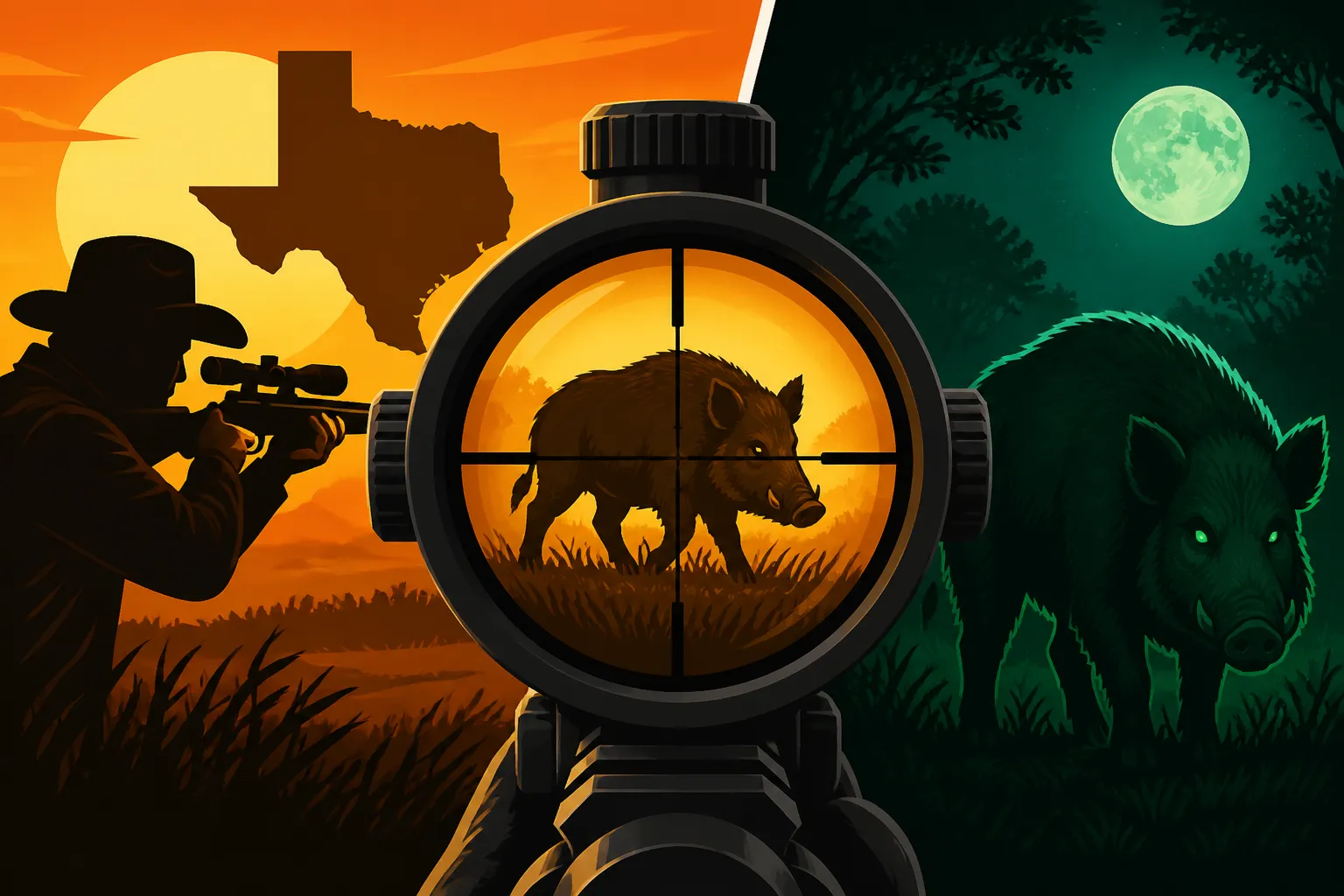
Hunting hogs in Texas is a 24/7 endeavor, and whether you're stalking them under the scorching midday sun or trying to pick them out of the blackest night, having the right rifle scope can make or break your hunt. The struggle is real: one moment you're squinting through a traditional optic in bright daylight, and the next you're trying to figure out how to transition to low-light conditions without missing a beat, often feeling like you need two different rifles. This guide will help you understand the options and choose the best rifle scope to confidently tackle hog hunting both day and night in the diverse Texas landscape.
Understanding the Unique Challenges of Hog Hunting in Texas
Hog hunting in Texas isn't your average deer hunt. These intelligent, prolific animals are active around the clock, and their destructive nature means there's no closed season and often no bag limit. This constant pressure, coupled with their nocturnal habits, makes them a formidable quarry. The vast, varied terrain of Texas, from the dense South Texas brush to the open fields of the Panhandle and the thickets of the Pineywoods, demands versatile gear.
The Demands of Daylight Hog Hunting
During the day, hogs might be found rooting in agricultural fields, wallowing in muddy creek beds, or bedded down in thick cover. This means your daylight scope needs to offer excellent clarity, a wide field of view, and sufficient magnification to positively identify your target and make an ethical shot, sometimes at considerable distances.
- Variable Light Conditions: Even during the day, light can vary drastically. Think about the transition from a bright, sunny field to the deep shade of a mesquite tree line. Your scope needs to handle these changes without losing clarity or causing eye strain. A good scope will gather enough light to keep your sight picture bright, even in shadowy areas.
- Target Acquisition in Cover: Hogs often blend surprisingly well into their surroundings. They're not always standing out in the open. You might be trying to pick out a dark silhouette against a darker background of brush or dirt. Good glass is paramount here, offering contrast and resolution to differentiate between a hog and a shadow. You'll need a reticle that's visible against various backgrounds, but not so thick it obscures a precise aiming point.
- Ethical Shot Placement: While hogs are tough, a well-placed shot is crucial for a quick, humane kill. Knowing Best Shot Placement for Hogs means having a scope that allows for consistent precision, whether you're aiming for the ear, the shoulder, or the vitals behind the leg. This involves having reliable turrets for zeroing and a clear, uncluttered reticle.
The Complexities of Nighttime Hog Hunting
Night hunting for hogs is where things get really interesting – and often frustrating without the right gear. Hogs are primarily nocturnal, so a significant portion of successful hunting happens after sunset. The legality of night hunting for hogs in Texas is pretty straightforward; it's generally allowed on private land, often without a license if you're a landowner or have permission. You can learn more about this in our guide on Hog Hunting at Night in Texas: Is It Legal? (Yes).
- Complete Darkness: This isn't just low light; it's often pitch black, especially far from city lights. Traditional scopes are all but useless, even with illuminated reticles, because they can't gather enough ambient light to provide a clear image of the target itself. This is where specialized night vision or thermal optics become indispensable.
- Target Identification in the Dark: At night, distinguishing between hogs, other animals, and even inanimate objects becomes extremely difficult. Misidentification can lead to unsafe situations or unintended consequences. This is why scopes designed for night use must offer features that allow for clear detection, recognition, and identification.
- Stealth and Movement: Hogs have excellent senses of smell and hearing. Moving around with bulky, cumbersome night vision equipment can be challenging, and any light source (like a white light for scanning, unless you're using a red/green filter for specific purposes) can spook them. The right night optic should be relatively compact and intuitive to use in the dark.
Key Features to Look for in a Day/Night Hog Hunting Scope
When you're looking for a scope that can pull double duty for both day and night hog hunting, you're essentially looking for a blend of versatility, ruggedness, and specialized technology. It’s a tall order, but modern optics have come a long way.
Optical Clarity and Light Transmission
For any scope, the quality of the glass and its coatings directly impacts how much light reaches your eye and how clear the image appears.
- High-Quality Glass: Look for scopes with ED (Extra-low Dispersion) or HD (High Definition) glass. This reduces chromatic aberration (color fringing) and provides a sharper, truer color image, which is invaluable for picking out details in challenging light. Brands like Vortex, Leupold, and Nightforce are known for their exceptional glass quality.
- Multi-Coated Lenses: Fully multi-coated lenses are critical. These coatings minimize glare and maximize light transmission, giving you a brighter and clearer image, especially during dawn, dusk, and even starlit nights if you're relying on passive night vision. The better the coatings, the more effective your scope will be in varying light conditions.
Reticle Options and Illumination
The reticle is your aiming point, and for day/night use, it needs to be adaptable.
- Illuminated Reticles: For day hunting, an illuminated reticle can help it stand out against dark backgrounds or in dense cover. For night hunting with digital night vision, it's absolutely essential to see your aiming point without relying on ambient light. Different scopes offer various color options (red, green) and brightness settings. Make sure it has a wide range of adjustment, from dim enough for true darkness to bright enough for daylight.
- Daylight Visible Illumination: Some illuminated reticles are only really effective in low light. For a true day/night scope, you need an illumination system that is bright enough to be visible and effective even in full daylight. This ensures consistency in your aiming point regardless of the ambient light.
- BDC (Bullet Drop Compensating) or MOA/MRAD Reticles: Depending on your preferred shooting style and typical distances, a reticle with holdover points can be beneficial for faster follow-up shots on running hogs or shots at varying ranges without having to adjust your turrets. When selecting a rifle scope for Feral Hog Hunting Tactics for Texas, consider how well its reticle integrates with your chosen ammunition and typical hunting ranges.
Durability and Weather Resistance
Texas weather is notoriously unpredictable. One day it's 100 degrees and dry, the next it's a torrential downpour. Your scope needs to withstand it all.
- Waterproof and Fogproof: An O-ring sealed, nitrogen or argon purged scope is a must. This prevents moisture from getting inside and fogging up the lenses during humidity changes or rain, ensuring your view remains clear.
- Shockproof: Hogs are tough, and your gear can take a beating. From bumping your rifle in the truck to accidental drops, your scope needs to hold zero and withstand recoil without structural failure. Look for scopes machined from a single piece of aircraft-grade aluminum.
Magnification Range and Field of View
Finding the right balance between magnification and field of view is crucial for versatility.
- Variable Magnification: A 3-9x, 4-12x, or even a 2.5-15x is a great starting point for many hog hunting scenarios. Lower magnifications (2-4x) offer a wider field of view for quick target acquisition in thick brush or for running shots. Higher magnifications (9-15x) are useful for precise shots at longer distances across open fields.
- Wide Field of View: Especially important for quick target acquisition and tracking moving hogs. A wider field of view at lower magnification allows you to see more of your surroundings, which is critical when hogs are running in a group or busting out of cover.
Types of Scopes for Dual-Purpose Hog Hunting
The "day and night" requirement for hog hunting really pushes the boundaries of traditional optics. While some illuminated reticles perform well in low light, true night hunting demands specialized technology.
1. Traditional Rifle Scopes with Excellent Low-Light Performance
These are your standard optical scopes, but with features optimized for challenging light conditions. They are primarily day scopes but excel at dawn and dusk.
- Pros:
- Exceptional Clarity: Often superior resolution and true-to-life color rendition in daylight compared to digital options.
- Reliability: Fewer electronic components mean less to go wrong and no battery dependency for the primary function.
- User-Friendly: Most hunters are familiar with traditional optics, making them easy to pick up and use.
- Cost-Effective: Generally more affordable than true night vision or thermal options.
- Cons:
- Limited Night Capability: While good in low light, they are almost useless in complete darkness. An illuminated reticle helps you see the crosshairs, but you won't see the hog.
- No Image Enhancement: They rely solely on ambient light.
- Ideal Scenarios: Perfect if your hog hunting primarily occurs during daylight hours and extends only into the twilight zones. If you mostly hunt over feeders right at legal shooting light, a high-quality traditional scope with an illuminated reticle might suffice. For instances of How to Hunt Hogs During the Day in Texas, these scopes are often the best choice for clarity and precision.
- Brands to Consider: Leupold VX-Freedom series with illuminated reticles, Vortex Crossfire II or Diamondback HP with illuminated options, and even some higher-end Bushnell or Nikon models can offer solid performance for daylight and twilight conditions.
2. Digital Night Vision Scopes
These scopes use an intensifier tube or a digital sensor to amplify ambient light or infrared light, allowing you to see in near-total darkness. Many modern digital night vision scopes can also function as day scopes.
- Pros:
- True Night Capability: Allows you to see clearly in conditions where traditional scopes fail.
- Day and Night Functionality: Many models have a "day mode" that displays a full-color image, often comparable to a smartphone camera.
- Recording Capabilities: Many come with built-in video and still image recording, which is fantastic for reviewing your shots or sharing hunt experiences.
- Affordable Night Vision: Generally more accessible price-wise than thermal optics.
- Cons:
- Image Quality: While good for night, the "day mode" image can sometimes be less crisp and vibrant than a dedicated optical scope. Night vision can be grainy or monochromatic.
- Battery Dependent: They require battery power for all functions, day or night.
- IR Illuminator Needed: Often require an external or built-in infrared (IR) illuminator for best performance in complete darkness, which can be visible to other hunters (though not typically to hogs).
- Lag/Refresh Rate: Some older or cheaper models might have a slight lag in the display.
- Ideal Scenarios: Excellent for hunters who need legitimate night vision but also want a scope that can transition to day use without swapping optics. They are a solid choice for hunting over feeders at night or stalking hogs in moonlit fields. Brands like Pulsar, ATN, and Sightmark offer popular digital night vision scopes.
- Things to Look For: Consider models with high sensor resolution, good refresh rates, and included or easily attachable IR illuminators. Pay attention to battery life and whether they use standard, easily replaceable batteries or proprietary rechargeable packs.
3. Thermal Imaging Scopes
Thermal scopes detect heat signatures, creating an image based on temperature differences rather than ambient light. This is a game-changer for night hunting and also surprisingly useful during the day.
- Pros:
- Superior Detection at Night: Can detect hogs through thick brush, fog, smoke, and total darkness, as they see heat, not light. This is arguably the best technology for Thermal Hog Hunting in Texas.
- Daytime Advantage: Useful during the day for locating bedded animals in dense cover that might be invisible to the naked eye or a traditional scope.
- No Light Required: Doesn't rely on ambient light or an IR illuminator, making you completely undetectable visually.
- Quick Target Acquisition: Heat signatures stand out dramatically against cooler backgrounds.
- Cons:
- Cost: Significantly more expensive than digital night vision or traditional scopes. Best Budget Thermal Scope Under $2000 will still be a considerable investment.
- Image Quality: Does not offer true color or detail like optical scopes. Everything is displayed in a palette of heat colors (e.g., white-hot, black-hot, rainbow). Identifying specific anatomical features for precise shot placement can take practice.
- Battery Dependent: Like digital night vision, they require battery power.
- Ideal Scenarios: If night hunting is your primary goal, and you want the absolute best detection capabilities, thermal is the way to go. It’s unmatched for identifying hogs in a field or tracking them moving through dense cover. Many experienced hunters find thermal to be the ultimate tool for How to Hunt Hogs at Night With Thermal.
- Brands to Consider: Pulsar, AGM, Trijicon, and ATN are leading brands in thermal optics. When comparing Pulsar vs AGM Thermal Scopes for Hogs, you'll find different features and price points that cater to various budgets and preferences. Also, exploring Thermal Scope vs Night Vision for Hog Hunting provides a detailed comparison to help you make an informed decision.
Here's a quick comparison of these scope types:
| Feature | Traditional Scope (Low Light Opt.) | Digital Night Vision Scope | Thermal Imaging Scope |
|---|---|---|---|
| Daytime Use | Excellent clarity & color | Good color, less crisp | Clear, but monochromatic |
| Nighttime Use | Poor (illuminated reticle only) | Good (with IR illuminator) | Excellent (heat signature) |
| Detection | Visual | Light amplification | Heat signature |
| Identification | Excellent (day), Poor (night) | Good (night), Fair (day) | Fair (night), Good (day) |
| Cost | Low to Moderate | Moderate to High | High to Very High |
| Battery | No (for primary function) | Yes | Yes |
| Environment | Clear line of sight | Clear line of sight (visual) | Fog, smoke, brush, darkness |
Top Recommendations and Considerations for Your Setup
Choosing the "best" scope is highly personal and depends heavily on your budget, hunting style, and priorities. However, we can break down some solid approaches for a versatile day/night hog hunting setup in Texas.
Dedicated Day Scope Paired with Night Vision/Thermal Clip-On
One popular and highly effective strategy is to use a high-quality traditional day scope as your primary optic and pair it with a clip-on night vision or thermal device.
- How it Works: The clip-on attaches to the front of your existing day scope. When it gets dark, you simply attach the clip-on, and your day scope effectively becomes a night vision or thermal scope without needing to re-zero.
- Pros:
- Retains Day Scope Quality: You get the superior optical performance of your day scope during daylight hours.
- No Re-Zeroing: A major advantage as you don't have to adjust your zero between day and night hunting.
- Versatility: You can use the night vision/thermal device as a handheld monocular for scanning before clipping it onto your rifle. Many hunters find a dedicated Best Thermal Monocular for Scanning in Texas invaluable for spotting hogs.
- Cons:
- Cost: Buying a quality day scope and a clip-on device can be more expensive than an all-in-one unit.
- Added Weight/Bulk: The clip-on adds weight and length to the front of your rifle.
- Day Scope Requirements: Your day scope needs to have good light transmission and often a fixed magnification or specific magnification range for optimal performance with the clip-on.
- Recommendation: If you prioritize daytime optical clarity but still need robust night capabilities, this setup is fantastic. Look for a reputable traditional scope like a Trijicon AccuPoint or a Leupold VX-5HD, and pair it with a Pulsar Krypton or an AGM Rattler clip-on.
All-in-One Digital Night Vision or Thermal Scopes
These units are designed from the ground up to handle both day and night operations within a single housing.
- How it Works: They have internal processing that converts light or heat into an image displayed on a small screen within the scope. Many allow you to switch between day (color) and night (monochromatic/thermal palette) modes.
- Pros:
- Single Unit: Less gear to carry and manage.
- Simplicity: No need to attach or detach components, just switch modes.
- Often Feature-Rich: Many come with built-in rangefinders, ballistic calculators, and recording capabilities.
- Cons:
- Compromise in Day Clarity: While functional, the "day mode" on digital night vision often doesn't match the crispness of a dedicated optical scope. Thermal scopes offer a unique, but not traditional, view.
- Battery Dependency: Critical for all functions.
- Recommendation: If you want simplicity and don't want to carry extra gear, an all-in-one unit is a strong contender. For serious night hunting, an all-in-one thermal scope like the Pulsar Thermion 2 or AGM Adder can be incredibly effective. For a more budget-friendly approach, digital night vision scopes like the ATN X-Sight LTV or Sightmark Wraith are popular options. You can find excellent advice on specific thermal units in our article on the Best Thermal Scopes for Hog Hunting in Texas.
Considerations for Your Texas Hog Setup
- Power Source: Always carry spare batteries or a portable power bank, especially for electronic optics. Modern lithium batteries offer great performance.
- Mounting System: Invest in a high-quality quick-detach (QD) mounting system if you opt for a clip-on, allowing for easy transitions. If you're going with an all-in-one, ensure the mount is robust and holds zero perfectly.
- Accessories: For digital night vision, a powerful, focusable IR illuminator is often a must. For thermal, while not strictly necessary, some hunters appreciate a thermal monocular for scouting before shoulder-mounting the rifle.
- Legalities: While generally unrestricted for private land, always double-check the latest Texas Hunting Regulations Changes for 2026 or the Texas Outdoor Annual for any county-specific rules or updates regarding night hunting equipment.
Ultimately, the best rifle scope for hog hunting day and night in Texas is one that fits your specific needs, budget, and hunting style. Whether you choose the unparalleled detection of thermal, the versatility of digital night vision, or a combination of traditional optics with clip-on tech, investing in quality gear will make your Texas hog hunts more successful and enjoyable. Planning your hunts effectively, including understanding how to use tools like GoHunt for scouting and mapping potential hog hotspots, is part of the overall strategy. The goal is to be prepared for those elusive feral hogs whenever and wherever they appear, day or night.
Disclaimer
Please ensure you are aware of and adhere to all current Texas Parks and Wildlife Department regulations regarding hunting, including licensing, seasons, bag limits, and legal methods. This guide is for informational purposes only and does not supersede official TPWD guidelines. Always prioritize safety and ethical hunting practices.